
Landlord certificates for every property you let, on one list.
A letting agent tracks the same certificates again and again, once per property: gas safety every year, EICR every five years, EPC every ten, plus alarms, licences, inspections and contractor insurance. ExpiryEdge groups every record by property, links it to the landlord and contractor, and reminds the right person at 90, 60, 30 and 7 days, so the engineer is booked before the date rather than after it.
Last updated · ExpiryEdge editorial team
Every landlord certificate, grouped by property
Gas safety, EICR, EPC and alarms for each property
HMO and selective licences with their conditions
Contractor insurance and landlord contacts linked to each record
Recurring schedules, so each renewal creates the next
Quick answer
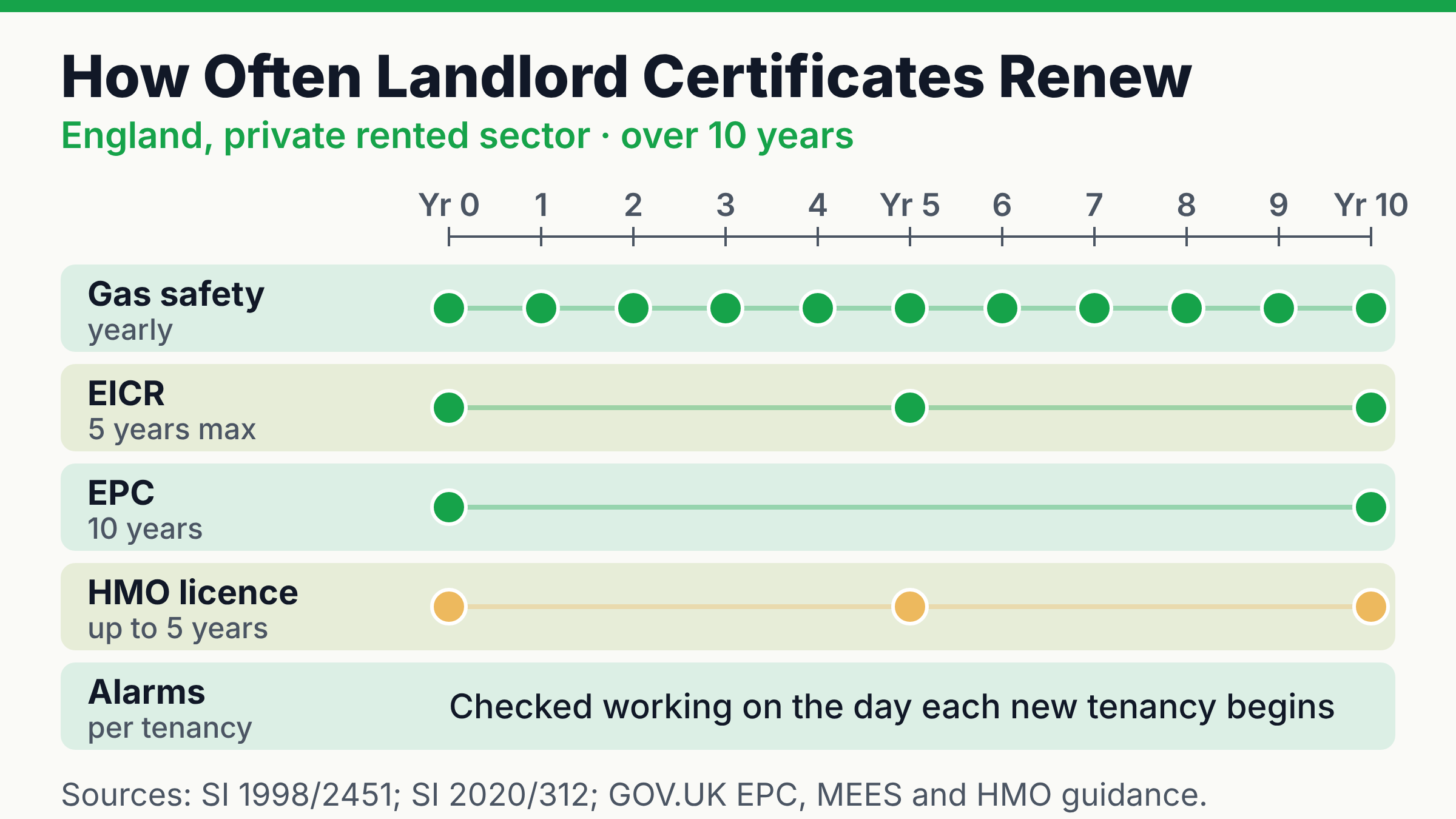
In England, the core landlord certificates are a gas safety record every 12 months, an EICR at least every 5 years and an EPC valid for 10 years, rated E or better. Add alarms checked on the first day of each tenancy and any HMO or selective licence (up to 5 years). Track each one per property, with an owner, the certificate on file and a reminder 90 days out. ExpiryEdge does this per property, with reminders at 90, 60, 30 and 7 days.
What a letting agent keeps current, per property
Gas safety record (CP12) and boiler service
Electrical Installation Condition Report (EICR)
Energy Performance Certificate (EPC) and MEES exemptions
Smoke and carbon monoxide alarms
HMO, additional and selective licences
Fire risk assessment for common parts
Legionella risk assessment
PAT and appliance checks
Deposit protection and Right to Rent follow-up checks
Contractor public liability certificates
Landlord insurance, rent reviews and inspections
PRS Database registration and Making Tax Digital updates
Landlord certificates in England: how often, and what a miss costs (last verified 12 Oct 2026)
| How often or by when | If it is missed | Official source | |
|---|---|---|---|
| Gas safety record (CP12) | Every 12 months. A check in the 2 months before the deadline keeps the original date. Copy to tenants within 28 days | Criminal offence: on indictment, an unlimited fine, up to 2 years in prison, or both | Gas Safety (Installation and Use) Regulations 1998, regs 36 and 36A; HSE |
| EICR (electrical safety) | At least every 5 years, or sooner if the report says. Copy to tenants within 28 days; remedial work within 28 days | Council financial penalty up to £40,000 per breach | SI 2020/312, regs 3 and 11 |
| Energy Performance Certificate | Valid 10 years. Make it available to prospective tenants at the earliest opportunity; give it free to the new tenant | Fixed penalty charge of £200 | GOV.UK guide to EPCs for the sale and let of dwellings |
| Minimum energy efficiency (MEES) | EPC band E or better to let, unless an exemption is registered. Most exemptions last 5 years. Government plans band C by 1 October 2030 | Up to £5,000 per property | GOV.UK MEES landlord guidance (updated 5 May 2026); government response, 21 Jan 2026 |
| Smoke and carbon monoxide alarms | Smoke alarm on every storey with living accommodation; CO alarm in rooms with a fixed combustion appliance (not gas cookers). Check they work on day one of each tenancy | Up to £5,000 per breach of a remedial notice | Smoke and Carbon Monoxide Alarm (England) Regulations 2015, as amended 2022; GOV.UK booklet |
| Mandatory HMO licence | Needed for 5 or more people forming more than 1 household. A licence lasts up to 5 years | Prosecution, or a civil penalty up to £40,000 | GOV.UK HMO licence; Housing Act 2004 ss. 68 and 249A |
| Additional or selective licence | Set by each council's scheme. A licence lasts up to 5 years | Prosecution, or a civil penalty up to £40,000 | Housing Act 2004 ss. 91, 95 and 249A; your council |
| Fire risk assessment (common parts) | Carry one out and review it regularly where you control shared areas, such as HMOs and blocks of flats | A fine or prison | GOV.UK fire safety responsibilities (Regulatory Reform (Fire Safety) Order 2005) |
| Legionella risk assessment | No fixed review interval in law: review it periodically and when the water system changes. No "legionella certificate" is required | Enforcement under health and safety law | HSE: legionella and landlords' responsibilities |
| Appliances you supply (PAT) | Private landlords: no fixed legal interval. The 5-yearly equipment check applies to social landlords. A visual check before each new tenancy is recommended | Liability if an unsafe appliance causes harm | GOV.UK electrical safety standards guidance |
| Deposit protection | Protect the deposit in an approved scheme within 30 days of receiving it | Court can order repayment of up to 3 times the deposit | GOV.UK deposit protection schemes and landlords |
| Right to Rent follow-up check | Before the tenancy, then before a time-limited statutory excuse runs out (for example 12 months after a Home Office "yes" response) | Civil penalty up to £10,000 per occupier (first breach), £20,000 (repeat) | Home Office code of practice, 1 October 2026 |
| PRS Database registration | Regional roll-out from 15 December 2026, West Midlands first. £65 per property per year, renewed yearly | Government says landlords who do not register risk a fine | MHCLG Housing Hub; Renters' Rights Act roadmap |
| Making Tax Digital for Income Tax | Qualifying income over £50,000: from 6 April 2026. Over £30,000: from 6 April 2027. Quarterly updates by 7 Aug, 7 Nov, 7 Feb and 7 May | Penalty points (a £200 penalty at 4 points). None for late quarterly updates in 2026 to 2027 | HMRC guidance on MTD for Income Tax |
| Contractor public liability, landlord insurance, rent reviews, inspections | Set by your contracts and terms of business, not by statute | Uninsured work or a missed review under your agreement | Your management agreement and policies |
Set up landlord certificate tracking yourself this week
Give every property its own block of rows
Start with one sheet, one row per certificate per property. Add a column for the property, the certificate, the date of the last check, the next due date, the landlord, the contractor, the owner in your office and where the PDF is filed. Fill it from the certificates you hold, not from memory: the date on the report is the one that counts.
Rows for gas, EICR, EPC, alarms, licence, FRA and legionella
A nation column (England, Wales, Scotland)
Blank date means "not on file": treat it as overdue
Let formulas work out every next date
Put the last check date in column C and let the sheet calculate the rest in Excel or Google Sheets. The gas formula gives the last day of the 12-month period; booking from 2 months before it keeps that date. The 90-day "book now" flag is our advice: engineers and electricians often need several weeks' notice, and tenants need time to agree access.
Gas safety deadline: =EDATE(C2,12)-1, and window opens: =EDATE(C2,10)
EICR: =EDATE(C2,60), or the earlier date written on the report
EPC expiry: =EDATE(C2,120). Days left: =D2-TODAY()
Status: =IF(C2="","NOT ON FILE",IF(E2<0,"OVERDUE",IF(E2<=90,"BOOK NOW","OK")))
Write the access letter and the chase list once
Most late certificates are late because of access, not forgetfulness. Write one letter offering two dates, and log every attempt with the date and channel. Government guidance on electrical safety says to keep copies of all communications with the tenant about access; HSE gives the same advice for gas checks. Do the same for contractors: ask for the new public liability certificate a month before the old one ends.
"Your [gas safety check] is due by [date]. The engineer can visit on [date 1] or [date 2]. Please confirm one by [date]."
Access log: date, channel, response
Contractor certificate requested 30 days before expiry
Run one weekly sweep, sorted by days left
Every Monday, sort by days left and work the top of the list: book anything marked BOOK NOW, chase anything booked but not done, and file each new certificate the day it arrives, with the tenant copy sent. After each check, overwrite the last check date with the new one so the next cycle starts itself.
Book: everything under 90 days
Chase: booked but not completed
File: new certificate in, tenant copy out, date rolled forward
Each property is a group, each certificate a record
Every certificate for a property in one group, linked to the landlord and contractor
Agencies we work with set up each property or unit as a group holding its EICR, gas safety record and boiler service, EPC, PAT, fire risk assessment, licence, insurance, inspections and rent review. Each record links to the landlord and the contractor, so a reminder can go to the person who must act, not only to the office.
One group per property or unit, plus the office
Landlord and contractor contacts linked to each record
A custom status column for where each renewal stands
Complete one certificate and the next one is already scheduled
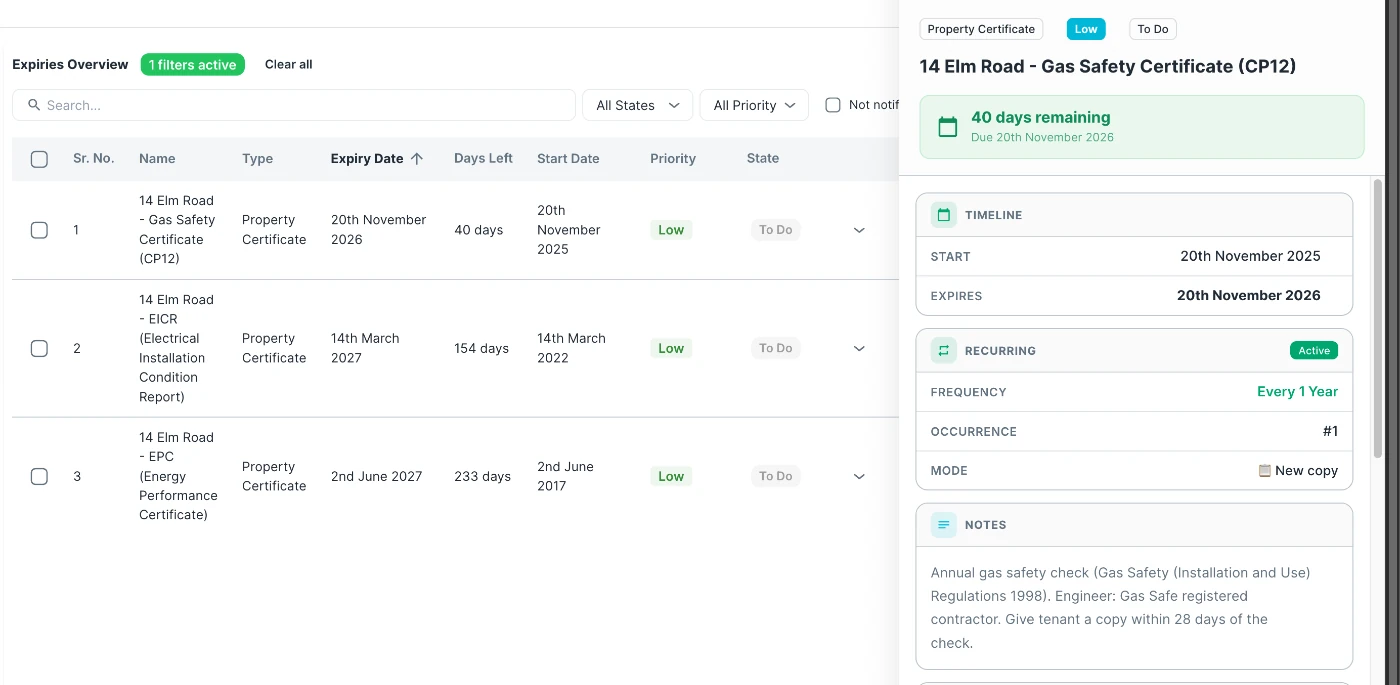
Set each certificate as a recurring record: annual for gas safety, five-yearly for the EICR, ten-yearly for the EPC. When the new certificate is uploaded, ExpiryEdge creates the next record as a copy with the new due date, so nobody re-enters each certificate by hand. Reminders go out at 90, 60, 30 and 7 days by email, SMS, Slack or Teams.
Renew-as-copy for every repeating certificate
Reminders to the owner and a backup
Document requests to contractors for new certificates
What a council, tenant or landlord asks for, already filed
Every certificate, reminder and access attempt is timestamped. When a council asks for an EICR within 7 days, or a landlord asks what is due across their portfolio, filter by property or landlord and export the history as CSV, PDF or XLSX.
Timestamped audit trail per property
Export by property, landlord or certificate type
Escalation when a date passes
Spreadsheet or software? When the spreadsheet is enough
A handful of properties and one person who opens it weekly: a spreadsheet is enough
It fails when dates are re-typed by hand after every renewal and one is missed
It cannot email the landlord, tenant or contractor who has to act
It cannot show a council or landlord who did what, and when
ExpiryEdge vs a spreadsheet vs a calendar
| ExpiryEdge | Spreadsheet | Calendar | |
|---|---|---|---|
| Certificates grouped by property | Manual | ||
| Next renewal created automatically | Formula | Partial | |
| Reminders to landlord, contractor and staff | Manual | ||
| Certificate PDF on the record | Link only | ||
| Escalation when a date passes | |||
| Timestamped audit trail and export | |||
| Cost | 14-day free trial, then paid | Free | Free |
What changes for the lettings team
Gas safety dates in one spreadsheet, EICRs in three inboxes, licence renewals on a manager's calendar, and every renewal typed in again by hand. The engineer's reminder call is the first anyone hears that a certificate is due.
Every certificate sits in its property group with the PDF attached. Each renewal creates the next, reminders reach the person who must act 90 days out, and anything overdue escalates to the compliance lead.
Who uses it in lettings
Letting and managing agents
Keep certificates current across every managed property and show landlords exactly what is due and what is done.
Portfolio landlords
See every property's gas, electrical, EPC and licence dates on one screen, without a spreadsheet per house.
Property and lettings managers
Book engineers and electricians on time and log every access attempt.
Compliance leads
Track HMO and selective licences, fire risk assessments and legislative changes such as the PRS Database.
Office managers
Collect contractor insurance certificates and keep the office's own renewals current.
A gas safety record renewed every 12 months where there is gas, an EICR at least every 5 years, and a valid EPC (10 years) rated E or better. You also need working smoke and carbon monoxide alarms, deposit protection within 30 days, Right to Rent checks, and an HMO or selective licence where your property or area requires one.
Every 12 months, by a Gas Safe registered engineer. A check done in the 2 months before the deadline keeps the original deadline date. Give existing tenants a copy within 28 days of the check and new tenants a copy before they move in.
In England, the electrical installation must be inspected and tested at least every 5 years, or sooner if the last report says so. Tenants get a copy within 28 days, and any C1, C2 or further-investigation items must be dealt with within 28 days. Councils can impose a financial penalty of up to £40,000.
There is no fixed legal testing interval for appliances that private landlords supply, but they must be safe. The 5-yearly equipment check introduced in 2025 applies to social landlords. Government guidance recommends at least a visual check before each new tenancy, and many agents record PAT tests as good practice.
It tracks every certificate, licence and recurring duty per property, with the document, the responsible person and reminders before each due date. Good tools repeat renewals automatically, link records to landlords and contractors, and keep a timestamped history. It sits alongside your property management system rather than replacing it.
Yes. One row per certificate per property, with EDATE formulas for the next due date and a status column, works well for a small portfolio. It gets harder when renewals are re-typed by hand every cycle, when several people share the sheet, or when landlords and contractors need their own reminders.
The certificate duties stay the same, but the new PRS Database will collect safety information, including gas, electrical and EPC details. Government plans a regional roll-out from 15 December 2026 with a £65 annual fee per property. Section 21 notices could no longer be served from 1 May 2026.
Gas Safety (Installation and Use) Regulations 1998, reg. 36
Electrical Safety Standards Regulations 2020, reg. 3
GOV.UK: guide to EPCs for the sale and let of dwellings
GOV.UK: minimum energy efficiency standard, landlord guidance
GOV.UK: smoke and carbon monoxide alarm regulations booklet
Housing Act 2004, s. 249A (civil penalties)
HSE: legionella and landlords' responsibilities
Home Office: Right to Rent code of practice (1 Oct 2026)
MHCLG Housing Hub: register your rental property
HMRC: when you need Making Tax Digital for Income Tax
Every landlord certificate, every property, one list
Import your tracker, attach the certificates, and let each renewal schedule the next. Free 14-day trial, no credit card.