
Renters' Rights Act: Landlord Checklist and Every Key Date

The Renters' Rights Act 2025 is changing private renting in England in three phases. Since 1 May 2026, section 21 has gone, tenancies are rolling and rent can rise only once a year using Form 4A. Next, landlords must register each let property on a national database, region by region from 15 December 2026. An ombudsman is expected in 2028.
Sound familiar? You have read five summaries with five different sets of dates, and you still can't tell what you must do this month and what can wait until 2028. This checklist separates what already applies, what starts next and what is still only planned, with the official source for each date.
Key takeaways
- Section 21 ended on 1 May 2026. All private assured tenancies became rolling assured periodic tenancies, and you now need a ground under section 8 to regain possession.
- Existing tenants needed the government Information Sheet by 31 May 2026. New tenancies need written information before they start. Missing either can mean a fine of up to £7,000.
- Rent can rise once a year, using Form 4A with at least 2 months' notice. Pet requests need a written answer within 28 days.
- PRS Database registration opens on 15 December 2026 in the West Midlands, with every region's deadline passed by 14 November 2027. The fee is £65 per property per year.
- Councils can now fine up to £7,000 for a category 1 hazard (since 22 June 2026), and rent repayment orders can reach 2 years' rent.
- Still to come: a mandatory landlord ombudsman (expected 2028), Awaab's Law for private renting (consultation closes 18 December 2026) and the Decent Homes Standard (2035).
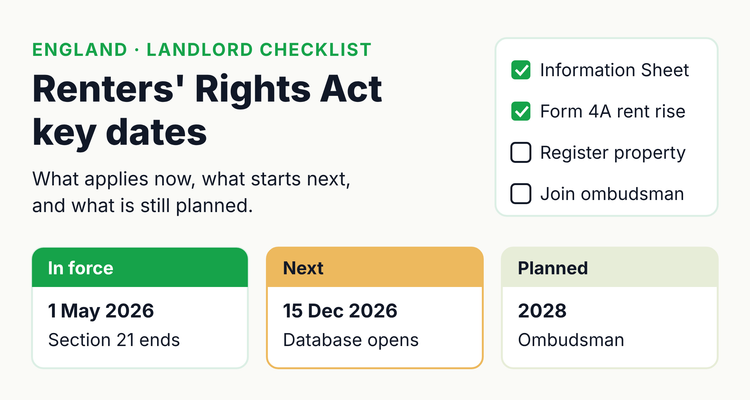 The Renters' Rights Act arrives in phases: tenancy reform first, then the database and ombudsman, then housing standards.
What has the Renters' Rights Act already changed?
Phase 1 of the Renters' Rights Act took effect on 1 May 2026 for private assured tenancies in England, through the Commencement No. 2 Regulations (SI 2026/421). Government guidance for landlords sums up the result: you cannot have an end date on the tenancy, you cannot use section 21, and you need a legal reason to evict.
Renters' Rights Act phase 1: what applies now (England, last verified 12 October 2026)
| Change | In force | What you must do | Official source |
|---|---|---|---|
| Section 21 abolished | 1 May 2026 | Use a section 8 notice with a valid ground. Many grounds need 4 months' notice. Pre-May notices could only reach court by 31 July 2026 | GOV.UK overview for landlords; notice of possession guidance (updated 1 Aug 2026) |
| Assured periodic tenancies | 1 May 2026 | No fixed end dates. Tenants can leave with 2 months' notice | GOV.UK overview for landlords |
| Information Sheet for existing written tenancies | By 31 May 2026 | Give the exact government PDF to every named tenant, on paper or as an attachment (a link is not valid) | GOV.UK Information Sheet 2026 page |
| Written information for new tenancies | From 1 May 2026 | Give the required terms in writing before the tenancy is agreed | GOV.UK written information guidance |
| Rent increases | 1 May 2026 | Once a year, by Form 4A, with at least 2 months' notice. Tenants can challenge above-market increases | GOV.UK overview for landlords |
| Rental bidding and rent in advance | 1 May 2026 | Publish an asking rent and accept nothing above it. No rent before signing, then at most 1 month in advance | GOV.UK overviews for landlords and tenants |
| Pets | 1 May 2026 | Answer a written request within 28 days, and refuse only with a valid reason | Housing Act 1988 s.16A (inserted by RRA s.11) |
| No discrimination against children or benefits | 1 May 2026 | Apply the same criteria to every applicant | GOV.UK overview for landlords |
| Category 1 hazard penalty | 22 June 2026 | Fix serious hazards: councils can fine up to £7,000 | SI 2026/638 |
Possession has new limits too. You cannot use the selling or moving-in grounds in the first 12 months of a tenancy. If you took a deposit, a court will only grant possession if it was protected and the prescribed information given, or it has been returned.
What did landlords have to do by 31 May 2026?
If a tenancy started before 1 May 2026 with a written agreement, you had to give every named tenant the Renters' Rights Act Information Sheet 2026 by 31 May 2026. If the tenancy was purely verbal, you had to give written information about its key terms instead. Your existing written agreement does not need rewriting.
If you missed it, the guidance does not give a late window, so our advice is to send it today and record the date and method. A council can fine up to £7,000 for this breach. One trap: GOV.UK says you must give the exact PDF as an attachment or on paper. A link to the PDF does not count.
Where you served a valid section 8 or section 21 notice before 1 May 2026 and it later lapsed, or the court case ended without possession, the tenancy becomes assured periodic. You then have one month to give the Information Sheet.
When do the next Renters' Rights Act stages start?
The next stage is the PRS Database, which opens on 15 December 2026. After that come the landlord ombudsman (expected 2028) and new housing standards (Decent Homes from 2035). The November 2025 roadmap set this order; later regulations fixed several dates.
Renters' Rights Act timeline: what is confirmed and what is planned (last verified 12 October 2026)
| Stage | Date | Status | Official source |
|---|---|---|---|
| New council investigatory powers | 27 December 2025 | In force | RRA roadmap |
| Phase 1 tenancy reform | 1 May 2026 | In force | SI 2026/421 |
| Category 1 hazard fines up to £7,000 | 22 June 2026 | In force | SI 2026/638 |
| Landlord redress scheme approval rules | 17 September 2026 | In force (rules for approving a scheme, not yet a duty to join) | SI 2026/1033 |
| PRS Database regional registration | 15 December 2026 to 14 November 2027 | Draft regulations laid; dates published by MHCLG | Draft PRS Database Regulations 2026; MHCLG Housing Hub (updated 10 Sep 2026) |
| Tenancy reform for social housing | 2027 | Planned | RRA roadmap |
| Mandatory landlord ombudsman membership | Expected 2028 | Planned, with advance notice promised | RRA roadmap |
| Awaab's Law for private renting | To be set after consultation (closes 18 December 2026) | Consultation | GOV.UK consultation, 9 Oct 2026 |
| Minimum EPC C for private lets | 1 October 2030 | Planned | Decent Homes policy statement, 28 Jan 2026 |
| Decent Homes Standard for private renting | 2035 | Confirmed policy, regulations to follow | Decent Homes policy statement, 28 Jan 2026 |
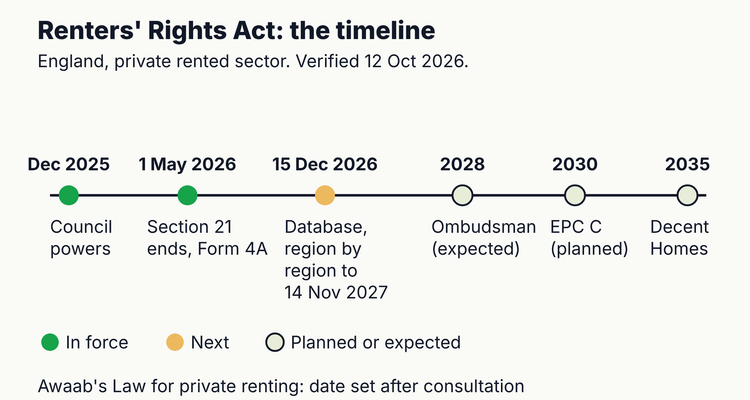 In force, next and planned: the Renters' Rights Act timeline for private landlords in England.
How does PRS Database registration work, and when is my deadline?
You register yourself and each let property on the government's "Register your rental property" service, which needs a GOV.UK One Login. Each region gets 3 months from the date the regulations start there. The deadline follows the property's location, not yours, so a London landlord with a flat in Birmingham works to the West Midlands date.
PRS Database registration deadlines by region (England)
| Region | Regulations start | Deadline to register |
|---|---|---|
| West Midlands | 15 December 2026 | 14 March 2027 |
| East of England | 15 January 2027 | 14 April 2027 |
| East Midlands | 15 February 2027 | 14 May 2027 |
| South East | 15 March 2027 | 14 June 2027 |
| Yorkshire and the Humber | 15 April 2027 | 14 July 2027 |
| North West | 15 May 2027 | 14 August 2027 |
| North East | 15 June 2027 | 14 September 2027 |
| London | 15 July 2027 | 14 October 2027 |
| South West | 15 August 2027 | 14 November 2027 |
Start dates: draft PRS Database Regulations 2026, regulation 1. Deadlines: MHCLG Housing Hub. You can register early.
What the draft regulations require, in plain English:
- Fee: £65 per property per year, pro-rated during roll-out, according to MHCLG. A dwelling entry cannot be made until the fee is paid (reg. 6(5)).
- Documents: for a let property, upload the gas safety record, the EICR (or EIC) and its expiry date, and the EPC, plus any MEES exemption. You can create the entry first, but these must follow within 28 days or the entry goes inactive (regs 6(2) and 11).
- Updates: when any information goes out of date, such as a new gas record, update the entry within 28 days (reg. 9(4)).
- Renewal: every 12 months. Later properties take the same renewal date as your existing entries, so one landlord has one renewal date (reg. 10).
- Agents: a letting agent can upload certain information for you, but you start the registration and stay responsible.
- Empty properties: you only need to register let properties for now. Future rules will require registration before marketing, with your registration numbers on adverts (RRA s.82).
Because uploads include your certificates, a lapsed gas record or EICR will show up the moment you register. See our guides to gas safety certificate renewal and the 2-month rule and how often landlords need an EICR.
Renters' Rights Act landlord checklist: what to do now
Work through these steps in order. Allow about 15 minutes per property, plus an hour once for templates. The times are our estimates.
- List every let property with its region (5 minutes each). Note the database deadline from the table above.
- Check the 31 May paperwork (5 minutes each). Confirm every named tenant got the Information Sheet, or written terms for verbal tenancies. If not, send it now and log the date.
- Fix your new-tenancy pack (30 minutes, once). Remove end dates, add the required written information and update adverts to show an asking rent.
- Gather certificates for the database (5 minutes each). Find the current gas record, EICR and EPC as PDFs. Book anything due before your registration deadline.
- Set the rent review date (2 minutes each). Record the last increase date. The next increase can take effect no sooner than 12 months later, with Form 4A served at least 2 months before.
- Write a pet request reply template (15 minutes, once). Set a 28-day reply deadline from the day each request arrives.
- Review possession plans (as needed). Check the new grounds and notice periods before serving anything.
- Put the next dates in your calendar: your database deadline, the registration renewal 12 months later, and 2028 for the ombudsman.
Copy-paste tracker for the Renters' Rights Act dates
Use one row per property in Excel or Google Sheets. Put the region deadlines from the table above on a sheet called Regions (region in column A, deadline in column C).
Renters' Rights Act tracker: columns and row 2 formulas
| Column | Heading | Row 2 |
|---|---|---|
| A | Property | Address |
| B | Region | Exact region name from the table, such as North West |
| C | Register by | =VLOOKUP(B2,Regions!A:C,3,FALSE) |
| D | Registered on | Date you completed the entry |
| E | Renewal due | =IF(D2="","",EDATE(D2,12)-1) |
| F | Last rent increase took effect | Date |
| G | Earliest next increase | =IF(F2="","",EDATE(F2,12)) |
| H | Serve Form 4A by | =IF(G2="","",EDATE(G2,-2)-7) |
| I | Pet request received | Date, if any |
| J | Pet reply due | =IF(I2="","",I2+28) |
| K | Info Sheet or written terms given | Date and method |
| L | Status | =IF(A2="","",IF(AND(D2="",C2-TODAY()<=60),"REGISTER NOW",IF(K2="","CHECK PAPERWORK",IF(J2="","OK",IF(J2-TODAY()<=7,"PET REPLY DUE","OK"))))) |
Column H builds in a week for postal service, which is our advice rather than a legal rule. Column E assumes a 12-month cycle from the day you register; check the renewal date the service shows you. Our free landlord compliance tracker template adds the certificate dates that the database asks for.
How can landlords get ahead, not just comply?
- Register early, in one sitting. Later properties share your first renewal date, so one yearly renewal covers the portfolio.
- Renew certificates before you register. An entry with fresh documents will not need updating again within weeks.
- Treat every new certificate as a database update. You have 28 days. Make "update database" the last step whenever a gas, EICR or EPC record arrives.
💡 Pro Tip
Letting agencies that use ExpiryEdge typically keep each property's certificates together as one group. The database entry fits naturally in the same group as a yearly record, with a checklist step to update it within 28 days of each new certificate.
What happens if you miss a Renters' Rights Act duty?
⚠️What happens if you miss it: councils can fine up to £7,000 for breaches such as missing the Information Sheet or written terms, or for not registering on the PRS Database. Offences, such as repeat breaches within 5 years or giving false database information, carry a fine of up to £40,000 as an alternative to prosecution. Tenants can also seek a rent repayment order of up to 2 years' rent for listed offences.
Sources: GOV.UK enforcement guidance for landlords; RRA ss. 91 and 92; GOV.UK overview for landlords. Councils must be satisfied beyond reasonable doubt, give notice, and allow 28 days for written representations. You can appeal a final notice to the First-tier Tribunal within 28 days.
Spreadsheet or software for Renters' Rights Act tracking?
For a handful of properties and one person, the tracker above is enough if you open it every Monday.
It gets harder when one landlord has properties in several regions, when an agency manages many landlords, or when a certificate renewal has to trigger a database update within 28 days. Then you need reminders that reach the right person and a record of what was done. ExpiryEdge holds each property's records with an owner and a backup owner, sends reminders at 90, 60, 30 and 7 days by email, SMS, Slack or Teams, and keeps an audit trail. For the certificate side, see how agents track landlord certificates for every property, and our wider landlord compliance checklist with a 12-month calendar.
Renters' Rights Act landlord checklist
- ✓
Every tenancy is periodic with no end date
- ✓
Information Sheet or written terms given to every named tenant, date logged
- ✓
New-tenancy pack includes the required written information
- ✓
Adverts show an asking rent; no bidding, no rent before signing
- ✓
Rent review dates and Form 4A serve-by dates recorded
- ✓
Pet request reply template ready, 28-day deadline tracked
- ✓
Region and database deadline noted for every property
- ✓
Gas record, EICR and EPC current and saved as PDFs
- ✓
Database renewal and 28-day update rule in your calendar
Want every 2027 date on one page? Our landlord compliance calendar adds each regional deadline to your own calendar. If your rental income is over £30,000, also check the Making Tax Digital deadlines for landlords.
Frequently asked questions
When did the Renters' Rights Act come into force?
The Act received Royal Assent on 27 October 2025. Its main tenancy changes, including the end of section 21, took effect on 1 May 2026 for private tenancies in England. Later stages, such as the PRS Database from 15 December 2026, are being switched on by separate regulations.
Do I need to give tenants a new tenancy agreement?
Not for existing tenancies with a written agreement. Instead, you had to give each named tenant the government Information Sheet by 31 May 2026. New tenancies from 1 May 2026 need specified written information given before the tenancy is agreed.
When do I have to register on the PRS Database?
It depends on where the property is. Registration starts in the West Midlands on 15 December 2026, and each region then has 3 months. The last deadline, for the South West, is 14 November 2027. You can register early.
How much does PRS Database registration cost?
MHCLG says the fee is £65 per property per year, pro-rated during the roll-out. You renew every 12 months, and later properties share your existing renewal date under the draft regulations.
When will the landlord ombudsman start?
The government's roadmap expects mandatory membership in 2028, with advance notice. The rules for approving a redress scheme came into force on 17 September 2026, but no duty to join applies yet.
Can I still increase the rent under the Renters' Rights Act?
Yes, once a year, using Form 4A with at least 2 months' notice. Tenants can challenge an increase above the open market rent at the First-tier Tribunal, and need not pay the higher rent until it decides.
Does the Renters' Rights Act apply in Wales and Scotland?
The tenancy reforms, database and ombudsman described here apply to England. Wales and Scotland have their own systems, such as Rent Smart Wales and Scottish landlord registration, so check the rules for each nation.
Sources
- GOV.UK, Renters' Rights Act: an overview for landlords (1 May 2026)
- GOV.UK, Renters' Rights Act overview for tenants (updated 1 May 2026)
- GOV.UK, Enforcement measures for landlords: Renters' Rights Act 2025
- GOV.UK, The Renters' Rights Act Information Sheet 2026 (updated 8 Jun 2026)
- GOV.UK, Tenancy agreements: written information for your tenant
- GOV.UK, Giving notice of possession to tenants before 1 May 2026 (updated 1 Aug 2026)
- GOV.UK, Implementing the Renters' Rights Act 2025: our roadmap
- MHCLG Housing Hub, Get ready: Register your rental property (updated 10 Sep 2026)
- Draft Private Rented Sector Database Regulations 2026
- GOV.UK, Stronger protections and greater confidence for renters (9 Sep 2026)
- Renters' Rights Act 2025, sections 11, 82, 91 and 92
- The Renters' Rights Act 2025 (Commencement No. 2 and Transitional and Saving Provisions) Regulations 2026, SI 2026/421
- The Renters' Rights Act 2025 (Commencement No. 3) Regulations 2026, SI 2026/638
- The Private Landlord Redress Schemes (Approval and Designation) Regulations 2026, SI 2026/1033
- GOV.UK, Extending Awaab's Law to private rented tenancies and to licences (consultation, 9 Oct 2026)
- GOV.UK, Clampdown on dangerous homes to protect more tenants and families (8 Oct 2026)
- MHCLG, The New Decent Homes Standard: policy statement (28 Jan 2026)
Last reviewed: 12 October 2026
Frequently asked questions
Not for existing tenancies with a written agreement. Instead, you had to give each named tenant the government Information Sheet by 31 May 2026. New tenancies from 1 May 2026 need specified written information given before the tenancy is agreed.
It depends on where the property is. Registration starts in the West Midlands on 15 December 2026, and each region then has 3 months. The last deadline, for the South West, is 14 November 2027. You can register early.
MHCLG says the fee is £65 per property per year, pro-rated during the roll-out. You renew every 12 months, and later properties share your existing renewal date under the draft regulations.
The government's roadmap expects mandatory membership in 2028, with advance notice. The rules for approving a redress scheme came into force on 17 September 2026, but no duty to join applies yet.
Yes, once a year, using Form 4A with at least 2 months' notice. Tenants can challenge an increase above the open market rent at the First-tier Tribunal, and need not pay the higher rent until it decides.
The tenancy reforms, database and ombudsman described here apply to England. Wales and Scotland have their own systems, such as Rent Smart Wales and Scottish landlord registration, so check the rules for each nation.