
Gas Safety Certificate for Landlords: 8 Steps and 2-Month Rule

A landlord gas safety certificate (officially the landlord gas safety record, often called a CP12) has to be renewed at least every 12 months by a Gas Safe registered engineer. You can have the check done up to 2 months early and keep your original deadline. Existing tenants get a copy within 28 days of the check; new tenants get one before they move in.
Want the date worked out for you? Our free gas safety certificate guide calculates your next check and the 2-month early window.
The hard part usually isn't the rule. It's that every let has its check on a different date, one tenant never answers the door, and the only reminder you get is the engineer ringing you. Below you'll find the date maths, how the rules differ across the four UK nations, an access letter you can send today and a free tracker that flags what to book.
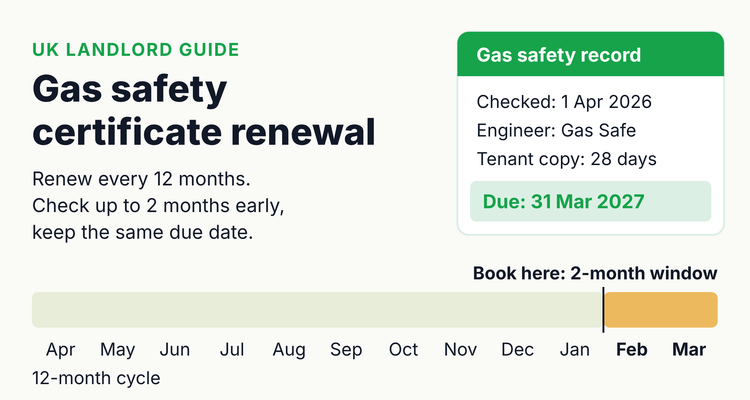 The gas safety certificate runs on a 12-month cycle. Book the check inside the last 2 months to keep the same due date.
How often does a landlord need a gas safety certificate?
Every 12 months. Regulation 36(3) of the Gas Safety (Installation and Use) Regulations 1998 (GSIUR) requires each gas appliance and flue you provide to be checked within 12 months of installation, then at intervals of no more than 12 months since the last check. Before a new tenancy starts, the appliances must have been checked within the previous 12 months.
HSE (the Health and Safety Executive) says only a Gas Safe registered engineer can do the check. For the other certificates on your list, see our letting agent and landlord compliance overview.
Do gas safety certificate rules differ in England, Wales, Scotland and Northern Ireland?
The core duty is the same in all four nations: a check every 12 months, a record, and a tenant copy within 28 days. The differences are the 2-month rule, record keeping and what else the record affects.
Landlord gas safety rules by UK nation (last verified 12 October 2026)
| Nation | Check, tenant copy and 2-month rule | Keep the record | Also note | Official source |
|---|---|---|---|---|
| England | Every 12 months; existing tenants within 28 days, new tenants before moving in (GSIUR 1998 reg 36). 2-month rule: Yes (reg 36A) | Until 2 further checks (at least 2 years) | Landlord database asks for the record; regions open from 15 Dec 2026 | https://www.legislation.gov.uk/uksi/1998/2451/regulation/36 |
| Wales | Same 1998 regulations. 2-month rule: Yes (reg 36A) | Until 2 further checks | No landlord's notice while the tenant-copy rules are breached (Sch 9A para 5C) | https://www.legislation.gov.uk/anaw/2016/1/schedule/9A |
| Scotland | Same 1998 regulations. 2-month rule: Yes (reg 36A) | Until 2 further checks | Gas installations are part of the Repairing Standard (2006 Act s13) | https://www.gov.scot/publications/repairing-standard-statutory-guidance-private-landlords/pages/15/ |
| Northern Ireland | Every 12 months; existing tenants within 28 days, new tenants before moving in (GSIUR (NI) 2004 reg 36). 2-month rule: No early-check rule in the current text | 2 years from the date of the check | Separate NI regulations; Gas Safe Register still applies | https://www.legislation.gov.uk/nisr/2004/63/regulation/36 |
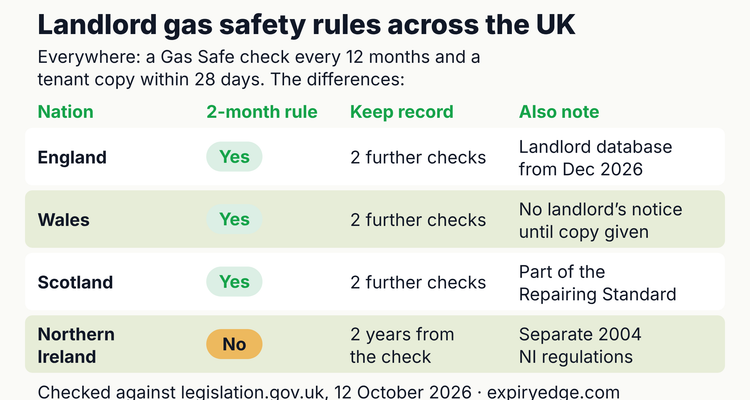 Gas safety rules across the UK at a glance. Free to embed with a link back to this page.
What is the gas safety certificate 2 month rule?
The 2-month rule lets you do the annual check early without losing time. Under regulation 36A, a check completed within the 2 months ending with the deadline date is treated as if it had been done on the deadline date. HSE describes this as having the check done "any time from 10 to 12 calendar months after the previous check".
The rule is optional, and it only helps before the deadline. Keep each record until two further checks have been done, so you can prove the timings.
Worked example: last check on 1 April 2026, deadline 31 March 2027
| Check done on | Inside the window? | Next clock date | Next deadline |
|---|---|---|---|
| 20 Jan 2027 | No, early | 20 Jan 2027 | 19 Jan 2028 |
| 1 Feb 2027 | Yes, first day | 1 Apr 2027 | 31 Mar 2028 |
| 31 Mar 2027 | Yes, last day | 1 Apr 2027 | 31 Mar 2028 |
| 10 Apr 2027 | No, late (overdue) | 10 Apr 2027 | 9 Apr 2028 |
The formulas: window opens `=EDATE(last check,10)`, deadline `=EDATE(last check,12)-1`. We use the day before the anniversary as the deadline because it is the cautious reading of "not more than 12 months".
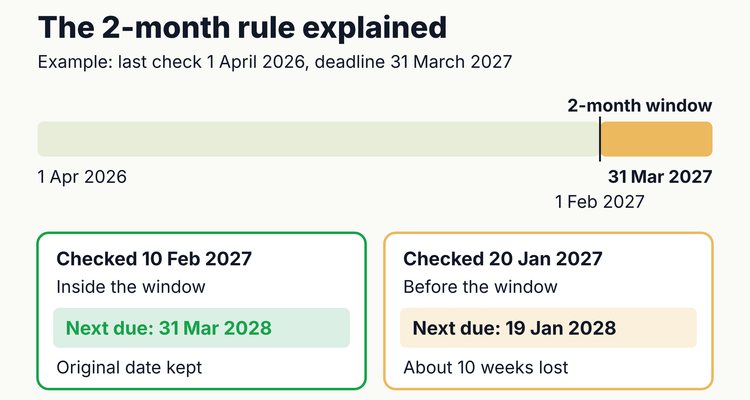 The 2-month rule: check inside the window and the next due date stays the same.
How do I track the gas safety deadline in a spreadsheet?
Give each property one row and let the formulas do the date maths. Setting up a row takes a couple of minutes.
Gas safety tracker: columns and row 2 formulas (Excel or Google Sheets)
| Column | Heading | Row 2 |
|---|---|---|
| A | Property | Address |
| B | Clock date | Last check date (after a check, the value from H) |
| C | Window opens | =EDATE(B2,10) |
| D | Deadline | =EDATE(B2,12)-1 |
| E | Days left | =D2-TODAY() (format as Number) |
| F | Booked visit | Engineer booking date |
| G | Check done on | Date on the new record |
| H | Next clock date | =IF(G2="","",IF(AND(G2>=C2,G2<=D2),EDATE(B2,12),G2)) |
| I | Tenant copy due | =IF(G2="","",G2+27) |
| J | Status | =IF(B2="","",IF(G2<>"","Done: roll over",IF(TODAY()>D2,"OVERDUE",IF(F2<>"",IF(F2<C2,"Booked too early",IF(F2>D2,"Booked too late","Booked")),IF(E2<=90,"BOOK NOW","OK"))))) |
Format column J red for OVERDUE and amber for BOOK NOW, then sort by column D. Column H applies the 2-month rule for you. Column I counts the check day as day 1, the cautious reading of "within 28 days". After each check, paste H into B as values and clear F and G.
Example: a flat last checked on 1 December 2025 shows a deadline of 30 November 2026 and, on 12 October 2026, 49 days left: BOOK NOW. If you would rather not build it, our free landlord compliance tracker spreadsheet has a Gas safety sheet with these formulas ready-made: window opens, deadline, next clock date under the 2-month rule, tenant copy due, early-booking warnings, plus EICR and EPC sheets. No sign-up needed.
Who is responsible for what on a gas safety check?
The landlord carries the legal duty, even when someone else books the engineer.
Gas safety responsibilities (last verified 12 October 2026)
| Who | Responsible for | Source |
|---|---|---|
| Landlord | Annual check of appliances and flues they provide (including LPG heaters and communal boilers), the record and tenant copies | GSIUR 1998 reg 36; https://www.hse.gov.uk/gas/landlords/safetycheckswhat.htm |
| Letting agent | Whatever the management contract says. The landlord keeps overall responsibility | HSE INDG285: https://www.hse.gov.uk/pubns/indg285.htm |
| Gas Safe registered engineer | Doing the check and signing the record with their registration number | Reg 36(3)(c) and (4); https://www.hse.gov.uk/gas/landlords/safetycheckswhocan.htm |
| Tenant | Checks on their own appliances; access as the tenancy agreement allows | https://www.hse.gov.uk/gas/landlords/dealing.htm |
Before the visit, check the engineer is registered. HSE says you can enter the licence number from their ID card on the Gas Safe Register website, or call the free helpline on 0800 408 5500. The back of the card shows which work they are qualified for.
What must a landlord gas safety record include?
The record must include nine items set out in regulation 36(3)(c). Check every record for them before you file it.
- Date of the check.
- Property address.
- Landlord's (or agent's) name and address.
- Description and location of each appliance or flue.
- Any safety defect found.
- Any remedial action taken.
- Confirmation the check covered regulation 26(9)(a) to (d).
- Engineer's name and signature.
- Gas Safe registration number.
HSE accepts secure electronic records. Email copies are fine if the tenant agrees, but give paper if they ask.
Do this now: get access with a tenant letter
If a tenant hasn't let the engineer in, write to them today. You mustn't force entry, but regulation 39 gives you a defence if you "took all reasonable steps", and HSE inspectors "will look for repeated attempts". This letter follows HSE's advice: explain the legal requirement and offer the tenant their own appointment. We'd send it two weeks before the visit.
Subject: Annual gas safety check at [property address]
Dear [tenant name], by law the gas appliances and flues we provide in your home must be checked for safety by a Gas Safe registered engineer at least every 12 months. The check is for your own safety.
[Engineer or company], Gas Safe registration number [number], will visit on [date] between [time] and [time]. If that doesn't suit you, contact [landlord or agent contact] on [phone or email] by [date] and choose your own appointment. [Only if true: Your tenancy agreement (clause [number]) allows access for safety checks.] We will send you a copy of the gas safety record within 28 days of the check. Yours sincerely, [landlord or agent]
If the engineer cannot get in, leave a notice that day with your contact details, then resend the letter. Log every attempt. If refusals continue, HSE says you may need court action under the tenancy contract.
What happens if your gas safety certificate lapses?
⚠️What happens if you miss it: breaching regulation 36 is a criminal offence. HSE warns landlords they risk prosecution, and in the Crown Court the maximum penalty is an unlimited fine, imprisonment of up to two years, or both. It is also an offence to use, or allow the use of, a gas appliance you know to be unsafe. In Wales, you also cannot give a landlord's notice until the tenant has a valid record.
In England, section 21 "no fault" notices ended on 1 May 2026, so the old rule that a missing certificate blocked a section 21 notice no longer matters. The record still does. Under the Renters' Rights Act 2025, landlords must register on the new landlord registration service, which opens in the West Midlands on 15 December 2026 and reaches every area within 12 months; everyone letting property must be registered by 14 November 2027. The draft regulations ask for the gas safety record and its issue date, and require updates within 28 days of information going out of date, so upload each new record within 28 days of the check. Our Renters' Rights Act checklist covers the regional dates.
What should I do if my gas safety certificate has already expired?
Book the first available Gas Safe registered engineer today. The 2-month rule only covers checks done before the deadline, so your next deadline runs 12 months from the date of the late check.
Gas safety check overdue: what to do now
| If | Do this |
|---|---|
| The tenant is in place | Book the earliest engineer and send the access letter with the date |
| The tenant refused access | Keep making and logging attempts (your regulation 39 defence). Do not force entry |
| A new tenant is moving in | Hold the keys until the check is done and the tenant has a copy |
| An appliance fails or is switched off | Do not reconnect it until a Gas Safe registered engineer fixes it. If it heats the home, provide emergency heating meanwhile |
| Anyone smells gas | Open doors and windows, turn off the gas at the meter if you know where it is, and call the National Gas Emergency Service on 0800 111 999 |
Run a portfolio's gas checks as one routine
- List every gas appliance and flue in each property, and mark the ones the tenant owns.
- Enter each property's clock date in the spreadsheet.
- Book the engineer 6 to 8 weeks before the deadline. That's our advice, and it sits inside the 2-month window.
- Check the engineer on the Gas Safe Register.
- Send the access letter and keep a copy.
- If access fails, leave a notice and resend the letter that week. Log every attempt.
- Check the record against the nine items, send the tenant's copy within 28 days and file proof that you did.
- Close out any defects, upload the record to the database where that applies, and roll the clock date forward.
Four ways to cut the number of visits
- If two properties' deadlines are under 2 months apart, one visit that falls inside both windows keeps both dates.
- Pair the check with the boiler service. HSE says a service isn't a safety check, but one engineer can do both on the same visit.
- When you fit a new appliance, regulation 36A lets you check it up to 2 months late, once, so it lines up with the others in the property.
- Keep the access log with the record, so your reasonable-steps evidence sits in one place.
When a spreadsheet stops being enough
With fewer than about 10 properties and one person who opens the spreadsheet every Monday, the spreadsheet is fine. That's our rule of thumb, not a legal line. Set a recurring reminder, or use our landlord compliance calendar tool to see the year at a glance.
It breaks when it depends on one person remembering, when staff change, or when an inspector or a court wants each property's record and access log together. In ExpiryEdge, each gas check is a recurring record with an owner, the PDF and access letters attached, and reminders on the schedule you choose (say 90, 60, 30 and 7 days) by email, SMS, WhatsApp, Slack or Teams. Overdue checks escalate to a manager, and you can ask the engineer or agent to upload the new record through a link. If you'd also like each gas contractor's public liability insurance tracked next to the property, see our guide to tracking vendor certificates of insurance.
The same tracker handles your electrical report, which runs on a clock of up to 5 years in England. See how often landlords need an EICR.
Frequently asked questions
Is a CP12 the same as a gas safety certificate?
Yes. HSE calls the document the landlord gas safety record and notes it used to be called a gas safety record, certificate or CP12 form. There's no single official form, so any record works as long as it contains the nine items the law requires.
Can I renew a gas safety certificate early without losing time?
Yes, if the check happens within the 2 months ending with your deadline date. Regulation 36A treats that check as if it was done on the deadline date, so your next deadline stays 12 months on. A check earlier than that window starts a new 12-month clock from the day it was actually done.
What should I do if my gas safety certificate has expired?
Book the first available Gas Safe registered engineer and tell the tenant the date in writing. Your next deadline runs 12 months from the late check, because the 2-month rule doesn't apply after the deadline. If a tenant refused access, keep a written record of every attempt: that's your defence under regulation 39.
Can I use the same gas safety record for a new tenant?
Yes, as long as the current record is under 12 months old. Regulation 36 only requires the appliances to have been checked in the 12 months before the new tenancy starts. Give the new tenants a copy before they move in. A new tenant doesn't reset anything: the next check is due on the same deadline as before.
Does the 2-month rule apply in Northern Ireland?
Not as far as the published law shows. Northern Ireland has its own 2004 gas safety regulations, and the current text of regulation 36 has no early-check rule. Checks are still due at least every 12 months, and you must keep records for 2 years from the check.
Will I need to upload my gas safety certificate to the landlord database?
In England, yes, once your area opens. The government's registration guidance and the draft database regulations ask for a copy of the gas safety record and its issue date for homes with a gas supply. Registration opens in the West Midlands on 15 December 2026, and every landlord letting property must be registered by 14 November 2027.
Sources
- Gas Safety (Installation and Use) Regulations 1998, regulation 36
- Gas Safety (Installation and Use) Regulations 1998, regulation 36A
- Gas Safety (Installation and Use) Regulations 1998, regulation 39
- Gas Safety (Installation and Use) Regulations (Northern Ireland) 2004, regulation 36
- Renting Homes (Wales) Act 2016, Schedule 9A
- Housing (Scotland) Act 2006, section 13
- Scottish Government, Repairing Standard statutory guidance, Annex D2: gas
- HSE, Landlords: a guide to landlords' duties (INDG285)
- HSE, Gas safety check records and what to keep
- HSE, What does a gas safety check cover?
- HSE, Dealing with tenants
- HSE, Gas safety checks: who can do it?
- HSE, Check an engineer: are they Gas Safe registered?
- HSE, Gas safety checks: what if?
- nidirect, Gas Safe Register
- Health and Safety at Work etc. Act 1974, Schedule 3A
- GOV.UK, Giving notice of possession to tenants before 1 May 2026
- GOV.UK, Stronger protections and greater confidence for renters (9 September 2026)
- GOV.UK campaign, Renting is changing: get ready to register
- Draft Private Rented Sector Database Regulations 2026
- National Gas, Emergency contacts
Last reviewed: 29 October 2026
Frequently asked questions
Yes, if the check happens within the 2 months ending with your deadline date. Regulation 36A treats that check as if it was done on the deadline date, so your next deadline stays 12 months on. A check earlier than that window starts a new 12-month clock from the day it was actually done.
Book the first available Gas Safe registered engineer and tell the tenant the date in writing. Your next deadline runs 12 months from the late check, because the 2-month rule doesn't apply after the deadline. If a tenant refused access, keep a written record of every attempt: that's your defence under regulation 39.
Yes, as long as the current record is under 12 months old. Regulation 36 only requires the appliances to have been checked in the 12 months before the new tenancy starts. Give the new tenants a copy before they move in. A new tenant doesn't reset anything: the next check is due on the same deadline as before.
Not as far as the published law shows. Northern Ireland has its own 2004 gas safety regulations, and the current text of regulation 36 has no early-check rule. Checks are still due at least every 12 months, and you must keep records for 2 years from the check.
In England, yes, once your area opens. The government's registration guidance and the draft database regulations ask for a copy of the gas safety record and its issue date for homes with a gas supply. Registration opens in the West Midlands on 15 December 2026, and every landlord letting property must be registered by 14 November 2027.
Not safety or OSHA compliance advice
This article is for general informational purposes and does not constitute formal OSHA or workplace-safety compliance advice. Safety regulations and standards (OSHA, state plans, EU OSHA, AS/NZS, etc.) vary by jurisdiction and change. Consult a qualified safety professional or your regulator for the specifics of your operation.