
HMO Licence Guide: Mandatory, Additional, Selective and Renewal

An HMO licence is the council licence needed to let a house in multiple occupation. In England, an HMO with 5 or more people from 2 or more households needs a mandatory licence, and councils can license smaller lets through additional or selective schemes. Licences last up to 5 years; letting without one risks a penalty of up to £40,000.
If you manage several shared houses, the hard part is not the first application. It is knowing which council schemes cover which properties, when each licence expires, and which conditions you signed up to. This guide sets out the rules as of October 2026, then gives you a licence register you can build this week.
Key takeaways
- Mandatory licensing covers HMOs with 5 or more people forming 2 or more households.
- Additional and selective licensing are council schemes; each designation lasts no more than 5 years, so check yours.
- 5 years maximum: no licence can run longer, and you must renew before it runs out.
- Mandatory conditions include an annual gas safety certificate for the council, working smoke alarms, minimum bedroom sizes and a maximum number of occupants.
- £40,000: the maximum civil penalty in England for licensing offences since 1 May 2026, up from £30,000.
- Up to 2 years' rent can be ordered back to tenants or the council through a rent repayment order for an unlicensed HMO.
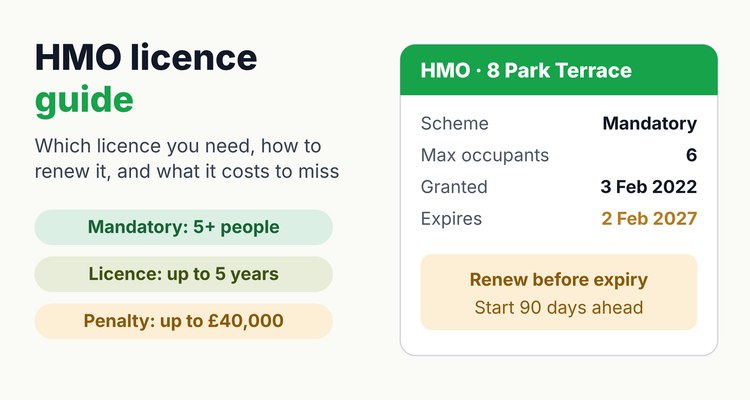 Every HMO licence carries an expiry date, an occupant limit and conditions to track.
What is an HMO, and when does it need a licence?
A house in multiple occupation (HMO) is a property rented by at least 3 people who are not from one household, such as a family, and who share facilities like the kitchen or bathroom. Not every HMO needs a licence. In England, a mandatory licence is needed when the HMO:
- is occupied by 5 or more people;
- who live in 2 or more separate households; and
- meets the standard test, the converted building test, or the self-contained flat test (but not a purpose-built flat in a block of 3 or more flats).
At least one tenant must pay rent. Even smaller properties may need a licence if your council runs an additional or selective scheme.
What are the three types of HMO licence?
There is one national scheme (mandatory) and two that councils choose to run (additional and selective). One property needs only one licence: an HMO licensed under the mandatory or additional scheme does not also need a selective licence.
Mandatory, additional and selective licensing in England (as of October 2026)
| Mandatory HMO licence | Additional HMO licence | Selective licence | |
|---|---|---|---|
| Covers | HMOs with 5+ people in 2+ households | Other HMOs of a type the council names, for example 3 or 4 sharers | Privately rented homes in a designated area, including single households |
| Who decides | National law | Your council, after consultation | Your council, after consultation |
| Why a council uses it | Applies everywhere | Poorly managed HMOs causing problems in the area | Low housing demand, anti-social behaviour, or other conditions set by order |
| Scheme length | Permanent | Designation lasts up to 5 years | Designation lasts up to 5 years |
| Licence length | Up to 5 years | Up to 5 years | Up to 5 years |
| Legal basis | Housing Act 2004, Part 2; SI 2018/221 | Housing Act 2004, s.56 | Housing Act 2004, Part 3, s.80 |
Because council designations end after 5 years at most, a property that needed no licence last year may need one now, and the reverse. Check your council's website for current schemes and their end dates before each new tenancy.
How long does an HMO licence last, and how do you renew it?
An HMO licence lasts for the period the council sets, which must not end more than 5 years after the licence was granted. Licences do not renew automatically, so you must apply again before the expiry date. GOV.UK puts it plainly: "You must renew your licence before it runs out."
- Apply before expiry. A licence application that has been properly made and is still being decided gives you a defence to the offence of running an unlicensed HMO.
- Expect the council's own process. For example, one London council opens its renewal portal 30 days before expiry and treats any application after the expiry date as a new application, at a higher fee.
- Licences cannot be transferred. If you sell the property or change the licence holder, the new person must apply.
- If the licence holder dies, the house is treated as exempt for 3 months, and the council can extend that by a further 3 months at the personal representatives' request.
Councils set their own fees and may ask for current gas, electrical and fire safety certificates with a renewal, as that London council does. Start gathering them about 90 days before expiry (our suggestion, not a legal rule).
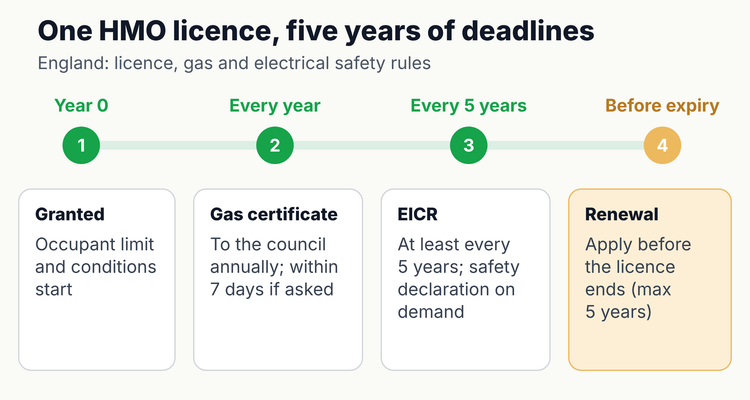 One HMO licence, five years of deadlines. The renewal must be in before the expiry date.
What conditions come with an HMO licence?
Every licence must include the conditions set out in Schedule 4 of the Housing Act 2004, and the council can add its own. Breaking a condition is a separate offence, so treat each one as a task with an owner.
Mandatory HMO licence conditions in England
| Condition | What you must do |
|---|---|
| Gas safety | Give the council a gas safety certificate from the last 12 months, every year |
| Electrical installation | Keep every installation safe and in proper working order; give the council a safety declaration on demand |
| Appliances and furniture | Keep them safe; give the council a declaration on demand |
| Smoke alarms | One on each storey with living accommodation, kept in working order |
| Carbon monoxide alarms | In any room with a fixed combustion appliance other than a gas cooker |
| Written statement | Give each occupier a written statement of the terms of occupation |
| Bedroom sizes | At least 6.51 m² for one person over 10, 10.22 m² for two people over 10, 4.64 m² for a child under 10; rooms under 4.64 m² cannot be bedrooms |
| Occupant limits | No more people or households than the licence allows, per house and per room |
| Household waste | Follow the council's storage and disposal scheme |
The HMO management regulations add duties for the manager, such as displaying your name, address and phone number in a prominent place, and sending the council the latest gas safety certificate within 7 days of a written request. The underlying checks are covered in our guides to gas safety certificate renewal and EICR deadlines.
What happens if you let an HMO without a licence?
It is a criminal offence, and since 1 May 2026 the offence also reaches superior landlords, not just the person managing the property.
⚠️What happens if you miss it: in England a council can impose a civil penalty of up to £40,000 for each licensing offence instead of prosecuting (the cap was £30,000 before 1 May 2026). On prosecution, running an unlicensed HMO carries an unlimited fine. The First-tier Tribunal can also make a rent repayment order requiring you to repay up to 2 years' rent to the tenants, or to the council where universal credit paid the rent. Breaching a licence condition is a separate offence.
There are defences. You are not guilty of running an unlicensed HMO if a valid application or a temporary exemption notice was pending, or if you can prove a reasonable excuse. For a superior landlord, a clause in the tenancy agreement is not on its own a defence.
What is a temporary exemption notice?
If you are about to stop the property being a licensable HMO, for example by reducing the number of occupants, you can tell the council and ask for a temporary exemption notice. It lasts 3 months. The council can serve a second notice for another 3 months only in exceptional circumstances, and no further notices after that.
Are HMO licensing rules different in Wales and Scotland?
Yes. Track the nation for every property, because the triggers and licence lengths differ.
HMO licensing by nation (as of October 2026)
| England | Wales | Scotland | |
|---|---|---|---|
| Main law | Housing Act 2004, Parts 2 and 3 | Housing Act 2004, Parts 2 and 3 | Housing (Scotland) Act 2006, Part 5 |
| Mandatory trigger | 5+ people, 2+ households | 3+ storeys and 5+ people (prescribed description) | 3+ people not all from one or two families |
| Maximum licence length | 5 years | 5 years | 3 years (or shorter, at least 6 months, if stated) |
| Civil penalty up to £40,000 | Yes | No (s.249A covers England only) | Not applicable (separate Scottish regime) |
How do you build an HMO licence register this week?
Pull every licence into one sheet, one row per property, and let formulas flag renewals, over-occupation and missing gas certificates. For 15 shared houses, allow about 2 hours (our estimate), most of it spent checking council websites for schemes.
- Check every council's schemes (5 minutes a council). Note mandatory, additional or selective, and the date each designation ends.
- Find each licence (3 minutes a property). Record the licence number, holder, grant date, expiry date and maximum occupants from the licence document, not memory.
- List the conditions. Copy any council-added conditions with deadlines, such as works to complete, into their own rows.
- Record the current occupants and the latest gas and electrical dates.
- Fix red rows this week, and diarise every renewal 90 days ahead.
HMO licence register spreadsheet layout
| Column | Heading | What to enter or formula |
|---|---|---|
| A | Property | Address, council and nation |
| B | Scheme | Mandatory, additional or selective |
| C | Licence number / holder | From the licence |
| D | Licence expiry | Date on the licence |
| E | Days to expiry | =D2-TODAY() |
| F | Max occupants | From the licence |
| G | Current occupants | Count today |
| H | Occupancy check | =IF(G2>F2,"OVER LIMIT","OK") |
| I | Last gas certificate | Date of check |
| J | Gas due | =EDATE(I2,12) |
| K | Last EICR / next due | Next due date from the report |
| L | Scheme ends | Designation end date (additional or selective) |
| M | Owner | Person responsible, plus a backup |
Then add conditional formatting (Excel: "Use a formula"; Google Sheets: "Custom formula is"):
- Red: =$E2<=30, licence expiring within 30 days (or expired).
- Amber: =AND($E2>30,$E2<=90), start the renewal now.
- Red: =$H2="OVER LIMIT"
- Amber: =$J2-TODAY()<=60, book the gas engineer.
💡 Pro Tip
Letting agencies that use ExpiryEdge often track each property as a group, with the HMO or selective licence held next to the gas, electrical and fire safety certificates it depends on. The habit worth copying with any tool: when a licence is granted, create the renewal task the same day with the expiry date from the licence, and add each council condition as its own item.
How can you make licensing easier beyond the minimum?
- Keep a renewal pack per property: licence, floor plan with room sizes, latest gas certificate, EICR, fire alarm and emergency lighting records, and tenancy statements.
- Measure rooms once and record them. Room sizes rarely change, and the 6.51 m² and 10.22 m² limits decide your occupant numbers.
- Watch council consultations. Councils must consult before making a designation, which gives you notice before a new scheme starts.
- Line up deadlines. Book the gas check and EICR so fresh certificates are ready for the renewal application.
- Watch the EPC rules too. The government plans to require an EPC for the whole house when single rooms are let; see our EPC rules for landlords.
What are the most common HMO licence mistakes?
Common HMO licence mistakes and fixes
| Mistake | Fix |
|---|---|
| Applying after the expiry date | Diarise 90 days ahead; some councils treat late renewals as new applications |
| Assuming no scheme applies because none did last year | Check council designations, which change at least every 5 years |
| Adding a sharer without checking the licence limit | Use the occupancy check column before every new tenancy |
| Not sending the annual gas certificate to the council | Track it as a licence condition, not only a tenant duty |
| Selling a licensed HMO and assuming the licence transfers | The buyer must apply; licences cannot be transferred |
Spreadsheet or software: how should you track HMO licences?
A spreadsheet works for a handful of HMOs in one council area, checked weekly. A tool earns its place when you manage dozens of properties across several councils, when conditions and certificates feed each other, and when you need an audit trail for a council or a tribunal. The Renters' Rights Act checklist covers other duties that changed on 1 May 2026.
ExpiryEdge holds each licence, condition and certificate as a record with an owner, a backup and reminders at 90, 60, 30 and 7 days. See the letting agent compliance page, or start with the free landlord compliance tracker.
Frequently asked questions
How long does an HMO licence last?
Up to 5 years. The council sets the period, but it must not end more than 5 years after the licence was granted. You must apply to renew before it expires, because licences do not renew automatically.
Do I need an HMO licence for 3 or 4 tenants?
Not under mandatory licensing in England, which starts at 5 people in 2 or more households. But your council may run an additional licensing scheme for smaller HMOs, or a selective scheme covering all private rentals in an area, so check its website.
What is the fine for not having an HMO licence?
In England a council can impose a civil penalty of up to £40,000 per offence, and a prosecution can bring an unlimited fine. Tenants or the council can also apply for a rent repayment order of up to 2 years' rent.
What is the difference between additional and selective licensing?
Additional licensing covers HMOs that fall outside the mandatory scheme, such as smaller shared houses. Selective licensing covers privately rented homes of any kind, including single-family lets, in a designated area. Both are council schemes that last up to 5 years.
Can I transfer an HMO licence when I sell the property?
No. An HMO licence cannot be transferred to another person, so the buyer must apply for a new licence. Plan the application before completion so the property is not let unlicensed.
What conditions are in every HMO licence?
In England, every licence includes conditions on annual gas safety certificates for the council, electrical and appliance safety, smoke and carbon monoxide alarms, written terms for occupiers, minimum bedroom sizes, occupant limits and household waste. Councils can add their own conditions.
Sources
- House in multiple occupation licence, GOV.UK
- Housing Act 2004, section 68 (HMO licence duration), legislation.gov.uk
- Housing Act 2004, section 72 (licensing offences), legislation.gov.uk
- Housing Act 2004, section 249A (financial penalties), legislation.gov.uk
- Housing Act 2004, Schedule 4 (mandatory licence conditions), legislation.gov.uk
- Housing Act 2004, sections 56, 60, 62, 80, 84 and 91, legislation.gov.uk
- Licensing of HMOs (Prescribed Description) (England) Order 2018, article 4
- Licensing of HMOs (Mandatory Conditions of Licences) (England) Regulations 2018
- Financial Penalties (Housing Offences and Breach of Banning Orders) Regulations 2026 (SI 2026/319)
- Housing and Planning Act 2016, sections 40 and 44 (rent repayment orders)
- Management of Houses in Multiple Occupation (England) Regulations 2006, regulations 3 and 6
- Licensing of HMOs (Prescribed Descriptions) (Wales) Order 2006, article 3
- Housing (Scotland) Act 2006, sections 125 and 134
- Renewal of HMO licensing, Camden Council (example of a council renewal process)
Last reviewed: 12 October 2026
Frequently asked questions
Not under mandatory licensing in England, which starts at 5 people in 2 or more households. But your council may run an additional licensing scheme for smaller HMOs, or a selective scheme covering all private rentals in an area, so check its website.
In England a council can impose a civil penalty of up to £40,000 per offence, and a prosecution can bring an unlimited fine. Tenants or the council can also apply for a rent repayment order of up to 2 years' rent.
Additional licensing covers HMOs that fall outside the mandatory scheme, such as smaller shared houses. Selective licensing covers privately rented homes of any kind, including single-family lets, in a designated area. Both are council schemes that last up to 5 years.
No. An HMO licence cannot be transferred to another person, so the buyer must apply for a new licence. Plan the application before completion so the property is not let unlicensed.
In England, every licence includes conditions on annual gas safety certificates for the council, electrical and appliance safety, smoke and carbon monoxide alarms, written terms for occupiers, minimum bedroom sizes, occupant limits and household waste. Councils can add their own conditions.


