
COI and vendor insurance tracking software - without the per-vendor pricing.
See every vendor's Certificate of Insurance in one place, get reminders before each policy runs out, and prove additional-insured status with the endorsement on file. Built for property managers, GCs, and HOAs that need vendor insurance tracking software - without the per-subcontractor network fees Avetta and ISNetworld charge.
Last updated · ExpiryEdge editorial team
Quick answer
COI and vendor insurance tracking software keeps every vendor's Certificate of Insurance in one place. It reads each cert, checks coverage limits, carrier rating and dates against your rules, confirms your entity is named additional insured, and sends reminders before the policy runs out. Getting the actual certificate is a document collection request - a link the vendor opens with no login required, uploads their COI to, and signs if you need an acknowledgement. The goal is simple: every vendor working for you has active insurance, so if something goes wrong, their policy pays - not yours.
Why manual COI tracking carries the risk
9 in 10
certificates in some artisan-contractor market segments materially misrepresented the cover in force.
Source: IRMI – Dybdahl (2015; artisan-contractor market)COI ≠ policy
A certificate is a point-in-time summary; it does not amend or guarantee the insurance coverage behind it.
Source: ACORD, cited by IRMI (2015)$165,514
maximum OSHA penalty per willful or repeat violation involving an unqualified or uninsured contractor on a site you control.
Source: OSHA (2025 adjustment)Every COI field that needs to be tracked
Insured name - must match your master service agreement
Policy effective + expiration date (drives 90/60/30/7 alerts)
Carrier + AM Best rating (A- or better often required)
General liability limits ($1M / $2M aggregate minimum)
Auto liability limits (if vendor drives on-site)
Workers' comp (required except no-employee sole props)
Umbrella / excess liability ($5M+ on higher-tier work)
Additional insured language (your entity on the policy)
Waiver of subrogation endorsement
Endorsement forms (CG 20 10 / CG 20 37), not just the cert page
From a cert in an inbox to a vendor that cannot mobilise non-compliant
Send a document collection link; the cert is read and checked against your rules
Send the vendor a document collection request - a link they open with no account or login, upload their COI to, fill in policy details, and sign if you need an acknowledgement. Define minimum GL, auto, WC and umbrella limits, required carriers, AM Best ratings and additional-insured language - per property if requirements differ. Each uploaded cert is parsed and compared. Insufficient limits, missing endorsements or expired carriers are flagged before the vendor is ever marked active.
Vendor fills it in on any device, no login required
Per-property requirement rules
Endorsement (CG 20 10 / CG 20 37) captured, not just the cert page
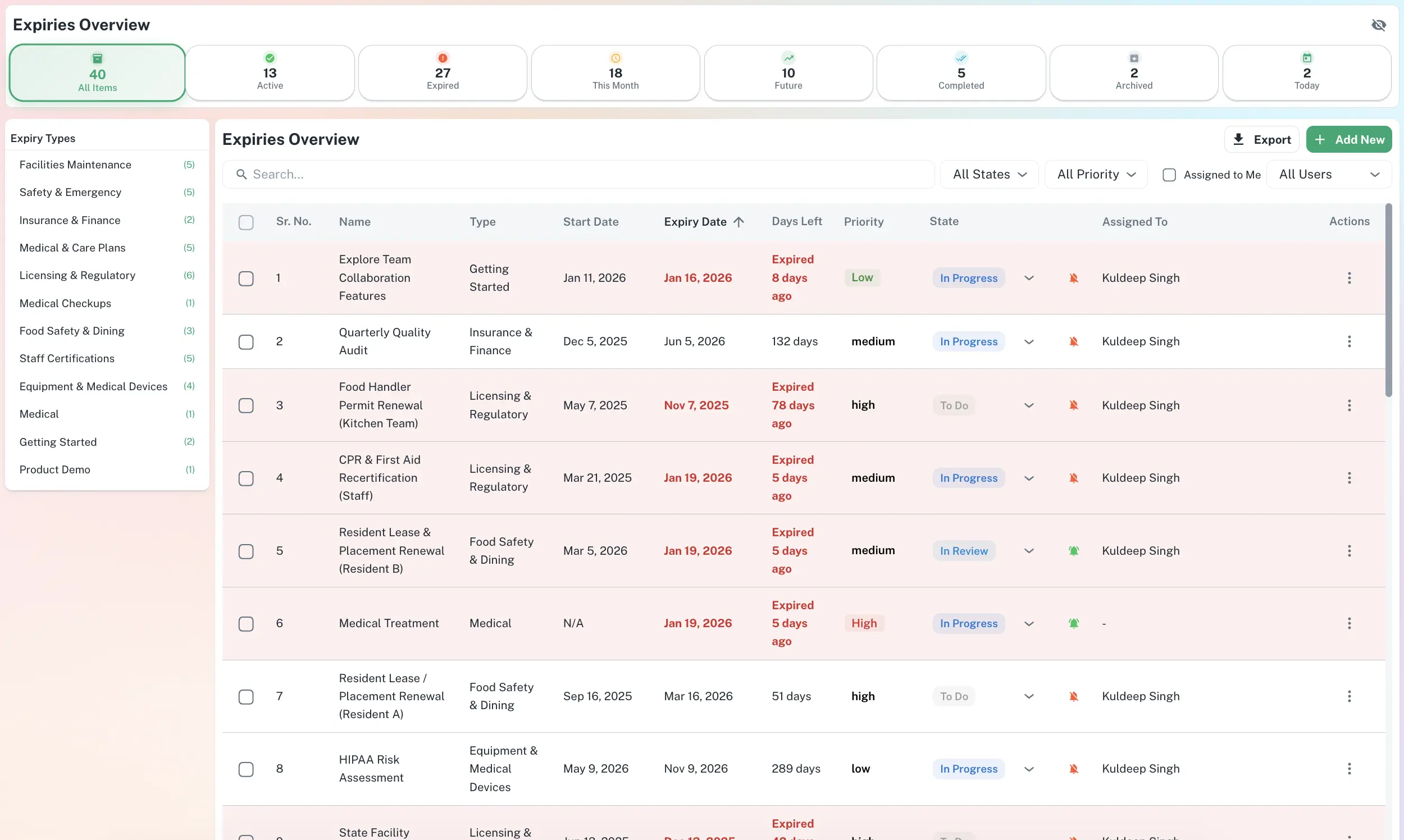
Traffic-light COI status across every vendor and property
Filter by vendor, property, carrier or what is renewing next. The renewal pipeline is visible 90 days out, so December stops being a fire drill and property staff stop chasing certificates by email.
Traffic-light health per vendor
Renewal pipeline visible 90 days out
Per-location and multi-entity vendor scoping
Reminders fire at 90/60/30/7 days, and the audit pack is one click
The collection link follows up on its own - vendors get the renewal reminder; your team gets a Slack or Teams ping if action is needed. If a cert is wrong or incomplete, reject just that field with a comment and the same link reactivates for the vendor to fix only what is flagged. A timestamped log shows every cert reviewed, every renewal received and who approved it - hand it to a carrier, auditor or owner in 30 seconds.
Email, SMS, WhatsApp, Slack & Teams reminders
Reject a field and the vendor fixes only that, not the whole cert
Timestamped review history, exportable in one click
Who uses COI tracking software
Property managers (commercial + residential)
Tracking 50–500 vendors across multiple buildings, each with separate insurance requirements. Vendors upload COIs to a portal; ExpiryEdge alerts 60/30/7 days out and auto-emails the vendor a renewal reminder so staff stop chasing.
General contractors & construction firms
Subs show up with expired COIs and OCIP/CCIP programs demand strict pre-mobilization checks. A pre-mobilization gate keeps a sub inactive until the COI passes validation; expired triggers a Slack/Teams flag to the PM.
HOA boards & community management
Self-managed boards with rotating volunteer leadership where COIs lapse unnoticed. A board portal survives turnover - the outgoing board hands over a clean compliance snapshot, the incoming board picks up where it left off.
Facility & operations managers
Vendor onboarding that lives in an inbox and annual renewals that become a December fire drill. One dashboard shows every vendor COI with traffic-light health and a renewal pipeline 90 days out.
Fitness, retail & franchise operators
Multi-location operators needing cleaning crews, equipment service and HVAC at every site, each with its own master agreement. Per-location COI rules and vendors scoped to specific properties, centralized for the franchisor.
How COI tracking pricing compares (US, 2026)
| ExpiryEdge | Certificial | MyCOI | Avetta | ISNetworld | |
|---|---|---|---|---|---|
| Pricing model | Flat monthly, unlimited vendors | Tiered SaaS | Per-vendor + setup | Per-sub (paid by sub) | Per-sub (paid by sub) |
| Typical cost | From free; unlimited COIs | $99–$299 / month | $13–$19 / vendor / yr | ~$400–$900 / sub / yr | ~$875+ / sub / yr |
| Vendor self-service upload portal | |||||
| Additional-insured (CG 20 10/37) tracking | |||||
| 90/60/30/7-day expiration reminders | |||||
| No per-vendor fees | |||||
| Tracks every other expiry alongside COIs |
A Certificate of Insurance (COI) is a one-page document from a broker or carrier that proves a business has active insurance. It shows the insured business, the carrier, the policy numbers, the start and end dates, and the coverage limits. The COI is not the policy itself. It is a snapshot of what the policy looked like on the day it was issued. The COI you collected in January may already be out of date by April, which is why ongoing tracking matters.
They track COIs because vendor insurance is what keeps risk off the property owner or general contractor. If a contractor gets hurt or damages something and their insurance has lapsed, the lawsuit lands on you instead of them. A 2024 study found that manual COI tracking misses up to 45 percent of compliance issues, and a single uninsured accident can lead to a six-figure lawsuit. Tracking COIs actively keeps that risk on the vendor, where it belongs.
COI tracking software does four jobs. First, it collects certificates from vendors through a portal or email. Second, it reads each cert and stores the key fields: insured business, carrier, limits, dates, and additional insured language. Third, it checks the cert against your rules (for example: $1M general liability minimum, AM Best A- carrier rating, your business named as additional insured). Fourth, it sends reminders to the vendor and your team before each policy runs out. Better platforms also store endorsements, keep an audit trail, and let you set different rules for different properties.
Pricing varies by model. Self-service SaaS platforms range from $99 to $299 per month (Certificial Starter at $99/mo for up to 100 certificates, Pro at $299). Per-vendor models like CertFocus self-service are $6–$8 per vendor per year, with full-service review at $13–$19 per vendor. Enterprise networks like Avetta and ISNetworld are reported by contractors at roughly $400–$900 and $875+ per subcontractor per year respectively; neither publishes public pricing. ExpiryEdge takes the SaaS approach: a flat monthly subscription with unlimited vendors, scaling on team seats and notifications rather than per-cert fees.
You can, and many small operators do. But spreadsheets stop working once you pass about 20 vendors. They break down for three reasons. First, there is no automatic reminder 30 days before a cert expires - someone has to check manually. Second, there is no way to verify the additional insured language or endorsements; the spreadsheet just shows what was on the cert page. Third, there is no audit trail when a carrier or auditor asks who reviewed which cert and when. A 2024 industry report found spreadsheet-based COI tracking hits 60 to 70 percent compliance, while purpose-built software reaches 90 percent or higher.
A Certificate of Insurance just shows that the vendor has coverage. Additional insured status is what actually extends that coverage to protect your business if something goes wrong. The COI page only confirms what was true the day it was printed. The real protection comes from a policy endorsement - usually CG 20 10 for ongoing work and CG 20 37 for completed work. Good COI tracking captures both the certificate AND the endorsement, so you can prove additional insured status if a claim ever comes up.
COIs should be re-collected at every policy renewal - typically once per year, or whenever the vendor changes carriers. Reviews should happen on a 90/60/30/7 day cadence before the listed expiration. Best practice is to start the renewal request at 60 days out so you have buffer for delays at the broker. ExpiryEdge defaults to 90/60/30/7 day reminder windows for COIs, which can be customized per vendor or per property.
For most operations teams under 500 vendors, yes. ExpiryEdge handles vendor portals, expiration alerts, AI parsing of certificate fields, additional-insured tracking, and audit logs. The places to consider a specialized COI platform are: live sync with broker management systems for real-time policy status (Certificial), full-service expert review of every cert (CertFocus), or insurance-carrier integrations specific to construction OCIP/CCIP programs (Jones). ExpiryEdge often covers 80–90% of the workflow at a fraction of the per-vendor cost, and pairs that with deadline tracking for every other expiry your team manages.
Avetta and ISNetworld are subcontractor prequalification networks - subcontractors pay an annual fee - contractors report roughly $400–$900 with Avetta and $875+ with ISN, though neither vendor publishes public pricing - to be visible to hiring clients on the network. They are well-suited for oil and gas, utilities, and very large industrial buyers. For mid-size GCs and property managers who want their own private compliance program without forcing every sub onto a paid network, ExpiryEdge is the lighter-weight alternative: vendors upload COIs free, the GC pays a flat monthly subscription, and there are no per-vendor charges.
The integrations that matter most: (1) Slack and Microsoft Teams for surfacing alerts where teams already work; (2) email and SMS for vendor-side reminders; (3) document storage (Google Drive, OneDrive, Box) for cert archive; (4) accounting / AP systems (QuickBooks, NetSuite, Sage) so an unpaid AP invoice can be flagged on a non-compliant vendor; (5) project management tools (Procore, Buildertrend) so site teams see compliance status on the project record. ExpiryEdge supports email, SMS, WhatsApp, Slack, and Teams natively, with API access for the rest.
No. ExpiryEdge sends the vendor a document collection link - they open it, upload the certificate, fill in the policy details you require, and sign if needed, without creating an account or installing anything. This is what keeps collection rates high: there is no signup step between the vendor receiving the request and completing it. If a cert is wrong or incomplete, you can reject just that field with a comment and the same link reactivates for the vendor to fix only what is flagged.
Set a reminder sequence on each certificate that goes to the vendor's contact as well as your own team - for example at 30, 15 and 5 days before expiry - and include an upload link so the vendor can send the renewed certificate without creating an account. When the new COI arrives, update the record and the next sequence starts from the new date. If nothing arrives by the expiry date, escalate internally so the vendor is paused before they go back on site.
Stop chasing certificates. Start tracking them.
Set up your insurance requirements, invite your first vendors, and have a complete COI dashboard live before lunch. No per-vendor fees - ever.