
Healthcare compliance software that keeps credentialing current.
One in five hospitals loses more than $1M a year to credentialing delays. ExpiryEdge tracks every provider credential, every training certificate, every device calibration, every facility inspection - with reminders to clinicians AND managers, and tracer-ready evidence one search away. HIPAA-aware infrastructure, BAA available, 14-day free trial.
Quick answer
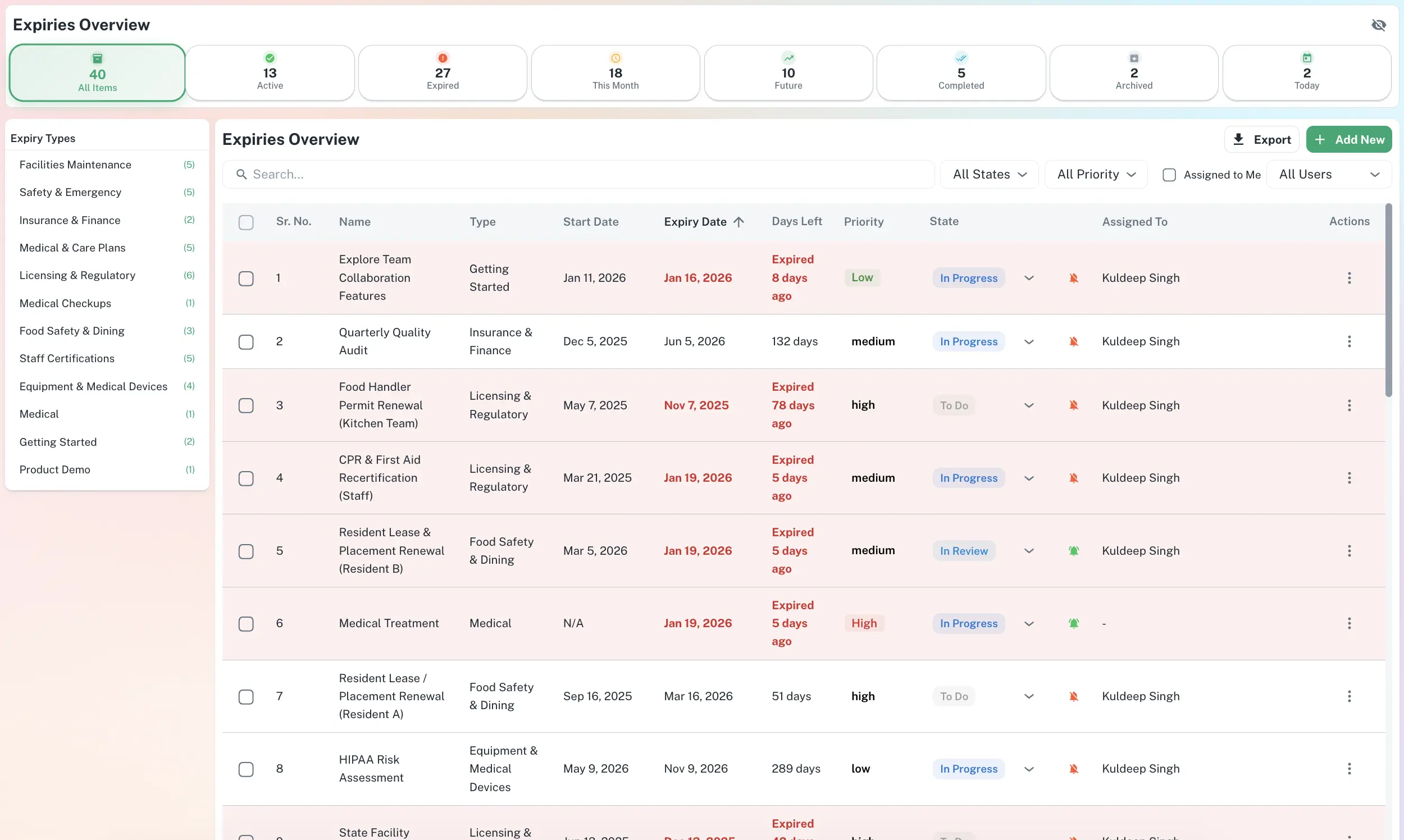
Healthcare compliance software tracks every dated obligation across a care organisation - provider credentialing and payer enrolment, clinical certifications (BLS/ACLS/PALS), DEA and state licensure, OIG/SAM exclusion screening, and medical-device calibration. ExpiryEdge stores each item against its parent record (provider, device, facility) with timestamped history, fires reminders to the clinician and their manager, and produces Joint Commission / CQC / DNV tracer evidence in a single search. New-hire credentialing documents - license copies, DEA certificates, CVs - can be requested as a document collection link the clinician fills in with no account required, and rejecting one bad file re-requests just that document instead of restarting the whole intake.
What credentialing friction costs
1 in 4
healthcare organisations lose as much as $1M a year in billings to credentialing delays
Source: Intelliworx poll, 1-9 Dec 2025~$122,000
physician personal billing typically lost while credentialing is pending
Source: Neolytix (physician-specific analysis)90-180 days
between submission of a provider application and credential verification and approval
Source: MGMA$16,550
maximum OSHA penalty per serious violation for clinical-setting workplace hazards (2025)
Source: OSHA / U.S. Dept of Labor (2025)Three things healthcare needs that general compliance tools don't deliver
Credentialing, audit-readiness, and shared reminder ownership - the gaps a generic tracker leaves open.
Credentialing without the 120-day cycle
Physician credentialing typically takes four months and costs about $122k in lost billing per provider per cycle. ExpiryEdge tracks every payer enrolment, primary-source verification, and re-credentialing date so the cycle is measured against a system, not a clipboard.
Audit-ready for Joint Commission / CQC / DNV
Tracer audits expect evidence retrieved in under five minutes. Every credential, training certificate, and equipment calibration is one search away - across every clinician, every device, every site.
Reminders to the clinician AND the manager
NMC PIN renewal goes to the nurse plus the line manager. BLS / ACLS / PALS expiry to the clinician plus credentialing. Medical-device calibration to facilities plus biomed. Nobody is the sole reminder owner.
Tracked across every provider, device, and facility
Provider credentialing + payer enrolment
NPI, DEA, state licence per state
Board certification + re-credentialing (2–3 yr cycle)
AHA BLS / ACLS / PALS / NRP (2-yr expiry)
Annual TB / N95 fit-test / bloodborne pathogen training
OIG (LEIE) / SAM.gov / state Medicaid exclusion checks
DEA registration (3-yr) + state controlled-substance authority
Medical-device calibration + PM intervals
FDA UDI / recall cross-referencing
Compact / per-state licensure for travel nurses
Six capabilities built for the healthcare compliance stack
The provider file, tracked against a system
NPI, DEA, state licence per state, board certification, CV / education / training, malpractice history, peer references, and payer enrolment per plan - with the re-credentialing cycle (typically 2–3 years) scheduled automatically. Sanction screening runs monthly against OIG LEIE, SAM.gov, and state Medicaid lists so an exclusion mid-employment is caught the day it lands. Gathering the file for a new physician is a document collection link sent straight to them - no account to create - and if credentialing rejects one item, like an expired licence copy, only that field re-opens for resubmission.
Primary-source verification dates tracked per provider
Multi-state physician licensure handled separately
Continuous OIG / SAM monitoring, not once-per-cycle
New-hire documents collected via a no-login link with field-level reject/resubmit
Any surveyor question answered in a single search
Surveyors run tracer methodology - they pick a patient, provider, or device and trace evidence backward in real time. The audit fails when retrieval takes too long, not because the evidence is missing. ExpiryEdge stores everything against the parent record with timestamped history; most customers report retrieval under 60 seconds.
Joint Commission / CQC / DNV evidence packets per cycle
HR file, training transcript, equipment history per record
Export to PDF or CSV in seconds
Reminders fire to the clinician and the manager
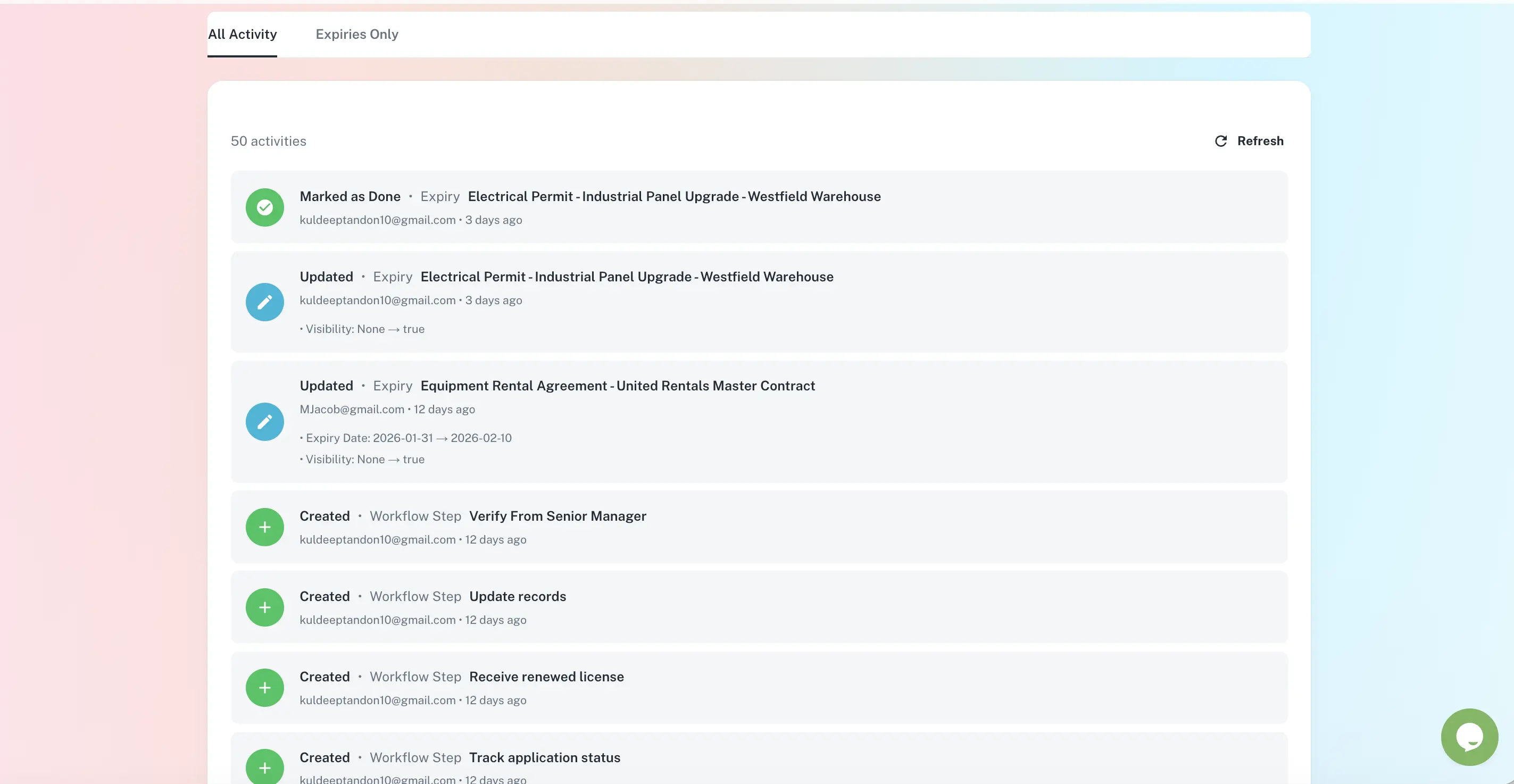
AHA certifications expire every 2 years; renewal alerts go out at 90 / 60 / 30 days to the clinician plus credentialing. Medical-device calibration reminders go to facilities plus biomed. Nobody is the single point of failure for a lapsed credential.
90 / 60 / 30-day cadence per certification
Email, SMS, WhatsApp, Slack, Microsoft Teams
Manager + clinician notified on the same record
Every healthcare setting with credentialing and compliance
Hospitals & health systems
Roll up expiring credentials, overdue training, and lapsed device PMs across every facility, with drill-down per site.
Medical groups & physician practices
Track payer enrolment and re-credentialing so new physicians start billing on time, not four months late.
Home health & hospice agencies
Manage clinician licensure and DME calibration across multiple states from one dashboard.
Skilled nursing & long-term care
Keep mandatory in-service hours, TB screens and fit-tests current for every caregiver.
Travel-nurse / staffing agencies
Per-state endorsements and compact licensure tracked separately for every placement.
Behavioural health & addiction treatment
DEA, state controlled-substance authorities, and CSOS certificates tracked at federal and state level.
Surgery centres / ASCs
Surgical-equipment calibration, FDA recall cross-checks, and tracer-ready histories per device.
FQHCs & rural-health clinics
Credentialing PLUS facility compliance PLUS contract renewals in one mid-market-priced system.
ExpiryEdge vs symplr, MedTrainer, and spreadsheets
| ExpiryEdge | symplr | MedTrainer | Spreadsheet | |
|---|---|---|---|---|
| Provider credentialing + payer enrolment | Partial | |||
| AHA BLS / ACLS / PALS expiry tracking | Partial | |||
| Monthly OIG / SAM / state exclusion checks | ||||
| Medical-device calibration + biomed | Partial | |||
| Multi-state physician licensure | Partial | |||
| Audit-ready tracer evidence export | Partial | |||
| Pricing for <500 providers / single ASC | Free | |||
| Setup in under one week |
The published figures point the same way: one in four healthcare organisations reports losing as much as $1 million a year in billings to credentialing delays (Intelliworx poll, conducted 1-9 December 2025), and MGMA puts the gap between submitting a provider application and final credential verification and approval at 90 to 180 days. Neolytix estimates roughly $122,000 in lost personal billing per physician over such a delay. For a 200-provider group adding 4 new physicians a year, that is roughly half a million dollars a year in deferred revenue from credentialing friction alone.
symplr and HealthStream are enterprise platforms - full credentialing + privileging + payer enrolment + competency tracking - typically priced for hospitals and health systems with budgets above $50,000 per year. MedTrainer is a strong mid-market alternative focused on training + credentialing. ExpiryEdge fits the same mid-market band but goes wider: provider credentialing PLUS medical-device calibration PLUS facility compliance PLUS contract / vendor / insurance renewals in one system. Most customers run ExpiryEdge alongside a clinical-only tool, or replace several point tools with it.
Yes. We run monthly automated checks against the OIG List of Excluded Individuals / Entities (LEIE), SAM.gov, and state Medicaid exclusion lists. Any match is flagged immediately to the credentialing team. CMS expects continuous monitoring rather than once-per-cycle screening - that is the standard ExpiryEdge defaults to.
Anything with a renewal date or refresh interval: AHA BLS / ACLS / PALS / NRP, state nursing licensure (per state), board certification, DEA + state controlled-substance authorities, annual TB / N95 fit-test, OSHA bloodborne pathogen training, HIPAA training, code-of-conduct attestations, mandatory in-service hours, and any facility-specific orientation. For travel-nurse / locum agencies, per-state endorsements and compact licensure are tracked separately.
Surveyors run tracer methodology - they pick a patient, a provider, or a device and trace evidence backward in real time. The audit fails when retrieval takes too long, not because the evidence does not exist. ExpiryEdge stores everything against the parent record (provider / device / facility) with timestamped history, so any tracer question is answered by a single search. Most customers report retrieval under 60 seconds end-to-end.
Yes. Each facility, site, or clinic has its own records and can be reviewed independently. The aggregated dashboard rolls up everything - total expiring credentials in 30 / 60 / 90 days, overdue training, lapsed device PMs - across the whole organisation, with drill-down per facility. Suitable for hospital systems, medical groups with multiple offices, and home-health agencies operating across multiple states.
Most credentialing data lives outside the EMR by design. ExpiryEdge supports CSV import for bulk loads, plus webhook / API integration with common HRIS platforms (BambooHR, Workday, ADP) for new-hire and termination events. For full EMR integration, we work with your IT team during implementation.
Each device has a record with: PM interval, calibration certificate, FDA UDI, manufacturer, model, serial number, install date, warranty. Reminders fire ahead of every PM and calibration due date. FDA recall feeds can be cross-referenced against your inventory to catch any device on a recall list. Suitable for hospital biomed teams, ASC surgical equipment, and home-health durable medical equipment.
Yes. Send a document collection link for a licence copy, DEA certificate, CV, or malpractice history and the clinician fills it in with no signup, login, or app to install. If your credentialing team rejects one item - say, an expired licence copy - only that field reopens for resubmission, so the clinician is not asked to redo the whole submission.
Every credential current. Every certificate retrievable. Always tracer-ready.
Free 14-day trial. BAA available. Multi-site ready.

This guide draws on our work with healthcare operations teams across primary care, specialty practices and home-care providers. It references public Joint Commission and CMS guidance, HRSA HPSA designations, and the credential expiry patterns we have observed across ExpiryEdge customer accounts. We update the page whenever the underlying regulations or industry best practices change.
Not medical, clinical, or HIPAA compliance advice
This article is for general informational purposes and does not constitute clinical or HIPAA compliance advice. ExpiryEdge is not currently a HIPAA Business Associate. Healthcare organisations handling Protected Health Information should review the specifics of their compliance programme with a qualified privacy officer or HIPAA consultant.