
Facilities management compliance software for every building and inspection.
A lapsed gas safety certificate voids your insurance. A missed lift inspection triggers a prohibition notice. ExpiryEdge tracks every fire, lift, gas, EICR, legionella, asbestos and HVAC inspection across every building - with 90-day lead alerts so contractors get booked before each certificate expires.
Quick answer
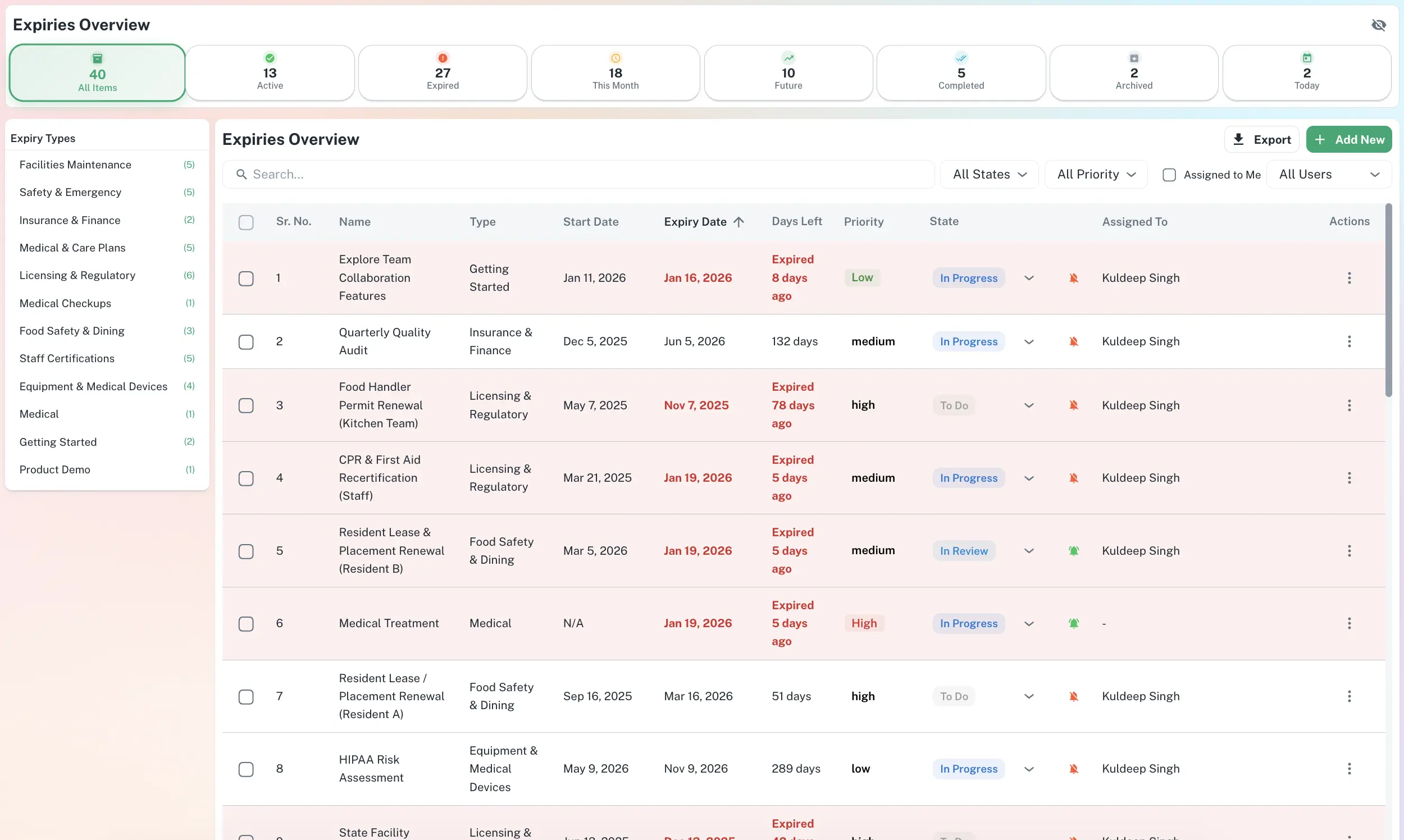
Facilities-management compliance software tracks the deadline, certificate and inspection layer across a property portfolio: gas safety, fire alarm and extinguisher servicing, EICR and PAT, lift inspections (LOLER / ASME A17.1), legionella and asbestos, and HVAC/TM44 cycles. ExpiryEdge fires the first alert 90 days before each certificate expires - enough lead time to book the engineer - stores every certificate against its record, and rolls each cycle up per building and per portfolio.
Why statutory inspections cannot live in a spreadsheet
Review regularly
ACOP L8 requires the legionella risk assessment to be reviewed regularly and whenever it may no longer be valid - a two-year cycle is industry convention, not statute; monitoring data retained 5 years.
Source: HSE ACOP L8 (UK)6 months
LOLER cycle for lift / hoist inspection in the UK; ASME A17.1 mandates state-regulated cycles in the U.S.
Source: HSE LOLER 1998 / ASME A17.194%
of spreadsheets in 85 intensive audits contained errors.
Source: Panko, University of Hawaii (spreadsheet-error research review)Three things facilities compliance needs that a CMMS does not deliver
The first reminder fires 90 days out - while the calendar is still open
Gas Safe engineers, certified electrical contractors, lift inspectors and legionella consultants book weeks ahead, especially in spring (insurance renewal season) and autumn (heating turn-on). The 90-day alert gives time to secure a slot, complete the inspection, and upload the new certificate with weeks of buffer.
First alert 90 days before each certificate expires
Reminders per inspection type, per building, per owner
New certificate re-arms the next cycle automatically
Every cycle tracked per building and rolled up per portfolio
A 12-building portfolio has 12 gas safety cycles, 12 EICR cycles, 12 fire alarm tests and 12 legionella plans - plus per-building asbestos registers and PAT schedules. ExpiryEdge tracks each cycle per building and aggregates the whole estate with filters by property, inspection type, owner or due date.
Per-building inspection records and status
Portfolio rollup across 10–500 sites
UK + US terminology and regulations side by side
Every certificate retrievable in under 60 seconds
Insurers, lenders, prospective tenants and inspectors want current evidence on request. Every certificate is stored against its inspection record - no email digs, no paper-file searches. Generate a property-by-property compliance report for a board review or an ISO 41001 audit in seconds, in CSV or PDF.
Certificate vault per inspection record
Insurance / lender / audit exports (CSV + PDF)
Vendor COIs tracked alongside the inspections
Six modules covering the facilities-compliance stack
Gas safety + fire safety inspection tracking
Electrical (EICR / NETA) + PAT testing
Lifts (LOLER / ASME A17.1)
Legionella, asbestos & water hygiene
HVAC, boiler & TM44 air conditioning
Insurance, lender & audit exports
Every kind of facilities operator with statutory obligations
Commercial property managers
Multi-building portfolios where a lapsed gas safety or EICR certificate can void insurance - each cycle tracked per building, rolled up per portfolio.
Multi-family / residential
Landlord obligations like the CP12 gas safety record, with personal director liability if a tenant is not provided a current certificate.
Corporate real estate / FM teams
In-house FM teams replacing inspection spreadsheets and feeding TM44, water and asbestos data into ESG, SFDR and CSRD reporting.
Healthcare estates
High-stakes statutory cycles across hospital estates where water hygiene, fire and electrical evidence must be inspector-ready at all times.
Education / university estates
Large multi-building estates with mixed-age stock, asbestos registers and re-survey schedules tracked per building.
Retail & hospitality estates
Multi-store and multi-location operators standardising inspection cadences and vendor COIs across every site.
ExpiryEdge vs CMMS platforms and enterprise IWMS
| ExpiryEdge | FMX | Limble | Planon | Spreadsheet | |
|---|---|---|---|---|---|
| Statutory inspection cycles (gas / fire / lifts / legionella) | Partial | Partial | Partial | ||
| Certificate vault per inspection record | Partial | ||||
| 90-day lead-time alerts to book engineers | Partial | Partial | |||
| Multi-site portfolio rollup | |||||
| UK + US terminology / regulations | Partial | Partial | Partial | ||
| PPM scheduling + work orders | Partial | ||||
| Pricing for 10–500 sites | Free | ||||
| Setup in under one week | Partial | Partial |
It varies by jurisdiction, but a typical stack across commercial property: annual gas safety inspection (CP12 in the UK; equivalent state requirements in the U.S.), EICR every 5 years (more frequent for high-use commercial), lift / elevator inspection every 6 months (LOLER UK; ASME A17.1 U.S.), fire alarm and extinguisher servicing on NFPA cycles, two-yearly legionella risk assessment (ACOP L8), and asbestos management plan reviews where pre-2000 building materials are present. ExpiryEdge ships with templates for each category.
FMX, Limble, and UpKeep are CMMS platforms - they focus on PPM work orders, asset maintenance, and inventory. Compliance is a secondary feature. Planon is an enterprise IWMS suite with deep facility-management capability but enterprise pricing. ExpiryEdge focuses on the deadline / certificate / inspection layer specifically - what is expiring, when the renewal window is, what evidence is on file. Most customers run ExpiryEdge alongside a CMMS for work-order management, or replace a heavier IWMS with it when compliance is the primary pain.
A lapsed gas safety certificate typically voids property insurance because most policies require a valid certificate to be in force. For landlords, failure to provide a current CP12 to tenants is a criminal offence with personal director liability in the UK. A lapsed EICR commonly results in insurers declining to renew until a valid report is produced - meaning the building can be operating effectively uninsured during the gap.
Set the first ExpiryEdge alert to 90 days before expiry. Gas Safe engineers, certified electrical contractors, lift inspectors, and legionella consultants are often booked weeks in advance - particularly in spring (insurance renewal season) and autumn (heating-system turn-on). The 90-day alert gives time to secure a slot, complete the inspection, and have the new certificate uploaded with weeks of buffer.
Yes. Each property is a node with its own inspection records, certificates, and status view. The aggregated dashboard shows the entire portfolio with filters by property, inspection type, owner, or due date. For multi-site operators (10+ buildings) this is where ExpiryEdge displaces both spreadsheets and the heavier FM platforms.
Yes. The platform is jurisdiction-aware: PPM, LOLER, CP12, EICR, ACOP L8 for the UK; NFPA, ASME A17.1, OSHA 1910, state Certificate of Occupancy cycles for the U.S. - plus Australian, Canadian, and EU equivalents where applicable. Templates can be customised per region.
Energy efficiency (TM44 / mech-vent inspections), water management (legionella records), waste handling (hazardous-material disposal), and asbestos management are increasingly fed into ESG, SFDR, and CSRD reports. Tracking them once in ExpiryEdge and exporting against multiple frameworks removes a major duplication of effort.
Every facilities vendor (cleaners, HVAC, lift maintenance, fire-safety, security) has its own COI. Send each one a document collection link - they upload the cert with no account required - and ExpiryEdge tracks it alongside the property inspections, with the same renewal cadence and evidence vault. When a vendor is on-site, the GC or property manager can verify current insurance in seconds.
Yes. Send a document collection link and the vendor opens it, uploads their certificate, fills in the policy details you require, and signs if needed - no login or account. If it is wrong or incomplete, reject the field with a comment and the same link reactivates so they fix only what is flagged.
Create one record per inspection type per building, each with its own interval, contractor and last certificate, so a missed check at one site is visible on its own rather than averaged into a portfolio. Required intervals depend on your jurisdiction and standards, so confirm them with your fire authority or competent person. ExpiryEdge reminds the site owner ahead of each visit, escalates overdue items, and keeps the service reports on the record for the next inspection or insurer review.
Every inspection scheduled. Every certificate on file. Every site ready for audit.
Free 14-day trial. UK + US regulatory templates. Multi-site portfolio rollup.

This guide is built from work with facilities managers across commercial real estate, multi-family residential, healthcare and education portfolios. It references NFPA life-safety code cycles, local fire-marshal inspection patterns, IFMA best practices and the recurring inspection cadences we observe across ExpiryEdge customer accounts. We refresh the page whenever the underlying codes or industry standards change.