
EPC for Landlords: 10-Year Rule, Band E Now and Band C by 2030

An EPC for landlords is the Energy Performance Certificate you must give every new tenant free of charge, valid for 10 years. In England and Wales a rental must be rated E or better unless an exemption is registered, with fines up to £5,000 per property. The government plans to raise the minimum to band C by 1 October 2030.
Most landlords with more than a few homes have the same mess: EPCs lodged in different years, a couple of exemptions registered in a hurry, and no idea which properties will need work before 2030. This guide covers the rules as they stand in October 2026, what's planned, and a one-afternoon audit you can do in a spreadsheet. One thing to get straight first: band C by 2030 is a plan, not law. Band E is what councils enforce today.
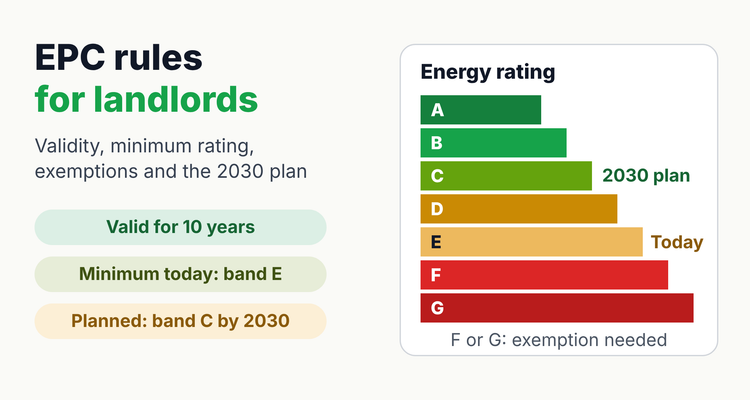 An EPC lasts 10 years. The rating it shows decides whether you can let the property.
What is an EPC for landlords, and how long is it valid?
An EPC rates a home's energy efficiency from A (best) to G and lists recommended improvements with indicative costs. It's valid for 10 years, or until a newer one is lodged for the same building, and you can reuse it for any number of lettings in that time. Look up any lodged certificate, with its expiry date, on the government's find an energy certificate service.
The duty to provide an EPC kicks in when you market or let a home. So under current rules an EPC that expires halfway through a tenancy doesn't have to be replaced on the spot. The government is still deciding whether to require a valid EPC throughout every tenancy. If yours has expired, get a new one before you next market the home or agree a new tenancy.
When must a landlord provide an EPC?
Give a valid EPC, free of charge, to anyone thinking of renting the home. Do it at the earliest opportunity, and no later than when you first send them written details or show them round. Whoever becomes the tenant must get their own free copy.
EPC duties when letting a home in England and Wales (as of October 2026)
| Duty | Deadline or rule | Penalty |
|---|---|---|
| Commission an EPC when you market the property | Use all reasonable efforts to get it within 7 days; a further 21 days is allowed if that fails | £200 penalty charge |
| Show the rating in adverts | Any advert in commercial media must state the rating, for example "C" | £200 per advert |
| Give it to prospective tenants | Earliest opportunity; no later than written information or a viewing | £200 penalty charge |
| Give it to the new tenant | Free of charge | £200 penalty charge |
| Show it to trading standards | Within 7 days of a request | Penalty charge notice |
| Meet the minimum rating (MEES) | E or better, or a registered exemption | Up to £5,000 per property |
Trading standards enforce the duty to provide an EPC; your local council enforces the minimum rating. Under current guidance, letting a single room doesn't need its own EPC, although the whole building needs one if it's sold or let as a whole. Letting rooms in a shared house? Read our HMO licence guide too.
What is the minimum EPC rating for a rental property?
The minimum is band E. The Minimum Energy Efficiency Standard (MEES) Regulations stopped new lettings of F and G properties from 1 April 2018, and all continuing lettings from 1 April 2020. They cover homes let on an assured, regulated or domestic agricultural tenancy that are legally required to have an EPC.
If your property is F or G, you must improve it to E or register an exemption before you let it. You never have to spend more than £3,500 including VAT, and money spent on recommended improvements since 1 October 2017 counts toward that cap. Work costs more than that? Make every improvement you can within £3,500, then register an "all relevant improvements made" exemption. If third-party funding covers the whole cost, the cap doesn't apply.
All of this applies to England and Wales, not the rest of the UK. Scotland runs its own scheme, so check gov.scot if you let there.
Which MEES exemptions can you register, and when do they expire?
Every exemption goes on the PRS Exemptions Register, and it only counts from the date you register it. Most of them expire after 5 years. Then you must try again to reach E or register a fresh exemption, which makes each exemption a deadline in its own right. Nobody sends you a reminder.
MEES exemptions for domestic landlords (as of October 2026)
| Exemption | When it applies | How long it lasts | Evidence to upload |
|---|---|---|---|
| All relevant improvements made | Still below E after spending up to £3,500, or no improvements possible | 5 years | Details and dates of improvements; any surveyor report used |
| High cost | The cheapest recommended measure costs more than £3,500 | 5 years | 3 quotes from qualified installers |
| Wall insulation | Only wall insulation is recommended and an expert says it would harm the building | 5 years | Written expert opinion |
| Third-party consent | Consent from a tenant, superior landlord, mortgage lender, freeholder or planners is refused | 5 years, or until the tenancy ends if the tenant refused | Correspondence or decision notice |
| Property devaluation | Improvements would cut market value by more than 5% | 5 years | Report from an independent RICS valuer |
| New landlord | You recently became the landlord in certain circumstances | 6 months | Date and circumstances |
⚠️What happens if you miss it: a council can serve a compliance notice up to 12 months after a suspected breach, and a penalty up to 18 months after it. Maximum penalties per property are £2,000 for letting a non-compliant home for under 3 months, £4,000 for 3 months or more, £1,000 for false information on the Exemptions Register and £2,000 for ignoring a compliance notice, capped at £5,000 per property in total. The council can also publish the breach on the public register for at least 12 months.
What is changing: will the EPC minimum rise to band C by 2030?
Yes, if Parliament approves it. In January 2026 the government confirmed it'll seek to amend the regulations so that every private tenancy in England and Wales meets a higher standard, equivalent to band C, by 1 October 2030. Until then, band E is the law.
EPC for landlords: current law vs the government's January 2026 plan
| Current law (October 2026) | Planned (subject to Parliamentary approval) | |
|---|---|---|
| Minimum standard | Band E | Band C equivalent, using new EPC metrics: a fabric performance standard plus either a heating system or smart readiness standard |
| Deadline | In force since 1 April 2020 | All tenancies by 1 October 2030 |
| Spending cap | £3,500 including VAT | £10,000 per property |
| Main exemptions | Mostly 5 years | Cost cap, property value and negative impacts exemptions: 10 years; others typically 5 |
| Maximum fine | £5,000 per property | £30,000 per property per breach |
| Early action | None | Homes rated C or above on the current scale (EER) before 1 October 2029 count as compliant until that EPC expires |
Two related reforms affect timing. Reformed EPCs with the new metrics were due from October 2026, but in March 2026 the government pushed their launch to the second half of 2027. It also plans to require an EPC at the point of marketing, and an EPC for a whole house in multiple occupation (HMO) when a single room is let. It wants the new regulations in force in 2027.
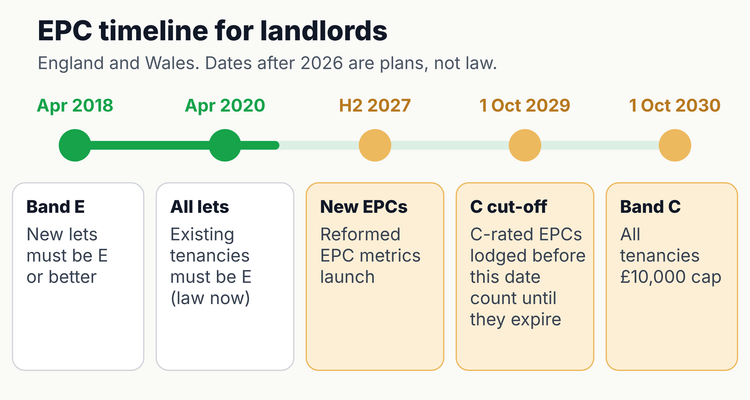 The EPC timeline for landlords in England and Wales. Dates after 2026 are government plans, not yet law.
Should you get a new EPC before October 2029?
Often, yes, if your home is close to C. Under the plan, a property rated C or above on the current scale before 1 October 2029 counts as compliant until that EPC expires, which can be up to 10 years later. Treat this as planning advice: the policy isn't law yet.
- Rated A to C now: note the expiry date. If it expires before October 2030, consider re-assessing before 1 October 2029.
- Rated D, with cheap measures listed: price the measures in the EPC recommendations. If they lift the rating to C, do the work and get a new EPC before 1 October 2029.
- Rated D or E, needing major work: plan it across the next void periods, and budget against the planned £10,000 cap.
- Rated F or G: you are breaching the current law unless an exemption is registered. Act now.
Worked example (illustrative). A flat rated D with a lodged date of 14 June 2021 has an EPC expiring on 14 June 2031. If loft insulation and low-energy lighting would lift it to C, doing that work and lodging a new C-rated EPC in, say, March 2029 would, under the plan, keep it compliant until March 2039.
How do you audit every EPC in your portfolio in one afternoon?
Look up each property on the official register, type one row per property into the layout below, and let the formulas sort your portfolio into act now, plan, and fine. Every EPC is searchable by postcode, so 30 properties take roughly 2 to 3 hours (our estimate).
- Search the register (about 3 minutes a property). Use the find an energy certificate service by postcode. Record the rating, lodged date, expiry date and potential rating.
- Check the Exemptions Register for any exemptions you hold, and note each registration date.
- Fill in the sheet, then sort by the status column so the worst homes sit right at the top.
- Act on F and G rows today: improve or register a valid exemption.
- Book assessors for D and E homes where the recommendations look cheap, so new EPCs can be lodged well before October 2029.
EPC audit spreadsheet layout
| Column | Heading | What to enter or formula |
|---|---|---|
| A | Property | Address and nation (England or Wales) |
| B | Current rating | Letter from the register, for example D |
| C | Lodged date | From the register |
| D | EPC expiry | =EDATE(C2,120) |
| E | Potential rating | From the recommendations |
| F | Status | =IF(OR(B2="F",B2="G"),"Below E: act now",IF(OR(B2="D",B2="E"),"Plan for C","C or better")) |
| G | Exemption registered | Date, or blank |
| H | Exemption expiry | =IF(G2="","",EDATE(G2,60)) |
| I | C before Oct 2029? | =IF(F2<>"C or better","No",IF(D2<DATE(2030,10,1),"Re-assess before 1 Oct 2029","Yes")) |
| J | Owner | Person responsible, plus a backup |
Then add conditional formatting (Excel: "Use a formula"; Google Sheets: "Custom formula is"):
- Red: =$F2="Below E: act now"
- Red: =AND($H2<>"",$H2-TODAY()<=90), exemption expiring within 90 days.
- Amber: =$D2-TODAY()<=180, EPC expiring within 6 months, so book an assessor before you next advertise.
💡 Pro Tip
Track each property as a group, with the EPC sitting alongside the gas safety record and EICR. And whatever tool you use, log every MEES exemption as its own dated item with an expiry 5 years out. Exemptions are the deadline most portfolios forget, because nobody sends a renewal notice.
How should you plan EPC upgrades?
- Start from the EPC recommendations. They list each measure, a rough cost and the resulting rating.
- Price up the cheapest measures first, and keep invoices: recommended work since 1 October 2017 counts toward the current cap.
- Check funding. The January 2026 government response pointed landlords to Warm Homes: Local Grants and the Boiler Upgrade Scheme, and said the zero rate of VAT on energy-saving materials will stay until March 2027.
- Schedule disruptive work in void periods, and get tenant consent in writing for anything during a tenancy.
- Re-assess after the work so the register shows the new rating.
Pair the EPC review with your other certificate dates: the gas safety check and the EICR often need the same access visits. Line them up in the same week and you only need to arrange access with your tenant once, rather than three times.
What are the most common EPC mistakes landlords make?
Common EPC mistakes and fixes
| Mistake | Fix |
|---|---|
| Advertising without the rating | Add the letter to every listing template |
| Letting an exemption lapse after 5 years | Track the exemption expiry date, not just the EPC expiry |
| Spending on measures not in the EPC recommendations | Pick measures from the recommendations, or you may not qualify for an exemption |
| Assuming an old C rating protects you forever | Under the plan, a C counts only until that EPC expires |
| Waiting for 2030 | Re-assess homes near C before 1 October 2029 |
Spreadsheet or software: how should you track EPCs?
With a handful of homes, one EPC every 10 years per property is easy to track in a spreadsheet. It gets harder once you add 5-year exemptions, the October 2029 cut-off, gas checks every 12 months and EICRs every 5 years, across dozens of properties and several staff. A tool earns its place when reminders must reach whoever books the assessor, and when you need an audit trail for a council compliance notice.
ExpiryEdge holds each EPC and exemption as a record with an owner, a backup and reminders at 90, 60, 30 and 7 days. See our letting agent compliance page for the full set of landlord certificates. If you prefer a spreadsheet, the free landlord compliance tracker already has EPC columns.
Frequently asked questions
How long is an EPC valid for a rental property?
An EPC is valid for 10 years, or until a newer EPC is produced for the same building. You can reuse it for any number of lettings in that time, and you can check its expiry date on the government's find an energy certificate service by searching the postcode.
What is the minimum EPC rating for a rental property?
In England and Wales the minimum is band E. Since 1 April 2020 you cannot let, or continue to let, a covered property rated F or G unless a valid exemption is registered on the PRS Exemptions Register.
Will landlords need an EPC rating of C by 2030?
That is the government's plan. Its January 2026 response says all private tenancies must meet a band C equivalent by 1 October 2030, subject to Parliamentary approval. Until new regulations are made, band E remains the legal minimum.
What is the fine for not having an EPC as a landlord?
Failing to provide an EPC, or to show the rating in an advert, can bring a £200 penalty charge each time. Letting a home below band E without an exemption can bring penalties of up to £5,000 per property in total.
How long does a MEES exemption last?
Most MEES exemptions last 5 years, after which you must try again to reach band E or register a new exemption. The new-landlord exemption lasts 6 months, and a tenant-consent exemption can end when that tenancy ends.
Do I need a new EPC when my tenant renews?
Not if the current EPC is still valid, because one EPC covers any number of lettings for 10 years. If it has expired, the safest course is to commission a new one before agreeing a new tenancy, since the government has not yet finished reviewing when a valid EPC must be held.
Sources
- Domestic private rented property: minimum energy efficiency standard, landlord guidance (DESNZ, updated 5 May 2026)
- A guide to energy performance certificates for the marketing, sale and let of dwellings, GOV.UK
- Energy Performance of Buildings (England and Wales) Regulations 2012, regulations 6 and 38, legislation.gov.uk
- Energy Efficiency (Private Rented Property) (England and Wales) Regulations 2015, regulations 23 and 40, legislation.gov.uk
- Improving the energy performance of privately rented homes: government response (DESNZ, 21 January 2026)
- Reforms to the Energy Performance of Buildings regime: partial government response (updated 9 March 2026)
- Find an energy certificate, GOV.UK
Last reviewed: 12 October 2026
Frequently asked questions
In England and Wales the minimum is band E. Since 1 April 2020 you cannot let, or continue to let, a covered property rated F or G unless a valid exemption is registered on the PRS Exemptions Register.
That is the government's plan. Its January 2026 response says all private tenancies must meet a band C equivalent by 1 October 2030, subject to Parliamentary approval. Until new regulations are made, band E remains the legal minimum.
Failing to provide an EPC, or to show the rating in an advert, can bring a £200 penalty charge each time. Letting a home below band E without an exemption can bring penalties of up to £5,000 per property in total.
Most MEES exemptions last 5 years, after which you must try again to reach band E or register a new exemption. The new-landlord exemption lasts 6 months, and a tenant-consent exemption can end when that tenancy ends.
Not if the current EPC is still valid, because one EPC covers any number of lettings for 10 years. If it has expired, the safest course is to commission a new one before agreeing a new tenancy, since the government has not yet finished reviewing when a valid EPC must be held.