
Assisted living compliance: caregivers, residents and the building, on one list.
An assisted living community runs on three kinds of deadline: credentials held by each caregiver, assessments and plans owed to each resident, and drills and inspections owed by the building. ExpiryEdge gives each one a record with a due date, an owner, a backup and the proof, and reminds them at 90, 60, 30 and 7 days, so the administrator sees what is coming before a surveyor does.
Last updated · ExpiryEdge editorial team
Assisted living compliance, organized the way surveyors check it
Caregiver credentials and training tracked per person
Assessments, service plans and evacuation evaluations per resident
Fire drills and system inspections per building
Daily, weekly, admission and survey-prep checklists that repeat
Quick answer
Assisted living compliance means meeting your state licensing rule every day, not only on survey day. States, not the federal government, license assisted living, so list every recurring duty in your state rule and fire code: caregiver credentials, resident assessments and service plans, fire drills and system inspections. Give each one a due date, an owner, proof and a reminder. ExpiryEdge holds those records, repeats annual cycles automatically and sends reminders at 90, 60, 30 and 7 days.
What an assisted living community keeps current
CNA and medication aide registry listings
Caregiver background checks and TB screening
CPR, first aid, fire safety and dementia training
Resident assessments and service plan reviews
Evacuation capability evaluations per resident
Medication regimen reviews and cart audits
Fire, disaster and elopement drills
Fire alarm, sprinkler and extinguisher inspections
Kitchen hood suppression and generator service
Facility license, postings and survey corrections
Resident satisfaction surveys and rate notices
Home care agency license and staff files
Recurring assisted living deadlines: a sourced reference (last verified 12 Oct 2026)
| How often or by when | Where this rule applies | Official source | |
|---|---|---|---|
| Who licenses assisted living | Each state; there is no federal assisted living license | All states have at least one category of residential care | HHS ASPE, Compendium of Residential Care and Assisted Living Regulations (2015) |
| Caregiver background check | At hire and every 4 years after | Wisconsin CBRFs (example) | Wis. Admin. Code DHS 83.17(1) |
| Tuberculosis screening | Within 90 days before the start of employment | Wisconsin CBRFs (example) | Wis. Admin. Code DHS 83.17(2)(a) |
| Fire safety, first aid and choking training | Within 90 days after starting employment | Wisconsin CBRFs (example) | Wis. Admin. Code DHS 83.20(2)(b)-(c) |
| CNA registry status | Paid nursing work at least once in every 24 months, or retrain or retest | Federal rule for certified nursing homes; states run the registries | 42 CFR 483.35(d)(6) |
| Resident assessment | Before admission, at a change in condition, and at least annually | Wisconsin CBRFs (example) | Wis. Admin. Code DHS 83.35(1)(a) |
| Individual service plan | Within 30 days after admission; review annually or at a change | Wisconsin CBRFs (example) | Wis. Admin. Code DHS 83.35(3) |
| Evacuation capability evaluation | Within 3 days of admission; update at least annually | Wisconsin CBRFs (example) | Wis. Admin. Code DHS 83.35(5) |
| Resident satisfaction evaluation | At least annually | Wisconsin CBRFs (example) | Wis. Admin. Code DHS 83.35(4) |
| Medication regimen review | Within 30 days of admission, at a significant change, and at least every 12 months | Wisconsin CBRFs (example) | Wis. Admin. Code DHS 83.37(1)(e) |
| Fire drills (board and care) | At least 6 a year, every 2 months, with at least 2 at night while residents sleep | Where NFPA 101 board-and-care rules apply | NFPA 101, as published by the Kansas State Fire Marshal (Form 802) |
| Fire drills (Wisconsin) | At least quarterly, plus 1 a year simulating sleeping hours | Wisconsin CBRFs | Wis. Admin. Code DHS 83.47(2)(d) |
| Disaster evacuation drills | At least semi-annually | Wisconsin CBRFs (example) | Wis. Admin. Code DHS 83.47(2)(e) |
| Fire inspection by the fire authority | Annually; keep reports for 2 years | Wisconsin CBRFs (example) | Wis. Admin. Code DHS 83.47(3) |
| Fire alarm system | Visual check twice a year; full inspection and test yearly | NFPA 72 (2010), the edition CMS references; confirm your local code | Minnesota Dept. of Health summary of NFPA 72 |
| Sprinkler system | Valves and gauges monthly; full service yearly; internal pipe check every 5 years | NFPA 25 (2011); confirm your local code | Minnesota Dept. of Health summary of NFPA 25 |
| Kitchen hood suppression | Inspect monthly; service every 6 months | NFPA 17A (2009) and NFPA 96 (2011); confirm your local code | Minnesota Dept. of Health summary |
| Emergency generator | Inspect weekly; run diesel sets under load monthly for at least 30 minutes | NFPA 110 (2010); confirm your local code | Minnesota Dept. of Health summary of NFPA 110 |
| State licensing inspection | Georgia: unannounced, about every 11 to 15 months. Florida: relicensure biennially, unannounced | Georgia personal care homes and assisted living; Florida ALFs | Georgia DCH HFR; Fla. Stat. s. 408.811 |
| Correcting survey deficiencies | Georgia: plan within 10 days. Florida: correct within 30 calendar days. Wisconsin: 45 days to correct | Georgia personal care homes; Florida ALFs; Wisconsin CBRFs | Ga. Comp. R. & Regs. 111-8-62-.11; Fla. Stat. s. 408.811; Wisconsin DHS survey guide |
Set up assisted living compliance tracking yourself this week
List every recurring duty from your own state rule
Open your state's assisted living or residential care rule and ask your local fire authority which fire code edition it enforces. Search the rule for "days", "annually", "quarterly" and "months", and copy every sentence with a deadline into a list with its section number. Sort the list into four groups: caregivers, residents, building, and license and postings. The reference table above shows what to look for.
One line per duty, with the rule section beside it
Mark which duties repeat per caregiver and which per resident
Add vendor services your fire authority checks, such as hood and sprinkler service
Build a ten-column tracker with three formulas
Use one row per duty per person, resident or system, with columns for item, person or resident, rule section, last done, next due, days left, status, owner, backup and where the proof is filed. Three formulas do the date work in Excel or Google Sheets. The 42-day "call ahead" window is our advice, not a rule: it gives time to book a class or a vendor.
Next due: =EDATE(D2,12) for annual items, =EDATE(D2,3) for quarterly drills, =EDATE(D2,48) for a 4-year check
Days left: =E2-TODAY()
Status: =IF(J2="","NO PROOF",IF(F2<0,"OVERDUE",IF(F2<=42,"CALL AHEAD","OK")))
Color the status column and sort by days left
Let admissions, new hires and move-outs create the dates
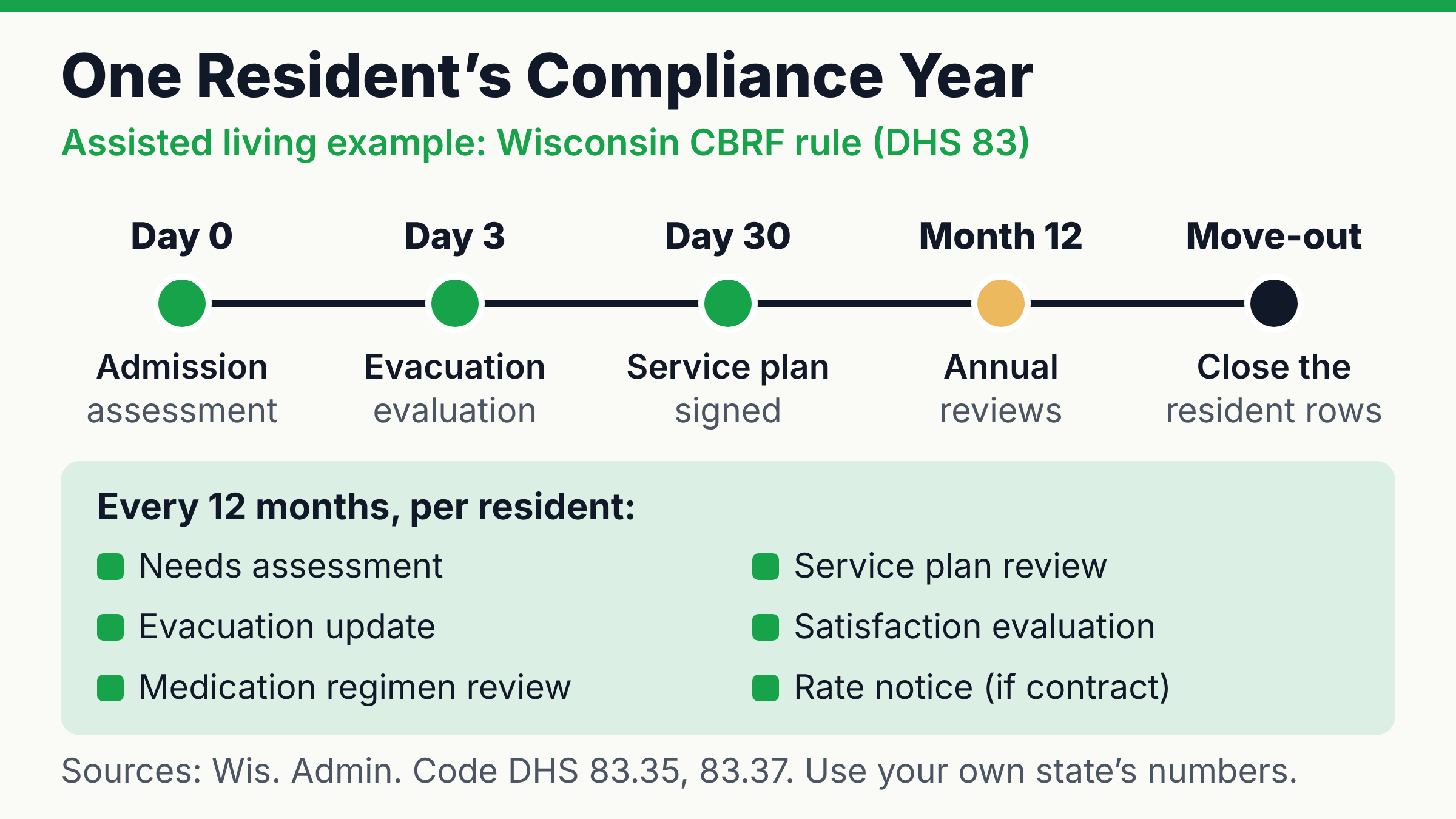
Most gaps start at a change: a new resident, a new caregiver, a resident who moves out. Add a step to each of those checklists that writes the rows. One assisted living operator we work with adds each new resident's annual cycle on admission (care plan, evacuation assessment, satisfaction survey and rate increase notice) and has a step in the weekly check-in to remove records for residents who have moved out.
Admission: assessment, service plan, evacuation evaluation and annual review rows
New hire: registry listing, CPR and first aid, and training due within your state's window
Move-out: close that resident's rows the same week
Look at the list every day and call ahead 4 to 6 weeks
A tracker only works if someone opens it. The executive director of one memory care community we work with reviews the compliance list every morning, completes anything overdue and calls ahead on anything due in the next 4 to 6 weeks. Add a weekly 10-minute check-in where each owner reads out only their overdue and call-ahead items.
Daily: overdue items first, then the next 6 weeks
Weekly: owners report red and amber items only
Twice a year: run your survey-prep checklist against real files
Caregivers, residents and the building, each with their own records
Registry listings, CPR and training against each caregiver
Hold each CNA or medication aide listing, CPR card, background check and training record against the person, with the document attached. New hires upload their certificates through a document request link with no login. Reminders go to the caregiver and the office lead together at 90, 60, 30 and 7 days, so a class can be booked before the card runs out.
One record per credential, per state
Document requests to new hires and agency staff
Caregiver and office lead reminded together
Per-resident cycles that repeat, and checklists that run every day
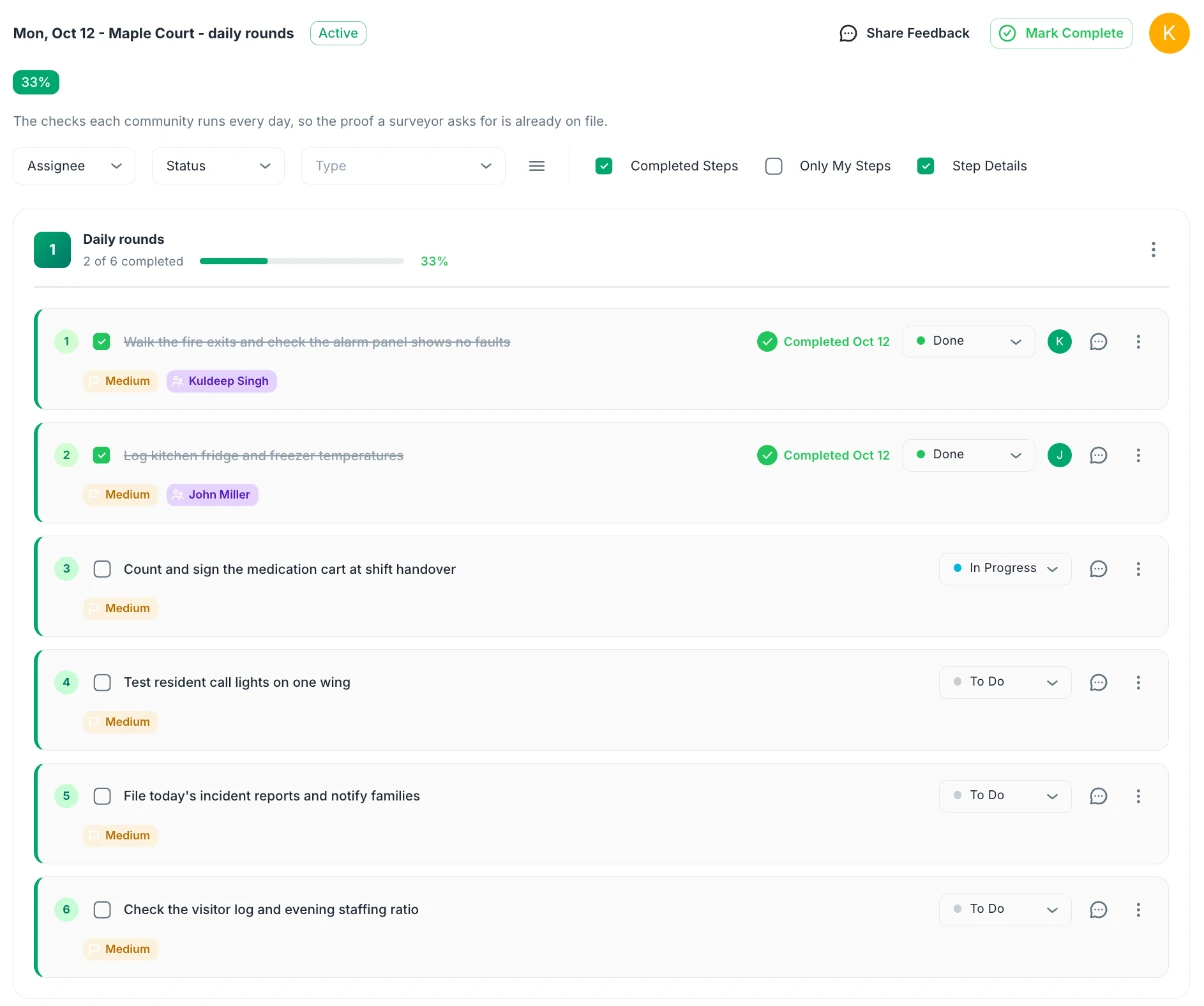
Set each resident's annual assessment, service plan review, evacuation evaluation and satisfaction survey as recurring records: when one is completed, the next is created as a copy with a new due date. Daily, weekly, admission, new-hire and survey-prep routines run as reusable checklists with steps, owners and progress, one copy per community.
Recurring records for annual and per-resident cycles
Reusable checklists, including a full survey-prep list
Separate copies per community, one dashboard
The proof a surveyor asks for, already on the record
Every completed drill, inspection report, renewal and reminder is timestamped. When a surveyor asks for the drill log, a caregiver's training or a resident's last evacuation evaluation, filter by community, person or resident and export the history as CSV, PDF or XLSX.
Timestamped audit trail for every record
Export by community, caregiver or resident
Escalation to the administrator when a date passes
Spreadsheet or software? When the spreadsheet is enough
One home, stable staff and one person who opens it every week: a spreadsheet is enough
It fails when that person is away or leaves, because nobody else looks
It cannot remind the caregiver whose card is due, only whoever reads it
It cannot show a surveyor who checked what, and when
ExpiryEdge vs a spreadsheet vs a calendar
| ExpiryEdge | Spreadsheet | Calendar | |
|---|---|---|---|
| Credentials tracked per caregiver | Manual | ||
| Per-resident annual cycles that repeat | Manual | Partial | |
| Reminders to the caregiver and the office lead | Manual | ||
| Daily, weekly and survey-prep checklists | Manual | ||
| Escalation when a date passes | |||
| Roll-up across communities | Manual | ||
| Timestamped audit trail and export | |||
| Cost | 14-day free trial, then paid | Free | Free |
What changes for the administrator
CNA dates in one spreadsheet, CPR cards in a drawer, service plan reviews remembered by the nurse, the drill log in a binder and the sprinkler report in last year's email. The first full picture appears when surveyors ask for it.
Every caregiver credential, resident cycle and building check sits on one dashboard with its proof. The administrator reviews it each morning and calls ahead on anything due in 4 to 6 weeks, and anything overdue escalates automatically.
Who uses it in assisted living and home care
Administrators and executive directors
Hold the license and answer to the surveyor, and want one daily list of what is overdue and what is coming in the next six weeks.
Office and HR leads
Run new-hire paperwork, registry checks, background checks and training dates for every caregiver.
Resident care leads and nurses
Keep assessments, service plans, evacuation evaluations and medication reviews on time for every resident.
Maintenance leads
Schedule drills and vendor inspections, and attach the log or report to each one.
Multi-community operators
See every community on one screen and use the same checklists in each.
Home care agency owners
Track the agency license and every caregiver's credentials, even when staff never come to the office.
Assisted living compliance means meeting the licensing rule of the state you operate in, every day. Residential care settings are licensed and regulated at the state level, so the rules on staff training, resident assessments, medication and fire safety differ by state. Most of the work is recurring: dated tasks per caregiver, per resident and per building that must be done and documented on time.
It holds each recurring duty as a record with a due date, an owner, a backup and the proof, and sends reminders before the date. Good tools also repeat annual cycles automatically, run daily and survey-prep checklists, and keep a timestamped history you can export for a surveyor. It does not replace your state rule, your care records system or your pharmacy; it makes sure the dated tasks around them happen.
It depends on the state. Georgia runs unannounced compliance inspections approximately every 11 to 15 months or as needed, and Florida conducts relicensure inspections biennially, with all inspections unannounced except as specified. Wisconsin surveys may be announced or unannounced. Plan as if the next survey could come tomorrow.
Track two dates per aide: the expiry date on the state nurse aide registry and the date of their last paid nursing work, because federal rules require retraining or retesting after 24 consecutive months without paid nursing work. Check the registry, not the wallet card, and start reminders 90 days out. Our free CNA certification tracker template does the date maths for you.
Fire drills, fire alarm and sprinkler inspections, extinguisher service, kitchen hood suppression service, generator tests and the annual fire inspection all recur. Where NFPA 101 board-and-care rules apply, drills are needed at least six times a year with two at night; Wisconsin CBRFs drill at least quarterly. Ask your fire authority which code edition it enforces.
Yes, for one home with stable staff and one person who opens the sheet every week. Use one row per duty per person or resident, an EDATE formula for the next due date and a status column. It starts to fail with several communities, staff turnover, or when you must prove to a surveyor who checked what and when.
Create the resident's recurring rows on the day of admission: assessment, service plan review, evacuation evaluation and satisfaction survey, plus any rate notice your contract requires. When one is completed, set the next due date straight away. Close all of that resident's rows in the week they move out, so the list only shows real work.
HHS ASPE: Compendium of Residential Care and Assisted Living Regulations
Wisconsin Administrative Code ch. DHS 83 (CBRFs)
42 CFR 483.35: nurse aide 24-month rule
Kansas State Fire Marshal: assisted living fire drill form (NFPA 101)
Minnesota Dept. of Health: life safety code inspection summaries
Georgia DCH: Personal Care Homes (inspection frequency)
Florida Statutes s. 408.811: inspections and corrections
Wisconsin DHS: assisted living survey guide
Every caregiver, resident and building deadline on one list
Import your tracker, attach the proof, and let reminders reach the right person at 90, 60, 30 and 7 days. Free 14-day trial, no credit card.