Assisted Living Survey Checklist: 50 Items and a 90-Day Plan

An assisted living survey checklist lists the records, postings and building conditions that state surveyors check, often without notice. Group it into seven areas: license and postings, staff files, resident files, medication, fire safety, environment and food, and policies. In seven of the eight states compared below, the law sets a routine survey every 12 to 24 months.
"Surveyors could walk in any day, and I don't know what's out of date." Sound familiar? Below you'll find all 50 items, your state's survey schedule and correction deadlines, and a 90-day plan that needs nothing more than a printer and a pen. Correction clocks are short (Georgia wants a plan of correction within 10 days), so the work pays off before the surveyor even arrives.
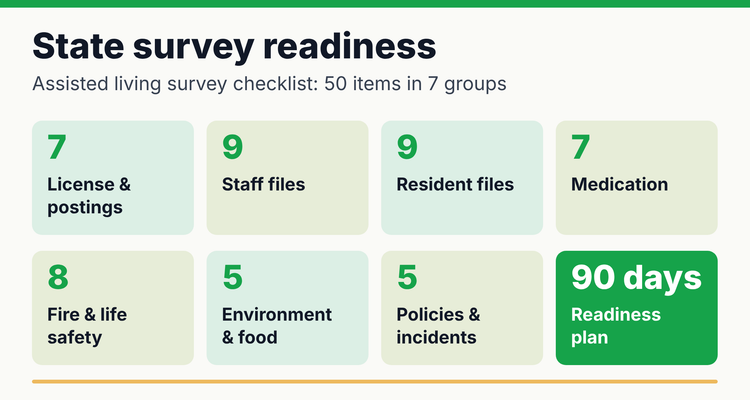 The 50-item assisted living survey checklist, grouped into the seven areas surveyors review.
How often are assisted living facilities surveyed?
It depends on your state. Pennsylvania's floor is once every 12 months; Florida, Minnesota and Texas allow up to 2 years, and Wisconsin sets no fixed interval at all. We pulled frequency, notice and correction deadlines for eight states straight from each state's own statute or rule. Find your state and check the date of your last visit.
Assisted living survey frequency by state (last verified 12 Oct 2026)
| State and agency | Routine survey | Notice | After deficiencies | Official rule |
|---|---|---|---|---|
| Florida: Agency for Health Care Administration | Biennial relicensure inspection, unless otherwise specified | Unannounced, except as specified | Correct within 30 calendar days; plan within 10 calendar days if required | Fla. Stat. 408.811 and 429.34 |
| Georgia: Healthcare Facility Regulation (personal care homes, assisted living communities) | Approximately every 11 to 15 months, or as needed | Unannounced | Plan of correction within 10 days of receiving the report | Ga. Comp. R. & Regs. 111-8-62-.11, 111-8-63-.10 |
| Minnesota: Department of Health | At least once every 2 years | Without advance notice | Comply by the correction order date; follow-up survey within 90 days for level 3 to 5 violations | Minn. Stat. 144G.30 |
| North Carolina: Division of Health Service Regulation (adult care homes) | Annually (can be waived, but at least every 2 years); life safety every 2 years | Subject to inspection at all times | No day count in the statute; follow the notice | N.C. Gen. Stat. 131D-2.11 |
| Pennsylvania: Department of Human Services (assisted living residences) | At least once every 12 months | Announced or unannounced | Written plan to correct each item in an acceptable period | 55 Pa. Code 20.31, 20.33, 20.52, 2800.11 |
| Texas: Health and Human Services Commission | At least every 2 years | Not stated in the statute | Plan of correction by the 10th working day after the final statement of violations | Tex. Health & Safety Code 247.027, 247.0271 |
| Washington: Department of Social and Health Services | At least every 18 months (average 15); up to 24 after 3 clean inspections | Unannounced allowed at any time | Written notice of violations; follow its deadlines | RCW 18.20.110 |
| Wisconsin: Division of Quality Assurance (community-based residential facilities, CBRFs) | No fixed interval; as the department deems necessary | Announced and unannounced | Correct internally within 45 days; no routine plan | Wis. Stat. 50.03(2); DHS survey guide |
Official rules:
- Florida: s. 408.811 and s. 429.34
- Georgia: DCH Personal Care Home Program, rule 111-8-62 and rule 111-8-63
- Minnesota: s. 144G.30
- North Carolina: G.S. 131D-2.11
- Pennsylvania: 55 Pa. Code ch. 20 and s. 2800.11
- Texas: Health and Safety Code ch. 247
- Washington: RCW 18.20.110
- Wisconsin: Wis. Stat. 50.03 and the DHS survey guide
But don't plan around the calendar in the statute alone. In September 2026, Minnesota's Legislative Auditor found the health department "has not inspected assisted living facilities as frequently as required by law" (summary). And a single complaint can bring a surveyor to your door any day. For license terms in the same states, see our guide to assisted living regulations by state.
What do surveyors check? The full assisted living survey checklist
Surveyors check whether your paperwork, postings and daily practice match your state rule. Wisconsin's survey guide describes the visit plainly: the surveyor hands over "A list of documents needed for review," tours the building, interviews people in private, reads records and safety code items, then holds an exit conference.
Most of the day counts below come from Wisconsin's DHS 83, because it spells them out. Where your state sets a different deadline, use your state's number on the sheet.
1. License and postings (7 items)
License and postings
- ✓
Current license posted in a public area, with capacity and class matching your actual census and services
- ✓
Latest statement of deficiency (SOD) and any enforcement notice posted (Wisconsin: an SOD stays posted for 90 days)
- ✓
Most recent inspection report and plan of correction displayed where residents and visitors see notices (Georgia personal care homes)
- ✓
Resident rights, house rules and grievance procedure posted
- ✓
Long-term care ombudsman poster posted, with the office's name, address and phone number
- ✓
Activity schedule posted
- ✓
Copy of your state's assisted living rule kept on site (Wisconsin requires a copy of DHS 83 in the CBRF)
2. Staff files (9 items)
Staff files
- ✓
Written job description in every employee file
- ✓
Caregiver background check at hire, and repeated on your state's cycle (Wisconsin: at hire and every 4 years)
- ✓
Tuberculosis (TB) screening documented before hire (Wisconsin: within 90 days before the start of employment)
- ✓
Standard precautions training completed before any task with exposure to body fluids
- ✓
Fire safety training completed (Wisconsin: within 90 days of starting)
- ✓
First aid and choking training completed (Wisconsin: within 90 days of starting)
- ✓
Medication administration training completed before the employee passes medications, with trainer approval number recorded where required
- ✓
Registered nurse (RN) delegation records on file for delegated tasks, where your state uses delegation
- ✓
Certified nursing assistant (CNA) or certified medication aide (CMA) registry status checked and expiry dates logged
For staff licenses and credentials, see CNA license renewal requirements and tracking.
3. Resident files (9 items)
Resident files
- ✓
Pre-admission assessment, updated at least annually and after any change in condition (Wisconsin)
- ✓
Physician report or physical exam on file (Georgia personal care homes: dated within 30 days before admission)
- ✓
Temporary service plan written on admission
- ✓
Individual service plan completed (Wisconsin: within 30 days after admission), signed by the resident or representative
- ✓
Service plan reviewed annually or at a change in condition, with the review documented
- ✓
Evacuation capability assessment (Wisconsin: within 3 days of admission, updated at least annually)
- ✓
Current medication list with dose, directions and changes in condition
- ✓
Advance directives, guardianship or power of attorney papers on file where applicable
- ✓
Annual resident satisfaction evaluation offered (Wisconsin CBRFs)
4. Medication (7 items)
Medication
- ✓
Medication cart and room audit: locked, clean, labeled and organized by resident
- ✓
Expired, discontinued and recalled medications pulled and destroyed under your written disposal policy
- ✓
Discontinued medications not held past your state's limit (Wisconsin: no more than 30 days without a new order or pharmacist request)
- ✓
Controlled substances stored in a separate locked compartment
- ✓
Controlled-substance count sheets complete, signed and reconciled, with every discrepancy investigated
- ✓
Medication administration records (MARs) match current orders, with no blank doses
- ✓
Pharmacist or physician medication regimen review on file (Wisconsin: around admission, after significant changes and at least every 12 months)
5. Fire and life safety (8 items)
Fire and life safety
- ✓
Fire drill log with date, time and total evacuation time (Wisconsin: at least quarterly)
- ✓
At least one drill a year that simulates sleeping-hours conditions with overnight staff (Wisconsin)
- ✓
Tornado, flood or other disaster drills logged (Wisconsin: at least semi-annually)
- ✓
Annual fire inspection report by the local fire authority, kept for 2 years (Wisconsin)
- ✓
Fire extinguishers inspected annually by a qualified professional, with a dated tag on each (Wisconsin)
- ✓
Smoke detector tests logged (Wisconsin: not less than once every other month) and sprinkler inspection reports filed
- ✓
Kitchen hood suppression inspection report current under your fire code
- ✓
Exits and corridors clear, exit diagram posted and emergency numbers posted near staff phones
Drill rules differ by state; see our assisted living fire drill requirements guide. Read each extinguisher tag in person; the log can be wrong.
6. Environment and food (5 items)
Environment and food
- ✓
Hot water temperatures checked and logged at resident taps (Georgia personal care homes: not over 120 degrees Fahrenheit)
- ✓
Food temperature logs complete for cooking, holding and refrigeration
- ✓
Food stored off the floor, covered, labeled and dated, with nothing past its use-by date
- ✓
Weekly menus written and available to residents, and dated menus kept (Wisconsin: 60 days)
- ✓
Chemicals and hazardous materials stored securely, with no trip, burn or entrapment hazards on the tour route
7. Policies and incidents (5 items)
Policies and incidents
- ✓
Policies and procedures reviewed and dated, matching the current version of your state rule
- ✓
Incident reports complete, each with an investigation and follow-up action
- ✓
Self-reports to the state agency filed, with copies accessible on survey day
- ✓
Grievance log with a written summary of findings and action for each grievance (Wisconsin)
- ✓
Records kept for your state's retention period (Wisconsin: 2 years general, 7 years resident, 3 years employee)
Do this now: a 90-day survey readiness plan with no software
Run a 3-hour gap audit this week. Fix the causes in month one, hold a mock survey in month two, re-check in month three. All you need is the printed checklist, a pen and a calendar. (The times are our estimates for a single building.)
Days 1 to 7: run the 3-hour gap audit
- Print the checklist (15 minutes) as a score sheet: items down the side, files 1 to 5 across the top.
- Pull 5 staff files (5 minutes): a hire from the last 90 days, a night or weekend worker, a long-serving employee and 2 at random.
- Pull 5 resident files (5 minutes): your newest admission, a recent change in condition, a resident of over a year and 2 at random.
- Score every file (90 minutes). Mark each item yes or no; anything you can't find in 5 minutes counts as no.
- Walk the building (45 minutes): postings, med cart and controlled-substance count, drill log, extinguisher tags, hot water at two taps, fridge dates and exits.
- Find the patterns (20 minutes). An item that fails in 2 or more of 5 files is a process gap, not a filing slip. Give each an owner and a fix date.
Example (illustrative): 3 of your 5 staff files have no first aid date. Book it today. Then add "first aid booked in week 1" to the new-hire checklist so the next file doesn't come up blank.
Days 8 to 30: fix the system, not just the files
- Name an owner and a backup for each group, such as the office lead for staff files and the maintenance lead for fire safety.
- Build a tracker (layout below) and load the audit failures first.
- Clear every red item and file dated proof, such as a signed training sheet.
- Book a 10-minute weekly check-in where owners read out only overdue and due-soon items.
Days 31 to 60: run a mock survey
- Swap with an administrator from another home. An outsider spots the things your team walks past every day.
- Have them interview 2 staff and 2 willing residents: where is a service plan kept, what happens if the fire alarm sounds at night, who do you tell about a fall?
- Log every finding with an owner and a fix date.
Days 61 to 90: lock it in
- Re-audit every failed item with a fresh sample of files.
- Brief night and weekend staff on the survey-day script below.
- Stock the survey binder, newest record on top of each tab.
- Then repeat: spot-check 5 files a week and re-score all 50 items every quarter.
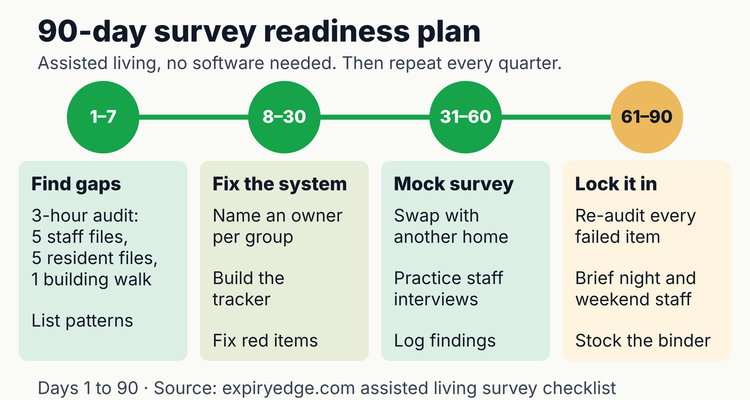 The 90-day survey readiness plan. Free to embed with a link back to this page.
How can you make survey day less stressful?
Decide now who does what in the first 15 minutes, and rehearse it. This is our advice rather than a regulatory script. Tape it to the reception desk.
- Minute 0: whoever answers the door signs the surveyors in and shows them to a quiet room picked in advance.
- Minutes 0 to 2: call the administrator, or the backup named on the shift sheet.
- Minutes 2 to 5: hand over the ten-tab binder, plus today's census and staff schedule.
- Minutes 5 to 10: take the document list and name one runner who logs every request. Florida requires copies of required records during an inspection, so keep a copier free.
- Minutes 10 to 15: brief the floor in one sentence. "Surveyors are here; keep care normal, answer honestly, and if you don't know, say where you'd find it."
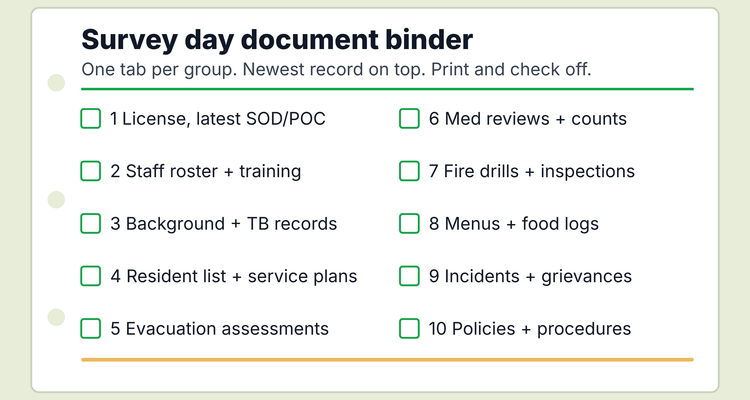 A ten-tab survey day binder: print it, check each tab and keep the newest record on top.
Two habits make the visit calmer.
- Take notes at the exit conference. Wisconsin calls the statement of deficiency (SOD) "a legal record," so check its wording.
- Fix what you can on the day, such as a blocked exit, and record when.
What happens if the survey finds deficiencies?
The state sends a written statement of deficiencies. You then correct each one by the state's deadline, and many states also want a written plan of correction. Put those dates in the calendar the day the report lands, not the day before they're due.
Georgia's rule says the plan "must identify the specific actions the home will take promptly", and the home must then check whether those actions worked. A plan that just says "retrained staff" won't survive that test. For each deficiency, write down the fix for the cited case, who else could have the same gap, the step you changed, how you'll monitor it (say, 5 files a week for 4 weeks) and where the proof lives.
⚠️What happens if you miss it: in Florida, an assisted living facility cited for a class I violation, or three or more class II violations in the circumstances the statute describes, must get an additional licensure inspection within 6 months. In Texas, many violations corrected within 45 days of notice escape an administrative penalty; miss that date and you lose the protection. In Wisconsin, failure to correct a violation could result in additional sanctions and a revisit can carry a $200 fee in some situations.
Spreadsheet or software?
A spreadsheet is fine for one building with a stable team, as long as somebody actually opens it every week. It takes about 20 minutes to build:
- Columns: A Item, B Person, C Rule, D Last done, E Next due, F Days left, G Status, H Owner, I Backup, J Proof location.
- Next due: =EDATE(D2,12) for annual items or =EDATE(D2,3) for quarterly drills. Days left: =E2-TODAY()
- Status: =IF(OR(J2="",F2<0),"RED",IF(F2<=30,"AMBER","GREEN")). Red means overdue or no proof; amber means due within 30 days.
Or skip the build: the free survey readiness checklist has all 50 items with owners, status, a dashboard and a printable PDF, no sign-up.
Spreadsheets break down in predictable places. You add a second home. The person who built it leaves. Reminders need to reach the night nurse, not just the office. Or a surveyor asks you to prove a check happened on time. That's where a tool earns its keep. In ExpiryEdge, each item is a record with an owner and a backup; reminders go out 90, 60, 30 and 7 days ahead by email, SMS, Slack or Teams, and the audit trail shows who completed what and when. For the wider picture, see our assisted living compliance guide.
💡 Pro Tip
Run the full checklist twice a year, and add a short weekly check that removes records for residents who have moved out. It works on paper too: put both dates in the calendar now. Pick weeks when your full day team is on shift.
Frequently asked questions
How often are assisted living facilities surveyed?
It depends on your state. Pennsylvania inspects at least every 12 months, North Carolina annually, Georgia about every 11 to 15 months and Washington at least every 18 months. Florida, Minnesota and Texas set at least every 2 years; Wisconsin sets no fixed interval.
Are assisted living state surveys unannounced?
Often, yes. Florida law says all inspections shall be unannounced except as specified, Minnesota surveys come without advance notice, and Georgia's compliance inspections are unannounced. Plan as if the next one will come without warning.
How can I find out what is out of date before a survey?
Pull 5 staff files and 5 resident files, score each one against the checklist, then walk the building. Budget about 3 hours. If an item fails in 2 or more files, you've found a process gap rather than a filing slip, so fix the process.
What is a mock survey in assisted living?
A mock survey is a practice run in which someone who doesn't own an area checks it the way a state surveyor would: records, postings, a building walk and a few staff interviews. Swapping with an administrator from another home works well, because an outsider notices what your own team has stopped seeing.
How long do you have to fix survey deficiencies?
It depends on the state. Florida requires correction within 30 calendar days and Wisconsin allows 45 days to correct internally. Georgia requires a written plan of correction within 10 days of receiving the report, and Texas by the 10th working day.
Is there a free assisted living survey checklist I can print?
Yes. Our free survey readiness checklist has the same 50 items in Excel, Google Sheets and a two-page printable PDF, with an owner, evidence location and status per item. No sign-up is needed.
Sources
State rules for each table row are linked under the survey table. Also used:
Frequently asked questions
Often, yes. Florida law says all inspections shall be unannounced except as specified. Minnesota surveys come with no advance notice, and Georgia doesn't warn you before its compliance inspections either. So plan as if the next one will show up without warning.
Pull 5 staff files and 5 resident files, score each one against the checklist, then walk the building. Budget about 3 hours. If an item fails in 2 or more files, you've found a process gap rather than a filing slip, so fix the process.
A mock survey is a practice run in which someone who doesn't own an area checks it the way a state surveyor would: records, postings, a building walk and a few staff interviews. Swapping with an administrator from another home works well, because an outsider notices what your own team has stopped seeing.
It depends on the state. Florida requires correction within 30 calendar days and Wisconsin allows 45 days to correct internally. Georgia requires a written plan of correction within 10 days of receiving the report, and Texas by the 10th working day.
Yes. Our free survey readiness checklist has the same 50 items in Excel, Google Sheets and a two-page printable PDF, with an owner, evidence location and status per item. No sign-up is needed.