
Home Care Agency License: 6-State Renewal Guide and Tracker

A home care agency license is a state permit to provide care in clients' homes. Each state decides which services need one: some license only medical home health, while others also license non-medical personal care. Terms run from up to one year in Minnesota to 2 years in California and Florida and 3 years in Texas.
You run a home care agency, or plan to, and need to know which license you need, when it renews and what happens to caregivers' credentials in between. State rules are spread across statutes, codes and agency pages, and many guides online are written to sell licensing services. This guide compares six states from the official texts and gives you a renewal tracker you can build today.
Key takeaways
- There is no federal home care agency license. Medicare only requires that "if state or local law provides licensing of HHAs, the HHA must be licensed" (42 CFR 484.100).
- Medical and non-medical care are often licensed separately: California licenses non-medical home care organizations through its Department of Social Services, and Florida registers companion and homemaker services instead of licensing them.
- Texas uses one license for home health, hospice, habilitation and personal assistance services. It expires 3 years after issue.
- Renewal windows are fixed: Florida wants renewals 60 to 120 days before expiry, and Pennsylvania at least 60 days before.
- Caregiver credentials run on separate clocks: a California home care aide registration lasts 2 years, and Texas requires an annual registry search for every employee.
- Since September 2025, giving personal assistance services to an assisted living resident in Texas without the required license is a criminal offense.
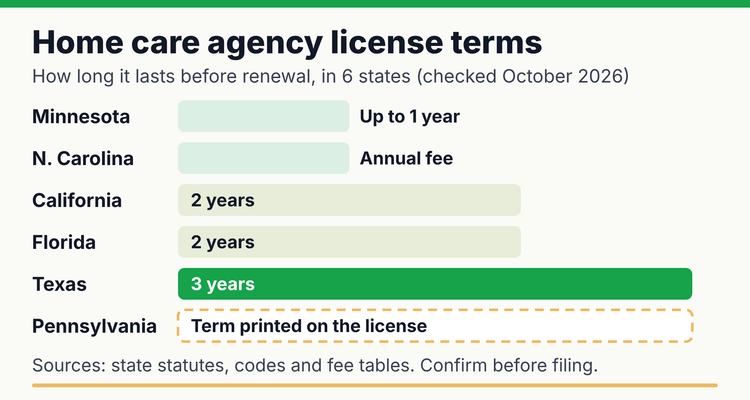 How long a home care agency license lasts in six states, from the official statutes, codes and agency fee tables (checked 12 October 2026).
What is a home care agency license?
It is the state's permission to send staff into clients' homes for the services named on the license. The license usually lists the agency's name, the services it may provide, the premises it operates from and an expiry date. Florida, for example, says a license issued on or after 1 July 2018 "must specify the home health services the licensee or registrant is authorized to perform".
Medicare and Medicaid sit on top of state licensing, not instead of it. A Medicare-certified home health agency (HHA) must follow its state license law, and its aides must meet federal training rules: at least 75 hours of training, including 16 hours of supervised practical training, and 12 hours of in-service training in each 12-month period (42 CFR 484.80).
Do you need a license for non-medical home care?
In many states, yes, but the license type depends on the state. Non-medical care means help with bathing, dressing, meals and companionship, without skilled nursing or therapy. Here is how four of our six states handle it:
- California: non-medical agencies need a Home Care Organization (HCO) license from the Department of Social Services, and their aides must be on the state Home Care Aide Registry.
- Florida: a provider offering only companion or homemaker services is "exempt from licensure" but "must register" with the Agency for Health Care Administration (AHCA). Home health services need a home health agency license.
- North Carolina: licensed "home care services" include "in-home aide services that involve hands-on care", so hands-on personal care needs a home care license.
- Pennsylvania: home care agencies and home care registries need a Department of Health license under 28 Pa. Code chapter 611. Their "home care services" include personal care, companionship and respite care.
Texas folds personal assistance services into the same agency license as home health, and Minnesota issues "a basic or comprehensive home care license" depending on the services provided.
Home care agency license requirements in 6 states
The table compares license type, regulator, term and fees in six states. Each row comes from the state's own statute, code or fee page, checked on 12 October 2026. Confirm with your regulator before you file.
Home care agency licensing in 6 states (last verified 12 October 2026)
| State | License and regulator | What it covers | Term and renewal | Fee (official figure) |
|---|---|---|---|---|
| California | Home Care Organization license; Department of Social Services, Home Care Services Branch | Aides helping clients with activities of daily living at home; aides listed on the Home Care Aide Registry | 2 years; aide registration also 2 years | $5,603 per 2-year license; $35 per aide registration |
| Florida | Home health agency license; Agency for Health Care Administration (AHCA) | Home health services named on the license; companion and homemaker providers register instead | Biennial; renewal received 60 to 120 days before expiry; $50 a day late fee (capped) | Companion or homemaker registration: $50 per biennium |
| Minnesota | Basic or comprehensive home care license; Minnesota Department of Health | Home care services at the licensed level | Valid for up to 1 year; new providers start on a temporary license | Not checked for this guide |
| North Carolina | Home care agency license; state Department under N.C. Gen. Stat. 131E-138 | Nursing, therapy and in-home aide services involving hands-on care | Renewed under Medical Care Commission rules | $510 nonrefundable annual license fee |
| Pennsylvania | Home care agency or home care registry license; Department of Health (28 Pa. Code ch. 611) | Personal care, help with daily tasks, companionship, respite and specialized care | Term shown on the license; renewal form at least 60 days before expiry; inspection before renewal | $100 application or renewal fee |
| Texas | Home and community support services agency (HCSSA) license; Health and Human Services Commission | Home health, hospice, habilitation and personal assistance services | Expires 3 years after issue | Set by rule between $600 and $2,625 |
Official sources for each row:
- California: CDSS Home Care Services, application fees and the Home Care Aide Registry
- Florida: s. 400.464, s. 400.509 and s. 408.806
- Minnesota: s. 144A.473 and s. 144A.43
- North Carolina: G.S. 131E-136 and G.S. 131E-138
- Pennsylvania: 28 Pa. Code ch. 611
- Texas: Health and Safety Code ch. 142
Running a residential setting as well? See our assisted living regulations by state guide for facility licenses.
How do you renew a home care agency license on time?
Work back from the expiry date on the license, not from a reminder the state may or may not send. The steps below take about 2 hours a year, plus document gathering (our estimate).
- Record the exact expiry date and license number from the certificate, one row per licensed location (Pennsylvania licenses each physical location separately).
- Work out the filing window. In Florida, the window opens 120 days and closes 60 days before expiry; in Pennsylvania, file at least 60 days before.
- Check what has changed since the last renewal: owners, administrator, address, services offered. Some states want these reported as they happen; Texas, for example, requires certain application changes to be reported for a fee of up to $50.
- Collect the renewal pack: application, fee, insurance certificates, policies, staff roster and any accreditation documents.
- Run a mock file review of 5 caregiver files before the renewal inspection (Pennsylvania inspects before renewing).
- File, pay, save the receipt and the confirmation in one folder, and diarise a follow-up call if nothing arrives within 30 days.
- Put the new license up where your state requires it and enter the next expiry date straight away.
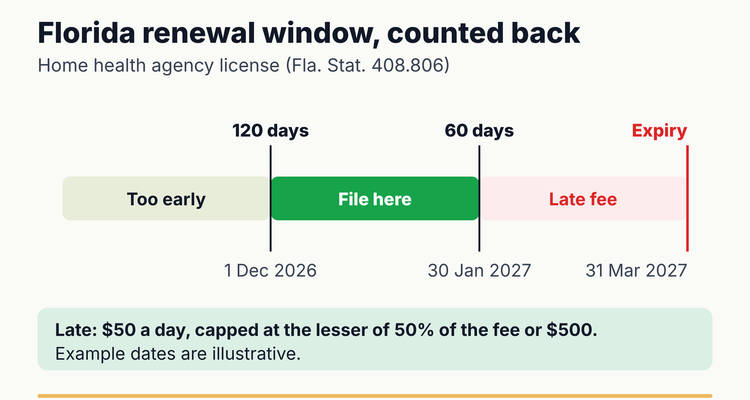 Count back from the expiry date: in Florida the renewal application must arrive between 120 and 60 days before it.
Do this now: a license and credential tracker
Track the agency license and every caregiver credential in one sheet with the window dates calculated for you. Setup takes about 30 minutes.
- Columns: A Item (license or credential), B Person or location, C Expires, D Window opens (days before), E Window closes (days before), F Opens on, G Closes on, H Days to close, I Status, J Owner, K Backup.
- Opens on: =C2-D2 Closes on: =C2-E2
- Days to close: =G2-TODAY()
- Status: =IF(TODAY()<F2,"WAIT",IF(H2<0,"LATE",IF(H2<=14,"FILE NOW","OPEN")))
- For items with no window, set D and E to your own lead time, such as 60 and 30.
Worked example (illustrative)
Say a Florida home health agency license expires on 31 March 2027. Enter 120 in D and 60 in E. The window opens on 1 December 2026 and closes on 30 January 2027. On 16 January 2027, status turns to FILE NOW.
Which staff credentials belong in the tracker?
Caregiver credential clocks for home care agencies
| Credential or check | Cycle | Rule |
|---|---|---|
| California home care aide registration | 2 years; renew on or before expiry | CDSS Home Care Aide Registry |
| Texas employee misconduct and nurse aide registry search | Before hire, then annually | Health and Safety Code 253.008 |
| Florida level 2 background screening | Before contact; rescreen every 5 years | Fla. Stat. 400.512, 408.809 |
| Pennsylvania criminal history report | Obtained at application or within 1 year before | 28 Pa. Code ch. 611 |
| Medicare home health aide in-service | 12 hours each 12 months | 42 CFR 484.80(d) |
| Medicare aide supervision (skilled patients) | Supervisory assessment at least every 14 days | 42 CFR 484.80(h) |
| CNA registry status | Usually every 2 years | State nurse aide registry |
For new hires, our caregiver onboarding checklist puts each pre-hire and first-90-day item on a timeline. For aides who hold a CNA, see CNA license renewal requirements.
How can you make license renewals painless?
Treat the renewal as a year-round habit, not a once-a-cycle scramble. These are practical suggestions, not legal requirements.
- Keep a standing renewal folder per location and drop documents in as they change, such as insurance renewals and policy updates.
- Name a backup for the license owner, so a holiday or resignation does not stall a filing.
- Review two caregiver files a week instead of all of them before inspection.
- Log every regulator email or notice with the date and the action taken.
- Before adding a service, such as medication help or skilled nursing, check whether your license names it.
What happens if your home care license lapses?
⚠️What happens if you miss it: in Florida, providing or advertising services not specified on the face of the license is unlicensed activity (Fla. Stat. 400.464), and a late renewal costs $50 a day, capped at 50% of the license fee or $500, whichever is less (s. 408.806). In Pennsylvania, no one may operate a home care agency or registry "without first having obtained a license" (28 Pa. Code 611.2). In Texas, a person required to hold a license who gives personal assistance services to an assisted living resident without it commits a Class A misdemeanor, or a third-degree felony after a previous conviction (Health and Safety Code 142.00605, effective 1 September 2025).
Spreadsheet or software?
One location with a handful of caregivers can run on the spreadsheet above, if one person checks it every week. It gets fragile with several locations, high turnover, or caregivers whose credentials expire on different cycles in different states. A spreadsheet also cannot chase a caregiver for a renewed card.
ExpiryEdge holds the license and each credential as a record with an owner and a backup, and sends reminders at 90, 60, 30 and 7 days by email, SMS, Slack or Teams. Document requests let caregivers upload renewed cards themselves, and the audit trail shows a surveyor when each item was checked.
💡 Pro Tip
Operators we work with often put the license renewal itself into a short reusable checklist: confirm the window, gather documents, submit and pay, save the receipt, upload a photo of the new license where it is posted. Writing the steps down once means anyone on the team can run the next renewal.
For the full set of deadlines in care settings, see our assisted living compliance guide.
Frequently asked questions
Do I need a license to start a non-medical home care agency?
In many states, yes. California requires a Home Care Organization license, North Carolina licenses in-home aide services involving hands-on care, and Pennsylvania licenses home care agencies and registries. Florida instead requires companion and homemaker providers to register with AHCA.
How long is a home care agency license valid?
It depends on the state. Minnesota licenses are valid for up to one year, California and Florida licenses for 2 years, and Texas licenses expire 3 years after issue. Pennsylvania prints the term on the license.
When should I submit my home care license renewal?
Follow your state's window. Florida requires the application to arrive 60 to 120 days before expiry and charges a daily late fee after that, and Pennsylvania requires the renewal form at least 60 days before expiry.
What is the difference between a home health agency and a home care agency?
A home health agency provides skilled services such as nursing and therapy and may be Medicare-certified. A home care agency usually provides non-medical personal care and companionship. States license them differently: Florida, for example, licenses home health agencies but only registers companion and homemaker providers.
Does Medicare require a state home care license?
Medicare requires a home health agency to be licensed if state or local law provides licensing of HHAs (42 CFR 484.100). Medicare does not issue licenses itself.
How do I keep caregiver credentials current?
Give every credential an expiry or recheck date the day you file it, assign an owner, and review the list weekly. Examples: California aide registrations last 2 years, Texas registry searches repeat annually, and Florida level 2 screening repeats every 5 years.
Sources
- 42 CFR 484.100, compliance with federal, state and local laws (eCFR)
- 42 CFR 484.80, home health aide services (eCFR)
- California DSS, Home Care Services
- California DSS, Home Care Services application fees
- California DSS, Home Care Aide Registry
- Florida Statutes s. 400.464, home health agency licensure
- Florida Statutes s. 400.509, companion and homemaker registration
- Florida Statutes s. 408.806, license application process
- Florida Statutes s. 408.809, background screening
- Minnesota Statutes s. 144A.473, temporary license and renewal
- Minnesota Statutes s. 144A.43, definitions
- North Carolina G.S. 131E-136, definitions
- North Carolina G.S. 131E-138, licensure requirements
- 28 Pa. Code ch. 611, home care agencies and home care registries
- Texas Health and Safety Code ch. 142, home and community support services
- Texas Health and Safety Code ch. 253, employee misconduct registry
- Last reviewed: 12 October 2026
Frequently asked questions
It depends on the state. Minnesota licenses are valid for up to one year, California and Florida licenses for 2 years, and Texas licenses expire 3 years after issue. Pennsylvania prints the term on the license.
Follow your state's window. Florida requires the application to arrive 60 to 120 days before expiry and charges a daily late fee after that, and Pennsylvania requires the renewal form at least 60 days before expiry.
A home health agency provides skilled services such as nursing and therapy and may be Medicare-certified. A home care agency usually provides non-medical personal care and companionship. States license them differently: Florida, for example, licenses home health agencies but only registers companion and homemaker providers.
Medicare requires a home health agency to be licensed if state or local law provides licensing of HHAs (42 CFR 484.100). Medicare does not issue licenses itself.
Give every credential an expiry or recheck date the day you file it, assign an owner, and review the list weekly. Examples: California aide registrations last 2 years, Texas registry searches repeat annually, and Florida level 2 screening repeats every 5 years.
Not medical, clinical, or HIPAA compliance advice
This article is for general informational purposes and does not constitute clinical or HIPAA compliance advice. ExpiryEdge is not currently a HIPAA Business Associate. Healthcare organisations handling Protected Health Information should review the specifics of their compliance programme with a qualified privacy officer or HIPAA consultant.


