
Caregiver Onboarding Checklist: Pre-Hire to Day 90 Deadlines

A caregiver onboarding checklist lists every task from job offer to day 90. It covers background and registry checks before the first shift, Form I-9 within 3 business days, tuberculosis (TB) screening, orientation before any duties, state-required training by its deadline, a competency sign-off and a dated record of each item that later expires.
New caregivers start fast because shifts need covering, and paperwork gets finished "later". Then a surveyor pulls the file of someone hired eight weeks ago and finds no first aid course and no TB result. This checklist puts every item on a dated timeline, with the deadlines from federal rules and four state examples, so nothing is left to memory.
Key takeaways
- Some checks must be done before the first shift. Florida says an employer "may not hire" or allow contact with vulnerable people until level 2 screening is complete.
- Form I-9: the employee completes Section 1 at the time of hire, and you complete Section 2 within 3 business days of the hire (8 CFR 274a.2).
- CDC says all health care personnel should have baseline TB screening, but not routine annual testing without a known exposure or ongoing transmission.
- State training clocks differ: Wisconsin allows 90 days for fire safety and first aid, while Pennsylvania wants first aid and CPR before any direct care.
- Several onboarding items expire: background checks (every 4 years in Wisconsin, 5 in Florida), Texas registry searches (annually) and bloodborne pathogens training (annually).
- Excluded individuals matter: no federal health care program pays for services furnished by someone on the OIG exclusion list, and the list updates monthly.
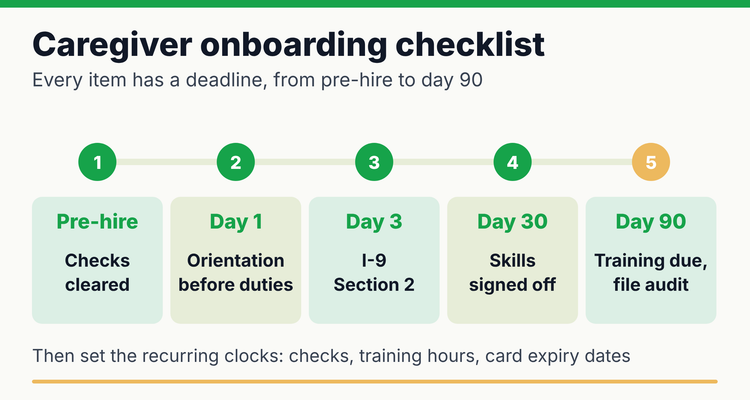 Every onboarding item has a deadline: before the offer, before the first shift, within days, within 90 days, or on a recurring cycle.
What should a caregiver onboarding checklist include?
It should include every pre-hire check, every first-week task and every training item your state sets a deadline for, plus the dates on which each item next expires. Start with the federal clocks that apply to most employers, then add your state's rule.
Federal onboarding clocks for caregivers (last verified 12 October 2026)
| Item | Deadline | Who it applies to | Rule |
|---|---|---|---|
| Form I-9, Section 1 | At the time of hire | Every new employee | 8 CFR 274a.2(b)(1)(i) |
| Form I-9, Section 2 | Within 3 business days of the hire | The employer | 8 CFR 274a.2(b)(1)(ii) |
| OIG exclusion check | Before hire (advice); the list updates monthly | Providers paid by Medicare or Medicaid | OIG exclusions FAQ |
| Bloodborne pathogens training | At initial assignment, then at least annually | Employees with occupational exposure | 29 CFR 1910.1030(g)(2) |
| Hepatitis B vaccination offered | Within 10 working days of initial assignment, after training | Employees with occupational exposure | 29 CFR 1910.1030(f)(2) |
| Baseline TB screening | On hire, with an individual risk assessment | Health care personnel (CDC recommendation) | CDC MMWR 2019;68(19) |
| Home health aide training | 75 hours, including 16 hours supervised practical, before aide work; 12 hours in-service each 12 months | Medicare-certified home health agencies | 42 CFR 484.80 |
State rules then add their own clocks. The table below shows four assisted living rules and one home care worker rule, each quoted from the official text.
State onboarding clocks: five examples (last verified 12 October 2026)
| State and setting | Before the first shift | Early deadlines | Recurring |
|---|---|---|---|
| Wisconsin CBRF (DHS 83) | Background check; TB screening within 90 days before start; orientation before any job duties | Fire safety, first aid and choking, resident rights, client group and challenging behaviors training within 90 days; direct supervision until all training is done | Background check every 4 years; 15 hours of continuing education per calendar year |
| Pennsylvania assisted living residence (55 Pa. Code 2800.65) | Fire safety orientation before or during the first work day; first aid and CPR certification before direct care | Orientation within 40 scheduled working hours; 18 hours of training before unsupervised work | At least 16 hours of annual training |
| Florida ALF (Fla. Stat. 429.52, ch. 435) | Level 2 screening complete; preservice orientation of at least 2 hours before interacting with residents (staff without core training) | 6 hours of extra training before helping with self-administered medicines | Level 2 rescreening every 5 years; 2 hours medication CE a year |
| Texas ALF or home care agency (HSC 253.008) | Search the employee misconduct registry and the nurse aide registry | None stated in this section | Search both registries annually |
| Washington long-term care workers (RCW 74.39A.074) | 5 hours (2 orientation, 3 safety) before giving care | 75 hours of entry-level training within 120 calendar days of hire | Set by other rules; check your license type |
For the wider set of rules your building follows, see our assisted living regulations by state guide.
Caregiver onboarding checklist: from offer to day 90
Work through these six phases in order. Each item carries the deadline from the tables above, or a suggested time where no rule sets one.
1. Before the offer is final
- ✓
Criminal background check started under your state's process (fingerprints where required)
- ✓
State registry searches done, such as the nurse aide registry and, in Texas, the employee misconduct registry
- ✓
OIG exclusion list (LEIE) searched and the result saved with the date
- ✓
Credentials verified at the source: CNA or medication aide status on the state registry, not just a copy of a card
- ✓
References and employment history checked
2. Before the first shift
- ✓
Background check cleared, where your state requires it before contact (Florida: before any contact with vulnerable persons)
- ✓
TB screening documented (Wisconsin: within 90 days before the start of employment)
- ✓
Form I-9 Section 1 completed by the employee at the time of hire
- ✓
Orientation completed: job duties, abuse and neglect reporting, emergency plan, residents they will care for
- ✓
First aid and CPR on file, if your state requires it before direct care (Pennsylvania)
3. Days 1 to 3
- ✓
Form I-9 Section 2 completed within 3 business days of the hire
- ✓
Bloodborne pathogens training before any task with exposure; hepatitis B vaccine offered within 10 working days
- ✓
Buddy shifts scheduled with a named mentor (advice)
- ✓
Personnel file opened with a job description and start date
4. Weeks 1 to 4
- ✓
Hands-on skills shown, practised under supervision, then signed off (bathing, transfers, toileting, meals)
- ✓
Medication training finished before any medication duties
- ✓
Short check-in at the end of week 1 and week 4: what is unclear, what is going well (advice)
5. Days 30 to 90
- ✓
Every state training item done by its deadline (Wisconsin: 90 days; Washington: 75 hours within 120 days)
- ✓
Competency checklist reviewed and signed by a supervisor
- ✓
Day-90 file audit: every item present, dated and signed
6. Set up the recurring clocks
- ✓
Next background check date entered (Wisconsin: 4 years; Florida: 5 years)
- ✓
Annual training hours target and due date entered
- ✓
Expiry dates entered for CPR, first aid, CNA or medication aide status and any driving documents
- ✓
Annual registry search date entered (Texas)
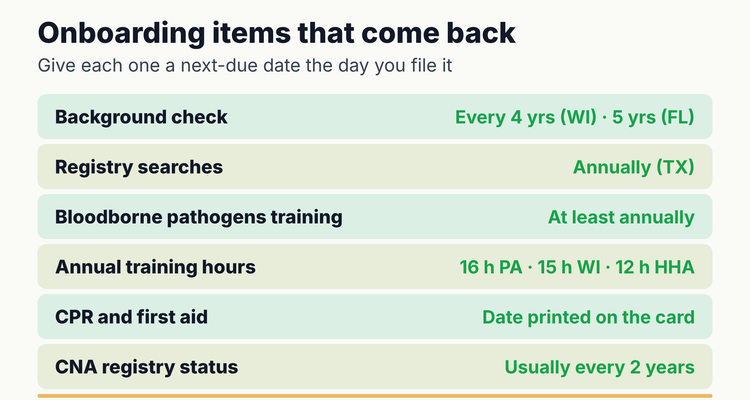 Onboarding is not finished on day 90: these items come back on their own clocks.
Which caregiver onboarding items expire?
Background checks, registry searches, annual training and certifications all expire or repeat, so each needs a next-due date on the day you file it. The table shows the cycle where a rule sets one.
Items that come back after onboarding
| Item | Cycle | Example rule |
|---|---|---|
| Criminal background check | Every 4 years (Wisconsin); every 5 years (Florida) | DHS 83.17(1); Fla. Stat. 408.809(2) |
| Registry searches | Annually (Texas) | Health and Safety Code 253.008(c) |
| Bloodborne pathogens training | At least annually | 29 CFR 1910.1030(g)(2) |
| Annual training hours | 16 hours a year (Pennsylvania); 15 per calendar year (Wisconsin); 12 per 12 months (home health aides) | 55 Pa. Code 2800.65(h); DHS 83.25; 42 CFR 484.80(d) |
| TB re-screening | Based on exposure risk, not routinely each year | DHS 83.17(2)(b); CDC 2019 |
| CNA registry status | Usually every 2 years; see your state | State nurse aide registry |
| CPR and first aid | The expiry date printed on the card | Your training provider |
CNA renewals have their own federal 24-month rule. Our guide to CNA license renewal requirements covers it state by state.
Do this now: a new-hire tracker you can build in 20 minutes
Use one row per hire per item, with the due date worked out from the hire date. It needs no software beyond a spreadsheet.
- Columns: A Employee, B Hire date, C Item, D Days from hire (use a negative number for "before start"), E Due date, F Done date, G Days left, H Status, I Proof location.
- Due date: =B2+D2
- Days left: =IF(F2<>"","",E2-TODAY())
- Status: =IF(F2<>"","DONE",IF(G2<0,"OVERDUE",IF(G2<=14,"DUE SOON","OPEN")))
- Template rows to copy for each hire: TB screening -90, orientation 0, I-9 Section 2 3 (count business days by hand or use =WORKDAY(B2,3)), hepatitis B offer 14 (10 working days, checked by hand), fire safety 90, first aid 90.
Worked example (illustrative)
Say a Wisconsin CBRF hires a caregiver who starts on Monday 2 November 2026. Fire safety and first aid are due by 31 January 2027 (=B2+90). I-9 Section 2 is due by Thursday 5 November (=WORKDAY(B2,3)). The background check is next due on 2 November 2030, four years after the check done at hire.
A 30-minute audit of your current files
- Pull the files of everyone hired in the last 90 days (5 minutes).
- Score each against phases 1 to 3 above: present, dated, signed (15 minutes).
- List any missing item with an owner and a date in the tracker (10 minutes).
How can you make onboarding better, not just compliant?
Caregivers who know who to ask and what good looks like settle in faster. These steps go beyond the rules (advice, not requirements).
- Give every new hire one named mentor for their first two weeks of shifts.
- Use observe, assist, do with the mentor present, then do alone, for each hands-on skill.
- Book a 15-minute check-in at day 7, day 30 and day 90, and write down one fix from each.
- Ask leavers in their first 90 days why they left, and track the answers.
- Keep a one-page "where things are" sheet: forms, supplies, on-call numbers, the incident form.
What happens if you miss an onboarding deadline?
⚠️What happens if you miss it: in Florida, an employer may not hire or allow contact with vulnerable persons until screening is complete. In Texas, a facility may not employ a person listed in either registry as having abused, neglected or exploited a person in care. OIG says no federal health care program will pay for items or services furnished by an excluded individual, and that ban reaches anyone who employs them. In Wisconsin, an employee who has not finished required training must be directly supervised.
Staff files are one of the first things surveyors review. Our assisted living survey checklist lists the staff-file items they check.
Spreadsheet or software?
A spreadsheet works for a small team with steady hiring and one person who updates it every week. It breaks when hiring is constant, when you run more than one site, or when nobody notices the row that turned red. Spreadsheets also cannot send reminders to the caregiver whose card is about to expire.
That is where software earns its place. ExpiryEdge holds each credential as a record with an owner and a backup, sends reminders at 90, 60, 30 and 7 days by email, SMS, Slack or Teams, and can send a document request so staff upload their own renewed card or e-sign an acknowledgment, such as the employee handbook or a care policy, from their phone.
💡 Pro Tip
Operators we work with often build their new-hire checklist with a step that says: if this caregiver has no fire safety or first aid course yet, add a reminder for 60 days from hire. Another common step adds a reminder one year from hire for the annual medication skills check. Both work just as well as calendar entries.
For every other deadline your community tracks, see our assisted living compliance guide.
Frequently asked questions
What should be on a caregiver onboarding checklist?
Pre-hire background and registry checks, Form I-9, TB screening, orientation, required state training with its deadline, a supervised competency sign-off and the next-due date for every item that expires. Group them by phase: before the offer, before the first shift, days 1 to 3, weeks 1 to 4 and days 30 to 90.
Can a caregiver start work before the background check clears?
It depends on your state and the role. Florida says an employer may not hire or allow contact with vulnerable persons until level 2 screening is complete, and Texas requires registry searches before hiring. Check your state rule before scheduling a first shift.
Do caregivers need a TB test every year?
Not routinely, under CDC's 2019 recommendations for health care personnel: baseline screening on hire, then testing after a known exposure or ongoing transmission. Your state may set its own rule; Wisconsin, for example, requires re-screening based on the likelihood of exposure.
How long do new caregivers have to finish training?
It varies. Wisconsin CBRFs allow 90 days for fire safety, first aid and several other courses, Washington allows 120 days for 75 hours of entry-level training, and Pennsylvania requires first aid and CPR before any direct care.
When is Form I-9 due for a new caregiver?
The employee completes Section 1 at the time of hire, and the employer completes Section 2 within 3 business days of the hire, under 8 CFR 274a.2. For a job lasting less than 3 business days, both must be done at the time of hire.
How often should you recheck caregiver backgrounds?
Follow your state's cycle: every 4 years in Wisconsin CBRFs and every 5 years for Florida level 2 screening. Texas requires an annual search of the employee misconduct and nurse aide registries.
Sources
- 8 CFR 274a.2, verification of identity and employment authorization (eCFR)
- 29 CFR 1910.1030, OSHA bloodborne pathogens standard (eCFR)
- CDC, Tuberculosis Screening, Testing, and Treatment of U.S. Health Care Personnel, MMWR 2019;68(19)
- HHS OIG, Exclusions FAQ
- 42 CFR 484.80, home health aide services (eCFR)
- Wisconsin DHS 83.17 to 83.20, hiring, orientation and approved training
- Wisconsin DHS 83.21 to 83.25, all-employee training and continuing education
- 55 Pa. Code 2800.65, staff orientation and training
- Florida Statutes s. 429.52, staff training
- Florida Statutes s. 435.06, exclusion from employment
- Florida Statutes s. 408.809, background screening
- Texas Health and Safety Code ch. 253, employee misconduct registry
- RCW 74.39A.074, long-term care worker training
- Last reviewed: 12 October 2026
Frequently asked questions
It depends on your state and the role. Florida says an employer may not hire or allow contact with vulnerable persons until level 2 screening is complete, and Texas requires registry searches before hiring. Check your state rule before scheduling a first shift.
Not routinely, under CDC's 2019 recommendations for health care personnel: baseline screening on hire, then testing after a known exposure or ongoing transmission. Your state may set its own rule; Wisconsin, for example, requires re-screening based on the likelihood of exposure.
It varies. Wisconsin CBRFs allow 90 days for fire safety, first aid and several other courses, Washington allows 120 days for 75 hours of entry-level training, and Pennsylvania requires first aid and CPR before any direct care.
The employee completes Section 1 at the time of hire, and the employer completes Section 2 within 3 business days of the hire, under 8 CFR 274a.2. For a job lasting less than 3 business days, both must be done at the time of hire.
Follow your state's cycle: every 4 years in Wisconsin CBRFs and every 5 years for Florida level 2 screening. Texas requires an annual search of the employee misconduct and nurse aide registries.