Assisted Living Fire Drill Requirements by State, With Free Log

Assisted living fire drill requirements come from your state rule and your local fire code. Where NFPA 101 board-and-care rules apply, you hold at least six drills a year, one every two months, with two at night while residents sleep. States differ: Pennsylvania and Texas require monthly drills, Wisconsin quarterly. Follow the stricter rule.
The problem usually sounds like this: "The night shift is two aides, residents get upset when the alarm goes off, and on survey day nobody can find the log." This guide gives you your state's rule, a schedule to copy, a free log and a 30-minute pre-survey check.
Key takeaways
- Six a year, two at night is the NFPA 101 board-and-care minimum, as published by the Kansas State Fire Marshal and matched by Florida's rule for sprinklered legacy buildings.
- Some states ask for more. Pennsylvania wants an unannounced drill every month. Texas wants a drill every month and one on each shift every quarter.
- Wisconsin asks for less: community-based residential facilities (CBRFs) drill quarterly, plus one sleeping-hours drill a year.
- Georgia and North Carolina count by shift: at least one drill per quarter on each shift.
- Logs need times and people, not just dates. Most rules ask for date, time, evacuation time, staff on duty and residents who needed help or resisted.
- Drills are a common citation. Minnesota's health department listed evacuation drills among the most-cited engineering deficiencies in its 2022 assisted living provider briefing.
 Six bimonthly drills rotated across shifts, with two at night, meets the NFPA 101 board-and-care minimum.
What are the assisted living fire drill requirements?
Assisted living fire drill requirements come from your state licensing rule and the fire code your local fire authority enforces. Where they differ, meet the stricter one.
Many fire authorities treat assisted living as a residential board and care occupancy under NFPA 101, the Life Safety Code. The Kansas State Fire Marshal, for example, inspects assisted living under the board-and-care chapters and requires drills "not less than six times per year on a bimonthly basis, with not less than two drills conducted at night when residents are sleeping." Some states write their own drill rule into the licensing code instead. Your state's assisted living regulations tell you which applies.
Assisted living fire drill requirements by state: 9 states compared
The table below shows the minimum drill rule in nine states, each checked against the official text on 12 Oct 2026. Local fire codes can add to these, so confirm with your fire authority.
Assisted living fire drill requirements by state (last verified 12 Oct 2026)
| State | Setting | Minimum drills | Night or shift rule | Official rule |
|---|---|---|---|---|
| Florida | Assisted living facility (ALF) | Sprinklered legacy: 6 a year, one every 2 months. Unsprinklered legacy: monthly, 12 a year. Non-legacy: per the NFPA 101 occupancy set by the local fire authority | Sprinklered legacy: 2 at night while residents sleep (only 1 must fall 11 p.m. to 7 a.m. if fully sprinklered). Unsprinklered: 4 a year on each shift | Fla. Admin. Code 69A-40.036 and 69A-40.038: https://www.flrules.org/gateway/ruleNo.asp?id=69A-40.036 |
| Georgia | Assisted living community (25+ residents); personal care home | Assisted living community: at least once per quarter on each shift, at alternating times | Community drills may be announced. Personal care homes: quarterly on each shift, with 2 a year during sleeping hours | Safety Fire Commissioner rule 120-3-3 (NFPA 101 Ch. 35 as modified; 33.5.7.3): https://oci.georgia.gov/document/document/120-3-3/download |
| Kansas | Assisted living (residential board and care) | 6 a year, every 2 months | 2 at night while residents sleep; actual evacuation of all residents | State Fire Marshal Form 802 and Fire Fact 037: https://www.firemarshal.ks.gov/DocumentCenter/View/957/Assisted-Living-Fire-Drill-Form-PDF |
| Minnesota | Assisted living facility | Twice a year on each shift, and at least one every other month | Staff drill; evacuating residents and sounding the alarm are not required | Minn. Stat. 144G.45, subd. 2(f): https://www.revisor.mn.gov/statutes/cite/144G.45 |
| North Carolina | Adult care home | Quarterly on each shift, unannounced | Records show date, time, shift and staff present | 10A NCAC 13F .0309(b)-(c): http://reports.oah.state.nc.us/ncac/title%2010a%20-%20health%20and%20human%20services/chapter%2013%20-%20nc%20medical%20care%20commission/subchapter%20f/10a%20ncac%2013f%20.0309.pdf |
| Oregon | Assisted living and residential care | Every other month, unannounced | Rotate day, evening and night shifts; sound the alarm unless the fire authority directs otherwise | OAR 411-054-0090(1), as summarized by the Oregon Department of Human Services: https://www.oregon.gov/odhs/licensing/community-based-care/Documents/fire-drills-life-safety-training.pdf |
| Pennsylvania | Assisted living residence | Unannounced, at least once a month | 1 during sleeping hours every 6 months; vary days and times | 55 Pa. Code 2800.132: https://www.pacodeandbulletin.gov/Display/pacode?file=/secure/pacode/data/055/chapter2800/s2800.132.html |
| Texas | Assisted living facility | At least 1 each month | At least 1 per quarter on each shift; drills may be announced | 26 Tex. Admin. Code 553.104(d): https://www.law.cornell.edu/regulations/texas/26-Tex-Admin-Code-SS-553-104 |
| Wisconsin | Community-based residential facility (CBRF) | At least quarterly, with staff on that shift | 1 a year simulating sleeping hours, night staff only; may be announced | Wis. Admin. Code DHS 83.47(2)(d): https://docs.legis.wisconsin.gov/document/administrativecode/DHS%2083.47 |
Texas proposed a rewrite of 553.104 on 4 September 2026 that keeps the same drill frequency. Wisconsin operators: see our guide to Wisconsin CBRF requirements.
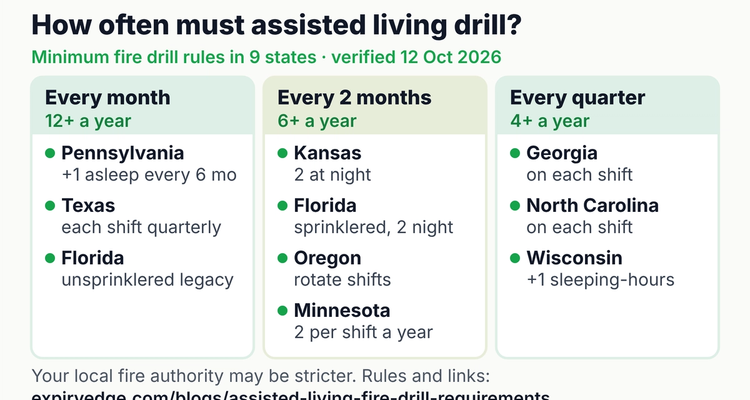 Minimum fire drill frequency in nine states, from the official rules (verified 12 October 2026). Free to embed with a link back.
Do this now: how do you build a 12-month drill schedule?
Put one drill in every window your rule sets, rotate shifts and place the night drills inside sleeping hours. With last year's logs in front of you, this takes about 30 minutes (our estimate). The example below meets the six-a-year, two-at-night minimum.
Example 2027 drill schedule (illustrative)
| Window | Example date and time | Shift | Simulated fire origin |
|---|---|---|---|
| Jan-Feb | Tue 12 Jan, 10:15 a.m. | Day | Kitchen |
| Mar-Apr | Wed 17 Mar, 6:40 p.m. | Evening | Laundry room |
| May-Jun | Thu 20 May, 2:30 a.m. | Night (residents asleep) | Resident room, east wing |
| Jul-Aug | Tue 13 Jul, 2:45 p.m. | Day | Activity room |
| Sep-Oct | Wed 22 Sep, 8:20 p.m. | Evening | Second-floor storage |
| Nov-Dec | Thu 4 Nov, 4:50 a.m. | Night (residents asleep) | Resident room, west wing |
If your state counts by shift (Georgia, North Carolina, Texas), check every quarter has one drill per shift. Then run each drill the same way:
- Assign a drill lead and a backup. The lead times the drill and signs the log.
- Call your alarm monitoring company before and after, as Minnesota's health department advises, so the fire department is not dispatched and the signal time is confirmed.
- Pick a new fire origin and exit route each time, and vary times so "no pattern is detectable," as Minnesota's health department advises.
- Run it with the staff on duty only. Wisconsin limits drills to "the employees scheduled to work at that time."
- Time it from the alarm until the last resident reaches the point of safety.
- Account for everyone before the all-clear.
- Debrief and log it the same day.
What should a fire drill log in assisted living record?
A fire drill log should record when the drill happened, who took part, where the simulated fire was, how long evacuation took and which residents needed help. The fields below combine the Wisconsin, Kansas, Oregon and Pennsylvania record lists.
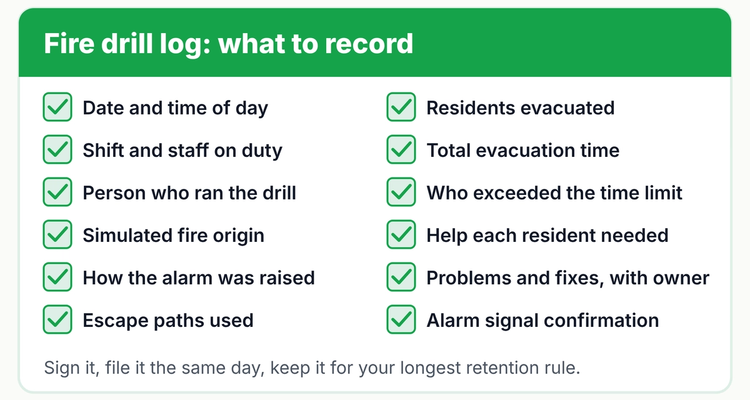 The fields state rules and fire codes ask a fire drill log to capture.
Fire drill log fields (example entries are illustrative)
| Field | Example entry |
|---|---|
| Date and time | Thu 20 May 2027, 2:30 a.m. |
| Shift, staff on duty, drill lead | Night: 3 staff (names); lead signs |
| Simulated fire origin, alarm method | Room 118; pull station by east stairs |
| Escape route used | East stair to rear assembly point |
| Residents in building and evacuated | 22 of 22 |
| Total evacuation time | 3 min 40 s |
| Residents who needed help or resisted | Room 112: one-person transfer; Room 215 refused at first |
| Problems, fix, owner, due date | East door slow to release; maintenance; 27 May |
| Monitoring company confirmation | Signal received 2:30 a.m.; reference number |
Our free fire drill log and schedule template has these columns ready in Excel and Google Sheets, a 12-month schedule that flags missed windows and night drills not run while residents slept, and a printable one-page log. No sign-up needed.
How do you make night fire drills less disruptive for residents?
Prepare residents and night staff in advance, then run a real drill during sleeping hours with the staff actually on that shift. These tips help:
- Explain drills at move-in. Wisconsin requires emergency procedures to be "clearly communicated to a new resident within 72 hours after admission." Describe the alarm and say staff will come to them.
- Announce it where your rule allows. Georgia, Texas and Wisconsin rules permit announcing drills; Pennsylvania and North Carolina require unannounced drills. Where allowed, a note at the evening meal helps residents who wake up confused.
- Brief night staff the week before. Agree who goes to which room first, which lights go on and what to say: "This is a practice drill. I'm here to help you."
- Plan for refusals. Wisconsin's emergency plan must cover "any resident who refuses to follow evacuation or emergency procedures." Kansas and Oregon ask the log to note residents who resisted.
- Check before you skip moving anyone. Kansas drills involve actual evacuation of all residents to an assembly point, while Minnesota's statute says evacuating residents is not required. Ask your fire authority what it expects.
How do you improve evacuation times between drills?
Debrief every drill, name a helper for each resident who needs one, and fix the slowest point first. Minnesota's health department calls for "a critique of each drill so that any problems encountered can be addressed." Before staff go back to work, ask where the clock stalled, which residents took longest and why, and what one change you will make before the next drill, with an owner.
Then keep a helper sheet: room, help needed, and the named helper on each shift. Wisconsin assesses each resident within 3 days of admission against a 2-minute (unsprinklered) or 4-minute (sprinklered) limit and requires every employee to be told who needs more than 2 minutes and "the type of assistance the resident needs." Update the sheet after each reassessment.
What do surveyors look for in fire drill records?
Surveyors and fire inspectors look for proof that drills happened on schedule, on every shift, with the staff who really work that shift. Minnesota's health department listed these problems behind its evacuation-drill citations in 2022:
- Fire drills not occurring or not documented.
- No written evacuation policy or procedure for staff.
- Missing exit floor plans or diagrams.
- Staff scripts too thin: more than an acronym is needed.
- No training for residents who can help in their own evacuation.
The day before a survey: a 30-minute check
- Lay the last 12 months of drill logs against your schedule. Check the count, the spacing and the shifts.
- Confirm each night drill is timed inside sleeping hours.
- Check every log has a total evacuation time and names residents who needed help.
- Close or date every open debrief action.
- Check vendor reports: alarm and sprinkler yearly service, hood service in the last 6 months, extinguisher tags current.
- Make sure "at least two people in your facility know where your drill records are kept," as Minnesota's health department advises.
If a drill was missed, do not backfill a log. Run it now, record the real date and note the gap. Our assisted living survey checklist extends this into a full pre-survey plan.
⚠️What happens if you miss it: in Florida, the Agency for Health Care Administration (AHCA) issues a statement of deficiency within 10 working days of an inspection, with a correction deadline. Fire safety violations that threaten a resident's life or safety turn an abbreviated survey into a full survey right away, and AHCA can require extra staff until the local fire authority confirms you comply (Fla. Admin. Code 59A-36.023, 59A-36.010).
If an inspection has already gone wrong, see what to do after a failed fire safety inspection.
Which fire safety inspections recur alongside drills?
Inspectors check system records too. These frequencies are from the NFPA editions NFPA 101 (2012) references, as summarized by the Minnesota Department of Health; your state may use newer editions.
Recurring fire-safety inspections
| System | Frequency | Standard |
|---|---|---|
| Portable fire extinguishers | Visual check monthly; maintenance yearly; internal exam every 6 years for 12-year-hydro types | NFPA 10 (2010) |
| Fire alarm system | Some parts visually inspected semiannually; full inspection and test yearly by an approved company | NFPA 72 (2010) |
| Sprinkler system | Control valves and wet-pipe gauges monthly; full service yearly; internal pipe check every 5 years | NFPA 25 (2011) |
| Kitchen hood suppression and exhaust | Inspected monthly; serviced every 6 months; exhaust checked for grease every 6 months | NFPA 17/17A (2009); NFPA 96 (2011) |
| Emergency generator | Inspected weekly; diesel sets run under load monthly for at least 30 minutes | NFPA 110 (2010) |
| Annual fire inspection | Yearly in Wisconsin and Texas; Florida sends the report to AHCA within 30 days | Wis. DHS 83.47(3); 26 TAC 553.104(a); Fla. 59A-36.004(5) |
Spreadsheet or software?
A printed log plus a spreadsheet is enough for one building with a steady team and one file owner. Give each drill and each inspection its own row with a due date, an owner, a backup owner and a link to the signed log. In a spreadsheet, =EDATE(last_done, months) gives the next due date and =next_due-TODAY() gives days left; color rows amber at 30 days and red at 7. The free template already does this.
The manual method breaks down when you run several buildings, when the person who kept the spreadsheet leaves, or when a surveyor asks who closed an item and when. A spreadsheet only reminds whoever opens it. That is where a tool earns its place: ExpiryEdge holds each drill or inspection as a recurring record, sends reminders to the owner and backup at 90, 60, 30 and 7 days by email, SMS, Slack or Teams, and keeps an audit trail of who closed it with what proof. See how it fits into an assisted living compliance program.
💡 Pro Tip
Name the night drill on your survey-prep checklist. One assisted-living operator we work with asks: "Fire drills conducted and logged and at least ONE done during overnight — when was it last completed?" Asking for the date, not a yes or no, shows at a glance whether the overnight drill is overdue.
Frequently asked questions
How often are fire drills required in assisted living?
It depends on your state and local fire code. Where NFPA 101 board-and-care rules apply, drills run at least six times a year, every two months, with two at night. Pennsylvania and Texas require monthly drills, while Wisconsin CBRFs drill at least quarterly plus one sleeping-hours drill a year.
How many night fire drills does assisted living need?
Under the NFPA 101 board-and-care rule, at least two a year while residents are sleeping. Pennsylvania requires one during sleeping hours every 6 months, and Wisconsin one a year that simulates sleeping hours. Rules that count by shift, such as Georgia and North Carolina, need a drill on the night shift every quarter.
Can assisted living fire drills be announced in advance?
Sometimes. Georgia, Texas and Wisconsin rules allow drills to be announced. Pennsylvania and North Carolina require unannounced drills, and Oregon requires them too. Check your own rule before you tell residents.
What should an assisted living fire drill log include?
At least the date and time, the shift and staff on duty, the simulated fire origin, the exit route used, the number of residents evacuated, the total evacuation time and residents who needed help or resisted. Add problems found, the fix and who owns it. Have the drill lead sign it the same day.
How long should we keep fire drill records?
It varies. Wisconsin CBRFs keep DHS 83 records for 2 years, and the Kansas State Fire Marshal's drill form asks for at least 5 years. Follow the longest period that applies to you.
What happens if we miss a required fire drill?
Expect a deficiency at your next survey or fire inspection. In Florida, AHCA issues a statement of deficiency within 10 working days with a correction deadline. Run the missed drill now and record the real date rather than backfilling a log.
Sources
- Florida Administrative Code 69A-40.036, drills in legacy facilities and 69A-40.038, non-legacy facilities
- Florida Administrative Code, Chapter 59A-36, Assisted Living Facility
- Georgia Safety Fire Commissioner, Rules 120-3-3, State Minimum Fire Safety Standards
- Kansas State Fire Marshal, Assisted Living Fire Drill Record, Form 802 and Fire Fact 037: Residential Board and Care
- Minnesota Statutes 144G.45, fire safety requirements for assisted living
- Minnesota Department of Health, Fire Drills and assisted living provider call, October 2022
- Minnesota Department of Health, NFPA inspection summaries: extinguishers, fire alarms, sprinklers, kitchen equipment, generators
- North Carolina Administrative Code 10A NCAC 13F .0309
- Oregon Department of Human Services, Fire Drills and Fire and Life Safety Training
- Pennsylvania Code, 55 Pa. Code 2800.132, Fire drills
- 26 Texas Administrative Code 553.104 and Texas Register proposed rules, 4 September 2026
- Wisconsin Administrative Code, Chapter DHS 83
Last reviewed: 12 October 2026
Frequently asked questions
Under the NFPA 101 board-and-care rule, at least two a year while residents are sleeping. Pennsylvania requires one during sleeping hours every 6 months, and Wisconsin one a year that simulates sleeping hours. Rules that count by shift, such as Georgia and North Carolina, need a drill on the night shift every quarter.
Sometimes. Georgia, Texas and Wisconsin rules allow drills to be announced. Pennsylvania and North Carolina require unannounced drills, and Oregon requires them too. Check your own rule before you tell residents.
At least the date and time, the shift and staff on duty, the simulated fire origin, the exit route used, the number of residents evacuated, the total evacuation time and residents who needed help or resisted. Add problems found, the fix and who owns it. Have the drill lead sign it the same day.
It varies. Wisconsin CBRFs keep DHS 83 records for 2 years, and the Kansas State Fire Marshal's drill form asks for at least 5 years. Follow the longest period that applies to you.
Expect a deficiency at your next survey or fire inspection. In Florida, AHCA issues a statement of deficiency within 10 working days with a correction deadline. Run the missed drill now and record the real date rather than backfilling a log.