
Assisted Living Regulations by State: 8-State Guide and Tracker

Assisted living is regulated by each state, not the federal government. Your state licensing agency writes the rules on licensing, admission, staff training, care plans, medication, fire safety and inspections, and the terms differ a lot. A Florida license lasts 2 years, a Texas license 3, and a Washington license no more than 12 months.
If you run or manage a community, you need three things: which rules apply to your license category, when your license renews, and what inspectors will check. This guide compares eight states from the official texts, then shows you how to turn your own rule into a dated tracker this week.
A few points before the detail. Even the name changes by state: assisted living facility in Florida, Texas, Washington and Minnesota, adult care home in North Carolina, assisted living residence in Pennsylvania, community-based residential facility (CBRF) in Wisconsin. Renewal windows are strict, from at least 30 days before expiry in Washington to 60 to 120 days in Florida. And each rule hides dozens of smaller clocks, like Wisconsin's background check every 4 years. Listing those clocks is the real compliance work.
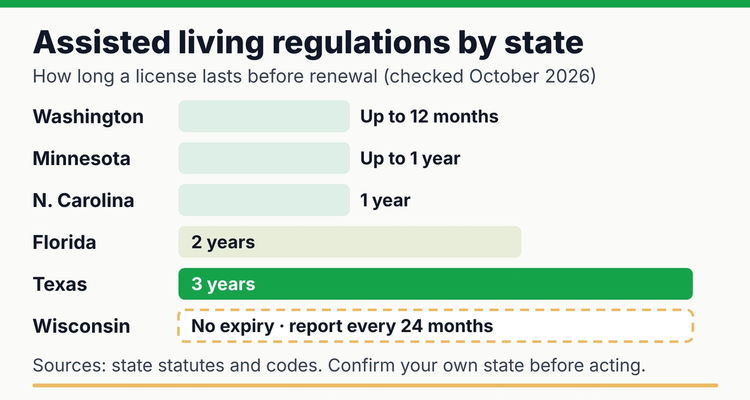 How long an assisted living license lasts in six of the eight states compared below, from the official statutes and rules (checked 12 October 2026).
Who regulates assisted living: the state or the federal government?
The state regulates assisted living. A federal HHS compendium puts it plainly: "Residential care settings are licensed and regulated at the state level, and all states have at least one category of residential care" (ASPE, 2015 edition). The same report notes that 40 states required direct care worker training at that time, with required hours ranging from 1 to 80.
Two federal rules still reach some communities. If you take Medicaid home and community-based services (HCBS) funding, your setting must meet the federal HCBS settings qualities in 42 CFR 441.301(c)(4), such as full access to the wider community. And if you employ certified nursing assistants (CNAs), their certification runs through your state's nurse aide registry. The detailed federal nurse aide rules apply to certified nursing homes, not to assisted living.
Everything else, from how many staff you schedule to how often you run fire drills, comes from your state's statute and rules. That's why the same building can pass in one state and be cited in the next.
Assisted living regulations by state: 8 states compared
The table below compares how eight states license and inspect assisted living. Each row comes from the state's own statute or code, checked on 12 October 2026. Rules change, so use the official links underneath to confirm before you act.
Assisted living licensing and inspections in 8 states (last verified 12 October 2026)
| State | Setting and main law | Licensing agency | License term and renewal | Routine inspections |
|---|---|---|---|---|
| Florida | Assisted living facility (ALF); Fla. Stat. ch. 429 part I and ch. 408 part II | Agency for Health Care Administration (AHCA) | Biennial: a standard license expires 2 years after issue. The renewal must arrive 60 to 120 days before expiry; a late application draws a daily late fee (capped) | Unannounced; relicensure inspections biennially unless otherwise specified |
| Georgia | Personal care home (rule 111-8-62); assisted living community = a personal care home serving 25 residents or more (rule 111-8-63) | Department of Community Health, Healthcare Facility Regulation (HFR) | Not confirmed on an official page we could access; check with HFR | Unannounced compliance inspections approximately every 11 to 15 months, or as needed |
| Minnesota | Assisted living facility, or assisted living facility with dementia care; Minn. Stat. ch. 144G | Minnesota Department of Health | Renewed for up to 1 year. Apply at least 60 calendar days before expiry; late fee if under 30 days | At least once every 2 years, without advance notice |
| North Carolina | Adult care home; N.C. Gen. Stat. ch. 131D | DHHS Division of Health Service Regulation (DHSR) | Renewals valid 1 year; a new home's first license runs 6 months | Annual licensure inspection (with listed exceptions); physical plant and life safety every 2 years |
| Pennsylvania | Assisted living residence (55 Pa. Code ch. 2800); personal care home (ch. 2600) | Department of Human Services (DHS) | Reapply at least 60 days before the certificate of compliance expires; $300 fee plus $75 per bed (assisted living) | On-site inspection at least once every 12 months; new residences reinspected within 3 months |
| Texas | Assisted living facility; Health and Safety Code ch. 247 | Health and Human Services Commission (HHSC) | License expires on the third anniversary of issue, on staggered dates | At least every 2 years after the initial inspection |
| Washington | Assisted living facility; RCW 18.20 and WAC 388-78A | Department of Social and Health Services (DSHS) | No more than 12 months; renewal application due at least 30 days before expiry | At least every 18 months, with an annual average of 15; up to 24 months after 3 clean inspections |
| Wisconsin | Community-based residential facility (CBRF); Wis. Stat. ch. 50 and DHS 83 | DHS Division of Quality Assurance (DQA) | Valid until revoked or suspended; report and fee every 24 months, or the license may be revoked | Announced or unannounced; 45 days to correct violations |
Official sources for each row:
- Florida: s. 408.806, s. 408.808 and s. 408.811
- Georgia: DCH Personal Care Home Program
- Minnesota: s. 144G.17 and s. 144G.30
- North Carolina: G.S. 131D-2.4 and G.S. 131D-2.11
- Pennsylvania: 55 Pa. Code 2800.11 and ch. 20
- Texas: Health and Safety Code ch. 247
- Washington: RCW 18.20.050 and RCW 18.20.110
- Wisconsin: Wis. Stat. 50.03 and the DHS survey guide
What do assisted living regulations cover?
Almost every state rule covers the same eight areas, even though the details differ. HHS found that states "generally have provisions covering the same areas" while "their requirements vary considerably." Wisconsin's chapter DHS 83 makes a good model because it states most deadlines in days, months or years.
The 8 areas a state assisted living rule usually covers, with Wisconsin DHS 83 examples
| Area | What the rule controls | Wisconsin example (DHS 83) |
|---|---|---|
| Licensing and postings | Who needs a license, capacity, what must be posted | Statement of deficiency posted for 90 days (83.14) |
| Admission and discharge | Who you may admit and keep, notice before discharge | Assessment before admission (83.35) |
| Assessment and service plans | When residents are assessed and plans written or reviewed | Service plan within 30 days of admission; reviewed annually (83.35) |
| Staffing and training | Background checks, health screening, required courses | Background check at hire and every 4 years (83.17); fire safety and first aid within 90 days (83.20) |
| Medication | Who may help with medicines, storage, reviews | Medication regimen review at least every 12 months (83.37) |
| Fire safety and emergencies | Drills, inspections, evacuation | Fire drills at least quarterly; annual fire inspection (83.47) |
| Resident rights | Rights, grievances, ombudsman access | Written summary of each grievance (83.33) |
| Records | What to keep and for how long | Resident records kept 7 years after discharge (83.13) |
For the full Wisconsin calendar, see our plain-English guide to Wisconsin CBRF requirements.
How do you find and read your state's assisted living rule?
Start from your license category, find the current official text, then pull every dated duty into a list. Budget about 90 minutes for a typical chapter. That's our estimate, not a rule; long chapters take longer.
- Name your license category (5 minutes). Copy the exact wording from your license certificate, such as "CBRF" or "adult care home". States often run two or more categories with different rules.
- Find the official text (10 minutes). Use the state legislature or code website, not a summary. Note the "current through" or register date at the top.
- Read the definitions first (10 minutes). Words like "resident care staff" or "significant change" decide who and what each rule covers.
- Highlight every clock (40 minutes). Search the text for "within", "days", "annually", "every", "before" and "prior to". Each hit is a deadline someone must own.
- List incorporated standards (10 minutes). Rules often point to outside codes, such as a fire code edition or CDC tuberculosis guidance. Add those to your list.
- Check for pending changes (15 minutes). Look for proposed rules or recent bulletins on the agency site, and note any effective dates.
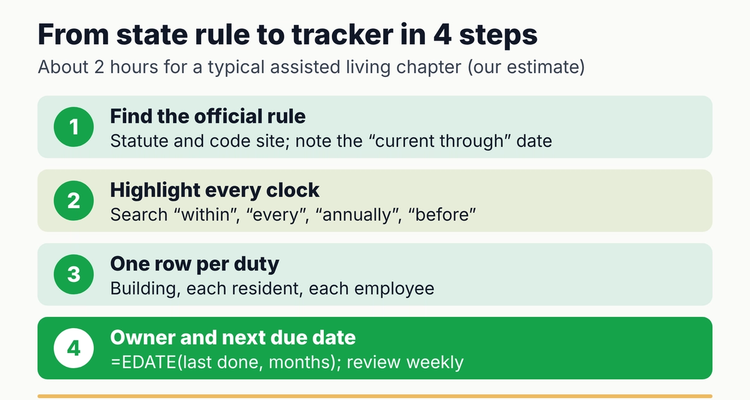 Turn your state rule into a tracker: every "within", "every" and "annually" becomes a dated row with an owner.
Do this now: turn your rule into a dated tracker
A spreadsheet with one row per duty is enough to start. Build it from the clocks you highlighted, then sort by the next due date. Setup takes about half an hour once you've pulled the clocks out of the rule.
Copy-paste spreadsheet layout
- Columns: A Rule reference, B Duty in plain English, C Applies to (building, each resident, each employee), D Trigger (calendar, admission, hire), E Every (months), F Last done, G Next due, H Days left, I Status, J Owner, K Backup, L Where the proof lives.
- Next due: =IF(OR(E2="",F2=""),"",EDATE(F2,E2))
- Days left: =IF(G2="","",G2-TODAY())
- Status: =IF(G2="","CHECK",IF(H2<0,"OVERDUE",IF(H2<=30,"DUE SOON","OK")))
- Formatting: red for OVERDUE, amber for DUE SOON, then sort by column H.
Worked example (illustrative)
Say you run a Wisconsin CBRF and a caregiver's last background check was on 3 March 2023. Put DHS 83.17(1) in column A, "Caregiver background check" in B, 48 in E and 3 March 2023 in F. Next due shows 3 March 2027. Add a row for the license too: in Wisconsin, set E to 24 for the biennial report and use the date the department gives you.
Your first week with the tracker
- ✓
Add the license itself as row 1, with the renewal or report date
- ✓
Add every building-level clock (drills, inspections, tests)
- ✓
Add one row per employee for each expiring item
- ✓
Add one row per resident for each annual review
- ✓
Name an owner and a backup for every row
- ✓
Book a 10-minute weekly review at a fixed time
How do you keep up when the rules change?
Give one person the job of watching for changes, and re-read your chapter once a year. Both habits cost little and save you from learning about a new rule from an inspector.
- Sign up for your agency's email updates or provider notices, and save each one in a dated folder.
- Keep a one-page change log: date, rule section, what changed, rows updated in your tracker.
- Re-read the definitions and clocks each year in the month before your renewal window opens.
- After every inspection, add any cited item to your tracker as a recurring check, not a one-off fix.
- Before you add services, such as memory care or medication help, check whether they need a different license category.
What happens if you miss a license renewal or report?
The penalties are set out in each statute. In Florida, under s. 408.806, a late renewal application draws a $50 per day late fee, capped at 50% of the license fee or $500, whichever is less. In Minnesota, s. 144G.17 adds a late fee if the renewal arrives less than 30 days before expiry.
In Wisconsin, the department warns a CBRF that misses its biennial report and may revoke the license if the report still isn't filed within 60 days after the report date (Wis. Stat. 50.03). And in Texas, nobody may operate an assisted living facility without a license at all (Health and Safety Code ch. 247).
Inspection findings carry their own deadlines. Our assisted living survey checklist covers correction windows in Florida, Georgia and Wisconsin and a 3-hour audit to find gaps first.
Spreadsheet or software?
A spreadsheet is enough for one building, a stable team and someone who opens it every week. It starts to fail when you add sites, when turnover is high, or when one person holds every date in their head. And a spreadsheet can't remind anyone. Someone has to look.
That's where a tool earns its place. In ExpiryEdge, each license, drill or credential is a record with an owner. Reminders go to that person by email, SMS, WhatsApp, Slack or Teams, overdue items escalate to a manager, and the audit trail shows inspectors who was reminded and what they uploaded.
💡 Pro Tip
Keep a survey-preparation checklist you run twice a year and a short weekly check-in, and add a step that removes records for residents who have moved out. This works just as well in a spreadsheet: one weekly review, one person, one list.
For staff-side deadlines, see our caregiver onboarding checklist for assisted living. For a wider view of the deadlines an assisted living community tracks, see our assisted living compliance guide.
Frequently asked questions
Is assisted living regulated by the federal government?
No. Each state licenses and regulates assisted living under its own statute and rules. Federal rules reach a community only in specific cases. The main one is the Medicaid home and community-based settings rule at 42 CFR 441.301(c)(4), which applies when the community receives Medicaid HCBS funding. Nurse aide registries also involve federal rules, but the detailed ones apply to nursing homes.
How often do you renew an assisted living license?
It depends on the state. Washington licenses last no more than 12 months and Minnesota renewals up to one year. Florida licenses run 2 years and Texas licenses 3. A Wisconsin CBRF license stays valid until revoked or suspended, but you still owe a report and fee every 24 months, so treat that date like a renewal.
How often are assisted living facilities inspected?
Pennsylvania inspects at least once every 12 months. North Carolina does it annually, with some exceptions, and Washington at least every 18 months. Texas and Minnesota allow up to 2 years between routine visits, while Georgia says roughly every 11 to 15 months. Most are unannounced. So plan as if an inspector could walk in any week.
Where do I find my state's assisted living regulations?
Go to your state legislature's statute site and the state administrative code site, or your licensing agency's rules page. Use the official text and note its "current through" date. Summaries on third-party sites, including old national compendiums, are often years out of date, and a single missed amendment can change a deadline.
What do assisted living regulations usually require?
Most cover eight areas: licensing and postings, admission and discharge, resident assessments and service plans, staff screening and training, medication, fire safety, resident rights and records. The details differ by state. Wisconsin, for example, wants a service plan within 30 days of admission and a background check every 4 years.
What is the difference between assisted living and a personal care home?
It's mostly a naming and licensing question, and each state answers it differently. In Georgia, an assisted living community is a personal care home serving 25 residents or more that is licensed to provide assisted living care, under a separate rule chapter. Check your license certificate for the exact category you hold.
Sources
- HHS ASPE, Compendium of Residential Care and Assisted Living Regulations and Policy, 2015 edition
- 42 CFR 441.301, Medicaid home and community-based settings (eCFR)
- Florida Statutes s. 408.806, license application process
- Florida Statutes s. 408.808, license categories
- Florida Statutes s. 408.811, inspections
- Georgia DCH, Personal Care Home Program
- Minnesota Statutes s. 144G.17, license renewal
- Minnesota Statutes s. 144G.30, surveys and investigations
- North Carolina G.S. 131D-2.4, adult care home licensure
- North Carolina G.S. 131D-2.11, inspections
- 55 Pa. Code 2800.11, assisted living residence licensure
- 55 Pa. Code ch. 20, licensure or approval of facilities
- Texas Health and Safety Code ch. 247, assisted living facilities
- RCW 18.20.050, assisted living licenses
- RCW 18.20.110, inspection of assisted living facilities
- Wisconsin Statutes s. 50.03
- Wisconsin Administrative Code ch. DHS 83
- Wisconsin DHS, Assisted Living Survey Guide
- Last reviewed: 12 October 2026
Frequently asked questions
It depends on the state. Washington licenses last no more than 12 months and Minnesota renewals up to one year. Florida licenses run 2 years and Texas licenses 3. A Wisconsin CBRF license stays valid until revoked or suspended, but you still owe a report and fee every 24 months, so treat that date like a renewal.
Pennsylvania inspects at least once every 12 months. North Carolina does it annually, with some exceptions, and Washington at least every 18 months. Texas and Minnesota allow up to 2 years between routine visits, while Georgia says roughly every 11 to 15 months. Most are unannounced. So plan as if an inspector could walk in any week.
Go to your state legislature's statute site and the state administrative code site, or your licensing agency's rules page. Use the official text and note its "current through" date. Summaries on third-party sites, including old national compendiums, are often years out of date, and a single missed amendment can change a deadline.
Most cover eight areas: licensing and postings, admission and discharge, resident assessments and service plans, staff screening and training, medication, fire safety, resident rights and records. The details differ by state. Wisconsin, for example, wants a service plan within 30 days of admission and a background check every 4 years.
It's mostly a naming and licensing question, and each state answers it differently. In Georgia, an assisted living community is a personal care home serving 25 residents or more that is licensed to provide assisted living care, under a separate rule chapter. Check your license certificate for the exact category you hold.