Wisconsin CBRF Requirements: DHS 83 Deadlines in Plain English

Wisconsin CBRF requirements come from chapter DHS 83 of the Administrative Code and chapter 50 of the statutes. A community-based residential facility needs a DHS license, a biennial report and fee every 24 months, caregiver background checks every 4 years, 15 hours of yearly staff training, annual resident assessments, quarterly fire drills and an annual fire inspection.
If you run a CBRF, you know the problem: DHS 83 is 28 pages long, and the deadlines are scattered across dozens of sections. This guide pulls every recurring date into one table, then shows you how to build a deadline calendar this week with a spreadsheet you already have.
Key takeaways
- The license does not expire, but every 24 months you must file a biennial report and pay $389 plus $50.25 per licensed resident.
- Background checks at hire and every 4 years after, for every caregiver.
- 90 days for new staff to finish fire safety, first aid and choking, resident rights, client group and challenging behaviors training.
- 15 hours of continuing education per calendar year for the administrator and resident care staff.
- Resident clocks: evacuation evaluation within 3 days of admission, individual service plan within 30 days, then both at least annually.
- Fire safety: drills at least quarterly (one a year simulating sleeping hours), disaster drills twice a year, and an annual fire inspection.
- Penalties: forfeitures of $10 to $1,000 per violation per day, and DHS may revoke a license if the biennial report is 60 days late.
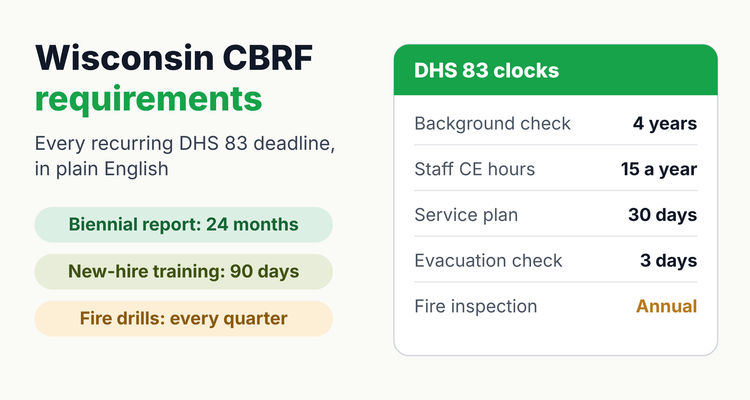 Key DHS 83 clocks to put on the calendar first: the biennial report, background checks, yearly training hours and quarterly drills.
What is a CBRF in Wisconsin?
A CBRF is a place where five or more unrelated adults live together and receive room and board, supervision and support services, with up to three hours of nursing care per resident per week. The Division of Quality Assurance (DQA) at the Wisconsin Department of Health Services (DHS) licenses CBRFs through its Bureau of Assisted Living.
DHS 83 sorts each CBRF by size and class. Size is small (5 to 8 residents), medium (9 to 20) or large (21 or more). Class describes who you serve: Class A residents can leave the building on a fire alarm without help or prompting, while Class C serves at least one resident who cannot. Each class is then split into ambulatory, semi-ambulatory and non-ambulatory. Your class drives your fire safety rules, so put it at the top of your calendar.
How does CBRF licensing work, and does the license expire?
A regular CBRF license is valid until DHS suspends or revokes it, so there is no renewal date. Instead, every 24 months, on a date DHS sets, you submit a biennial report through the DHS online system and pay the license continuation fee.
- Fee: $389 plus $50.25 per resident you are licensed to serve, every two years. A CBRF licensed for 20 residents pays $389 + (20 x $50.25) = $1,394.
- Late fee: $10 for every day after the deadline the fee is unpaid.
- Exemption: CBRFs where every resident's total monthly charges do not exceed the state supplemental payment rate are exempt from the fee.
- Late report: DHS issues a warning, and may revoke the license if the report is not complete within 60 days after the report date.
- New licenses: DHS has 70 days after a complete application to approve or deny. A first license may be probationary, valid for up to 12 months.
Changes have their own clocks: tell DHS within 7 days after the administrator changes, and give at least 30 days' notice before a change of ownership or closure. A license cannot be transferred to a buyer.
What staff training do Wisconsin CBRF requirements include?
Every employee needs orientation before doing any job duties, then a set of courses on fixed deadlines. Four topics (standard precautions, fire safety, first aid and choking, and medication administration) must be taught by trainers approved through the Wisconsin training registry run by the University of Wisconsin-Green Bay.
DHS 83 staff training deadlines (as of October 2026)
| Training | Deadline | Rule |
|---|---|---|
| Orientation (job duties, abuse reporting, residents' needs, emergency plan, policies, changes of condition) | Before any job duties | DHS 83.19 |
| Standard precautions | Before any task with possible exposure to blood or body fluids | DHS 83.20(2)(a) |
| Medication administration and management | Before managing or helping with medications | DHS 83.20(2)(d) |
| Fire safety | Within 90 days after starting | DHS 83.20(2)(b) |
| First aid and choking | Within 90 days after starting | DHS 83.20(2)(c) |
| Resident rights, client group, challenging behaviors | Within 90 days after starting | DHS 83.21 |
| Assessment, service plan development, personal care | Before doing those duties | DHS 83.22(1)-(3) |
| Dietary training | Within 90 days after taking on dietary duties | DHS 83.22(4) |
| Continuing education (administrator and resident care staff) | At least 15 hours per calendar year, from the first full calendar year | DHS 83.25 |
Until a new employee finishes all required training, the administrator or qualified resident care staff must directly supervise them. Some people are exempt from some courses: for example, registered nurses and licensed practical nurses skip most of them, and a nurse aide certified after 1999 and in good standing on the Wisconsin Nurse Aide Registry skips standard precautions, personal care and several 90-day topics. File the exemption proof in the employee record.
The 15 continuing education hours must cover standard precautions, client group topics, medications, resident rights, abuse prevention and reporting, and fire safety and emergency procedures including first aid. Record each course with the employee's name, instructor, date, content and length. For a full new-hire sequence, see our caregiver onboarding checklist.
Which staff checks repeat, and how often?
Caregiver background checks repeat every 4 years; everything else is mostly a one-time hiring step.
- Caregiver background check: at hire, employment or contract, and every 4 years after (DHS 83.17(1)).
- Tuberculosis and communicable disease screening: documented by a physician, physician assistant, nurse practitioner or registered nurse within 90 days before the start of employment, then re-screening based on the likelihood of exposure (DHS 83.17(2)).
- Employee record: job description, start date, background check and training or exemption proof, kept for 3 years after the person leaves (DHS 83.18, 83.13).
What are the resident assessment and care plan deadlines?
Each resident starts their own set of clocks on admission day. This is where most CBRFs lose track, because every resident is on a different cycle.
Per-resident deadlines under DHS 83 (as of October 2026)
| Task | Deadline | Rule |
|---|---|---|
| Assessment of needs, abilities and condition | Before admission (within 5 days for emergency admissions), at a change, and at least annually | DHS 83.35(1) |
| Temporary service plan | On admission | DHS 83.35(2) |
| Evacuation capability evaluation | Within 3 days of admission; at least annually or at a change | DHS 83.35(5) |
| Emergency and disaster procedures explained to the resident | Within 72 hours after admission | DHS 83.47(2)(c) |
| Individual service plan (ISP) | Within 30 days after admission; review annually or at a change | DHS 83.35(3) |
| Medication regimen review by a pharmacist or physician | 30 days before or after admission, at a significant medication change, and at least every 12 months | DHS 83.37(1)(e)1 |
| Psychotropic medication reassessment | At least quarterly | DHS 83.37(1)(h) |
| PRN (as needed) psychotropic use monitored | At least monthly | DHS 83.37(1)(i) |
| Satisfaction evaluation offered | At least annually | DHS 83.35(4) |
| Physical health examination | Annually, unless seen more often by a physician or advanced practice nurse | DHS 83.38(1)(g) |
Worked example (illustrative dates). A resident admitted on 2 November 2026 needs an evacuation evaluation by 5 November, emergency procedures explained by 5 November, and an ISP by 2 December. The medication review window runs from 3 October to 2 December. The next annual assessment, ISP review and evacuation evaluation are all due by 2 November 2027.
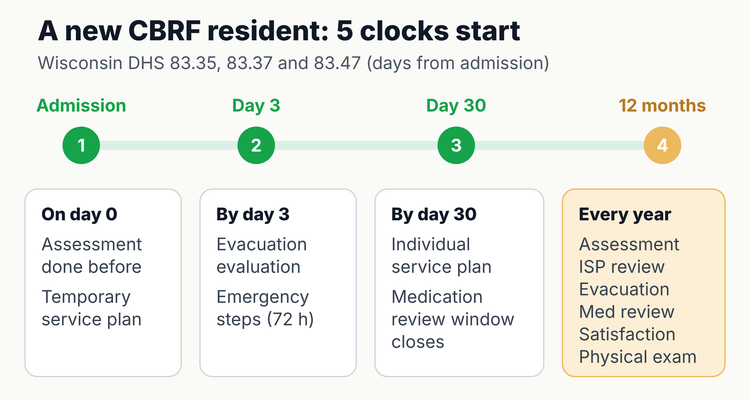 Every new admission starts five DHS 83 clocks. Put them all on the calendar on admission day.
What fire safety rules apply to a CBRF?
DHS 83 requires fire drills at least quarterly, with at least one a year that simulates sleeping hours, plus an annual inspection by the local fire authority or a certified fire inspector. Record the date, time and total evacuation time of each drill, and note any resident who took longer than allowed.
Recurring fire and building checks for Wisconsin CBRFs
| Check | How often | Rule |
|---|---|---|
| Fire evacuation drill | At least quarterly; 1 a year simulating sleeping hours | DHS 83.47(2)(d) |
| Tornado, flood or other disaster drill | At least semi-annually | DHS 83.47(2)(e) |
| Fire inspection (keep reports 2 years) | Annually | DHS 83.47(3) |
| Fire extinguisher inspection by a qualified professional | 1 year after purchase, then annually | DHS 83.47(4) |
| Smoke detectors on building power, tested by staff | Per manufacturer, at least every other month | DHS 83.48(1)(b) |
| Detection system inspected, cleaned and tested | Annually after the first year | DHS 83.48(3)(a) |
| Sprinkler system inspection and test | At least annually, or as NFPA 25 requires | DHS 83.48(8)(b) |
| Oil furnace service / gas furnace service | Every year / at least every 3 years (chimney on the same cycle) | DHS 83.46(1)(c) |
| Wood stove or fireplace flue cleaning | At least twice each heating season | DHS 83.46(1)(e) |
| Well water test (no public supply) | At least annually | DHS 83.46(3) |
Evacuation times also set staffing. If any resident needs 4 minutes or more to evacuate, DHS 83.47 requires a sprinkler system and at least one qualified staff member awake 24 hours a day. Our guide to assisted living fire drill requirements includes a drill log you can copy.
What must a CBRF report to DHS, and how fast?
The shortest clock in DHS 83 is 24 hours, for a death that may relate to a physical restraint, psychotropic medication or suicide.
DHS 83.12 reporting deadlines
| Event | Deadline |
|---|---|
| Death possibly related to restraint, psychotropic medication or suicide | Report to DHS within 24 hours |
| Death from an accident or injury | Report within 3 working days |
| Abuse, neglect or misappropriation by a caregiver, substantiated by your investigation | Report within 7 calendar days of when you knew or should have known |
| Missing resident, police called, injury needing hospital or emergency room care, fire, catastrophe, unplanned evacuation | Written report within 3 working days |
| Incident, injury or significant change in condition | Notify the legal representative and physician immediately |
| Allegation of misappropriation of property | Notify the legal representative within 72 hours |
How long must CBRF records be kept?
The default is 2 years for any record DHS 83 requires. Resident records are kept 7 years after final discharge, employee records 3 years after the person leaves, and dated menus 60 days. A statement of deficiency must stay posted for 90 days after you receive it.
⚠️What happens if you miss it: DHS can order a plan of correction and impose daily forfeitures of $10 to $1,000 per violation, with each day a separate violation (Wis. Stat. s. 50.03(5g)). Facilities have 45 days to correct violations, and a follow-up visit can bring a $200 revisit fee. DHS may revoke a license if the biennial report is not complete within 60 days after its due date. Operating without a license can mean a fine of up to $500 a day on a first conviction.
How do you build a DHS 83 deadline calendar this week?
Put every recurring item on one sheet, one row per item per person, and let date formulas flag what is due. For a CBRF with about 20 residents and 25 staff, expect roughly 4 to 6 hours the first time (our estimate), mostly spent finding the last completion dates.
- List facility items (30 minutes). Biennial report date, fire inspection, drills, extinguishers, detector tests, sprinklers, furnace, well water. Use the fire table above.
- List staff items (about 5 minutes per person). Hire date, background check date, TB screening, each 90-day course, and continuing education hours this year.
- List resident items (about 5 minutes per resident). Admission date, last assessment, ISP review, evacuation evaluation, medication review, physical exam and satisfaction evaluation.
- Enter the last-done date from the record, never from memory. If you cannot find proof, treat it as overdue.
- Fix red rows this week, then assign each row an owner and a backup.
Copy-paste spreadsheet layout for a CBRF deadline calendar
| Column | Heading | What to enter or formula |
|---|---|---|
| A | Item | For example "Fire drill" or "ISP review: Resident 12" |
| B | Type | Facility, Staff or Resident |
| C | Rule | DHS 83 section, for example 83.35(3) |
| D | Last done | Date from the record |
| E | Interval (months) | 3 quarterly, 6 semi-annual, 12 annual, 24 biennial, 36 gas furnace, 48 background check |
| F | Next due | =IF(OR(D2="",E2=""),"",EDATE(D2,E2)) |
| G | Days left | =IF(F2="","",F2-TODAY()) |
| H | Owner / backup | Two names |
| I | Evidence | Where the proof is filed |
For 90-day new-hire courses, add a row with the start date in column D and use =D2+90 in column F instead. For continuing education, add a row per person with hours so far in column I and a due date of 31 December.
Then add conditional formatting to the filled rows (Excel: "Use a formula"; Google Sheets: "Custom formula is"):
- Red: =AND($G2<>"",$G2<=7), overdue or due within a week.
- Amber: =AND($G2<>"",$G2>7,$G2<=30), schedule it now.
- Yellow: =AND($E2>=12,$G2<>"",$G2<=90), book outside help early (fire inspector, sprinkler contractor, pharmacist).
💡 Pro Tip
Assisted living operators who use ExpiryEdge often set each resident's annual cycle (assessment, service plan, evacuation evaluation, satisfaction survey) as recurring records, and add a weekly step to close records for residents who have moved out. The habit worth copying with any tool: when one annual item is done, create next year's entry the same day, and review the overdue list every morning.
How can you go beyond minimum compliance?
- Align each resident's annual items to one date. If the assessment, ISP review and evacuation evaluation all fall in the admission month, one meeting covers all three.
- Book the fire inspection 60 days early. The rule is annual, but local fire authorities set their own schedules.
- Run a mock survey twice a year with our assisted living survey checklist. DQA surveys may be announced or unannounced.
What are the most common DHS 83 deadline mistakes?
Common CBRF deadline mistakes and fixes
| Mistake | Fix |
|---|---|
| Treating the license as permanent and forgetting the biennial report | Put the DHS report date on the calendar with a 90-day reminder |
| Counting 90-day training from orientation instead of the start date | Use the employment start date in the formula |
| Running annual assessments from a single facility-wide date | Track each resident from their own admission or last review date |
| Logging drills without total evacuation time | Add columns for time, total evacuation time and residents over the limit |
| Background check renewals slipping for long-serving staff | One row per caregiver with a 48-month interval |
Spreadsheet or software: what should a CBRF use?
A spreadsheet is enough if one person owns it, you have one building, and someone opens it every week. It stops being enough when you run several sites, when staff turnover means dozens of 90-day clocks at once, or when the person who built the sheet leaves.
A tool earns its place when reminders must reach the right person on their own, when you need proof for a surveyor in minutes, and when annual items must roll forward automatically. ExpiryEdge does this with a record per item, an owner and backup, reminders at 90, 60, 30 and 7 days, and an audit trail. Our assisted living compliance page shows how operators set it up. Either way, start with the free staff training matrix for the training rows.
Frequently asked questions
Does a Wisconsin CBRF license expire?
No. A regular CBRF license is valid until DHS suspends or revokes it. Every 24 months you must submit a biennial report and pay the continuation fee, and DHS may revoke the license if the report is not complete within 60 days after its due date.
How much is the Wisconsin CBRF license fee?
The biennial fee is $389 plus $50.25 per resident the facility is licensed to serve, so a 20-resident CBRF pays $1,394 every two years. A late fee of $10 a day applies, and some low-charge facilities are exempt.
What training do CBRF staff need in Wisconsin?
Orientation before any duties, standard precautions and medication training before those tasks, and fire safety, first aid and choking, resident rights, client group and challenging behaviors training within 90 days of starting. After that, the administrator and resident care staff need at least 15 hours of continuing education each calendar year.
How often are fire drills required in a Wisconsin CBRF?
At least quarterly with employees and residents, and at least one drill a year must simulate usual sleeping hours. Tornado, flood or other disaster drills are required at least twice a year, and the facility needs an annual fire inspection.
How often must a CBRF reassess residents?
Before admission, when needs or condition change, and at least annually. The individual service plan is due within 30 days of admission and reviewed annually or at a change, and the evacuation evaluation is due within 3 days of admission and updated at least annually.
How often are CBRF background checks required?
At the time of hire, employment or contract, and every 4 years after, for each caregiver. DHS also checks owners and certain principal officers before initial licensing and every four years after.
Sources
- Wisconsin Administrative Code ch. DHS 83, Community-Based Residential Facilities (Legislative Reference Bureau)
- Wisconsin Statutes ch. 50, ss. 50.03 and 50.037 (PDF, Legislative Reference Bureau)
- Opening a Community-Based Residential Facility, Wisconsin DHS
- Community-Based Residential Facilities: Rules and Regulations, Wisconsin DHS
- Community-Based Residential Facilities: Approved Training Programs, Wisconsin DHS
- Assisted Living Survey Guide, Wisconsin DHS
Last reviewed: 12 October 2026
Frequently asked questions
The biennial fee is $389 plus $50.25 per resident the facility is licensed to serve, so a 20-resident CBRF pays $1,394 every two years. A late fee of $10 a day applies, and some low-charge facilities are exempt.
Orientation before any duties, standard precautions and medication training before those tasks, and fire safety, first aid and choking, resident rights, client group and challenging behaviors training within 90 days of starting. After that, the administrator and resident care staff need at least 15 hours of continuing education each calendar year.
At least quarterly with employees and residents, and at least one drill a year must simulate usual sleeping hours. Tornado, flood or other disaster drills are required at least twice a year, and the facility needs an annual fire inspection.
Before admission, when needs or condition change, and at least annually. The individual service plan is due within 30 days of admission and reviewed annually or at a change, and the evacuation evaluation is due within 3 days of admission and updated at least annually.
At the time of hire, employment or contract, and every 4 years after, for each caregiver. DHS also checks owners and certain principal officers before initial licensing and every four years after.