
Every gauge in calibration, every certificate on file, before the auditor asks.
Micrometers, torque wrenches, pressure gauges, CMMs and temperature loggers each have their own calibration interval, location and owner. ExpiryEdge keeps a register of every instrument with its due date and last certificate, reminds the owner before it lapses, collects certificates from your calibration lab by link and starts a checklist when a result comes back out of tolerance.
Last updated · ExpiryEdge editorial team
For quality managers, metrology leads and maintenance teams
One record per instrument, with interval and location
Next due date rolls forward after each calibration
Labs upload certificates by link, no login
Out-of-tolerance checklist with evidence
Quick answer
Calibration tracking means keeping a register of every measuring instrument used to prove product conformity, with the calibration interval your quality system sets, the next due date, the owner, the location and the latest calibration certificate. ISO 9001 clause 7.1.5 requires calibration or verification at specified intervals against traceable standards but leaves the interval to you. ExpiryEdge reminds before each due date, collects certificates from the lab and records what happened when a result was out of tolerance.
Why calibration findings keep appearing in audits
One overdue gauge, one finding
The auditor picks a torque wrench on the line. Its sticker says it was due last month. That is a nonconformity, however good the rest of the system is.
The register is a spreadsheet
It was accurate when it was built. Since then instruments have been added, moved between lines and retired, and nobody updated the file.
Certificates arrive by post or email
The lab sends the certificate to whoever placed the order. It never reaches the register, so the next due date is not updated.
Out-of-tolerance results go nowhere
An instrument comes back with an as-found result outside tolerance. Which products were measured with it since the last good calibration - and what was decided - is not recorded.
Instruments at the lab are invisible
Five gauges went out for calibration three weeks ago. Nobody knows if they are back, or which line is working without a calibrated replacement.
A full CAQ system is a big project
For 150 instruments, a CAQ suite with an implementation project feels like too much - so the spreadsheet stays.
What a calibration register should hold for each instrument
ISO 9001 does not prescribe intervals; it requires that you set them, keep instruments traceable and act when one is found unfit. These are the fields auditors usually ask to see, and where each one lives in ExpiryEdge.
| Field | Why it matters | Source | In ExpiryEdge |
|---|---|---|---|
| Unique ID and description | Identifies the instrument and links it to its calibration status | ISO 9001 cl. 7.1.5.2 | Record name and custom fields |
| Location, line or user | Shows where it is used and who to remind | Good practice | Location / team field |
| Calibration interval | Set by your organisation from use, stability and risk | ISO 9001 cl. 7.1.5.2 | Recurring interval per record |
| Last calibration and next due date | Proves it was in calibration when used | ISO 9001 cl. 7.1.5.2 | Due date with 90/60/30/7-day reminders |
| Calibration certificate | Evidence of traceability to national or international standards | ISO 9001 cl. 7.1.5.2; ISO/IEC 17025 for accredited labs | Certificate file on the record |
| As-found result | Shows whether past measurements can be trusted | ISO 9001 cl. 7.1.5.2 | Field on the certificate request |
| Action when out of tolerance | You must assess the validity of previous results and act | ISO 9001 cl. 7.1.5.2 | Checklist with photo and signature |
| Status (in use, at lab, quarantined, retired) | Stops uncalibrated instruments being used | Good practice | Status and owner on the dashboard |
Status, interval and certificate for every instrument
Green is in calibration, amber due within 30 days, red overdue, blue at the lab. Open any record to see the certificate the lab uploaded and the as-found result.
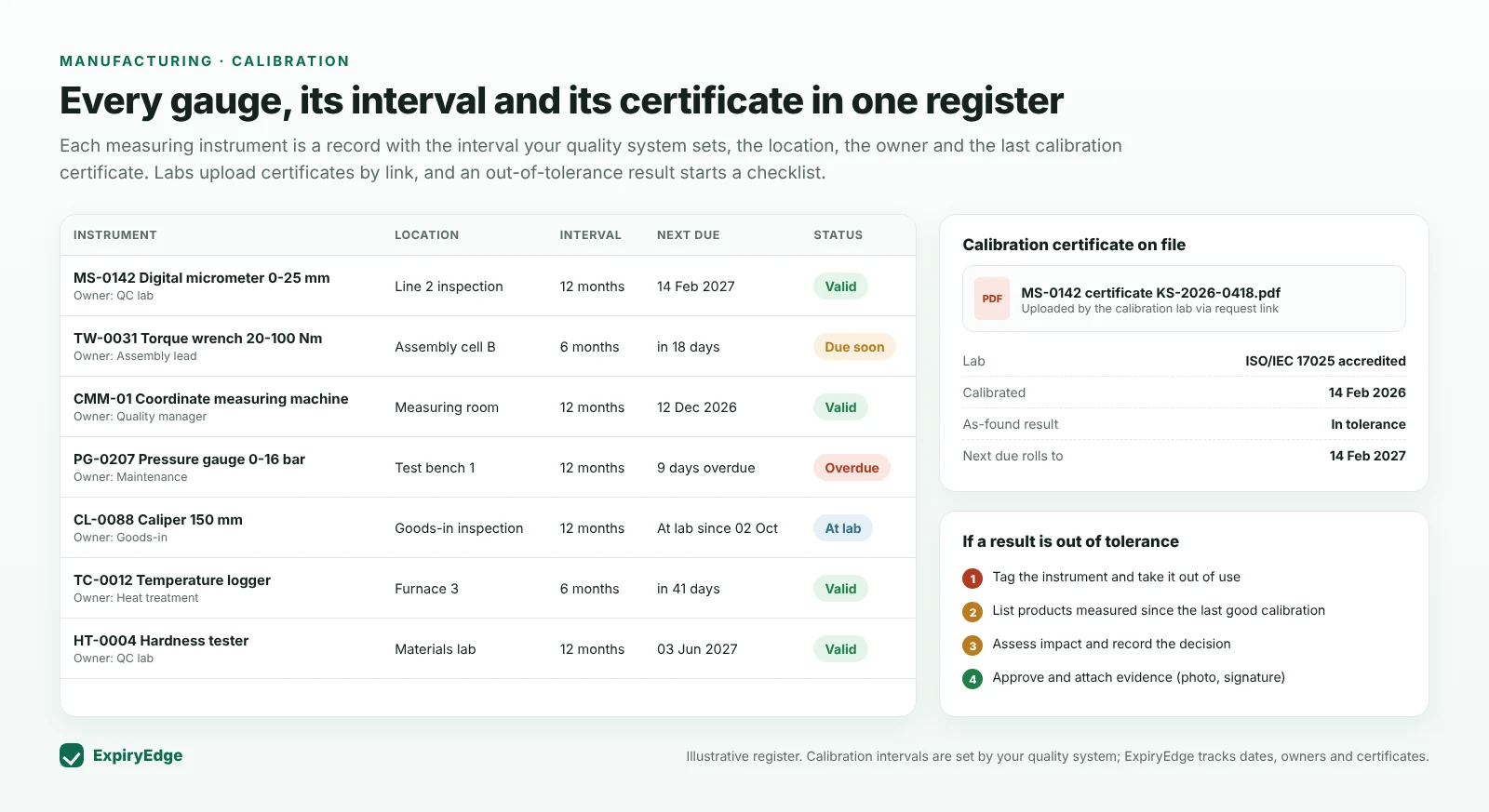
From a stale spreadsheet to a register that keeps itself current
Import your instruments once
Import your existing gauge list from a spreadsheet: ID, description, location, interval, last calibration and owner. Each instrument becomes a recurring record. When the new certificate is approved, the next due date rolls forward on the interval you set, so the register stays current without anyone rebuilding it.
Spreadsheet import of an existing gauge list
Recurring interval per instrument
Group by site, line or instrument type
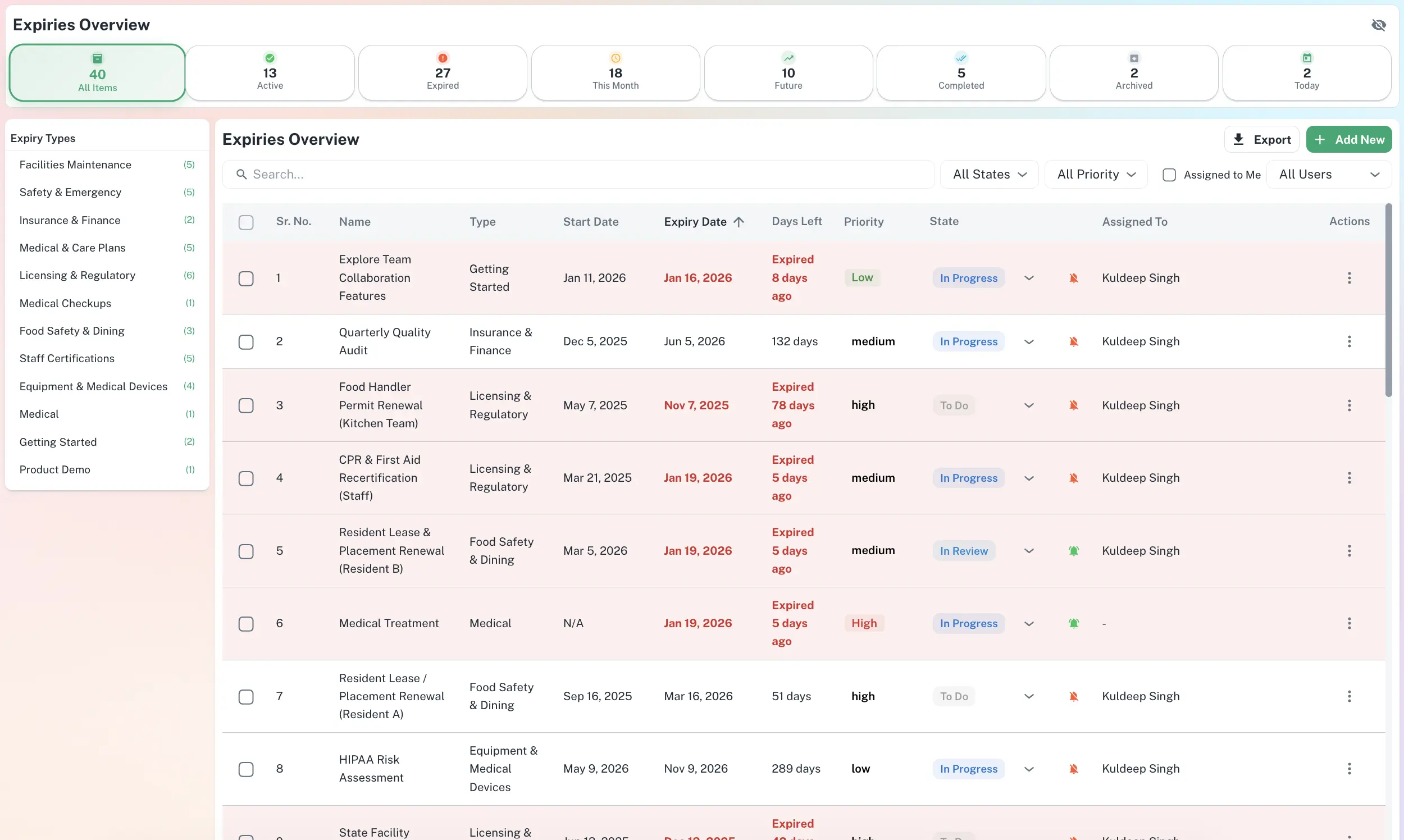
Reminders to the instrument owner
The owner gets reminders at 90, 60, 30 and 7 days by email, Teams, SMS or WhatsApp - enough time to book the lab and arrange a replacement on the line. If the date passes, ExpiryEdge escalates to the quality manager and the instrument shows as overdue on the dashboard.
Cadence configurable per instrument type
Escalation when a date passes
Overdue and at-lab status visible at a glance
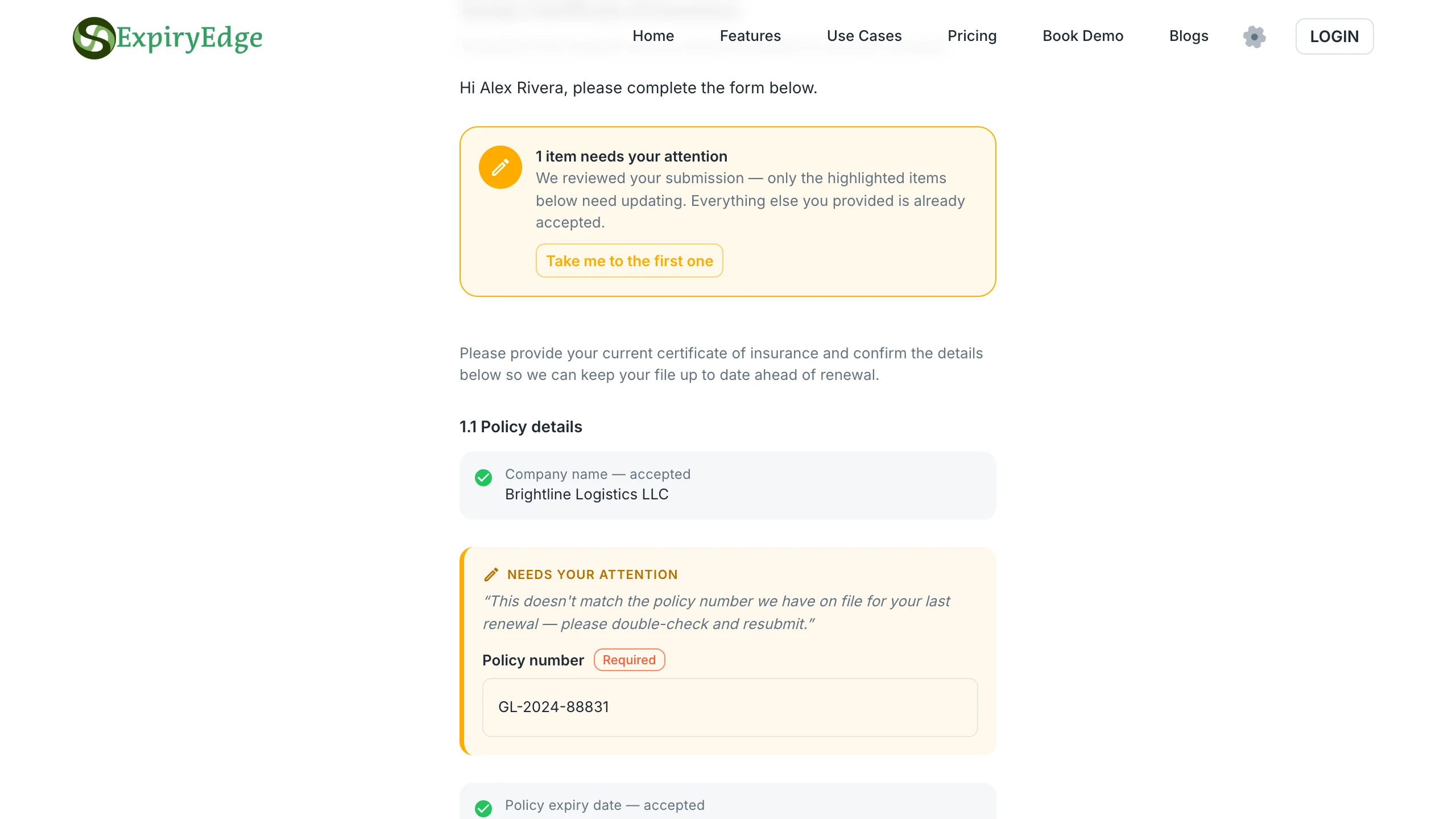
Your calibration lab uploads by link
Send the lab a request link for each batch. They upload the certificates, enter the calibration date and the as-found result, without creating an account. ExpiryEdge follows up until it is complete. If a certificate shows the wrong serial number, reject that item and the same link asks for a corrected copy.
No-login upload link for the lab
As-found result captured as a field
Reject and re-request a single certificate
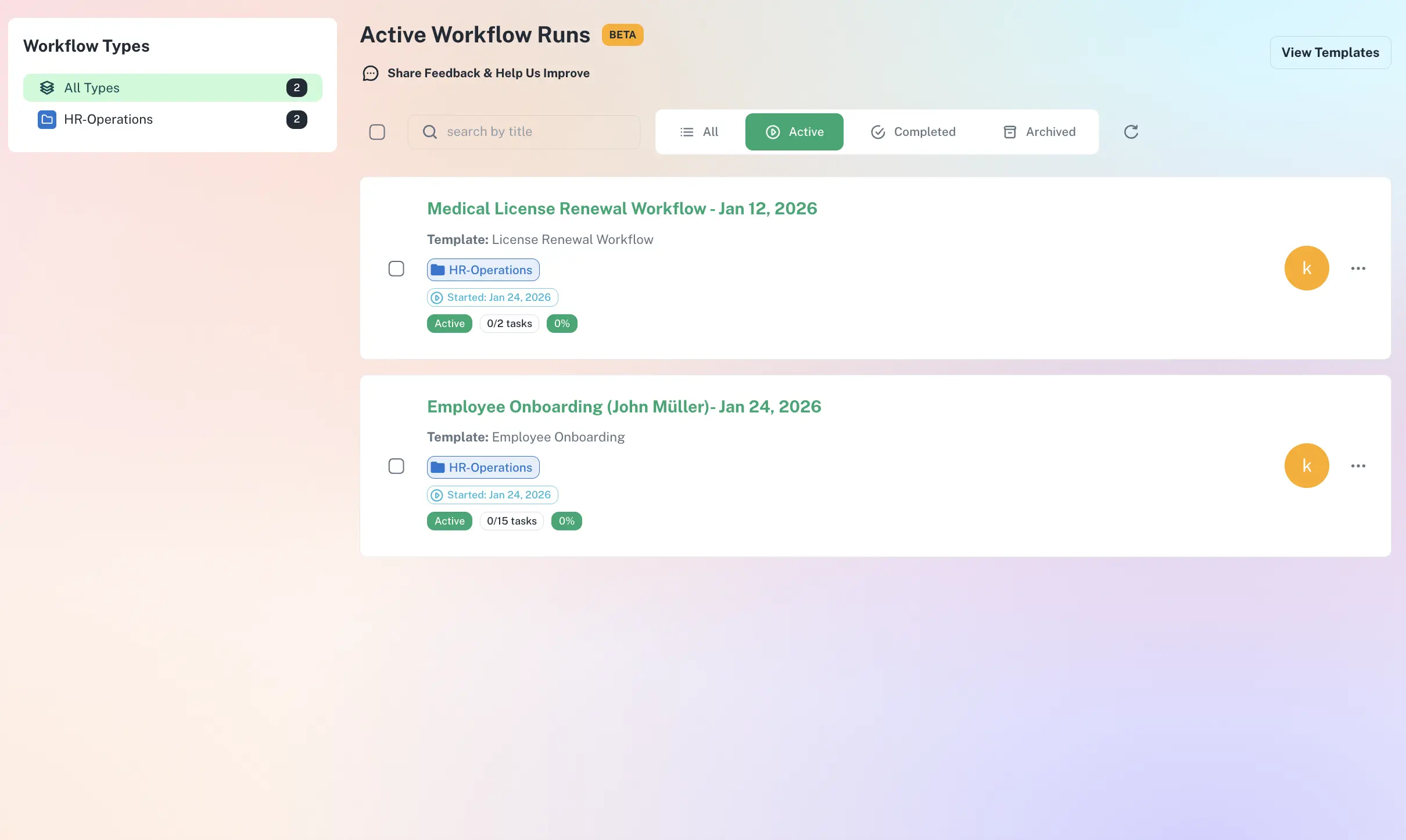
A checklist that records the impact assessment
An out-of-tolerance result starts a checklist: quarantine the instrument, list the products measured since the last good calibration, assess the impact and record the decision, then approve. Each step can require a photo, a signature and a timestamp - exactly what the auditor will ask to see.
Steps completed in order
Photo, signature and timestamp per step
Linked to the instrument record
Reminders that reach the line, not just the lab
Instrument owners on the shop floor get reminders by SMS or WhatsApp; the quality team by email, Slack or Microsoft Teams.
ExpiryEdge vs a gauge spreadsheet vs a CAQ calibration module
| ExpiryEdge | Spreadsheet | CAQ calibration module | |
|---|---|---|---|
| Live in a day, no implementation project | |||
| Reminders to instrument owners by SMS, Teams, email | Varies | ||
| Calibration lab uploads certificates without an account | Rarely | ||
| Out-of-tolerance checklist with evidence | |||
| Also ISO audits, inspections, permits, supplier certificates | Manual | Partly | |
| Timestamped audit trail | |||
| Measurement uncertainty and in-house calibration procedures |
ISO 9001 does not set a fixed interval. Clause 7.1.5.2 requires measuring equipment used to demonstrate conformity to be calibrated or verified at specified intervals, or before use, against standards traceable to international or national standards. You set the interval from the manufacturer's recommendation, how heavily the instrument is used, its stability history and the risk of a wrong measurement. ExpiryEdge holds that interval per instrument and reminds before each due date.
ISO 9001 requires traceability, not a specific accreditation. A certificate from a laboratory accredited to ISO/IEC 17025 - by DAkkS in Germany or UKAS in the UK - is the most straightforward way to show it, and many customers and sector standards require it. Record the lab and its accreditation on the certificate request in ExpiryEdge so it is visible at audit.
ISO 9001 requires you to assess whether the validity of previous measurement results has been affected and take appropriate action. In practice: quarantine the instrument, identify products measured with it since the last good calibration, assess the impact, decide on any recall or rework, and record it. ExpiryEdge turns this into a checklist on the instrument record with photo, signature and timestamp on each step.
Send the lab a request link for each batch of instruments. They upload the certificates and enter the calibration date and as-found result, without creating an account, and ExpiryEdge follows up until everything is in. When you approve a certificate, the next due date for that instrument rolls forward automatically.
Yes. Set the status to at lab when an instrument goes out, and the dashboard shows which instruments are away and since when. Combine that with a reminder to the line owner so a calibrated replacement is in place before the instrument leaves.
It covers the scheduling, ownership, certificate and evidence side of calibration management for organisations that use external labs. It does not calculate measurement uncertainty or run in-house calibration procedures; if you need those, a CAQ calibration module is the right tool, and ExpiryEdge can still track your other deadlines alongside it.
A calibration register that keeps itself current
Import your gauge list, set intervals and owners, send the first certificate request to your lab. Free 14-day trial, no credit card.