
Every statutory inspection, every building, one schedule you can prove.
Lifts, fire alarms, emergency lighting, fixed wiring, gas, water hygiene and fire doors all run on different intervals, different contractors and different certificates. ExpiryEdge keeps each inspection as a dated record per building, names the person responsible, collects the contractor's certificate by link and reminds people 90, 60, 30 and 7 days before it falls due.
Last updated · ExpiryEdge editorial team
Built for FM teams, managing agents and in-house estates teams
One record per inspection, per building
Recurring dates roll forward when you log the visit
Contractors upload certificates by link, no login
Per-building audit export for insurers and auditors
Quick answer
Building inspection tracking means holding every statutory and recommended inspection - lift thorough examinations, fire alarm servicing, emergency lighting tests, EICRs, gas safety checks, fire door checks, water hygiene - as a dated record per building with an owner, the contractor and the last certificate. ExpiryEdge reminds the owner at 90, 60, 30 and 7 days, escalates when a date passes and keeps a timestamped trail you can show an insurer or auditor.
Why inspection dates slip in a growing portfolio
The date lives in a contractor PDF
The next due date is printed on page 3 of last year's report, saved in someone's inbox. Nobody sees it again until the contractor phones - or doesn't.
Every asset has its own clock
Passenger lifts every 6 months, fire alarms every 6 months, emergency lighting monthly and annually, fixed wiring every few years. One spreadsheet column cannot hold all of that per building.
Contractor diaries fill up
By the time the reminder is noticed a week before the due date, the specialist contractor cannot come until next month and the building runs out of compliance.
People change, knowledge leaves
When a site manager leaves, so does the knowledge of which contractor does what, where the logbook is and when the next visit is due.
Proof is scattered
An insurer, auditor or fire officer asks for the last three years of certificates for one building. Someone spends two days searching inboxes and shared drives.
In-house checks go unrecorded
The monthly emergency lighting flick test and weekly fire alarm test are done, but with no record, date or photo they cannot be proven.
Common UK building inspections and their intervals
The intervals most UK property and FM teams track. Statutory maximums are marked; others come from British Standards or approved codes of practice and may be shortened by your competent person or risk assessment.
| Inspection | Interval | Basis | Who |
|---|---|---|---|
| Passenger lift thorough examination | Every 6 months (or per written examination scheme) | LOLER 1998 reg 9 | Competent person, often an insurer's engineer |
| Other lifting equipment (goods lifts, hoists) | Every 12 months (6 months if it lifts people) | LOLER 1998 reg 9 | Competent person |
| Fire alarm inspection and servicing | At least every 6 months; weekly user test | BS 5839-1 | Competent fire alarm contractor |
| Emergency lighting | Monthly functional test; annual full-duration test | BS 5266-1 / BS EN 50172 | Responsible person / competent contractor |
| Fixed wiring (EICR) - private rented homes | At least every 5 years | Electrical Safety Standards (PRS) (England) Regs 2020 | Qualified electrician |
| Fixed wiring (EICR) - commercial | Commonly 5 years for offices and shops, shorter for industrial | Electricity at Work Regs 1989; IET Guidance Note 3 | Qualified electrician |
| Landlord gas safety check | Every 12 months (up to 2 months early keeps the date) | Gas Safety (Installation and Use) Regs 1998 reg 36 | Gas Safe registered engineer |
| Communal fire doors (residential over 11 m) | At least every 3 months | Fire Safety (England) Regs 2022 reg 10 | Responsible person |
| Flat entrance fire doors (residential over 11 m) | Best endeavours, at least every 12 months | Fire Safety (England) Regs 2022 reg 10 | Responsible person |
| Dry risers | 6-monthly inspection; annual pressure test | BS 9990 | Specialist contractor |
| Fire risk assessment | Review regularly and after significant change; must be recorded | Regulatory Reform (Fire Safety) Order 2005 art. 9 | Responsible person |
| Asbestos management plan | Review at regular intervals; monitor condition of ACMs | Control of Asbestos Regs 2012 reg 4 | Duty holder |
See every building and every inspection on one screen
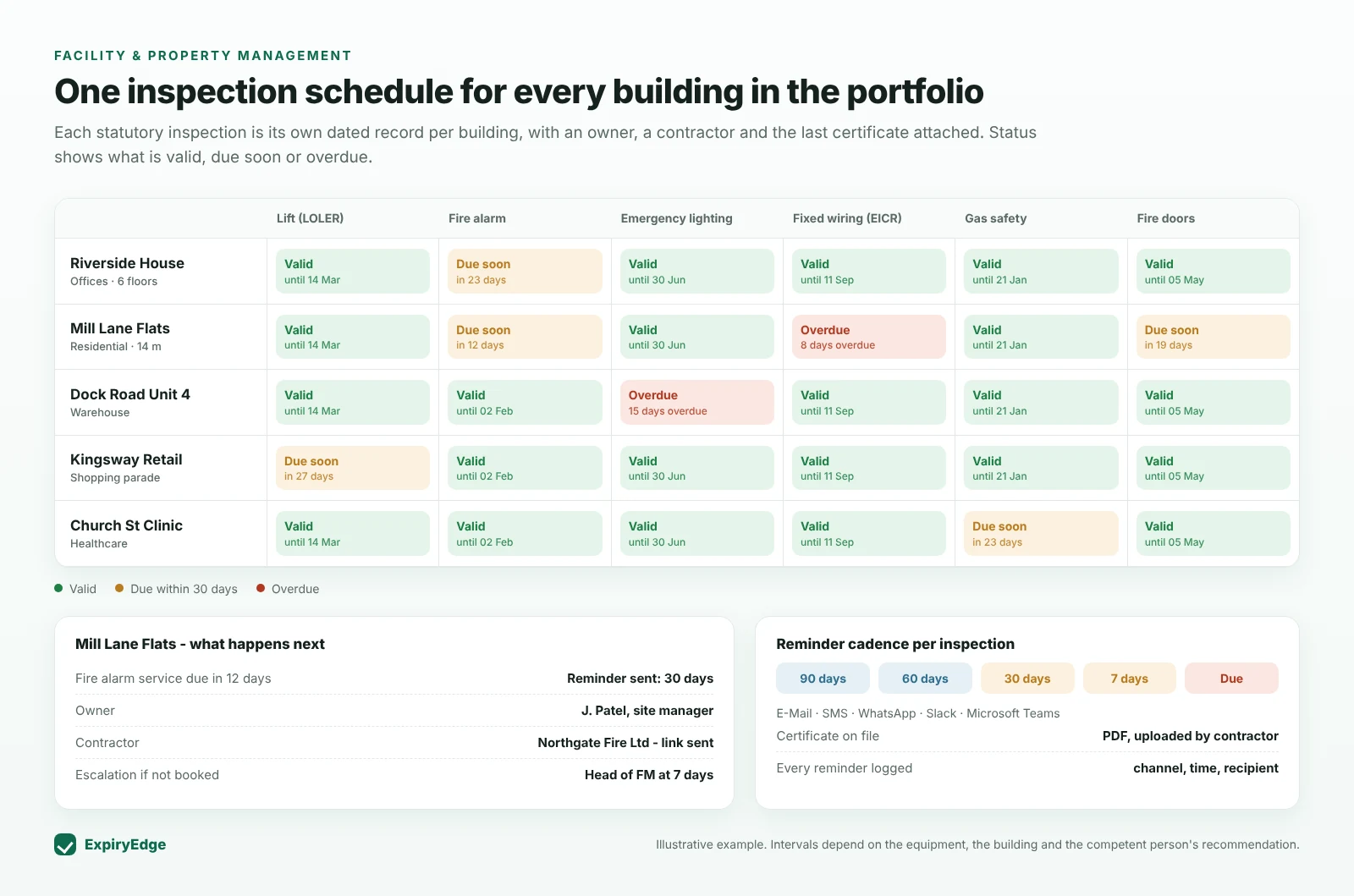
Each cell is a record with its own interval, owner, contractor and certificate. Green is valid, amber is due within 30 days, red is overdue.
From a contractor PDF to a schedule that runs itself
One record per inspection, per building
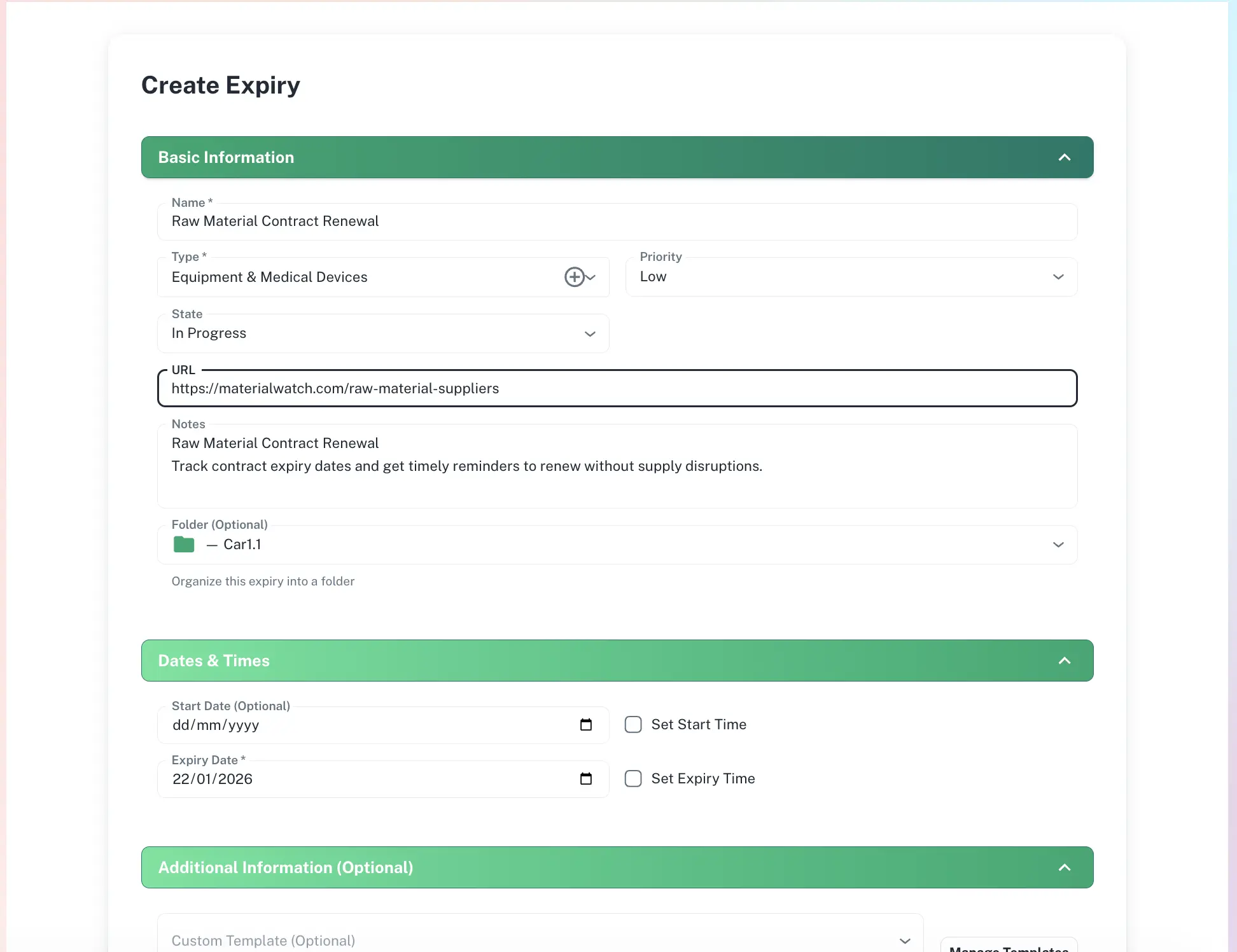
Import your buildings and their inspection dates from a spreadsheet, or add them one at a time. Each record carries the interval, the building, the responsible site or contract manager and the contractor. When the visit is logged, the next due date rolls forward on the interval you set - so the schedule never needs rebuilding.
Spreadsheet import for an existing schedule
Recurring records roll to the next due date
Group by building, region, client or asset type
Reminders that leave time to get a contractor in
The default cadence is 90, 60, 30 and 7 days before the due date, and you can set it per inspection type - a lift examination booked through an insurer needs more lead time than a monthly test. Reminders go to the named owner by email, SMS, WhatsApp, Slack or Teams. If the date passes, ExpiryEdge escalates to the next person in line.
Cadence configurable per record
Owner, backup and manager escalation
Status visible as valid, due soon or overdue
Contractors upload the certificate by link
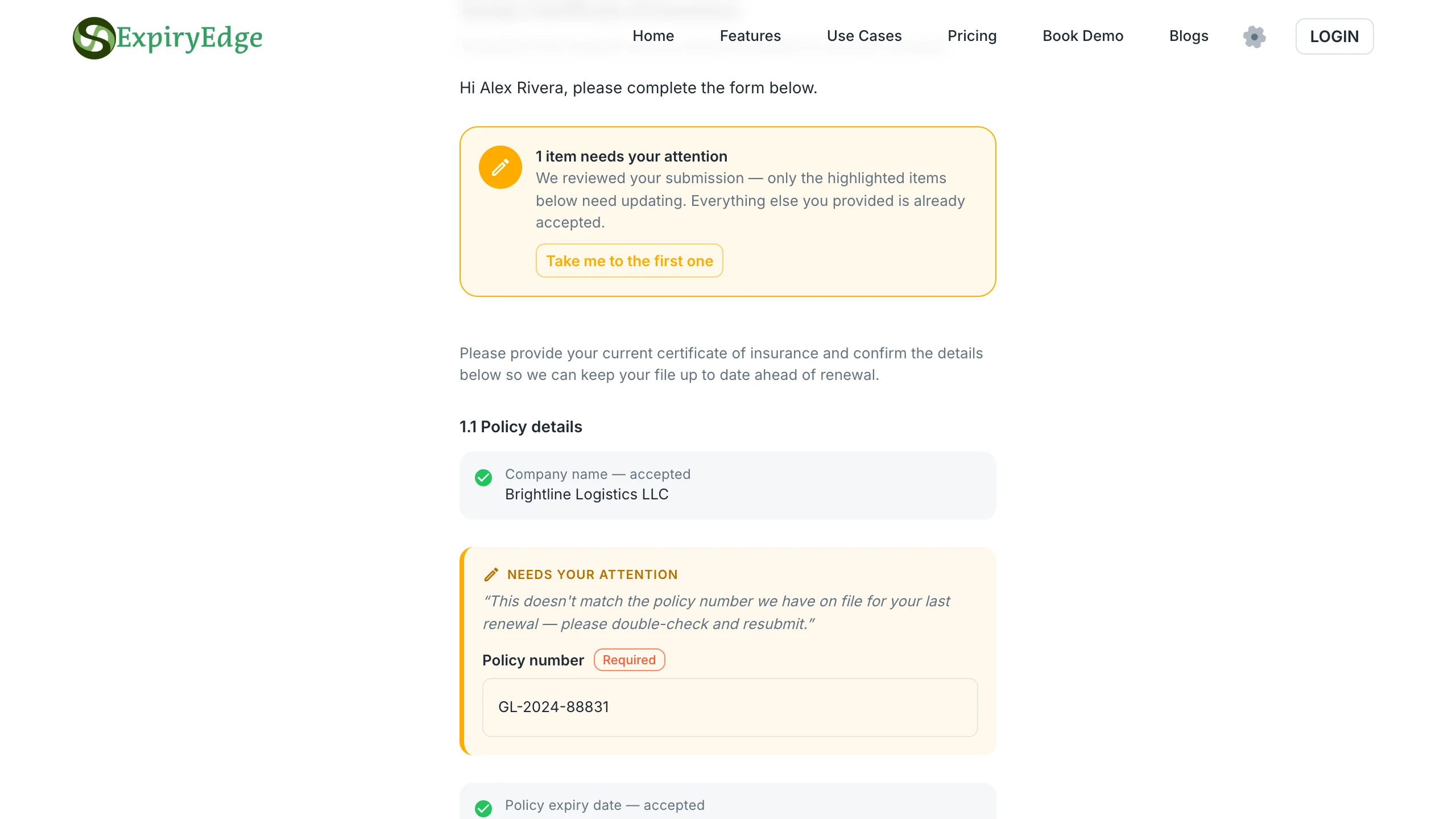
After the visit, the contractor gets a link to upload the certificate or report and confirm the visit date. They do not need an account. ExpiryEdge follows up automatically until it arrives. If the wrong building is on the certificate or a page is missing, reject that item with a comment and the same link asks for just that correction.
No-login upload link per request
Automatic follow-up until complete
Reject and re-request a single field
Checklists for weekly and monthly tests
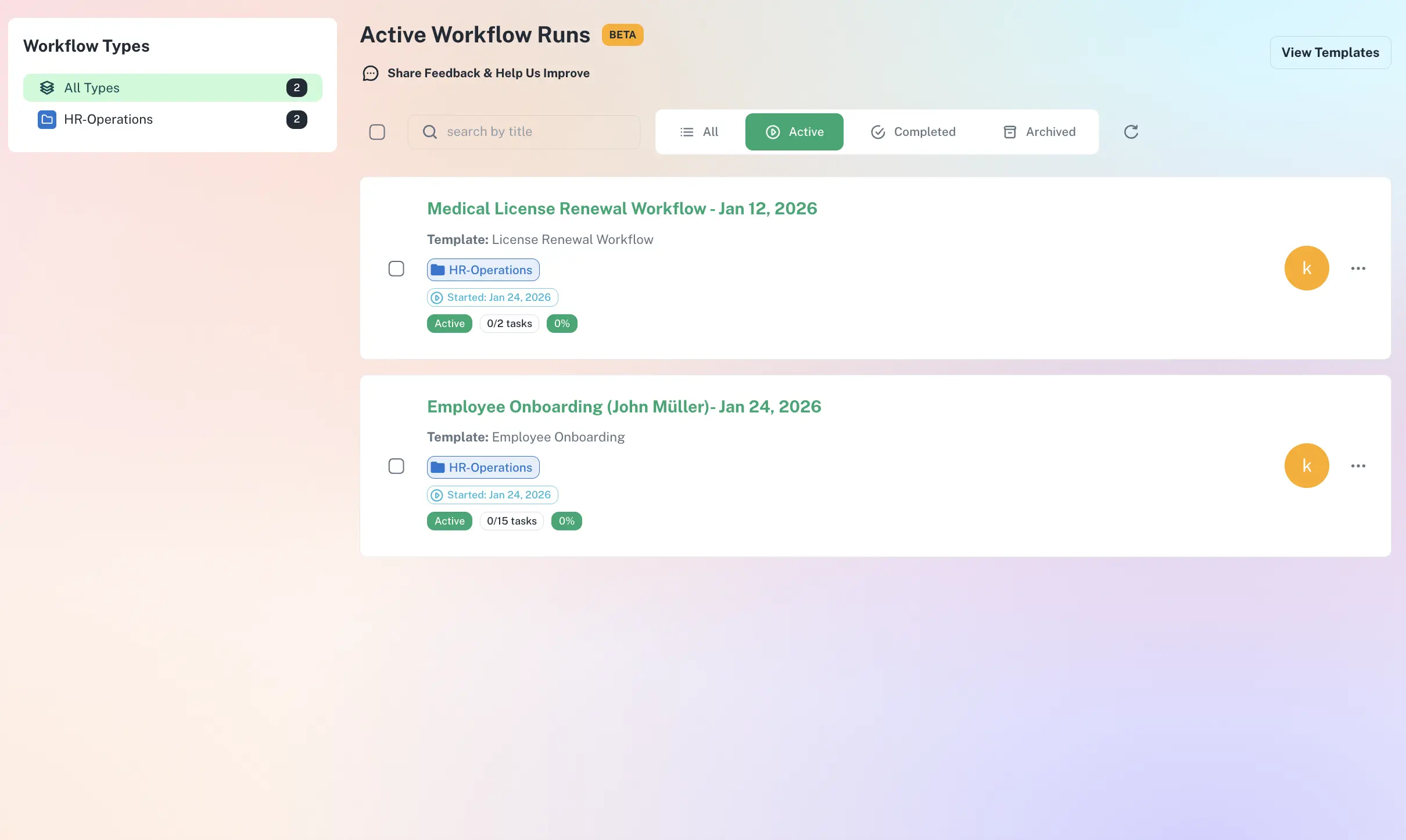
Weekly fire alarm call-point tests, monthly emergency lighting flick tests and fire door checks become checklists assigned to the site team. Each step can require a photo, a signature and a timestamp, so the record shows who checked what and when - including doors where access was refused.
Photo, signature, timestamp and location per step
Assigned to a site, a team or a person
Missed checks flagged automatically
A per-building audit pack in minutes
Filter by building and export every inspection, its current status, the certificate on file and the full history of reminders and uploads as CSV, PDF or XLSX. That is what an insurer, a fire officer, a client or a new managing agent will ask for.
Export by building, client or inspection type
Every reminder and upload timestamped
History survives staff changes
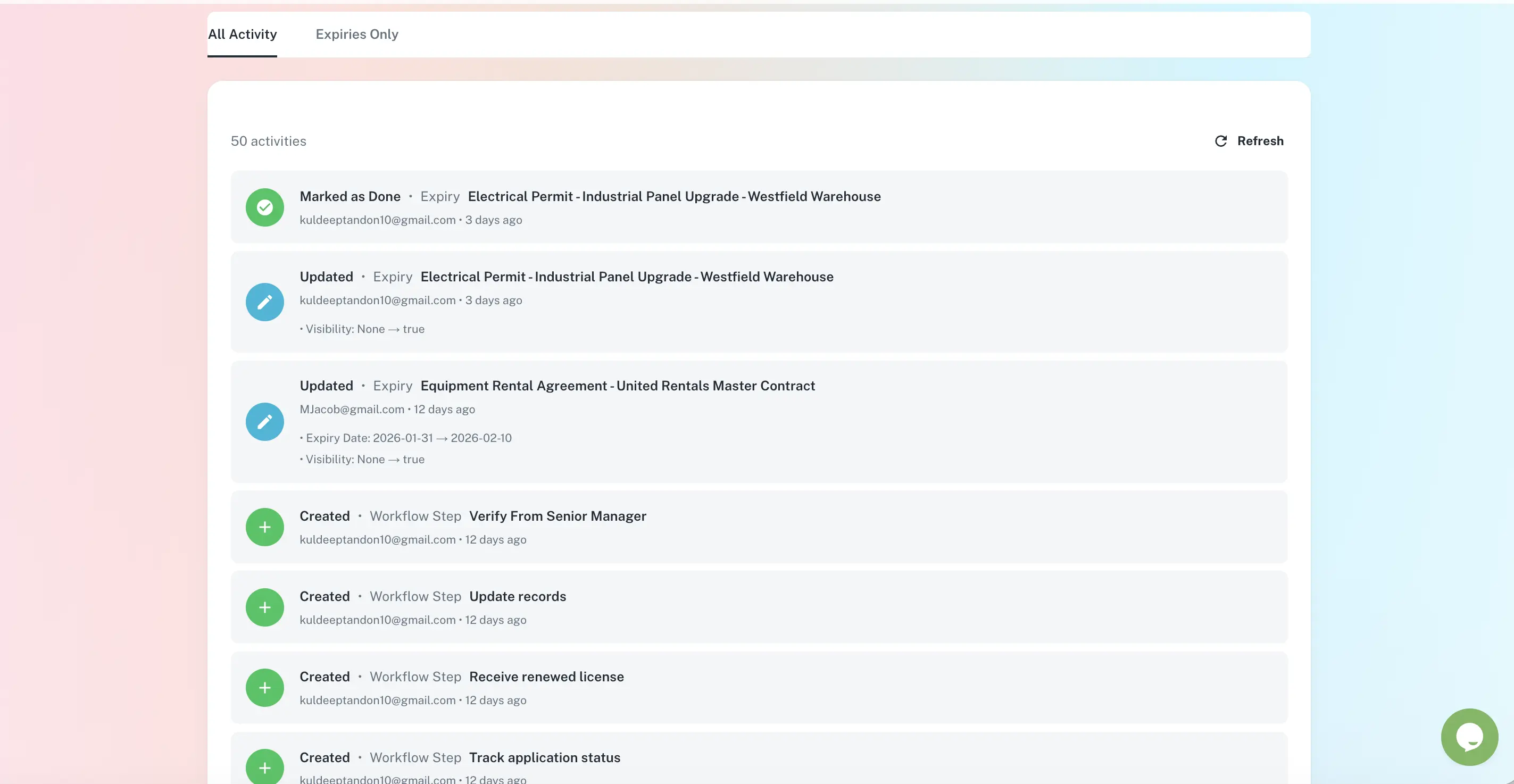
Reminders that reach site teams, not just inboxes
Site managers and caretakers are rarely at a desk. Send their reminders by SMS or WhatsApp and the FM team's by email, Slack or Microsoft Teams.
ExpiryEdge vs a spreadsheet vs a full CAFM system
| ExpiryEdge | Spreadsheet | CAFM / CMMS | |
|---|---|---|---|
| Live in a day, no implementation project | |||
| Reminders to owners by SMS, WhatsApp, Teams | Varies | ||
| Escalation when a date passes | |||
| Contractors upload certificates without an account | Rarely | ||
| Reject and re-request a single document | |||
| Also tracks insurance, leases, contracts and licences | Manual | Partly | |
| Timestamped audit trail | |||
| Work orders and helpdesk |
Most commercial buildings need lift thorough examinations (every 6 months for passenger lifts under LOLER 1998), fire alarm servicing at least every 6 months (BS 5839-1), monthly and annual emergency lighting tests (BS 5266-1), a fixed wiring inspection (commonly every 5 years for offices and shops), a fire risk assessment reviewed regularly, a legionella risk assessment and, where asbestos may be present, a management plan reviewed at regular intervals. Residential blocks over 11 m also need fire door checks under the Fire Safety (England) Regulations 2022. The exact list depends on the building, its systems and its use.
Start with an asset list per building (lifts, fire alarm, emergency lighting, fixed wiring, gas appliances, water systems, fire doors), add the interval and the contractor for each, then the last inspection date. That gives you a planned preventive maintenance (PPM) schedule. Many FM teams base the task list on SFG20 or their maintenance contracts. In ExpiryEdge each line becomes a recurring record with an owner and reminders, so the schedule keeps itself current instead of living in a spreadsheet.
Create one record per inspection per building with its interval, owner and contractor, and let the reminders run from there. In ExpiryEdge you import the schedule from a spreadsheet, see every building on one dashboard and filter by region, client or inspection type. Recurring records roll forward when the visit is logged. Teams with a CAFM often keep it for work orders and use ExpiryEdge for deadlines, certificates and evidence.
Earlier than most teams do. Specialist contractors and insurers' engineers book weeks ahead, and some inspections must happen within a fixed window. A first reminder at 90 days for annual items and at 30 days for six-monthly items leaves time to book, reschedule and chase. ExpiryEdge lets you set a different cadence per inspection type.
Send a request link tied to the inspection record. The contractor uploads the certificate or report, confirms the visit date and signs if needed, without creating an account. ExpiryEdge follows up automatically until it is complete, and you can reject one wrong item - for example the wrong address on the certificate - and ask for only that to be corrected.
In residential buildings over 11 metres, communal fire doors must be checked at least every 3 months, and the responsible person must use best endeavours to check flat entrance doors at least every 12 months, keeping a record of the steps taken. ExpiryEdge can hold both as recurring checklists with photos and timestamps, including a record when access to a flat was refused.
Yes. Every reminder, upload, approval and completion in ExpiryEdge is timestamped against the record. Filter by building and export the current status, certificates and history as CSV, PDF or XLSX. Because the history stays with the record, it survives a site manager leaving or a contract changing hands.
No. Your competent persons and contractors carry out the inspections and set the intervals for your assets; your risk assessments decide what applies. ExpiryEdge makes sure every agreed date has an owner, is booked in time and leaves evidence behind.
Put every building's inspections on one schedule
Import your buildings and last inspection dates, assign owners, send the first certificate request. Free 14-day trial, no credit card.