
A statutory inspection on one of our buildings is overdue. What do we do now?
Find out whether the equipment is still safe to use, book the inspection today and keep proof of every step. Then check the rest of the portfolio, because one overdue date usually means the system that should have caught it is not working. Finally, give every inspection an owner, a reminder cadence and a place for the certificate.
Last updated · ExpiryEdge editorial team
Quick answer
If a statutory inspection is overdue, ask your competent person whether the equipment can still be used safely and take it out of use if they say no; book the inspection today and get written confirmation; record what happened and what you did; and check every other building for the same gap. Then hold each inspection as a dated record per building with an owner, reminders 90, 60, 30 and 7 days ahead and escalation if it passes.
What to do in the next 48 hours
1. Establish exactly what is overdue, and by how long
Find the last certificate or report, the date it was done and the interval that applies - in the report itself, the written scheme of examination or the competent person's recommendation. Note whether the last report listed defects that were never closed. An overdue date on a lift or pressure system is a different risk from an overdue fire risk assessment review.
2. Decide whether the equipment can stay in use
Call the competent person, engineer surveyor or service company and ask. If the last report recorded a dangerous defect, or they advise against use, take the equipment out of service and put interim measures in place - for example fire watches or restricted areas for a fire system - and tell occupants or staff what has changed.
3. Book the inspection today and get it in writing
Ask for the earliest date and a written booking confirmation. If your usual contractor cannot come soon enough, ask another qualified provider. Keep the confirmation: it shows you acted as soon as you knew.
4. Check the jurisdiction-specific points
UK: thorough examinations under LOLER must happen at the intervals in regulation 9 or in the examination scheme, and an enforcing authority can ask for the reports. Germany: for lifts, pressure equipment and other equipment in BetrSichV Anhang 2 and 3, § 14 Abs. 5 BetrSichV treats an inspection carried out within two months after the due date as on time; beyond that, missing or late inspections are administrative offences under § 22 BetrSichV with fines under § 25 ArbSchG. If the inspection is required by a Land Prüfverordnung, check that regulation. Take legal advice where it matters.
5. Check your insurance position
Some policies make maintenance or inspection a condition of cover. Read the conditions or ask your broker how an overdue inspection affects the policy, and keep their answer on file. Do not assume cover either way.
6. Look at every other building the same way
Pull every inspection date for every building and sort by due date. Anything overdue or due in the next 30 days gets booked this week. One missed date usually points to a gap in how dates are tracked, not a one-off.
Inspections go overdue for predictable reasons
The contractor was meant to remind you
Many teams rely on the service company or the insurer's engineer to call. When their staff, schedule or contract changes, nobody calls.
The date was only in last year's report
The next due date sat in a PDF in someone's inbox. Nobody had it in a list that sends reminders.
The responsible person left
A site or contract manager moved on and the knowledge of which contractor does what, and when, went with them.
Every system runs on its own clock
Six-monthly lifts and fire alarms, monthly emergency lighting, multi-year electrical tests. A single spreadsheet column per building cannot carry that.
Every inspection, every building, one dated schedule
A record for each inspection with an owner
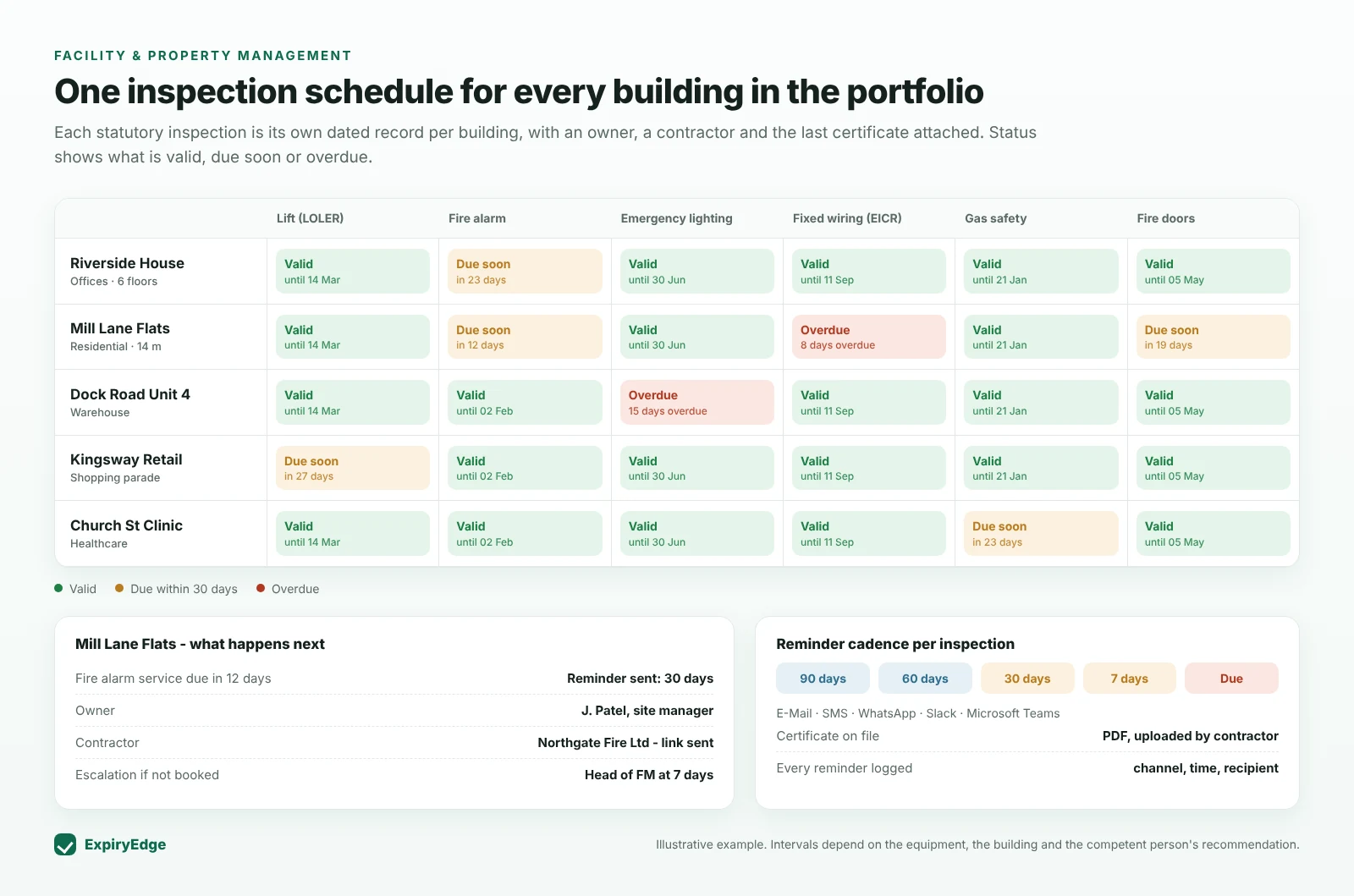
In ExpiryEdge each building gets a record per inspection - lift, fire alarm, emergency lighting, fixed wiring, gas, water hygiene, fire doors - with its interval, the responsible person and the contractor. When the visit is logged, the next due date rolls forward automatically.
Status per building: valid, due soon or overdue
Recurring dates roll forward
Portfolio view for head office
Reminders with enough lead time, escalation if ignored
Reminders go to the owner at 90, 60, 30 and 7 days by email, SMS, WhatsApp, Slack or Microsoft Teams. If the due date passes with no visit logged, the record escalates to the next manager so it cannot sit quietly overdue.
Cadence configurable per inspection type
Escalation to a named manager
Every reminder timestamped
Certificates collected from contractors by link
After the visit the contractor uploads the certificate through a link, without an account, and ExpiryEdge follows up until it arrives. The next time someone asks for proof, it is on the record with the full history.
No-login upload link
Automatic follow-up
Export per building as CSV, PDF or XLSX
Ask the competent person who examines it, today. Whether it is safe depends on its condition and the findings of the last report; if that report recorded a defect involving danger, it should not be used until the defect is fixed. Get the examination booked and keep a written record of the advice you were given and what you decided.
For equipment covered by BetrSichV Anhang 2 and 3 - such as lifts and pressure equipment - § 14 Abs. 5 BetrSichV treats an inspection carried out no later than two months after the due date as on time. That is not a general grace period for every inspection, and inspections under a Land Prüfverordnung or other rules follow their own text. Book as soon as you notice, and check the wording for your equipment.
It depends on the regulation and the country. In Germany, failing to have work equipment inspected on time is an administrative offence under § 22 BetrSichV, with fines under § 25 ArbSchG, and Land Prüfverordnungen set their own fines. In the UK, enforcing authorities can serve notices or prosecute under health and safety and fire safety law. After an incident, the larger exposure is often civil liability and, for individuals, potential criminal liability.
It depends on your policy conditions. Some policies require equipment to be inspected or maintained, and a breach can affect a claim. Ask your broker in writing and keep the answer. Then make sure every inspection your policy relies on has an owner and a reminder.
List every building and every inspection type, with the last date and interval for each, and sort by next due date. If the data is spread across contractor reports, ask each contractor for their current schedule for your buildings. Importing that list into ExpiryEdge gives you an immediate valid / due soon / overdue view across the portfolio.
Earlier than most teams do. Insurers' engineers and specialist contractors book weeks ahead. A first reminder 90 days before annual items and 30 days before monthly or six-monthly items leaves time to book, reschedule and chase.
See every inspection across every building
Import your buildings and inspection dates, assign owners, attach the certificates. Free 14-day trial, no credit card.