How Startups Track Trademark and Domain Renewals: 6 Tools We'd Shortlist

For a startup with a handful of trademarks and a few dozen domains, ExpiryEdge is the simplest tracker: one record per mark and per domain, reminders that start months ahead, and an escalation if nobody acts. Your trademark attorney still files and your registrar still renews; ExpiryEdge makes sure both happen on time.
If you or your counsel docket marks across many countries, Alt Legal is the better tool, with data from 180+ IP offices and a published price. Clarivate and Corsearch sell services to large brand owners, Markmonitor manages enterprise domain portfolios, and Cloudflare Registrar is a cheap place to hold domains on auto-renew.
We make ExpiryEdge, and we've ranked it first for the small-portfolio reader this post is for. The other five are described from their own websites as of 7 November 2026, with links so you can confirm anything before you rely on it.
| Tool | Reminds you and your attorney (email, SMS, WhatsApp, Slack, Teams) | Tracks trademarks, domains and SSL certificates in one place | Escalates to a manager if nobody renews | Reads dates from your registration certificate | Published pricing / free trial | Docketing with IP office data |
|---|---|---|---|---|---|---|
| ExpiryEdge Top pick | Yes, to your team and your attorney | Yes, plus contracts and insurance | Yes, built in | Yes, AI date extraction | $29-$199/month, 14-day free trial | Your attorney dockets |
| Alt Legal | Deadline reports and calendar sync | Trademarks only | Not stated | Derives data from 180+ IP offices | By number of matters, $60-$295/month | Yes, 180+ IP offices |
| Cloudflare Registrar | Not stated | Domains only, 390+ TLDs | Not stated | Not stated | At registry cost, no markup | No |
| Clarivate | Reminder timing you choose | Patents, trademarks and domains in IPfolio | Not stated | Not stated | Not published | Renewals handled by its agent network |
| Corsearch | Not stated | Domains; trademark clearance and watching | Not stated | Not stated | Not published | Not stated |
| Markmonitor | Not stated | Enterprise domain portfolios | Not stated | Not stated | Not published | No |
How we compared these tools
We built the table around how a startup actually loses a mark or a domain: nobody was told in time. So it asks who gets reminded and how, which matters when your attorney files and a co-founder holds the registrar login. Then whether marks, domains and SSL certificates sit in one place, whether a missed renewal reaches a manager, and whether the tool reads dates from your documents. Published pricing sorts the founder tools from the enterprise services, and docketing gets one column because it's Alt Legal's speciality. On 7 November 2026 we read each vendor's product and pricing pages, and checked the deadlines against the USPTO, GOV.UK and ICANN's renewal policy. We didn't pay for every service. We make ExpiryEdge and placed it first, so judge that call yourself.
Trademarks run on ten-year clocks; domains lapse in a week
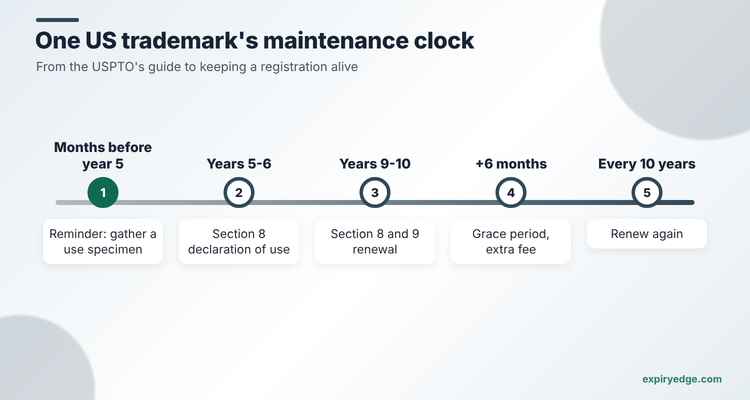
Trademark deadlines are long and easy to forget. The USPTO wants a Section 8 declaration of use between the fifth and sixth years after registration. Then it wants a combined Section 8 and 9 renewal between the ninth and tenth years, and every ten years after that. There's a six-month grace period with an extra fee. Miss that too and the registration is cancelled or expires.
So a mark registered on 15 March 2023 has its Section 8 window open on 15 March 2028. You'd want the first reminder months before that, because you'll need a specimen showing the mark still in use.
The UK is simpler. GOV.UK says a UK trade mark must be renewed every 10 years, and you can renew in the six months before expiry and up to six months after. It costs £245 for the first class and £60 for each extra class, plus a £60 late fee in the six months after expiry.
Domains move faster. ICANN's Expired Registration Recovery Policy only requires registrars to send two notices, about a month and about a week before expiry, and one more within five days after. If those go to a founder who has left, nobody sees them. After expiry, the registrar has to interrupt DNS for a period, so your site and email stop working.
- Registration number, jurisdiction and classes for each mark
- Registration date, plus the next window it opens (Section 8, renewal, or UK renewal)
- The attorney or firm who files, as a contact who gets reminders
- For each domain: registrar, account owner, expiry date and whether auto-renew is on
- The company card the registrar charges, and when that card expires
Here's a common way a domain lapses even with auto-renew switched on. The company card expires, the renewal charge fails, and the registrar's notices go to the inbox of someone who left last year. Nobody notices until the site and email stop resolving. That's why the card and its expiry date belong on the list too, with their own reminder a month ahead.
Before you compare tools: find every mark and every domain
Start with an inventory. Search the USPTO and UK IPO records for your marks, and list every domain with its registrar and expiry. Most startups find a domain or two on someone's personal account.
Then decide who does the filing. If an attorney dockets your marks, ask what reminders they send and copy those dates into your own tracker anyway. If nobody does, you need a tool or a service before the first Section 8 window.
Then run one test. Pick your next trademark deadline and your next domain expiry, and set both up in each tool on your shortlist. Check who gets told, when, and through which channel. If the only reminder lands in a shared inbox nobody reads, change it.
Finally, move every domain to auto-renew on a company card and give each one an owner. For the rest of your startup's calendar, see the SaaS startup compliance software guide, the SaaS subscription management comparison and our startup use case page.
1. ExpiryEdge: best for a startup tracking its own marks and domains
With ExpiryEdge, your .io domain doesn't lapse because the card on file expired, and your Section 8 window doesn't close while everyone assumed the attorney had it. You, your co-founder and your attorney all hear months ahead, and someone senior hears if nobody acts.
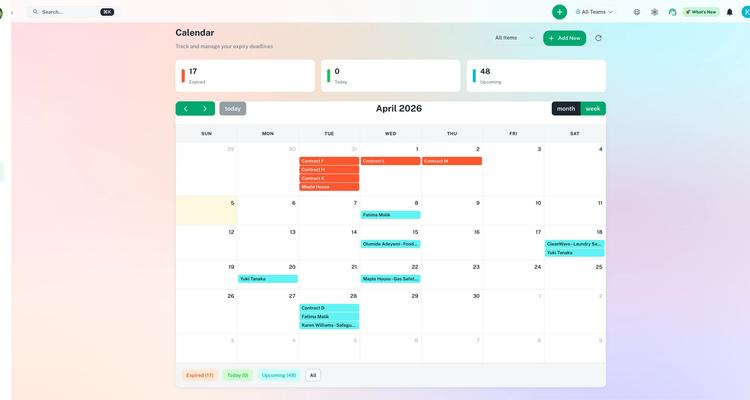
Each trademark and each domain is a record with an owner, a category and custom fields such as registration number, class, jurisdiction or registrar. You set the schedule: 180, 90 and 30 days before a US mark's Section 8 window closes, or 90, 30 and 7 days before a domain expires. Reminders go by email, SMS, WhatsApp, Slack or Microsoft Teams, to your team and to your trademark attorney as an outside contact, and anything still open on the due date escalates to a manager. Upload a registration certificate or registrar invoice and AI reads the dates off it, and the calendar view shows every mark, domain and SSL certificate together. Our domain and SSL expiry tracking page shows that setup.
Try it with your own marks and domains in 15 minutes:
- Create a template with fields for registration number, class, jurisdiction and registrar, then import your marks and domains from a CSV.
- Set 180/90/30-day reminders on each Section 8 or UK renewal window and 90/30/7 days on each domain, with your attorney added as an outside contact.
- Add the company card as its own record, with a reminder a month before it expires.
Pricing: $29 a month on the smallest plan and $199 on the largest, with a 14-day free trial and no card required. Plan sizes are on the ExpiryEdge pricing page.
Good to know: ExpiryEdge works alongside your attorney and your registrar: they file and renew, and it makes sure both happen on time. You enter each date once or let AI read it from the certificate. If you hold marks in many countries and want deadlines pulled from IP offices, your counsel's docketing tool (such as Alt Legal) does that part.
2. Alt Legal: best for attorneys and in-house counsel docketing marks
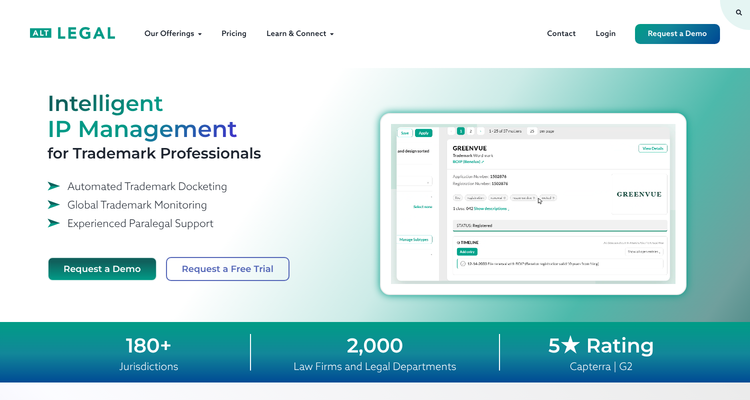
Alt Legal is trademark docketing software that connects to 180+ IP offices, derives data automatically and calculates due dates. It offers calendar sync, deadline reports, email templates and global trademark monitoring. Its customers are law firms and legal departments.
Pricing: published on the pricing page, based on the number of docketed matters, in tiers from up to 50 to up to 400. Monthly prices on the page run from $60 to $295, though the layout doesn't make clear which price goes with which tier. All plans include unlimited users and migration, with no setup fee.
Watch out for: Alt Legal is built for trademark professionals. A founder with three marks may find it more than they need, and it doesn't track domains.
3. Cloudflare Registrar: best cheap place to hold domains on auto-renew
Cloudflare Registrar says it doesn't mark up domain prices: you pay what the registry and ICANN charge. It supports 390+ TLDs, including .com, .ai, .app and .dev, and lets you renew automatically from the dashboard.
Pricing: at cost, per the product page. Prices vary by TLD.
Watch out for: auto-renew only works while the card on file works. The page doesn't describe renewal reminders, and it's a registrar, not a tracker, so domains held elsewhere won't show up.
4. Clarivate: best for handing trademark renewals to a service
Clarivate's corporate trademark renewals service takes over payment and paperwork, using a network of 2,000+ agents. You choose when reminders and invoices are generated, and budget reports project renewal fees. Its IPfolio software, built on Salesforce, holds patents, trademarks, domain names and copyrights in one place.
Pricing: not published; speak to the team.
Watch out for: both products are aimed at corporate IP teams with large portfolios.
5. Corsearch: best for clearance, watching and domain protection
Corsearch is best known for trademark search, clearance and watching. Its domain page offers registration, renewals and monitoring under one platform, through ICANN-accredited registrar services, plus takedowns and recovery of infringing domains.
Pricing: not published; talk to an expert.
Watch out for: the home page doesn't mention trademark renewal management, so you'd still need someone docketing your marks.
6. Markmonitor: best for enterprise domain portfolios
Markmonitor manages enterprise domain portfolios with a dedicated advisor, registration across gTLDs and ccTLDs, domain scoring to right-size a portfolio and DomainWatch threat monitoring. Its about page says it serves many of the world's best-known brands.
Pricing: not published; request a demo.
Watch out for: it's built for large brands. A startup with 20 domains won't need a portfolio advisor.
ExpiryEdge as an alternative to Alt Legal
Don't switch if you're a trademark attorney or paralegal. Alt Legal pulls office data and calculates deadlines across 180+ jurisdictions, which is the docketing job your practice runs on.
ExpiryEdge fits the other side of that relationship: the startup that owns the marks. You probably have two to five registrations, an outside attorney who files, and domains, SSL certificates and insurance policies that expire too. One tracker covers all of them, and it reminds your attorney as an outside contact.
It also helps when the knowledge sits with one person. If your co-founder registered the marks and the domains on a personal account, putting each one on a record with an owner and a backup means the next renewal doesn't depend on their inbox.
Frequently asked questions
Between the fifth and sixth years after your US registration date, according to the USPTO. A combined Section 8 and 9 renewal follows between the ninth and tenth years, then every ten years. Each deadline has a six-month grace period with an extra fee.
Every 10 years. GOV.UK says you can renew in the six months before expiry and up to six months after. The fee is £245 for the first class and £60 for each extra class, with a £60 late fee after expiry.
ICANN's policy requires registrars to send at least two notices, about a month and a week before expiry, plus one within five days after. They go to the registrant email on file, so check that address belongs to someone who still works for you.
Alt Legal publishes pricing based on how many matters you docket, with monthly prices from $60 to $295 on its page. Clarivate, Corsearch and Markmonitor quote on request. ExpiryEdge runs $29 to $199 a month, with a 14-day free trial, and you enter the deadlines yourself.
If your attorney files and you just need reminders, ExpiryEdge is cheaper and also tracks domains, SSL certificates and contracts. You enter the dates once or let it read them from your registration certificate, and your attorney keeps docketing.