
PAAS National and 6 Alternatives: Pharmacy Compliance Tools for Independent Pharmacies

ExpiryEdge is our first pick for running a pharmacy's compliance calendar. It runs the yearly self-inspection as a checklist, reminds you before the DEA registration and state permit expire, schedules the biennial inventory and SOP reviews, and keeps the record of who did what. If the PIC hasn't acted, it escalates to the owner.
It doesn't write policies or train staff. If a PBM contract asks for a compliance programme, pick PAAS National: it gives US independents a customised FWA and HIPAA policy manual, annual staff training, daily exclusion checks and audit help at published prices. For controlled substance records, add C2 Keep, with perpetual CII inventory and DEA biennial inventory reports. In the UK, Pharmsmart covers the CD register and RP log. Mitti suits checklist-style audits, and your pharmacy system (PioneerRx, for example) handles prescription-level checks.
We make ExpiryEdge, which is one of the six alternatives here. PAAS National and the rest are described from their own websites and price lists as of 7 November 2026, with links you can follow.
| Tool | Main job | Controlled substances | Reminders before deadlines | Published pricing |
|---|---|---|---|---|
| ExpiryEdge Our product | Deadlines, self-inspection checklists, document collection | Dates and checklists only | Email, SMS, WhatsApp, Slack, Teams | $29 to $199 a month |
| PAAS National | FWA, HIPAA and USP 800 programmes, audit help | No | Vault emails before expiry | $447 to $1,567 a year |
| C2 Keep | CII perpetual inventory and DEA reports | Yes | Not stated | $85 a month billed yearly |
| Pharmsmart | UK CD register, RP log, incident reports | Yes, UK CD register | Email for missed logs | Not published |
| Mitti (by SafetyCulture) | Checklists and audits | Checklists only | Not stated | $0 for up to 10; Premium $24 a seat |
| PioneerRx | Pharmacy management system | DEA edits, perpetual inventory | To-do list | Not published |
| D2 ComplySuite | Multi-state licensing and regulatory alerts | Not stated | Alert routing | Not published |
How we compared these tools
These tools do different jobs, so the first column says what each one is actually for. Then we asked the questions a board inspector or DEA investigator would: are controlled substance records covered, does anything warn you before a deadline, and can you see the price. We read each vendor's own product and pricing pages on 7 November 2026, and checked the rules in eCFR, Oregon's self-inspection form, the Responsible Pharmacist Regulations and GPhC standards. We didn't run paid trials. ExpiryEdge is ours, so read its section as the maker's case.
The DEA, the state board and the daily registers
Pharmacy compliance is a calendar of fixed dates plus daily records. Software earns its keep when it keeps both from slipping on a busy week.
Start with the DEA. Under 21 CFR 1301.13, a retail pharmacy's registration expires 36 months after its first period, and you can apply to renew no earlier than 60 days before. 21 CFR 1304.11 requires a new inventory of every controlled substance on hand at least every two years, and 21 CFR 1304.04 says those records must be kept for at least two years and be ready for inspection.
State boards add their own. Oregon's retail self-inspection form tells the pharmacist-in-charge to complete it each year by 1 February and within 15 days of becoming PIC, review it with staff, sign it and keep it ready for an unannounced inspection. Other states use similar forms on their own dates.
In the UK, the Responsible Pharmacist Regulations 2008 require written or electronic pharmacy procedures covering everything from supply to complaints and incidents, available at the premises and "reviewed regularly". The GPhC's standards for registered pharmacies judge governance and staff against these.
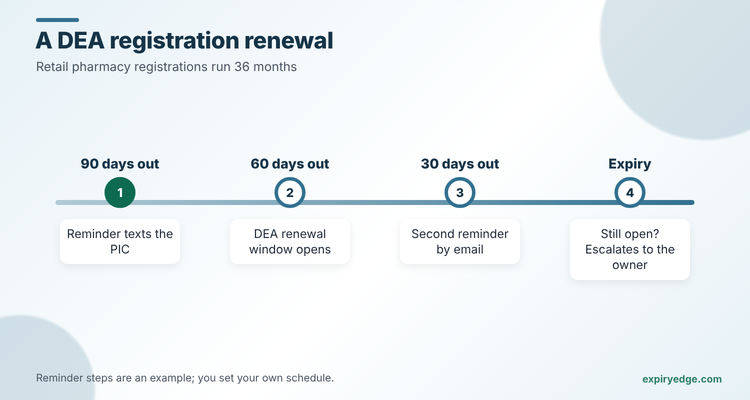
- DEA registration: reminder 90 days out, renew in the last 60
- Biennial controlled substance inventory: date of the last one plus two years
- State pharmacy permit and any controlled substance registration
- Annual self-inspection, plus one within 15 days of a new PIC where your state asks
- SOP or procedure review dates, with staff sign-off
- Annual FWA, HIPAA and USP 800 training for every employee
Separate daily records from the yearly calendar
Write down the five dates you'd least like to miss: DEA renewal, biennial inventory, state permit, self-inspection and the next SOP review. Then list the records you keep daily: CII counts, CD register, RP log, fridge temperatures.
Daily records belong in a specialist (C2 Keep, Pharmsmart or your pharmacy system). Programmes and training belong with PAAS or your own policies. The calendar, checklists and documents from outside people can sit in ExpiryEdge, and a trial with your five dates will show you in an hour whether it fits.
Our pharmacy compliance software guide maps each problem to a tool. For staff credentials see pharmacist licence and CPE tracking software, and the audit preparation page shows how the audit export works. Pharmacy-specific set-ups are on the pharmacies page.
1. ExpiryEdge: best for running the compliance calendar
ExpiryEdge holds every dated obligation as a record: the DEA registration, state permit, biennial inventory, self-inspection, SOP review and each employee's training. You set reminder steps, say 90, 60, 30 and 7 days, by email, SMS, WhatsApp, Slack or Teams. If the PIC hasn't acted when the date passes, it escalates to the owner.
The self-inspection itself becomes a reusable SOP checklist. Load your state's form as steps, assign them to the PIC and a technician, and schedule a run every January. Live progress shows what's left, and the audit trail records who ticked each step and when. A Monday fridge-temperature check or a monthly CII count review works the same way.
Document collection covers the paperwork you need from others. Send your wholesaler, reverse distributor or software vendor a no-login link to upload a renewed licence or sign a business associate agreement, and ExpiryEdge follows up until it arrives.
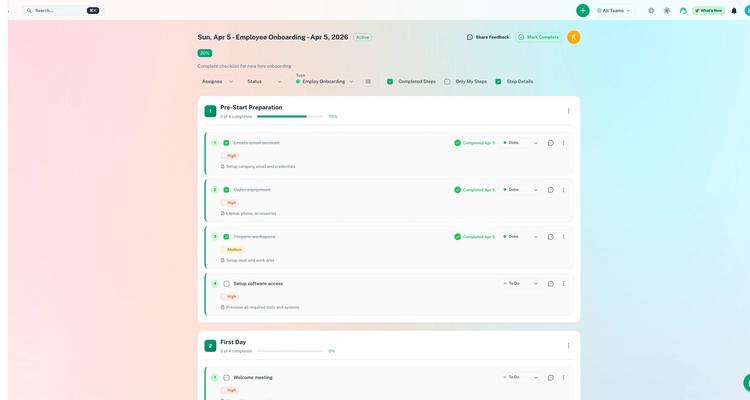
Pricing: monthly, from $29 for one user to $199 for the Power plan. You get 14 days to try it first, with no card required.
Watch out for: ExpiryEdge doesn't keep a controlled substance perpetual inventory, file reports with the DEA or a PMP, or write your FWA manual. Pair it with C2 Keep and PAAS, or your pharmacy system, for those.
Try it with your own inspection calendar in 15 minutes:
- Add the store's DEA registration, state permit and last biennial inventory date as records, each with a 90/60/30-day schedule that escalates to the owner.
- Turn your state's self-inspection form into a checklist template, assign steps to the PIC and a technician, and schedule it for every January.
- Send your wholesaler a no-login request link to upload its renewed licence.
The pricing page lists what each plan covers.
2. PAAS National: best compliance programme for US independents
PAAS National's FWA/HIPAA Compliance Program gives you a customised policy and procedure manual of more than 150 pages, a HIPAA risk analysis, a code of conduct that staff sign each year, annual FWA, HIPAA and cybersecurity training, and daily OIG and GSA exclusion checks. Pharmacist experts help if you have a data breach or an internal fraud case. A web dashboard shows programme status.
Its Audit Assistance service gives one-on-one help with audits, filling and billing questions, and a USP 800 programme covers hazardous drug risk assessments, policies and training. PAAS says PBMs and CMS require an effective compliance programme.
Pricing: listed on the Buy Now page: FWA/HIPAA $648 a year for up to 20 employees, Audit Assistance $559, USP 800 $447, and bundles from $1,069 (Silver) to $1,567 (Platinum). Pharmacies already in an audit must buy two years.
Watch out for: PAAS covers payer, privacy and USP 800 compliance. It doesn't keep your CII inventory or run a state self-inspection for you.
3. C2 Keep: best for controlled substance records
C2 Keep is a CII compliance tool. It keeps a perpetual inventory even when you split NDCs, creates DEA biennial inventory reports, and builds 90-day state audit reports and totals reports for a corrective action plan. Wholesaler integrations attach DEA 222 forms to orders, and it connects to pharmacy systems including Liberty, PioneerRx, BestRx and DigitalRx.
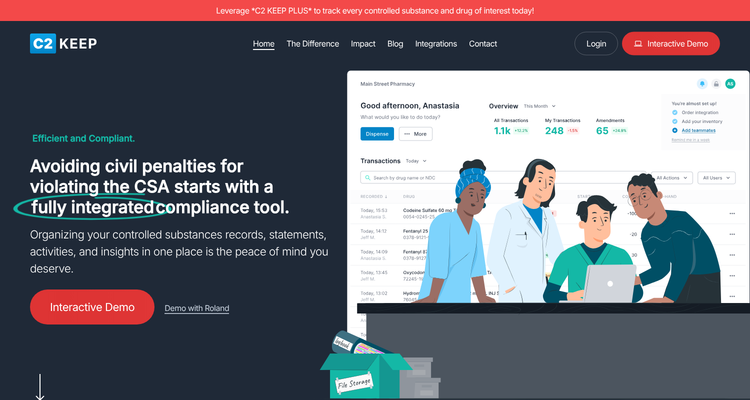
Pricing: the pricing page lists one plan at $85 a month billed yearly, with unlimited users and transactions. Month-to-month is available, and paying yearly gives two months free.
Watch out for: the page doesn't say whether $85 is per store or per account, or mention a free trial. Ask before you sign for several stores.
4. Pharmsmart: best for UK CD registers and daily logs
Pharmsmart is a UK suite. CDsmart is an electronic controlled drugs register with fast balance checks, discrepancy detection, patient returns, bulk destruction logs and a view for CD inspectors. Reportsmart records patient safety incidents and GDPR breaches against GPhC and PQS requirements.
Its free extras include a Responsible Pharmacist log that emails you if you forget to sign out, a temperature log with a reminder when the day's reading is missing, a private register, an NMS tracker and a cleaning log.
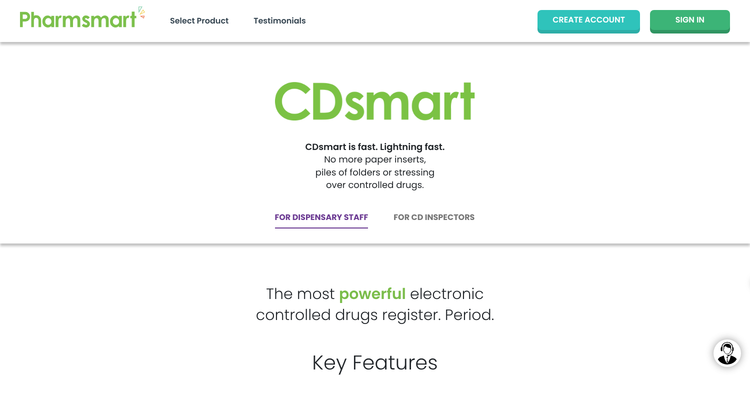
Pricing: not published on the home page; you sign up or contact support.
Watch out for: it's built for UK law. A US pharmacy should look at C2 Keep instead.
5. Mitti (by SafetyCulture): best for checklist-style audits
SafetyCulture's inspection app now appears as Mitti. Its pharmacy audit template is a free, editable checklist for dispensing and service checks that supervisors can change to fit the store. You could rebuild your state self-inspection form the same way.
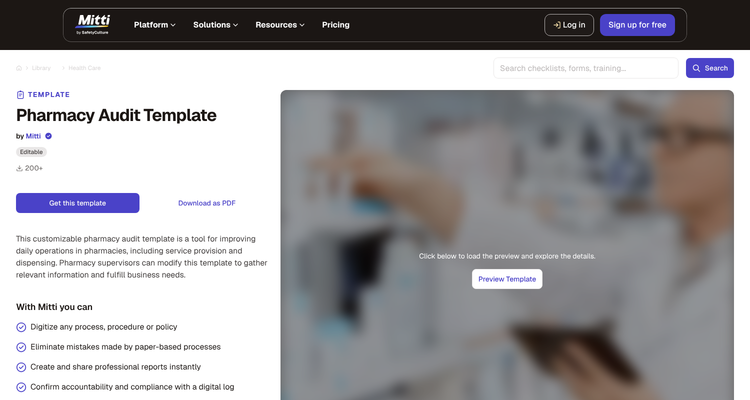
Pricing: the pricing page lists a $0 plan for teams of up to 10 with five active templates, and Premium at $24 a seat a month billed yearly ($29 monthly).
Watch out for: Mitti tracks inspections, not licence or permit expiry dates or outside documents.
6. PioneerRx: best for checks inside the dispensing workflow
If you run PioneerRx, use what's in it. It flags a missing or invalid prescriber DEA number, updates DEA and NPI data, keeps a perpetual inventory, tracks pseudoephedrine sales and has a dashboard to-do list you can assign to staff.
Pricing: not published; request a demo.
Watch out for: a pharmacy system checks prescriptions. It doesn't track the store's own permit, self-inspection or training dates. Liberty Software and other systems are similar.
7. D2 ComplySuite: best for multi-state pharmacy organisations
ComplySuite from D2 Solutions combines LicenseComply for licence status, AccredComply for accreditation tasks and RegComply, which triages state and federal regulatory alerts and routes them to the right people. It's built by pharmacists for anything from one site to large multi-site groups.
Pricing: not published; modular contracts through a demo.
Watch out for: the scope suits specialty, mail-order and non-resident pharmacies with many state licences. A single community store will use a fraction of it.
ExpiryEdge as an alternative to PAAS National
We put ExpiryEdge first because every pharmacy has these dates, and missing one (a lapsed DEA registration, a skipped self-inspection) is where trouble starts. PAAS National is still the right call for the programme itself.
PAAS and ExpiryEdge mostly do different jobs. PAAS writes your FWA and HIPAA manual, trains staff and checks exclusions. ExpiryEdge doesn't do any of that, so if a PBM contract asks for a compliance programme, keep PAAS.
Where the two overlap is the PAAS Vault, which stores licences and documents and emails before expiry. ExpiryEdge goes further on that one job: SMS and WhatsApp reminders to the person who must act, escalation, no-login upload links for wholesalers or staff, recurring checklists for self-inspections, and dashboards across several stores.
Switch that part if your Vault year is ending and you want one place for every date in the business. Don't switch if PAAS membership is the reason you have the Vault at all; at $99 a year it's the cheaper add-on.
Frequently asked questions
C2 Keep keeps a perpetual CII inventory, creates DEA biennial inventory reports and connects to systems such as PioneerRx and Liberty for $85 a month billed yearly. In the UK, Pharmsmart's CDsmart is an electronic controlled drugs register with discrepancy detection.
Under 21 CFR 1304.11, a DEA registrant must take a new inventory of all controlled substances on hand at least every two years. Under 21 CFR 1304.04, inventories and records must be kept for at least two years and be available for inspection.
It depends on the state. Oregon's form asks the pharmacist-in-charge to complete it every year by 1 February and within 15 days of becoming PIC. Check your board's site, then schedule it as a recurring checklist in a tool such as ExpiryEdge or Mitti.
Published prices include PAAS National at $447 to $1,567 a year, C2 Keep at $85 a month billed yearly, Mitti at $0 for up to 10 people or $24 a seat a month, and ExpiryEdge at $29 to $199 a month. Pharmsmart, PioneerRx and D2 ComplySuite quote on request.
Pharmacy systems such as PioneerRx flag invalid prescriber DEA numbers and keep a perpetual inventory. They don't track the store's permit, DEA renewal, self-inspection or staff training dates, so most owners add a deadline tracker such as ExpiryEdge or PAAS Vault.
Mitti has a $0 plan for teams of up to 10 with five active templates, including a pharmacy audit template. Pharmsmart offers free extras such as an RP log and temperature log. ExpiryEdge has a 14-day free trial with no credit card, then paid plans.
Not medical, clinical, or HIPAA compliance advice
This article is for general informational purposes and does not constitute clinical or HIPAA compliance advice. ExpiryEdge is not currently a HIPAA Business Associate. Healthcare organisations handling Protected Health Information should review the specifics of their compliance programme with a qualified privacy officer or HIPAA consultant.