
The 6 Best Grant Deadline Management Tools in 2027, Ranked for Nonprofits Juggling Post-Award Reports

ExpiryEdge is our first pick for nonprofits whose real problem is what happens after the award: quarterly reports, renewals, SAM.gov updates and the documents partners owe you. You set the reminder schedule, it texts or emails whoever owns the date, and a subrecipient can upload a report through a link without a login. If you also need to find funders and run applications, pair it with Instrumentl. It finds funders, keeps every application in one pipeline, and emails whoever owns a task 14, 7 and 2 days before it's due.
The others suit narrower cases. Fluxx Grantseeker and Euna Grants fit larger teams with heavy post-award reporting, Grantable is an AI writing tool with a $0 starting plan and a built-in tracker, and Plinth is a UK option whose basic funding tracker costs nothing.
We make ExpiryEdge, and we've put it first for post-award work, not for prospecting. The details on Instrumentl, Fluxx, Euna, Grantable and Plinth were taken from their own websites on 7 November 2026, and every one links to its source.
| Tool | Reminds whoever owns the report, on your schedule (email, SMS, WhatsApp) | Subrecipients upload and sign from a link, no login | Escalates overdue reports to the executive director | Audit trail you can export | Published pricing / free trial | Grant database and funder search |
|---|---|---|---|---|---|---|
| ExpiryEdge Top pick | Yes, email, SMS, WhatsApp, Slack, Teams | Yes, no-login link with e-signatures | Yes, built in | Yes, timestamped and exportable | $29-$199/month, 14-day free trial | Pairs with your research tool |
| Instrumentl | Fixed 14/7/2-day emails to the task owner | Not stated | Not stated | Not stated | $299 to $999 a month; 14-day trial | Yes, finds funders |
| Fluxx Grantseeker | Not stated | Not stated | Not stated | Not stated | Not published; demo | Not stated |
| Euna Grants | Automated reminders for progress and financial reports | Not stated | Not stated | Audit-ready documentation | Not published; request pricing | Not stated |
| Grantable | Scheduled scans report back by email | Not stated | Not stated | Not stated | $0, $50 or $150 a month | Not stated |
| Plinth (UK) | Deadline and reporting reminders on the £0 plan | Not stated | Not stated | Not stated | £0, then from £30 per user a month | Eligibility checks against live funder data |
How we compared these tools
We focused on the deadlines that cost a nonprofit money, so the first column asks whether a tool reminds the person who owns each report, on a schedule you choose. Then come the documents partners owe you, who hears about it when a report slips, and a log you can show an auditor. Published pricing matters to a budget set a year ahead. The last column covers funder search, which is a separate job from hitting report dates. We read each vendor's product, pricing and help pages on 7 November 2026, and checked the federal reporting dates against 2 CFR 200 and 2 CFR 25 on eCFR. We didn't run paid trials of all six. We make ExpiryEdge, so judge its ranking knowing that.
The deadlines that hurt arrive after the award letter
Finding the next grant is the fun part. Post-award dates are harder, because they repeat and they belong to different people.
Take a federal award. Under 2 CFR 200.328, annual financial reports are due no later than 90 days after the reporting period, and quarterly or semiannual reports within 30 days. When the award ends, 2 CFR 200.344 gives you 120 days to submit every final report, or 90 days if you're a subrecipient reporting to a pass-through entity. You also have to keep your SAM.gov registration active and review it every year under 2 CFR 25.200, or the agency can't add funds.
Spend $1,000,000 or more of federal money in a year and 2 CFR 200.501 adds a single audit. Its reporting package is due 30 days after you receive the auditor's report or nine months after year end, whichever comes first, per 200.512.
Foundations are less formal but just as fussy. Each one sets its own report dates, renewal windows and attachments. So the software has to do two jobs: hold every date per grant, and get the right person moving early enough that the narrative, the budget and the attachments are ready together.
- Application and letter of inquiry deadlines
- Interim narrative and financial reports, often quarterly or annual
- Federal reports: 30 days after a quarter, 90 days after a year
- Final reports: 120 days after the period of performance ends
- SAM.gov registration review: every year
- Renewal or reapplication window for multi-year funders
1. ExpiryEdge: best for post-award deadlines on a small budget
With ExpiryEdge, a late final report or a lapsed SAM.gov registration stops putting next year's funding at risk, and your development lead gets back the days spent chasing program staff and partners. Every report date has an owner who hears about it in time, and the executive director hears about it when nobody acts.
Each award becomes a record built from a custom template: funder, amount, grant period, program lead and report dates. Quarterly or annual reports repeat on their own, so you set them up once per award. You choose the reminder schedule; a federal final report might start at 90 days, then 60, 30 and 7. Reminders go by email, SMS, WhatsApp, Slack or Microsoft Teams, to your program lead, your finance person, or both, and if nobody marks the report done, it escalates to the executive director.
The document side matters as much. When a subrecipient owes you their quarterly numbers, send a request link. They upload the file and sign the certification without creating an account, and ExpiryEdge follows up until it arrives. Your reviewer can reject one field with a comment, which reopens the same link for just that item.
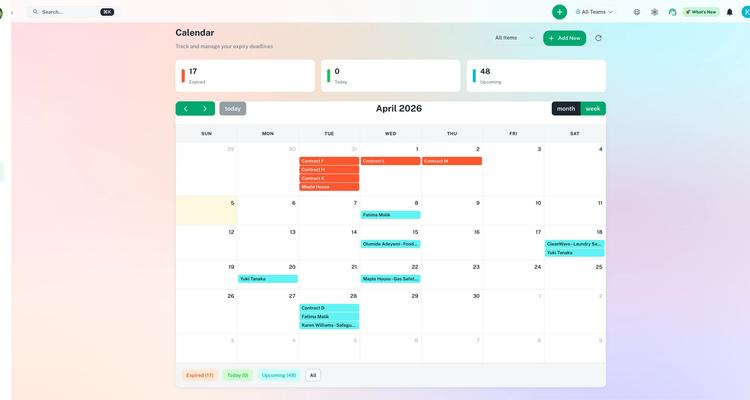
The same account can hold the SAM.gov annual review, your audit date, the insurance certificate a funder asked for and the renewal date on every multi-year grant. Our nonprofits page shows the setup.
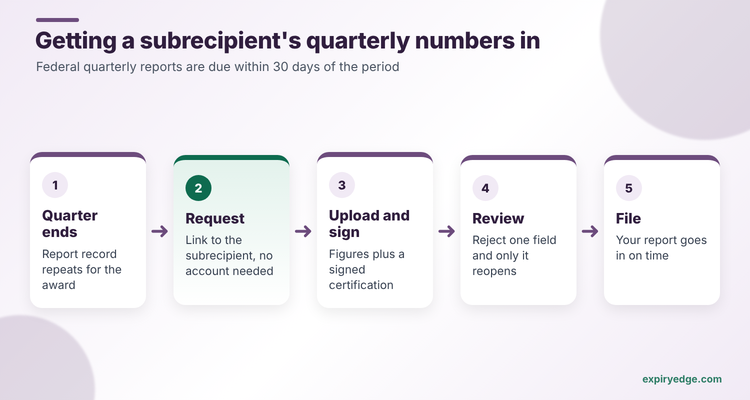
Try it with your own awards in 15 minutes:
- Create a grant template with fields for funder, amount, grant period and program lead, then import your active awards from a spreadsheet.
- Put a 90/60/30/7-day schedule on the next report for each award, sent to the program lead and finance, with escalation to the executive director.
- Send one subrecipient a no-login request link for their quarterly figures and a signed certification.
Pricing: one of four monthly plans, Personal $29, Pro $49, Business $99 or Power $199, chosen by how many dated items you track. Every plan starts with a 14-day free trial, no credit card. Each plan's item limit is on the ExpiryEdge pricing page.
Good to know: ExpiryEdge picks up where your research tool stops. Keep Instrumentl or your funder database for prospecting and proposals, and ExpiryEdge runs every date and document once the award letter arrives.
2. Instrumentl: best all-in-one grant tracker for most nonprofits
Instrumentl combines a grant database with a tracker. Its Tracker help article describes a project workspace where every saved opportunity moves through statuses such as Researching, Planned, Application Submitted and Awarded, with an "all projects" view of upcoming deadlines.
Tasks do the chasing. Per Instrumentl's tasks article, each task has one assignee plus followers, and only tasks with a deadline get reminders: 14 days, 7 days and 2 days before, on the day, and 2 days after. You can't change those timings. Recurring tasks cover repeating reports, and on Pre-Award and above the Award Assistant can generate reporting tasks and deadlines from an award letter.
Its deadline page adds a weekly email of upcoming saved deadlines and an automatic email when a funder changes a deadline.
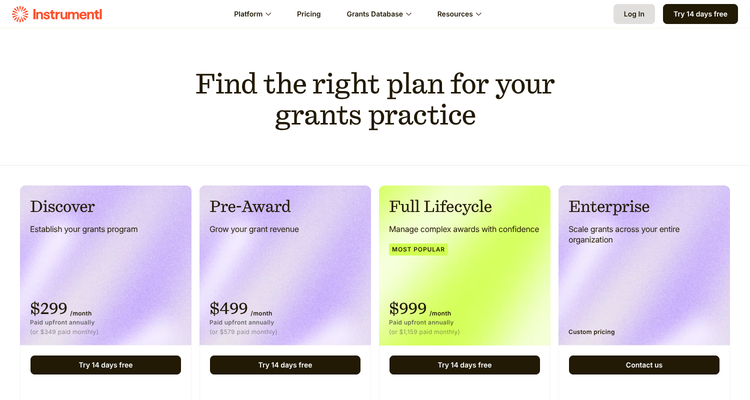
Pricing: published on the pricing page. Discover is $299 a month paid annually ($349 monthly) for up to 3 users, Pre-Award $499 ($579) for 5 users, and Full Lifecycle $999 ($1,159) for 15 users. Each has a 14-day free trial with no credit card.
Watch out for: Google and Outlook calendar sync and the Award Assistant start on Pre-Award, not Discover. Reminder timings are fixed, so a 60-day nudge for a big federal report has to be a separate task.
3. Fluxx Grantseeker: best for teams managing a large active portfolio
Fluxx is best known for funder software, but its Grantseeker product is built for applicants. The page says it manages deadlines, budgets, reporting and responsibilities for every grant in one place, with tasks, approvals and named owners. A calendar view shows deadlines and scheduled activities across grants, and the FAQ says most teams go live in one to two weeks.
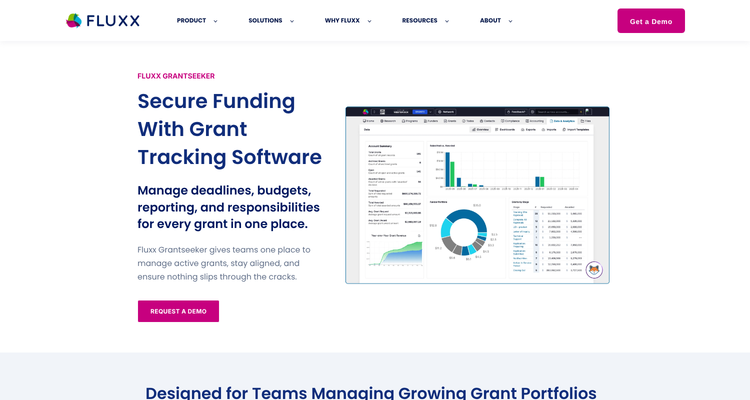
Pricing: not published. You request a demo or join a group demo.
Watch out for: the page doesn't mention reminders or notifications, so ask how the system tells a program lead that a report is due.
4. Euna Grants: best for public money and audit-heavy reporting
Euna Grants is pitched at both nonprofits and public agencies. Its Grant Seeker page says it tracks deadlines, deliverables and spending in one system, automates reminders for progress and financial reporting, and keeps audit-ready documentation for every award cycle.
The wider Euna Grants page adds custom tasks and workflows with automatic reminders, plus a reporting engine for audits. That suits an organisation drawing down federal or state funds that has to show its working.
Pricing: not published. Both pages route you to request pricing or a demo.
Watch out for: the main product page describes itself as purpose-built for government and public sector organisations, so a small charity with foundation grants may be paying for features it won't use.
5. Grantable: best free starting point for writing and tracking
Grantable is AI grant writing software that also runs a pipeline. Its homepage describes list, board, calendar and stats views of every grant from prospect to award, filled in as you work, and a Management desk that runs a daily check.
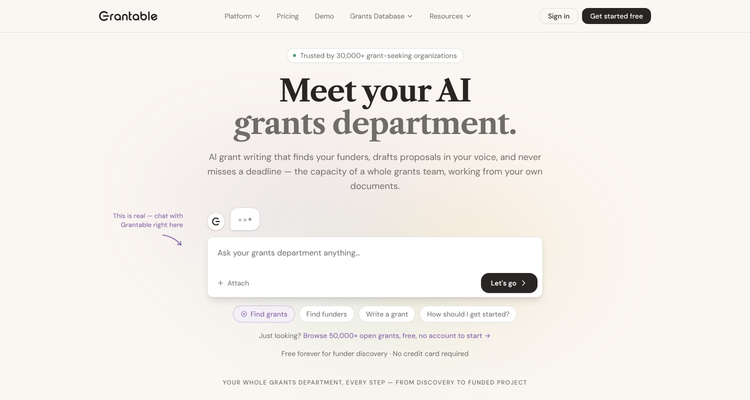
Pricing: the pricing page lists a $0 plan, Starter at $50 a month and Pro at $150 a month, with no per-seat fees. The same page lists a $300-a-month Agency Hub add-on.
Watch out for: the pricing page doesn't describe a dedicated reminder feature. The closest is scheduled scans that report back by email.
6. Plinth: best free option for UK charities
Plinth is a UK charity platform. Its pricing page lists a £0 Community plan with a funding tracker, deadline and reporting reminders, eligibility checks against live funder data, and capped funder research. Paid plans add multi-year grant tracking and a pipeline across grants and donors.
Pricing: Community is £0. Relationships is £30 per user a month and Intelligence £100 per user a month, each with a three-user minimum and shown excluding VAT.
Watch out for: it's built around UK funders and charities. A US nonprofit with federal awards will get more from Instrumentl or Euna Grants.
ExpiryEdge as an alternative to Instrumentl
We put ExpiryEdge first because the deadlines that cost a nonprofit money come after the award letter, and that's what it tracks. Switch to ExpiryEdge if you already know your funders and your pain is reporting. A 20-grant nonprofit with quarterly reports, a SAM.gov review and an annual audit has about 100 dated items a year. That fits the $49 Pro plan, which is less than a fifth of Instrumentl's entry price.
You also control the timing and the channel. A program director who ignores email will read a text that says the Q3 report is due in 14 days. And a subrecipient can upload their report through a link without a login.
Instrumentl is still the right call if prospecting is half your job. Its database, matching and Award Assistant cover the prospecting side. Some teams run both: Instrumentl until the award letter arrives, ExpiryEdge for every date and document after it.
Count next year's report dates, then load one real award
Start by counting. List every active grant and write down each report, renewal and registration date for the next 12 months. If you have fewer than 30 dates, a shared calendar might do. Past 50, you need a tool that assigns owners and chases them.
Then decide where the hard part sits. If it's finding money, buy a tool with a database. If it's getting reports in on time, test each shortlisted tool with one real award: load the grant, set the next report date, and see who gets reminded, when, and on what channel.
Finally, think beyond grants. The same team usually owns insurance renewals, state charity registrations and board policy reviews. Our nonprofit compliance software guide covers the full picture, and the nonprofit compliance calendar comparison handles 990s, registrations and policy reviews.
Frequently asked questions
Turn every report into a dated task with one owner as soon as the award letter arrives. Instrumentl's Award Assistant can create reporting tasks from the letter on Pre-Award plans. ExpiryEdge and Euna Grants send automatic reminders before each report and keep a record of what was submitted.
Published prices range from $0 (Grantable's starting plan and Plinth's Community plan) to $999 a month for Instrumentl Full Lifecycle. ExpiryEdge runs $29 to $199 a month after a 14-day free trial. Fluxx Grantseeker and Euna Grants quote on request after a demo.
Yes. Grantable's $0 plan includes its pipeline and dashboard, with a daily chat message limit. Plinth's £0 Community plan tracks UK grant applications with deadline and reporting reminders. ExpiryEdge and Instrumentl offer 14-day free trials, then paid plans only.
Under 2 CFR 200.344, a recipient must submit all financial, performance and other final reports within 120 calendar days after the period of performance ends. A subrecipient reports to its pass-through entity within 90 days. The agency can approve an extension when it's justified.
Not for finding or tracking applications. But you may want a second tool if reports, audits, SAM.gov reviews and partner documents keep slipping. Instrumentl's reminder timings are fixed, and they only go by email. ExpiryEdge adds custom schedules, SMS and WhatsApp reminders, and no-login document requests.
At least once a year. Under 2 CFR 25.200, an applicant or recipient must keep its SAM.gov registration active while it has an active federal award or pending application, and review and update the information every year. An agency generally can't add funds while you're out of compliance.