
Every warranty and service contract end date, per serial number.
Warranties are missed because they live per machine, not per customer, and parts cover often ends on a different day from labor cover. ExpiryEdge gives each serial number a record with its end dates, proof of purchase and owner, and sends reminders at 90, 60, 30 and 7 days, so dealers make the service contract offer in time and owners raise claims while cover still applies.
Last updated · ExpiryEdge editorial team
One method for the dealer who sells cover and the business that owns the equipment
One record per serial number, not per customer
Separate end dates for parts, labor and extended cover
Offer sequence for dealers at 90, 60, 30 and 7 days
Proof of purchase and claim references on the record
Quick answer
Warranty tracking software stores the end date of every warranty and service contract per serial number, with proof of purchase attached, and sends reminders before each one ends. Equipment dealers use those reminders to offer extended warranties and service contracts at 90, 60, 30 and 7 days. Businesses that own equipment use them to raise claims while cover still applies. ExpiryEdge holds each as a record with an owner, files and reminders by email, SMS, Slack or Teams.
What warranty tracking covers
Manufacturer warranties, one per serial number
Split cover: parts, labor, components with their own end dates
Extended warranties and service contracts
Maintenance contracts with notice and auto-renew dates
Install, delivery and invoice dates (the start-date rule)
Proof of purchase and warranty registration
Claim references and repair history
Service visits the warranty terms require
Software support and firmware subscriptions on equipment
Equipment leases and insurance
Warranty and coverage types: what to record and the rule behind it (US)
| What it is | Date to track | Rule | |
|---|---|---|---|
| Written warranty on business equipment | The maker's or seller's written promise. The federal Magnuson-Moss Act "does not apply to warranties on products sold for resale or for commercial purposes," so the document's terms govern | End date for each type of cover (parts, labor, components) and the start-date rule | FTC, Businessperson's Guide to Federal Warranty Law |
| Written warranty on a consumer product | Covered by Magnuson-Moss, which "covers only warranties on consumer products" | End date and proof of purchase | FTC, Businessperson's Guide to Federal Warranty Law |
| Extended warranty or service contract | "Service contracts, unlike warranties, are purchased separately from a product" | Contract end date, plus any notice or auto-renew date in the contract | FTC, Businessperson's Guide to Federal Warranty Law |
| Implied warranty of merchantability | Implied when a merchant sells goods of that kind, unless excluded. An exclusion generally must mention merchantability (conspicuously, if written), though wording such as "as is" or "with all faults" can also exclude it | No printed end date: check the sale terms for a disclaimer | UCC 2-314 and 2-316 |
| Time limit to sue for breach of warranty | Four years after the claim accrues. The contract can shorten it to no less than one year, not extend it. A warranty breach usually accrues at delivery, unless the warranty explicitly covers future performance | Delivery date, plus any shorter period written into the contract | UCC 2-725 (also New York UCC 2-725) |
| Warranty end date in a spreadsheet | EDATE returns the date a set number of months after a start date, in Excel and Google Sheets | =EDATE(start_date, months), formatted as a date | Microsoft Support; Google Docs Editors Help |
A warranty register that works in any spreadsheet
Calculate every end date, never type it
Give each machine its own row: Customer or site, Contact, Model, Serial number, Install date, Invoice date, Start rule (Install or Invoice), Warranty start, Parts months, Parts end, Labor months, Labor end, Next end, Days left, Status, Owner, Backup, Notes. Write down which start rule each manufacturer program uses, because six weeks between install and invoice moves every reminder by six weeks. Our free warranty and service contract tracker has this layout built in.
Warranty start: =IF(G2="Invoice",F2,E2)
Parts end: =EDATE(H2,I2); Labor end: =EDATE(H2,K2)
Next end: =IF(MIN(J2,L2)>=TODAY(),MIN(J2,L2),MAX(J2,L2)); Days left: =M2-TODAY()
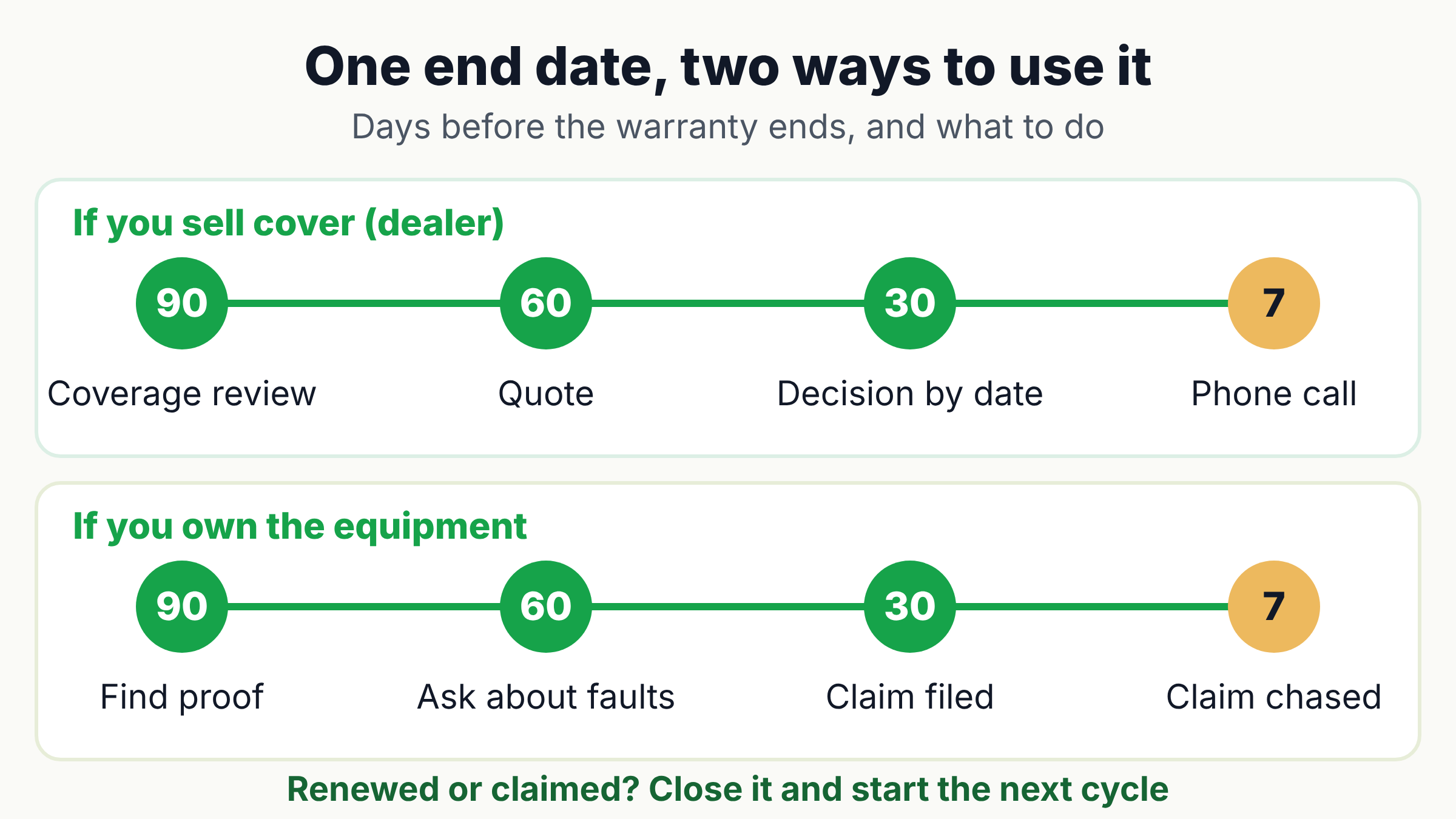
Dealers: run a 90/60/30/7 offer sequence
At 90 days, send a coverage review with options and prices. At 60, send a formal quote with the machine's service history. At 30, ask for a decision by a date. At 7, phone the decision-maker and log yes or no. Start from whichever cover ends first, and set Status to Offer due, Offered, Taken or Declined so nobody offers an extended warranty to a customer who already bought one. This is our recommended practice, not a rule.
Status list: Offer due, Offered, Taken, Declined
Owner and backup per account, so vacations don't stall offers
15-minute pipeline review on a fixed day each week
Owners: check before cover ends, then claim
Around 45 to 60 days before each end date (our suggestion), ask the person who runs the machine for any faults, intermittent errors or worn parts, and raise them as claims while cover applies. Keep the invoice, the registration confirmation and the delivery note on the row, because a claim usually needs proof of purchase and the delivery date is when a warranty breach usually accrues under UCC 2-725. Record the claim reference and outcome when it closes.
Claim status: Check due, Claim open, Claim settled, No claim needed
Proof on file: invoice, registration, delivery note
Service contracts: note the notice date, not just the end date
Each serial number, each cover type, each contract on its own record
Original warranty and extended contract on the same machine
One equipment dealer we work with keeps the original warranty and the extended contract on the same machine record, with the invoice end date pulled from accounting. When both end dates sit side by side, nobody offers cover a customer already bought, and the service team can see at a glance whether a repair is chargeable.
One record per serial number
Parts, labor and extended cover as separate dates
Invoice, contract and registration attached
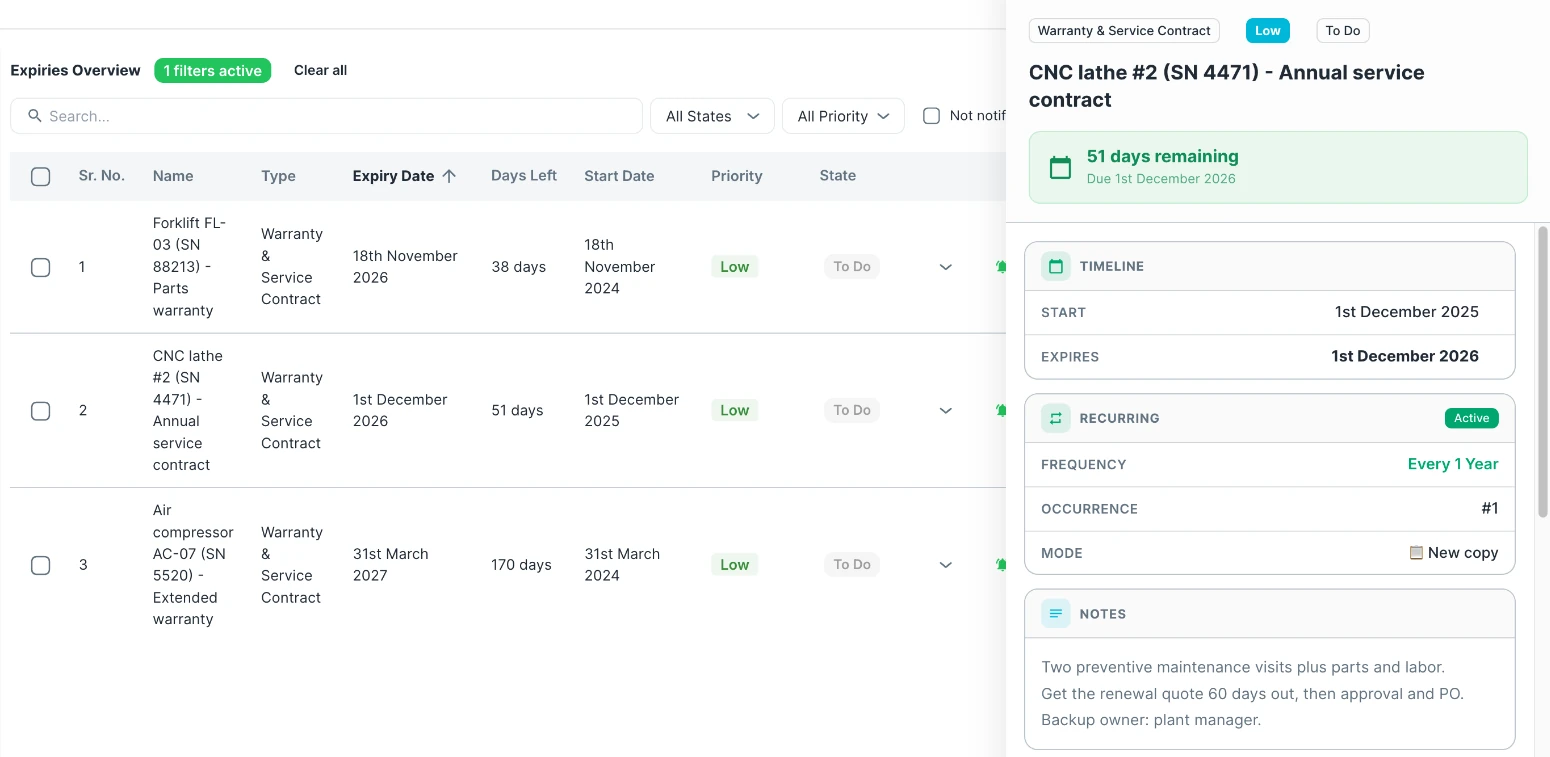
Annual service contracts renew as a copy
A service contract that renews each year becomes a recurring record: when it renews, the new term is created with the new contract attached and the old term keeps its history. Reminders reach the owner and a backup owner at 90, 60, 30 and 7 days by email, SMS, Slack or Teams, and workflow checklists hold the renewal steps.
Recurring records for annual contracts
Owner and backup owner on every record
Checklists for quote, approval and purchase order
The document a claim or an auditor asks for, already filed
Every renewal, reminder and upload is timestamped. When a manufacturer asks for proof of purchase or a customer disputes whether a machine was covered on a date, filter by serial number, customer or site and export the records as CSV, PDF or XLSX.
Timestamped history per machine
Export by serial number, customer or site
Compliance dashboard across sites
Who uses warranty tracking
Equipment dealers and service managers
Turn expiring manufacturer warranties into extended warranty and service contract offers, timed per machine rather than per account.
Account managers
Get the 90, 60, 30 and 7-day reminders for their own customers, with a backup owner who picks up during vacations.
Facilities and operations managers
Know which machines are still covered before paying for a repair, and raise claims while cover applies.
IT asset managers
Track hardware warranties, support contracts and firmware subscriptions per device and plan refreshes before cover ends.
Finance and procurement
See every service contract renewal and notice date ahead of time, so contracts are renewed on purpose rather than by default.
What changes for the service team
Warranty end dates sit in invoices and manufacturer portals, extended contracts sit in accounting, and the reminder lived in an account manager's calendar until they left. The first anyone hears of an expiry is a customer calling about an unexpected repair bill.
Every machine has one record with each cover type, the contract and the invoice. Reminders reach the account owner at 90, 60, 30 and 7 days, offers move through Offer due, Offered, Taken or Declined, and annual contracts roll forward with their history.
ExpiryEdge vs a spreadsheet vs a calendar
| ExpiryEdge | Spreadsheet | Calendar | |
|---|---|---|---|
| End dates calculated per serial number | |||
| Separate dates for parts, labor and extended cover | Manual | ||
| Reminders to the owner and a backup | Manual | ||
| Annual contracts that roll forward with history | Manual | Partial | |
| Invoice, contract and registration attached | Link only | ||
| Audit trail of who changed what |
Warranty tracking software stores warranty and service contract end dates for each product or serial number, with proof of purchase attached, and sends reminders before each one ends. Equipment dealers use it to time extended warranty and service contract offers. Businesses use it to get repairs done while their equipment is still covered.
Track warranties per serial number and start the offer 90 days before the first cover ends: a coverage review at 90 days, a quote at 60, a decision request at 30 and a phone call at 7. Record each offer as Offer due, Offered, Taken or Declined. Keeping the original warranty and any extended contract on the same machine record stops you offering cover a customer already bought.
Give each asset a record with its serial number, delivery date, each warranty end date and a copy of the invoice and registration. Around 45 to 60 days before cover ends, ask the people who use the machine about faults and raise any claims while cover applies. Record the claim reference and the outcome, and note notice dates on any service contract.
The Federal Trade Commission puts it plainly: "Service contracts, unlike warranties, are purchased separately from a product." A warranty comes with the product; an extended warranty sold later is usually a service contract with its own term, price and renewal date. Track them as separate end dates on the same machine record.
No. The FTC's guide says the Act covers only warranties on consumer products and "does not apply to warranties on products sold for resale or for commercial purposes." For business equipment, the written warranty and your purchase contract set the terms, together with your state's version of the Uniform Commercial Code.
Use =EDATE(start_date, months), for example =EDATE(H2,12) for a 12-month warranty starting on the date in H2. EDATE works in both Excel and Google Sheets. Format the result as a date, then use =M2-TODAY() in a number-formatted column to get the days left.
Yes, for a few dozen machines and one person who opens the file every week. A spreadsheet sends no reminders, and audits of real business spreadsheets compiled by Raymond Panko found errors in 94% of them. With hundreds of serial numbers, several account managers or several sites, software with assigned owners and automatic reminders is the safer control.
Every warranty and service contract end date, with reminders
Import your machine list, attach invoices and contracts, set reminders at 90, 60, 30 and 7 days. Free 14-day trial, no credit card.