
Warranty Tracking Software for Dealers: A 90/60/30/7 Renewal Plan

Warranty tracking software keeps one record per machine serial number, with a separate end date for each type of coverage, and sends reminders before each one ends. For equipment dealers, those reminders become a sales sequence: offer an extended warranty or service contract at 90, 60, 30 and 7 days, so expiring coverage turns into renewal revenue.
Sound familiar? "We only find out a warranty has ended when the customer calls with a fault." They get a repair bill they didn't expect, you get a complaint instead of a renewal, and the service contract sale is gone. This guide fixes that this week, with or without software.
Key takeaways
- Track per serial number, not per customer. Eight machines means eight sets of end dates.
- Calculate end dates, don't type them. =EDATE(start,months) works in Excel and Google Sheets; =end-TODAY() gives days left.
- Record the start-date rule. Install or invoice: pick the wrong one and every reminder is off.
- An extended warranty bought later is a service contract. In federal terms, one bought after the sale or for extra money is a service contract (16 CFR 700.11(c)).
- Run a 90/60/30/7 sequence. Coverage review at 90 days, quote at 60, decision request at 30, phone call at 7.
- Spreadsheets need a weekly owner. In six audit studies covering 85 real business spreadsheets, 94% contained errors (Panko, University of Hawai'i).
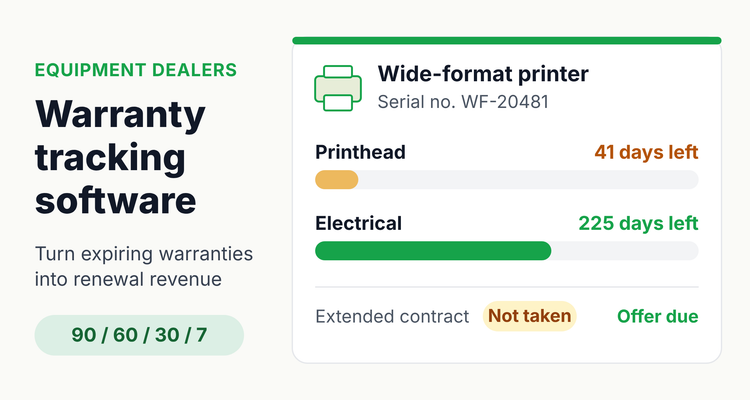 One record per machine: each type of coverage gets its own end date and days-left count.
Why do equipment warranties get missed?
Warranties get missed because the data is shaped wrong, not because people are careless. Five patterns cause most misses:
- Warranties live per serial number. A CRM (customer relationship management) system has one row per account, hiding most end dates.
- Coverage is split. Parts cover can end on a different day from labor cover.
- The start date is unclear. Programs count from install, invoice or shipping, which can be weeks apart.
- Extended contracts sit in another system, often accounting.
- The owner moved on, and the reminder lived in their calendar.
Tracking equipment your own business owns? Our guide to equipment warranty tracking for businesses covers claims and proof.
Do this now: build a warranty tracking spreadsheet (no software)
Build one row per serial number, calculate every end date with a formula, and add a status column that shows where each offer stands. For 50 machines with paperwork in one system, plan an afternoon (our estimate):
- Set up the columns (20 minutes). Copy the layout below into Excel or Google Sheets, first machine in row 2.
- Enter your installed base (2 hours). One row per serial number.
- Add formulas and colors (20 minutes). Copy row 2 down, then add the three row rules.
- Assign owners and book the weekly review (15 minutes). Every row gets an owner and a backup.
Prefer a ready-made file? Our free warranty and service contract tracker has all of this built in, with no sign-up.
Warranty tracking spreadsheet: columns and formulas (row 2)
| Column | Header | What goes in it |
|---|---|---|
| A | Customer | Account and site |
| B | Contact email | Who approves purchases |
| C | Model | Decides which plans you offer |
| D | Serial number | The unit the warranty covers |
| E | Install date | From the install job sheet |
| F | Invoice date | From accounting |
| G | Start rule | Dropdown: Install or Invoice |
| H | Warranty start | =IF(G2="Invoice",F2,E2) |
| I | Parts months | e.g. 12 |
| J | Parts end | =EDATE(H2,I2) |
| K | Labor months | e.g. 18 |
| L | Labor end | =EDATE(H2,K2) |
| M | Next end | =IF(MIN(J2,L2)>=TODAY(),MIN(J2,L2),MAX(J2,L2)) |
| N | Days left | =M2-TODAY() |
| O | Touch due | =IF(OR(Q2="Taken",Q2="Declined"),"",IF(N2<0,"Lapsed",IF(N2<=7,7,IF(N2<=30,30,IF(N2<=60,60,IF(N2<=90,90,"")))))) |
| P | Last touch sent | Dropdown: 90, 60, 30, 7 |
| Q | Status | Dropdown: Offer due, Offered, Taken, Declined |
| R | Owner | Account manager |
| S | Backup | Covers absences |
| T | Notes | Quote number, decline reason |
EDATE returns the date a set number of months after the start date, in Excel and Google Sheets. Format H, J, L and M as dates and N as a number. Then add three conditional formatting rules:
- Amber row: =AND($O2<>"",$O2&""<>$P2&""). A touch is due and not sent (&"" lets text dropdown values match).
- Red row: =AND($N2>=0,$N2<=30,$Q2<>"Taken",$Q2<>"Declined"). Under 30 days, no decision.
- Gray row: =$Q2="Taken". Done.
Worked example: the date math, step by step
One machine through the formulas (illustrative dates): a printer installed Mar 3, 2025, start rule Install, 12 months of parts cover and 18 of labor.
- Warranty start (H2): Install rule, so H2 = Mar 3, 2025.
- Parts end (J2): =EDATE(H2,12) returns Mar 3, 2026. Labor end (L2): =EDATE(H2,18) returns Sep 3, 2026.
- Next end (M2): on Jan 21, 2026 the earlier date is still ahead: Mar 3, 2026.
- Days left (N2): 41 days. Labor has 225.
- Touch due (O2): 41 is between 31 and 60, so 60. Last touch sent was 90, so the row turns amber: send the quote.
- Touch dates: Dec 3, 2025 (90), Jan 2, 2026 (60), Feb 1, 2026 (30), Feb 24, 2026 (7).
If the program counts from an invoice dated six weeks before install, every date moves six weeks earlier. That is why Start rule exists.
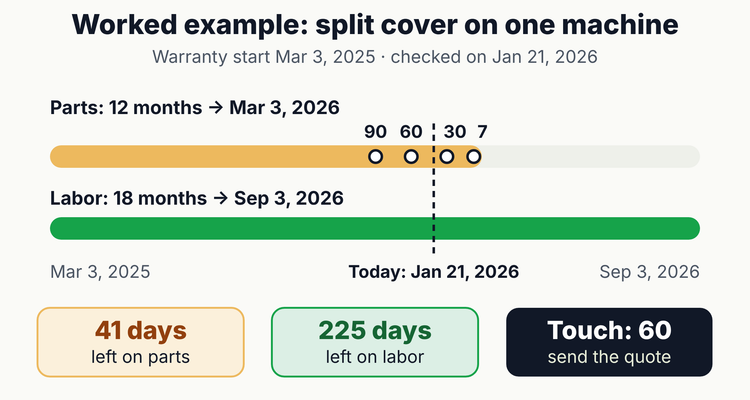 Split cover on one machine: the sequence runs from whichever cover ends first.
How do you fill in missing install dates?
Work through your paperwork from most to least reliable, and use the invoice date only when nothing better exists.
- Install or commissioning job sheet, the best evidence.
- Delivery note. Install can't come before delivery.
- Warranty registration, which shows the start date the manufacturer uses.
- The customer's asset register or first service ticket.
- Invoice date. The last resort. Write "install date estimated from invoice" in Notes.
If install came after invoice, the invoice date makes reminders early, the safe side. Set Start rule to match each program's terms.
Warranty vs service contract vs extended warranty: what is the difference?
A warranty comes with the product, while a service contract is bought separately. The Federal Trade Commission (FTC) guide to federal warranty law says: "Service contracts, unlike warranties, are purchased separately from a product." "Extended warranty" is a sales term; federal rules treat most as service contracts.
Warranty, service contract and extended warranty: official definitions (last verified 12 Oct 2026)
| Term | Official wording | Paid on top of the price? | How to track it | Source |
|---|---|---|---|---|
| Written warranty (manufacturer warranty) | "any written affirmation of fact or written promise made in connection with the sale of a consumer product" | No. The buyer "must not give any consideration beyond the purchase price" (16 CFR 700.11(b)) | Months per cover type | 15 U.S.C. 2301(6); 16 CFR 700.11(b) |
| Implied warranty | "a warranty that the goods shall be merchantable is implied in a contract for their sale if the seller is a merchant with respect to goods of that kind" | No. Arises under state law | File sales terms with the machine | UCC 2-314(1); 15 U.S.C. 2301(7) |
| Service contract | "a contract in writing to perform, over a fixed period of time or for a specified duration, services relating to the maintenance or repair (or both)" of a product | Yes, or entered after the sale | Own row and 90/60/30/7 cycle | 15 U.S.C. 2301(8); FTC guide |
| "Extended warranty" | Not defined in 15 U.S.C. 2301. An agreement "entered into at some date after the purchase" or calling for extra payment "is a service contract" | Usually yes | Track as a service contract | 16 CFR 700.11(c) |
| Maintenance or inspection plan | An agreement "which relates only to the performance of maintenance and/or inspection services" is a service contract | Even when free at the time of sale | Own row plus visit dates | 16 CFR 700.11(c) |
One limit matters for dealers. The Magnuson-Moss Warranty Act "covers only warranties on consumer products," and the FTC guide says it "does not apply to warranties on products sold for resale or for commercial purposes." For business equipment, use these definitions as vocabulary; your program and contract terms set the cover. Under the model Uniform Commercial Code (UCC), an action for breach of a sales contract must be commenced within four years (UCC 2-725); states adopt the UCC with changes.
Official sources: 15 U.S.C. 2301, 16 CFR 700.11, FTC Businessperson's Guide to Federal Warranty Law, UCC 2-314.
When should you send an extended warranty renewal offer?
Start 90 days before the warranty ends and follow up at 60, 30 and 7 days, which gives the customer time to find budget. With split coverage, start from whichever cover ends first.
- 90 days: coverage review. Say what is covered and when it ends, and offer a check visit.
- 60 days: quote. Recommend the option that fits the machine's usage.
- 30 days: decision request. State the end date and what repairs cost after it.
- 7 days: final call. Phone the decision-maker, then set Status to Taken or Declined with the reason.
- After the end date: a renewed contract gets its own row and cycle.
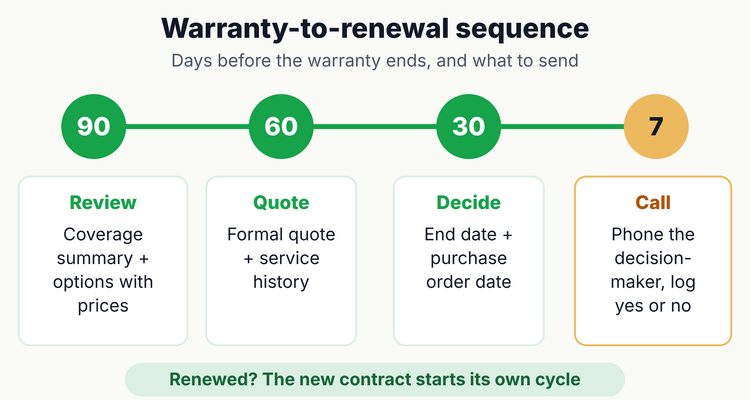 The warranty-to-renewal sequence: one action at each reminder.
Email 1: 90 days (coverage review)
Subject: Your [model] warranty: what's covered until [end date]
Hi [Name], the [parts] warranty on your [model] (serial [serial]) ends on [end date]. Until then, covered faults are repaired free. Can we book a check visit on [date] or [date] so any faults are fixed while covered? Cover afterwards starts from [price] a year.
Email 2: 60 days (quote)
Subject: Cover options for your [model] after [end date]
Hi [Name], thanks for having us in on [visit date]. We found: [condition]. Based on usage, I'd suggest [option], covering [parts/labor/visits] for [term] at [price]. Quote attached. Who else signs off, and is there a budget date to work to?
Email 3: 30 days (decision request)
Subject: [model] warranty ends [end date]: decision needed by [date]
Hi [Name], your [model] warranty ends on [end date]. After that, repairs are billed at [labor rate] an hour plus parts; a [common repair] costs [price]. For no gap in cover, we need the purchase order by [date]. Not renewing? Reply and I'll send our rate card.
⚠️What happens if you miss it: the customer usually learns the warranty has ended when a repair invoice arrives. The renewal conversation turns into a billing complaint, and the service contract sale is gone. Before you promise that cover can be added after a lapse, check your manufacturer program terms for what that requires.
How do you turn warranty expiries into service contract revenue?
Use the end of a warranty as a reason to visit and to offer choices. These tips are our advice, not industry benchmarks:
- Book a check visit 45 to 60 days before the end date. Faults get fixed while covered, and your quote gains substance.
- Price from your own service records: out-of-warranty repair cost per machine per year, plus admin and margin.
- Offer three tiers. For example: parts only; parts and labor; parts, labor and a preventive visit.
- Bring split coverage together into one contract with one end date.
- Co-term multi-machine customers. Prorate each machine to one shared renewal date: one purchase order a year instead of eight.
- Treat a decline as a future renewal. Record the reason and re-offer at the next service visit.
For tier pricing, co-terming formulas and decline codes, see our extended warranty renewal strategy guide.
What does a 15-minute weekly warranty pipeline review look like?
Pick a fixed slot, such as Monday at 9:00; the backup covers absences. Timings are our suggestion.
- Sort and filter (2 minutes). Days left, smallest first; hide Taken and Declined.
- Send the amber rows (5 minutes), then update Last touch sent and Status.
- Book the 7-day calls (3 minutes) in the owner's calendar.
- Clear lapsed rows (3 minutes). Record the decision; send the rate card.
- Look ahead (2 minutes) 120 days: book check visits, check owner absences.
Monthly, compare Taken with Declined and read decline reasons.
Spreadsheet or warranty tracking software: which do you need?
A spreadsheet is enough for a few dozen machines and one person who opens it weekly. It fails with hundreds of serial numbers, several account managers, or when its builder leaves, because nothing reminds anyone unless the file is open.
Formula errors are the other risk: Raymond Panko of the University of Hawai'i compiled six audit studies covering 85 real business spreadsheets and reported: "Collectively, these studies found errors in 94% of the spreadsheets studied."
Warranty tracking spreadsheet vs warranty tracking software
| What you need | Spreadsheet | Warranty tracking software |
|---|---|---|
| Reminders | None unless someone opens the file | Sent at 90, 60, 30 and 7 days to the record's owner |
| Ownership | A name typed in a cell | Assigned owner and backup who receive the reminders |
| Annual service contracts | Copy the row and retype the dates | Recurring record, renewed as a copy for the next term |
| Proof | Files in shared folders | Certificate, contract and invoice attached to the record |
| Change history | Overwritten on every edit | Audit trail of who changed what |
| Error risk | Errors in 94% of audited spreadsheets (Panko) | Dates set on the record, no formulas to copy down |
💡 Pro Tip
One equipment dealer we work with keeps the original warranty and the extended contract side by side on the same machine record. It works in a spreadsheet too: nobody offers cover to a customer who already bought it.
When reminders must reach people without anyone opening a file, ExpiryEdge is one option: each machine or contract becomes a record with an expiry date, an owner and backup, attached files, and reminders by email, SMS, Slack or Teams. Our warranty tracking page shows the dealer view, and the warranty management software buyer's guide covers what to compare across tools.
Warranty tracking checklist
- ✓
One row or record per serial number, not per customer
- ✓
Install date, invoice date and start rule recorded
- ✓
End dates calculated with EDATE, one per coverage type
- ✓
Extended warranties and service contracts on their own rows
- ✓
Owner, backup and status on every machine
- ✓
Certificate, contract and invoice filed with the machine
- ✓
15-minute pipeline review booked every week
Frequently asked questions
What is warranty tracking software?
Warranty tracking software stores warranty and service contract end dates for each product or serial number and sends reminders before each one ends. Equipment dealers use it to time extended warranty and service contract offers. Businesses use it to get repairs done while their equipment is still covered.
What formula calculates a warranty end date in Excel or Google Sheets?
Use =EDATE(start_date, months), for example =EDATE(H2,12) for a 12-month warranty starting on the date in H2. EDATE works in both Excel and Google Sheets. Format the result as a date, then use =M2-TODAY() in a number-formatted column to get the days left.
Is an extended warranty a warranty or a service contract?
Usually a service contract. Federal rules say an agreement entered into after the purchase, or one that costs extra on top of the product price, is a service contract (16 CFR 700.11(c)). Track it on its own row with its own start and end dates.
When should I send an extended warranty renewal offer?
Start 90 days before the warranty ends, then follow up at 60, 30 and 7 days. Use the 90-day email for a coverage review, 60 days for a quote, 30 days for a decision request and 7 days for a phone call. If coverage is split, start from whichever cover ends first.
What if I don't know a machine's install date?
Check the install job sheet, the delivery note and the warranty registration first, then fall back to the invoice date and mark it as estimated. If the machine was installed after it was invoiced, the invoice date makes your reminders early rather than late. Record which start rule the manufacturer program uses for each machine.
Can I track warranties in a spreadsheet?
Yes, for a few dozen machines and one owner who opens the file every week. A spreadsheet sends no reminders, and in six audit studies of 85 real business spreadsheets compiled by Raymond Panko, 94% contained errors. With hundreds of serial numbers or several account managers, software with assigned owners and automatic reminders is the safer control.
Sources
- Federal Trade Commission, Businessperson's Guide to Federal Warranty Law (page updated March 11, 2025)
- 15 U.S.C. 2301, Magnuson-Moss Warranty Act definitions (Cornell LII)
- 16 CFR 700.11, Written warranty, service contract, and insurance distinguished (eCFR, up to date as of 9/25/2026)
- Uniform Commercial Code 2-314, Implied warranty: merchantability (Cornell LII)
- Uniform Commercial Code 2-725, Statute of limitations in contracts for sale (Cornell LII)
- Raymond R. Panko, What We Don't Know About Spreadsheet Errors Today, EuSpRIG 2015 proceedings, Table 2 (arXiv:1602.02601)
- Microsoft Support, EDATE function
- Google Docs Editors Help, EDATE
Last reviewed: 12 October 2026
Frequently asked questions
Use =EDATE(start_date, months), for example =EDATE(H2,12) for a 12-month warranty starting on the date in H2. EDATE works in both Excel and Google Sheets. Format the result as a date, then use =M2-TODAY() in a number-formatted column to get the days left.
Usually a service contract. Federal rules say an agreement entered into after the purchase, or one that costs extra on top of the product price, is a service contract (16 CFR 700.11(c)). Track it on its own row with its own start and end dates.
Start 90 days before the warranty ends, then follow up at 60, 30 and 7 days. Use the 90-day email for a coverage review, 60 days for a quote, 30 days for a decision request and 7 days for a phone call. If coverage is split, start from whichever cover ends first.
Check the install job sheet, the delivery note and the warranty registration first, then fall back to the invoice date and mark it as estimated. If the machine was installed after it was invoiced, the invoice date makes your reminders early rather than late. Record which start rule the manufacturer program uses for each machine.
Yes, for a few dozen machines and one owner who opens the file every week. A spreadsheet sends no reminders, and in six audit studies of 85 real business spreadsheets compiled by Raymond Panko, 94% contained errors. With hundreds of serial numbers or several account managers, software with assigned owners and automatic reminders is the safer control.


