Service Contract Renewal Process: Notice Dates to Renegotiation

Build your service contract renewal process around the notice-by date, not the end date. Subtract the notice period from the end date, start reviewing 90 days before that, score the vendor on what they actually delivered, then renew, renegotiate, rebid or send written notice. If you're in New York or Wisconsin, state law also requires many vendors to warn you before an auto-renewal kicks in.
Here's the situation this prevents. Your HVAC (heating, ventilation and air conditioning) maintenance contract renewed itself last month at a higher price, and the cancellation window had closed before anyone looked at it. Below you'll find the date math, a vendor scorecard, the two state laws that protect business customers, and letters you can send this week.
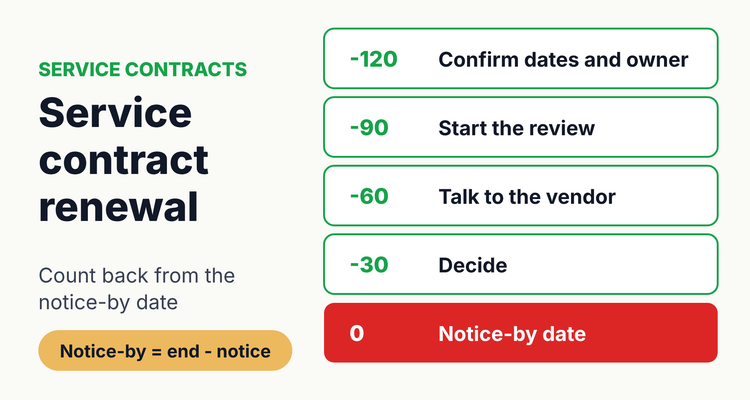 Work backwards from the notice-by date, not the end date.
Why service contracts renew without anyone deciding
An auto-renewal clause says the contract rolls over unless someone gives notice, and the notice deadline falls weeks or months before the end date. Three things usually line up:
- An automatic renewal clause, sometimes called an evergreen clause. The term rolls over unless either side gives notice.
- A notice period of 30, 60, 90 days or more before the end date. The number in your contract is the one that binds you.
- Nobody owns it. The person who signed has moved on, and the PDF sits in a shared drive.
Find the notice-by date: end date minus notice period
Subtract the notice period from the end date, then check how the contract says notice has to be given. You need four clauses: term, renewal, termination and notices. A sheet laid out like this does the arithmetic for you.
Service contract renewal dates: columns and formulas (row 2)
| Column | What goes in it | Formula or example |
|---|---|---|
| A: Contract and vendor | Service, site, vendor name | Example: HVAC maintenance, Building A |
| B: End date | Current term end | 6/30/2027 |
| C: Notice days | From the renewal or termination clause | 60 |
| D: Notice-by date | Last day for your notice to arrive | =B2-C2 |
| E: Review start | Start the review 90 days before notice-by (our advice) | =D2-90 |
| F: Days to notice-by | Sort by this every week | =D2-TODAY() |
| G: Auto-renews? | Yes / No, and the renewal length | Yes, 12 months |
| H: Notice method | From the notices clause | Certified mail to the address in section 14 |
| I: Vendor reminder window | New York: 30 to 15 days before notice-by | =TEXT(D2-30,"m/d/yyyy")&" to "&TEXT(D2-15,"m/d/yyyy") |
| J: Decision | Renew, Renegotiate, Rebid, End | Dropdown |
| K: Owner and backup | Who runs the review | Facilities manager / finance lead |
Worked example. A contract ends June 30, 2027 with 60 days' notice. The notice-by date is May 1, 2027, so the review starts January 31, 2027. If New York law applies, the vendor's written reminder should arrive between April 1 and April 16, 2027. Check whether your contract counts notice from when it's sent or when it's received, and send yours a few days early either way.
Our free contract renewal tracker already calculates the notice-by date, days to notice-by and a status from it, with no sign-up.
New York and Wisconsin make vendors warn you before auto-renewal
We checked two statutes that protect business customers of service contracts: New York's General Obligations Law (GOL) 5-903 and Wisconsin's 134.49. Both make an auto-renewal unenforceable if the provider skips the required notice. Other states may have their own rules; this table covers only these two.
Auto-renewal laws that reach business service contracts (last verified 12 October 2026)
| Law | What it covers | What the provider must do | If they don't |
|---|---|---|---|
| New York GOL 5-903 | Contracts "for service, maintenance or repair to or for any real or personal property" that renew unless the customer gives notice. Excludes renewal periods of "one month or less". | Written notice calling your attention to the renewal clause, "at least fifteen days and not more than thirty days" before your notice deadline, "served personally or by certified mail" | The renewal clause is not enforceable against you |
| Wisconsin 134.49(2) | Business services contracts and business equipment leases made, changed or renewed after May 1, 2011, renewing for more than one month. Excludes, among others, government contracts, real property leases and elevator or escalator maintenance. | At signing: a signed disclosure form or conspicuous, initialled disclosure stating the renewal, its length, any price increase, how to decline and the deadline | The renewal is not enforceable and the contract ends at the current term |
| Wisconsin 134.49(3) | The same contracts where the initial term and the renewal term are each more than one year | Written notice 15 to 60 days before your decline deadline, stating the deadline, any price increase and how to decline | Same; if the seller then refuses to end the contract after you decline, you may claim twice your damages, or twice the periodic payment or $1,000, whichever is less, plus costs and attorney fees |
Wisconsin also voids clauses that make you let the current vendor match a competitor's offer for service after the term ends (134.49(5)). The statute lists more exclusions than the table shows, including usage-based contracts with a predetermined minimum payment of $250,000 or more in a 12-month period, so read the full list. If a lot of money rides on a contract, ask your attorney how either law applies.
⚠️Once the notice-by date passes, an auto-renewal clause normally binds you to the next term on the contract's terms, including any price rise it allows. The New York and Wisconsin statutes can make the renewal unenforceable if the provider didn't give the required notice. Don't bank on that. Track the date and send your own notice on time.
Score the vendor from your own records before you talk price
Pick four to six measures you can count from work orders, invoices and the contract's service levels. Then decide.
Service contract renewal scorecard (template)
| Measure | Where the data comes from | How to calculate it |
|---|---|---|
| Response time met | Work orders with call and arrival times | Calls answered within the contract time / all calls |
| Preventive visits done | Visit reports against the schedule | Visits completed / visits scheduled |
| Repeat calls | Work orders for the same fault within 30 days | Repeat calls / all calls |
| Invoice accuracy | Invoices checked against contract rates | Invoices with no disputes / all invoices |
| Paperwork current | Insurance certificates, licenses, inspection reports | Documents current / documents required |
| Price against market | One or two comparison quotes | Current price / lowest comparable quote |
Score each measure from 1 to 5. Agree the thresholds before you look at the numbers, not after, or you'll grade on a curve. The 30-day repeat-call window is our suggestion; a lift engineer and a pest control firm need different yardsticks.
Renew, renegotiate, rebid or end: decide 30 days before notice-by
Three inputs: the scorecard, the price, and how badly you'd suffer if the kit went down. A chiller serving a server room isn't the same as the car park barrier. Decide no later than 30 days before notice-by, or you won't have room to act.
- Renew as is when scores are strong and the price is fair. Get the new term and price confirmed in writing.
- Renegotiate when the service is good but the price or scope isn't. Use the levers in the next section.
- Rebid when scores are weak, or the price sits well above your comparison quotes. A rebid takes time, so start it the day the review starts.
- End it when the equipment's being replaced or you can bring the work in house. Send non-renewal notice and plan the handover.
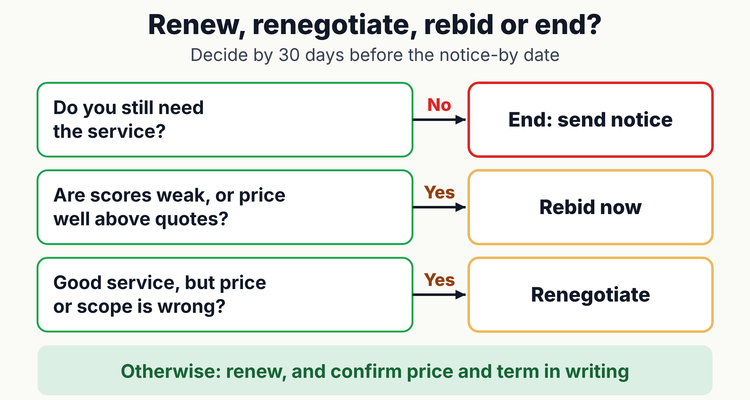 Make the call by 30 days before the notice-by date.
What to ask for when you renegotiate
Walk in with numbers. Saying response times have been poor gets a shrug. Saying 9 of 31 call-outs missed the four-hour window (your own figures, from your own work orders) gets a concession. Only pull the levers your scorecard supports.
- Scope: drop equipment you've replaced, and add anything coming off warranty.
- Service levels: response times, visit frequency, and a remedy when they're missed.
- Price: cap annual increases, or hold the price in exchange for a multi-year term.
- Renewal terms: a shorter renewal period, a shorter notice period, or renewal only by written agreement.
- Co-terming: one end date for every site or asset, so you run one review a year.
- Reporting: a monthly or quarterly summary of calls, visits and parts used.
A renegotiation email you can copy. Subject: [Contract] renewal: review before [notice-by date]. "Hi [first name], our contract for [service] ends on [end date], and our notice deadline is [notice-by date]. Over the last year, [X] of [Y] preventive visits were completed and [X]% of calls met the response time. Before we decide on renewal we'd like to discuss [scope / response times / price cap / renewal terms]. Can we meet by [date]? Please send your proposed terms for the next term by [date]."
A non-renewal notice you can copy. "Re: [Contract name and number] dated [date]. Under section [X] of the contract, we give notice that we will not renew the contract when the current term ends on [end date]. Please confirm receipt in writing, and confirm the final service visit and handover of service records by [date]." Send it by the method the notices clause names, and keep proof of delivery.
The renewal timeline, counted back from notice-by
Run the same steps for every contract. The lead times are what we'd recommend, not a legal rule.
- Notice-by minus 120 days: confirm the end date, notice period, notice method and owner.
- Minus 90 days: start the review. Pull work orders and invoices, and ask the people on site what's gone wrong.
- Minus 75 days: fill in the scorecard and get one or two comparison quotes.
- Minus 60 days: send the renegotiation email, or kick off the rebid.
- Minus 30 days: decide, with sign-off from the budget holder.
- Minus 15 days: if you're leaving or changing terms, send notice by the contract's method and keep proof.
- After the decision: save the signed renewal or notice, set the new end and notice-by dates, and file the scorecard.
Do a 60-minute audit of every service contract you pay for
Start from accounts payable, not the contract folder. The window cleaner on a rolling direct debit is a contract too, and it won't be in the folder. Timings assume roughly 20 contracts.
- Pull vendors from accounts payable (15 minutes). Every recurring payment to a service vendor is a contract you need to find.
- Read four clauses per contract (30 minutes): term, renewal, termination and notices. Fill in columns A to H above.
- Sort by days to notice-by (5 minutes). Anything under 120 days starts its review this week.
- Assign owners (10 minutes). One person and one backup per contract, with the review date in their calendar.
💡 Pro Tip
When a warranty ends, the maintenance contract often begins. Put both on the same asset record so the warranty end date and the contract's notice-by date sit side by side.
Our guide to equipment warranty tracking shows how, and the free warranty and service contract tracker has both columns ready.
Spreadsheet or software for service contract renewals?
Honestly, a spreadsheet is fine for one owner with a couple of dozen contracts who opens it every Monday. The notice-by formula does the hard part.
It gets risky once contracts spread across sites and departments, owners change, or someone asks you to prove who reviewed what. ExpiryEdge tracks each contract with its notice-by date, owner and backup, and reminds them at 90, 60, 30 and 7 days by email, SMS, WhatsApp, Slack or Teams. It escalates anything overdue to a manager, keeps the contract and scorecard on the record, and logs every change in an exportable audit trail. For the wider picture, see our warranty tracking page, the vendor contract renewal checklist and our facilities maintenance contracts guide.
Frequently asked questions
When should I start a service contract renewal?
Start about 90 days before the notice-by date, which is the end date minus the notice period. That leaves time to score the vendor, collect comparison quotes and rebid if you need to. Ninety days is our advice, not a rule. Give yourself longer for complex or multi-site contracts.
What is a notice-by date?
It's the last day your notice of non-renewal or change can reach the vendor under the contract. Work it out as the end date minus the notice period. For example, a contract ending June 30, 2027 with 60 days' notice has a notice-by date of May 1, 2027. Check whether notice counts from sending or receipt.
Is an automatic renewal clause enforceable in New York?
For contracts for service, maintenance or repair of real or personal property, GOL 5-903 says the clause isn't enforceable against the customer unless the provider gave written notice, in person or by certified mail, 15 to 30 days before the customer's notice deadline. It doesn't apply to renewal periods of one month or less.
What does Wisconsin's auto-renewal law require?
Wisconsin 134.49 requires a signed or initialled disclosure for business contracts that auto-renew for more than one month. If both the initial and renewal terms are over a year, the seller must also send written notice 15 to 60 days before your decline deadline. Without these, the renewal isn't enforceable and the contract ends at the current term.
How do I cancel a service contract that auto-renews?
Send written notice of non-renewal before the notice-by date, using the method in the contract's notices clause, and keep proof of delivery. Ask the vendor to confirm receipt in writing. Agree the date of the final service visit and the handover of service records in the same letter, so nothing is left open.
What should I review before renewing a maintenance contract?
Check response times against the contract, preventive visits completed, repeat calls, invoice accuracy, and whether the vendor's insurance and licenses are current. Compare the price with one or two quotes. Score each measure, then decide whether to renew, renegotiate, rebid or end the contract.
Sources
- New York General Obligations Law section 5-903 (NY Senate, revision of September 22, 2014)
- Wisconsin Statutes section 134.49, Renewals and extensions of business contracts (2023-24 statutes, published October 1, 2026)
- Microsoft Support, TEXT function
Last reviewed: 29 October 2026
Frequently asked questions
It's the last day your notice of non-renewal or change can reach the vendor under the contract. Work it out as the end date minus the notice period. For example, a contract ending June 30, 2027 with 60 days' notice has a notice-by date of May 1, 2027. Check whether notice counts from sending or receipt.
Not always. GOL 5-903 covers contracts to service, maintain or repair real or personal property. For those, the clause can't be enforced against the customer unless the provider sent written notice first. That notice must go in person or by certified mail, 15 to 30 days before the customer's notice deadline. The rule doesn't apply to renewal periods of one month or less.
Wisconsin 134.49 requires a signed or initialled disclosure for business contracts that auto-renew for more than one month. If both the initial and renewal terms are over a year, the seller must also send written notice 15 to 60 days before your decline deadline. Without these, the renewal isn't enforceable and the contract ends at the current term.
Send written notice of non-renewal before the notice-by date, using the method in the contract's notices clause, and keep proof of delivery. Ask the vendor to confirm receipt in writing. Agree the date of the final service visit and the handover of service records in the same letter, so nothing is left open.
Check response times against the contract, preventive visits completed, repeat calls, invoice accuracy, and whether the vendor's insurance and licenses are current. Compare the price with one or two quotes. Score each measure, then decide whether to renew, renegotiate, rebid or end the contract.
Not legal advice
This article is for general informational purposes and does not constitute legal advice. Laws, regulations and contract requirements vary by jurisdiction and change over time. Consult a qualified attorney in your jurisdiction before making decisions that depend on the specific legal interpretation discussed here.