
Facilities Maintenance Contract Guide: Scope, SLAs and Renewals

A facilities maintenance contract should name each system the vendor covers (HVAC, fire protection, elevators, cleaning), the inspection and test frequencies your code requires, response times by priority, the reports and certificates the vendor must hand over, and the date you must give notice before it renews. Track those dates per building, not per vendor.
You inherited a drawer of service agreements, nobody knows if the five-year sprinkler test was done, and the elevator contract renewed itself last spring. This guide shows what each contract should say, which frequencies we could confirm officially, and a register you can build this afternoon.
Key takeaways
- OSHA requires portable fire extinguishers to be visually inspected monthly and to get an annual maintenance check, with the annual date recorded (29 CFR 1910.157(e)).
- Many fire system frequencies come from the edition of NFPA 10, 25 or 72 your state or city adopted, so the same device can have different intervals in different places.
- In California an elevator permit lasts up to one year, or up to two years if a C-11 licensed company holds a full maintenance contract and services the elevator at least monthly (8 CCR 3001).
- In New York City the agency doing the periodic elevator inspection cannot be affiliated with the agency maintaining the device.
- Technicians who open a refrigerant circuit must hold EPA Section 608 certification, and EPA says those credentials do not expire.
- New York makes an automatic renewal clause in a service or maintenance contract unenforceable unless the vendor sends written notice 15 to 30 days before your cancellation deadline (GOL 5-903).
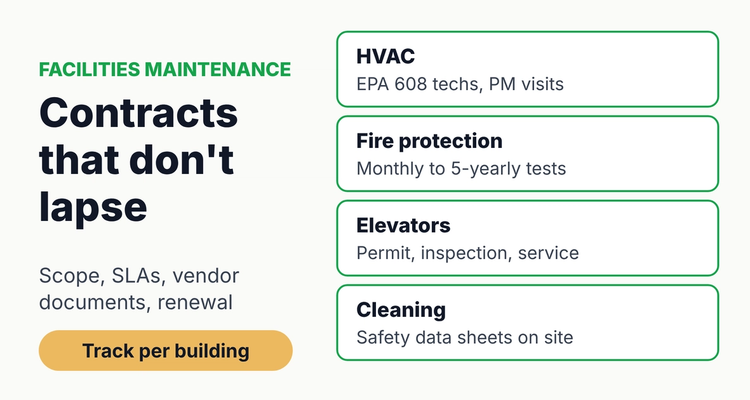 Four contract families, one register: scope, service levels, vendor documents and the notice-by date.
What is a facilities maintenance contract?
A facilities maintenance contract is an agreement for a vendor to inspect, test, service and repair building systems on a schedule, usually for a fixed fee plus agreed rates for extra work. Most buildings hold several, and fire protection is often split across two or three vendors.
In practice the contracts come in three shapes. A full-service contract covers planned maintenance plus most parts and repairs. A preventive maintenance (PM) only contract covers scheduled visits, and repairs are quoted separately. An on-call agreement only sets rates and response times. Which one you have decides who pays when something breaks, so write it at the top of your register.
What should each facilities maintenance contract cover?
Each contract should cover the scope by system, the visit and test frequency, what the vendor must hand over after each visit, and who keeps the official records. The table below is a starting checklist for each family; the legal requirements cited apply only where the named rule applies to your building.
Facilities maintenance contract scope by system (last verified 12 October 2026)
| System | What the contract should require | Vendor documents to collect | Official rule we checked |
|---|---|---|---|
| HVAC | PM visits per manufacturer schedule, filter and belt changes, refrigerant handling and leak records, response times | EPA Section 608 certification for each technician who opens a refrigerant circuit; visit reports | 40 CFR 82.161; EPA Section 608 page |
| Portable fire extinguishers | Annual maintenance, recharge and hydrostatic testing by trained persons; tagging | Annual maintenance record with date; service tags | 29 CFR 1910.157(e) |
| Sprinklers and standpipes | Inspections and tests to your adopted NFPA 25 edition; impairment notice | Inspection and test reports; deficiency list with repair quotes | 29 CFR 1910.159(c); state guidance on NFPA 25 |
| Fire alarm | Device testing to your adopted NFPA 72 edition by a qualified person; panel and battery tests | Test report listing every device tested | 29 CFR 1910.164(c); state guidance on NFPA 72 |
| Elevators | Monthly or more frequent service, call-back times, parts coverage, help with state or city inspections | Contractor licence; inspection and test filings; permit or certificate | 8 CCR 3001 (California); NYC DOB elevator rules |
| Cleaning | Tasks and frequencies by area, chemicals used, supervision, keys and access | Safety data sheets for chemicals brought on site; staffing list | 29 CFR 1910.1200(e)(2) |
Your insurance certificates sit across all of them. In one multiyear audit described by IRMI, more than 90 percent of vendors' certificates of insurance had material defects compared with the policies actually in force, so ask for the policy endorsements your contract requires, not just a certificate.
How often must fire protection systems be inspected?
It depends on the system and on the NFPA edition your jurisdiction adopted. OSHA sets a few frequencies directly; most others come from NFPA standards that states and cities adopt by edition. We only list frequencies that appear in at least two official documents. Use them to check your contract, then confirm the edition with your fire marshal or authority having jurisdiction (AHJ).
Fire protection frequencies confirmed in official sources (last verified 12 October 2026)
| Item | Frequency | Where it is stated |
|---|---|---|
| Portable extinguishers: visual inspection | Monthly | OSHA 1910.157(e)(2); NFPA 10-2010 7.2.1.2 as listed by North Dakota HHS; Connecticut DDS (30-day intervals) |
| Portable extinguishers: maintenance | Annually | OSHA 1910.157(e)(3); NFPA 10-2010 7.3.1.1.1 (North Dakota HHS); Connecticut DDS |
| Stored-pressure dry chemical extinguishers (12-year hydrostatic type) | Emptied and maintained every 6 years | OSHA 1910.157(e)(4); NFPA 10-2010 7.3.1.2.1 (South Dakota DOH) |
| Sprinkler main drain flow test | Annually | OSHA 1910.159(c)(2) for OSHA-required systems; Connecticut DDS |
| Sprinkler gauges | Replace or recalibrate every 5 years | NFPA 25-2011 (North Dakota HHS, South Dakota DOH); Connecticut DDS |
| Internal inspection of sprinkler piping for obstructions | Every 5 years | NFPA 25-2011 14.2 (North Dakota HHS, South Dakota DOH) |
| Kitchen hood suppression system | Every 6 months | NFPA 17A-2009 7.3.3 (North Dakota HHS); Connecticut DDS |
| Smoke detector sensitivity | 1 year after installation, then every 2 years; may extend to 5 years if results stay in range | Connecticut DDS; North Dakota HHS (2 years); South Dakota DOH (5 years) |
| Fire alarm devices (smoke detectors, pull stations, horns and strobes) | At least annually under NFPA 72-2010; Connecticut's guidelines ask for semi-annual testing | North Dakota HHS; Connecticut DDS |
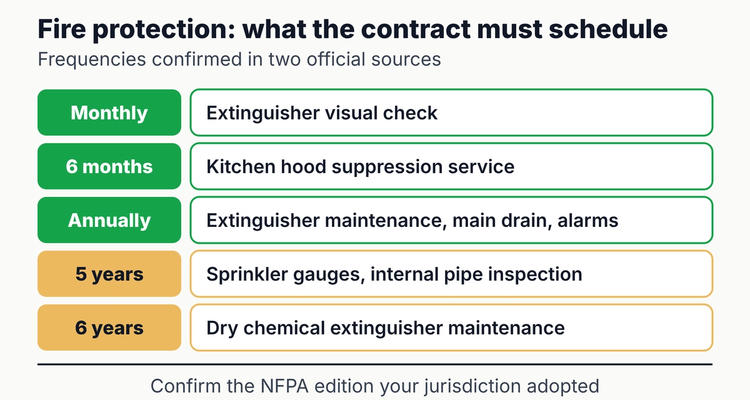 The fire protection calendar a contract should cover. Confirm the edition your jurisdiction adopted.
The state lists above are health and licensing guidance that cite the 2009 to 2011 editions of the NFPA standards (North Dakota's is based on the 2012 Life Safety Code). Newer editions changed some intervals, which is why your adopted edition decides. If you run a care home or other licensed setting, our guide to assisted living fire drill requirements covers the drills that sit alongside these inspections.
What do elevator maintenance contracts need to include?
An elevator maintenance contract should set the service frequency, call-back response times, parts coverage, and who arranges and attends the inspections your state or city requires. Elevator rules are set locally, so the details below are two examples, not a national standard.
- California. No elevator may run without a valid, current permit, posted in the car. The permit is issued for no more than one year, or up to two years if the elevator is covered for the whole term by a full maintenance contract with a C-11 licensed company that services it "not less often than monthly". The company must tell the state within 30 days if that contract is terminated or altered.
- New York City. An annual periodic inspection and an annual Category 1 (CAT1) no-load safety test, plus a Category 5 (CAT5) full-load test within five years of the last one. The periodic inspection agency "cannot be affiliated with the agency performing maintenance on the device". Defects must be corrected within 90 days and filed within 14 days of correction.
So in California, keep the maintenance contract end date on the same record as the permit, and in New York City budget for a separate inspection agency.
Which service levels belong in the contract?
Service levels should state response times by priority, planned maintenance completion, report turnaround and how the vendor warns you before a life-safety system goes out of service. No law sets these numbers for private buildings, so the values below are examples to negotiate.
Copyable SLA schedule for a facilities maintenance contract (example values, adjust to your building)
| Measure | Definition | Example target |
|---|---|---|
| Priority 1 response | Life-safety or total loss of service (fire alarm fault, trapped passenger, no heat in winter) | On site within 2 to 4 hours, 24/7 |
| Priority 2 response | Partial loss of service or comfort | Next business day |
| PM completion | Planned visits done in the scheduled month | 100% of life-safety visits; 95% of others |
| Report delivery | Signed inspection or test report received | Within 14 days of the visit |
| Deficiency quote | Priced repair proposal for each deficiency found | Within 10 business days |
| Impairment notice | Vendor tells you before taking a fire system out of service | Before work starts, with expected return time |
Connecticut's guidance for its licensed settings is a useful model for the last row: it asks for a fire watch if a system is down for more than four hours, and for the facility to review every contractor service report before signing off.
Which vendor certificates and documents should you collect?
Vendor documents for every facilities maintenance contract
- ✓
Certificate of insurance plus the endorsements the contract requires (additional insured, waiver of subrogation), with expiry dates
- ✓
State or local contractor licence for the trade (for example a C-11 elevator licence in California)
- ✓
EPA Section 608 certification for each HVAC technician who opens a refrigerant circuit (collect once; EPA says they do not expire)
- ✓
Inspection and test reports after every visit, listing each device tested
- ✓
Deficiency lists and proof of correction (in New York City, the correction filing)
- ✓
Safety data sheets for every chemical the cleaning vendor brings on site
- ✓
Current elevator permit or certificate, posted where the rule requires
The safety data sheet item is a legal duty, not just good practice. Under OSHA's hazard communication standard, an employer whose hazardous chemicals could expose another employer's staff must provide on-site access to the safety data sheets. Require your cleaning vendor to supply them and flag new products.
How do facilities maintenance contract renewals work?
Most service contracts either end on a date or renew automatically unless you give notice by a deadline. The notice-by date is the one that matters: miss it and an auto-renewal clause usually binds you for another term. A few states limit this for business service contracts; check yours.
State auto-renewal rules for business service contracts (two examples, last verified 12 October 2026)
| State | What the law says | Exclusions to note | Official source |
|---|---|---|---|
| New York | An auto-renewal clause in a contract for service, maintenance or repair of real or personal property is enforceable only if the vendor sends written notice, personally or by certified mail, 15 to 30 days before your cancellation deadline | Renewal periods of one month or less | GOL 5-903 (nysenate.gov) |
| Wisconsin | For business contracts with an initial term over one year renewing for over one year, the seller must send written notice 15 to 60 days before your deadline to decline, or the clause is unenforceable | Excludes elevator and escalator maintenance contracts and contracts with government bodies, among others | Wis. Stat. 134.49 (docs.legis.wisconsin.gov) |
Do not rely on these protections. Work out your own date: Notice-by = End date minus notice days, then start the renewal review at least 60 days before that (our planning advice). Our vendor contract renewal checklist covers the review itself.
⚠️What happens if you miss it: in California, an elevator may not be operated without a valid, current permit. In New York City, inspection reports not filed by the deadline lead to failure-to-file violations, and defects not corrected and filed within 104 days lead to failure-to-correct violations. OSHA requires the annual extinguisher maintenance date to be recorded and kept, and a missed notice date can lock you into another contract term.
Do this now: build a facilities contract register in two hours
You do not need software to get control. Set aside about two hours (our estimate for one building with six to ten contracts) and work through these steps:
- Gather (30 minutes). Pull every service agreement, the latest report from each vendor and every certificate of insurance into one folder.
- List (30 minutes). One row per contract per building, using the columns below.
- Date (20 minutes). Enter the end date and notice period from each contract, then the last and next due date for each inspection in the fire table above.
- Gap check (20 minutes). Flag missing reports, expired certificates and any frequency your contract does not mention.
- Assign (10 minutes). Give each row an owner and a backup, and book a monthly 15-minute review.
Copy-paste register layout (Excel, Google Sheets and LibreOffice)
| Column | Header | Formula or entry |
|---|---|---|
| A | Building | Text |
| B | System / vendor | Text, e.g. Elevators / vendor name |
| C | Contract type | Full-service, PM only or on-call |
| D | End date | Date |
| E | Notice days | Number from the contract |
| F | Notice-by | =D2-E2 |
| G | Next inspection due | Date from your adopted code |
| H | Last report received | Date |
| I | COI expiry | Date |
| J | Status | =IF(MIN(F2,G2,I2)<TODAY(),"OVERDUE",IF(MIN(F2,G2,I2)-TODAY()<=30,"DUE 30",IF(MIN(F2,G2,I2)-TODAY()<=90,"DUE 90","OK"))) |
Add conditional formatting on column J (red for OVERDUE, amber for DUE 30) and sort by the earliest date each month. If you would rather start from a built file, the free contractor document tracker handles certificates and the contract renewal tracker calculates notice-by dates.
How can you get more from the contracts you already have?
- Co-term contracts per building. Aligning end dates means one renewal review instead of six scattered ones.
- Ask for reports in a fixed format with every device listed, so a missing device stands out.
- Book the five-year items now. Gauges, internal pipe inspection and CAT5 tests are the ones most easily forgotten because they come round rarely.
💡 Pro Tip
Put inspections and contracts on the same list. One assisted living operator we work with tracks its fire alarm, sprinkler, kitchen hood suppression, generator and elevator inspections as recurring records next to the vendor contracts, so the person who renews a contract can see whether the last inspection report is on file.
Spreadsheet or software for facilities maintenance contracts?
A spreadsheet is enough for one building with a handful of contracts and one person who reviews it every month. Plenty of small sites never need more.
It gets harder with several buildings, a mix of monthly, annual and five-year items, vendors who must send certificates, and staff changes. That is where a tool such as ExpiryEdge earns its place: each contract, inspection and certificate is a record with an owner and backup, reminders at 90, 60, 30 and 7 days, document requests that vendors answer without logging in, and an audit trail. See how it works for facilities management compliance and for vendor contract management, and read our procurement contract management process for the wider post-signature routine.
Frequently asked questions
What should a facilities maintenance contract include?
The systems covered, visit and test frequencies, response and fix times by priority, reports and certificates the vendor must provide, parts and repair terms, insurance requirements, and the end date with its notice period. Write the contract type (full-service, PM only or on-call) at the top so everyone knows who pays for repairs.
How often do fire extinguishers need to be inspected?
OSHA requires a visual inspection every month and a maintenance check every year, and the annual date must be recorded. Stored-pressure dry chemical extinguishers that need a 12-year hydrostatic test must also be emptied and maintained every six years.
How often should sprinkler systems be tested?
It depends on the NFPA 25 edition your jurisdiction adopted. OSHA requires an annual main drain flow test for systems it covers, and state guidance based on NFPA 25-2011 lists five-year gauge replacement or recalibration and a five-year internal pipe inspection. Confirm the edition with your fire marshal.
Can the elevator maintenance company also do the inspection?
In New York City, no: the agency performing the periodic inspection cannot be affiliated with the agency maintaining the device. Other places set their own rules, so check with your state or city elevator unit.
Do HVAC technicians need a certificate?
Yes, if they could open the refrigerant circuit. EPA rules require Section 608 certification by type of equipment, and EPA says the credentials do not expire, so collect a copy once for each technician who works on your systems.
Can a maintenance contract renew automatically without notice?
Often yes, if you miss the notice date. New York requires the vendor to send written notice 15 to 30 days before your deadline for the clause to be enforceable, and Wisconsin has a similar rule for some business contracts but excludes elevator maintenance. Track your own notice-by date either way.
Sources
- eCFR, 29 CFR 1910.157 Portable fire extinguishers
- eCFR, 29 CFR 1910.159 Automatic sprinkler systems
- eCFR, 29 CFR 1910.164 Fire detection systems
- eCFR, 29 CFR 1910.1200 Hazard communication
- eCFR, 40 CFR 82.161 Technician certification
- U.S. EPA, Section 608 Technician Certification Requirements (updated 15 July 2026)
- North Dakota HHS, Life Safety Documentation Requirements (2012 NFPA 101)
- South Dakota Department of Health, Preventative Maintenance Activities
- Connecticut DDS, Fire Protection Equipment Testing and Maintenance Guidelines (Annex 7)
- California Code of Regulations, Title 8, Section 3001
- Cal/OSHA, Elevator Permits
- NYC Department of Buildings, Elevator Compliance
- NYC Department of Buildings, Elevator FAQs
- New York General Obligations Law 5-903
- Wisconsin Statutes 134.49, Renewals and extensions of business contracts
- IRMI, Avoiding Common Insurance Certificate Errors (2015)
Last reviewed: 12 October 2026
Frequently asked questions
OSHA requires a visual inspection every month and a maintenance check every year, and the annual date must be recorded. Stored-pressure dry chemical extinguishers that need a 12-year hydrostatic test must also be emptied and maintained every six years.
It depends on the NFPA 25 edition your jurisdiction adopted. OSHA requires an annual main drain flow test for systems it covers, and state guidance based on NFPA 25-2011 lists five-year gauge replacement or recalibration and a five-year internal pipe inspection. Confirm the edition with your fire marshal.
In New York City, no: the agency performing the periodic inspection cannot be affiliated with the agency maintaining the device. Other places set their own rules, so check with your state or city elevator unit.
Yes, if they could open the refrigerant circuit. EPA rules require Section 608 certification by type of equipment, and EPA says the credentials do not expire, so collect a copy once for each technician who works on your systems.
Often yes, if you miss the notice date. New York requires the vendor to send written notice 15 to 30 days before your deadline for the clause to be enforceable, and Wisconsin has a similar rule for some business contracts but excludes elevator maintenance. Track your own notice-by date either way.
Not legal advice
This article is for general informational purposes and does not constitute legal advice. Laws, regulations and contract requirements vary by jurisdiction and change over time. Consult a qualified attorney in your jurisdiction before making decisions that depend on the specific legal interpretation discussed here.


