
Equipment Warranty Tracking: Register, Prove and Claim in Time

Equipment warranty tracking means keeping one record per asset with its serial number, delivery date, each warranty's end date, the registration confirmation and proof of purchase. Set a check date about 60 days before each end date, so faults are found and claimed in writing while the equipment is still covered.
The compressor fails in month 25 of a 24-month warranty, or in month 23 when nobody can find the invoice. This guide shows how to set up a warranty register this week, what proof to keep, how to claim before expiry, and what the Uniform Commercial Code (UCC) says about deadlines.
Key takeaways
- Your contract sets the rules. Federal consumer warranty law "does not apply to warranties on products sold for resale or for commercial purposes" (FTC).
- Track per serial number. Each asset gets its own delivery date, end dates and proof, even when you bought ten at once.
- Check 60 days before expiry. Inspect, list faults and claim in writing while cover is live. The 60 days is our suggestion, not a rule.
- Tell the seller promptly. Under UCC 2-607(3)(a), a buyer must notify the seller of a breach "within a reasonable time" after discovering it "or be barred from any remedy."
- Know the outer limit. Model UCC 2-725 gives four years from when the cause of action accrues; the contract can cut that to one year. Wisconsin's version says six years.
- Keep a proof pack for every asset: invoice, delivery note, serial plate photo, registration confirmation, maintenance log and claim emails.
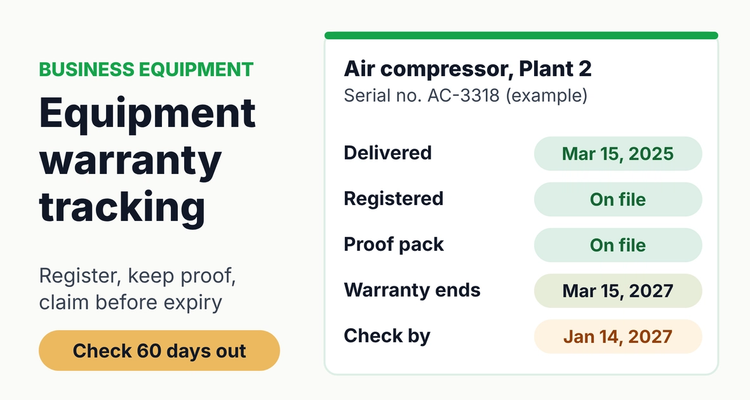 One record per asset, with the check-by date doing the work.
Why do businesses lose equipment warranty claims?
Most lost claims come from missing dates and missing paper, not from bad luck. Five patterns cause most of them:
- Nobody knows the end date. It sits in a PDF, an email or the supplier's portal.
- The start date is unclear. Delivery, install and invoice dates can be weeks apart, and the warranty terms say which one counts.
- Registration was never done, or the confirmation was not saved.
- Maintenance can't be shown. If the terms set servicing conditions, you need a log to prove you met them.
- Faults are reported by phone. A call with no written follow-up is hard to prove later.
What fields belong in an equipment warranty tracking register?
Record enough to make a claim without searching: the asset, the dates, the cover and where the proof lives. Copy these columns into a sheet, with headers in row 1.
Equipment warranty tracking register: columns and formulas (row 2)
| Column | Field | What goes in it |
|---|---|---|
| A | Asset and location | Example: Air compressor, Plant 2 |
| B | Make, model, serial number | From the serial plate; add a photo to the proof pack |
| C | Supplier and contact | Who you claim through: dealer, distributor or manufacturer |
| D | Delivery date | From the signed delivery note |
| E | Warranty start date | The date the terms say cover starts (delivery, install or invoice) |
| F | Cover type | Parts, labor, a major component, or a service contract |
| G | Months of cover | Example: 24 |
| H | End date | =EDATE(E2,G2) |
| I | Check-by date | =H2-60 |
| J | Days to check-by | =I2-TODAY() |
| K | Registered? | Yes / No, plus the confirmation number |
| L | Proof on file? | Yes / No, with a link to the folder |
| M | Claim status | Check due, Claim open, Claim settled, No claim needed, Cover extended |
| N | Owner and backup | The person who runs the check, and who covers absences |
Give each type of cover its own row. A machine with 12 months on parts and 36 months on a major component has two end dates and two check-by dates. Add conditional formatting so column J turns amber at 90 days or fewer and red at 30 or fewer.
Worked example (illustrative). A compressor is delivered and starts cover on March 15, 2025, with 24 months of parts cover. EDATE gives an end date of March 15, 2027, and the check-by date is January 14, 2027. From mid-October 2026 the row shows amber; book the inspection then.
How do you register equipment warranties?
Register each asset on the day it arrives, using the method in the warranty terms, and save the confirmation in the asset's proof folder.
For consumer products, the FTC says "requiring customers to return a registration card is an unreasonable duty that is not allowed in a full warranty." That rule comes from the Magnuson-Moss Act, which does not apply to products sold for commercial purposes. For business equipment, read the terms for any registration step or deadline and treat it as a condition until you know otherwise.
- Photograph the serial plate before the machine is installed somewhere hard to reach.
- Find the registration step in the warranty terms or the supplier's portal.
- Register and save the confirmation as a PDF or screenshot in the proof folder.
- Record the start-date rule in column E, using the date the terms name.
- Ask the supplier to confirm the end date in writing if their records may differ from yours.
What proof do you need for an equipment warranty claim?
You need proof of what you bought, when cover started, that you looked after it, and when you reported the fault. Keep one folder per asset with this proof pack:
Equipment warranty proof pack
- ✓
Invoice or purchase order showing model and serial number
- ✓
Signed delivery note or install sheet (start date evidence)
- ✓
Serial plate photo
- ✓
Warranty terms as they stood on the purchase date
- ✓
Registration confirmation
- ✓
Maintenance and service log, with dates and who did the work
- ✓
Fault log: date first noticed, symptoms, photos or error codes
- ✓
Every claim email, reference number and reply
How do you claim before an equipment warranty expires?
Inspect the equipment before the check-by date, report every fault in writing, and keep the claim reference. Treat this as a process with dates, not a phone call.
- Book the check at the amber row (90 days out). Ask the operator and your maintenance lead for known faults.
- Inspect by the check-by date (60 days out). Note noises, leaks, error codes and slow cycles. Photograph them.
- Report each fault in writing the same week. Email the supplier with the serial number, the fault, when it was first noticed and the end date.
- Get a claim reference and record it in the register. Set the status to Claim open.
- Chase weekly until the repair is booked. Note every reply in the fault log.
- Close it out. Record the outcome, save the job sheet and set the status to Claim settled or Cover extended.
Claim email (copy and adapt). Subject: Warranty claim, [model], serial [number], cover ends [date]. "We are reporting a fault under warranty on the [model], serial [number], delivered on [date]. Fault: [description], first noticed on [date]. Photos and our maintenance log are attached. Please confirm a claim reference and a repair date. We are reporting this before the warranty end date of [date]."
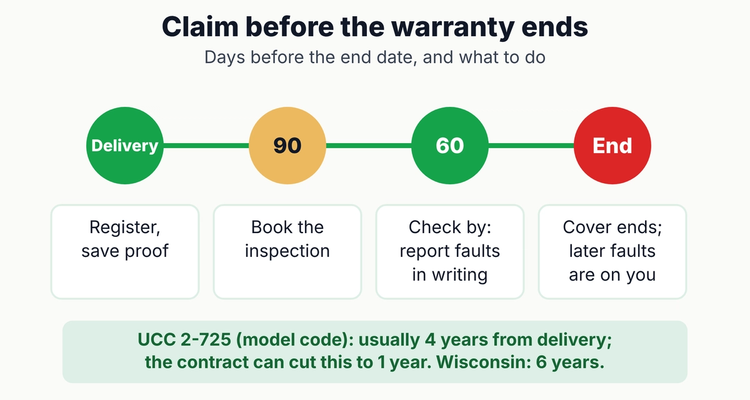 The check-by date leaves time to find faults, report them and get the repair booked.
What do UCC 2-725 and 2-607 mean for equipment warranties?
UCC 2-607 says you must tell the seller about a breach within a reasonable time, and UCC 2-725 sets the outer limit for suing. Both apply to sales of goods under each state's version of the UCC, so check yours. This is general information, not legal advice.
Warranty claim deadlines under the UCC: model code and two state versions (last verified 12 October 2026)
| Rule | Model UCC (Cornell LII) | New York UCC | Wisconsin Statutes |
|---|---|---|---|
| Notice of breach | 2-607(3)(a): notify "within a reasonable time after he discovers or should have discovered any breach" or "be barred from any remedy" | 2-607(3)(a): same wording | 402.607(3)(a): same rule ("after the buyer discovers") |
| Time to sue | 2-725(1): "within four years after the cause of action has accrued" | 2-725(1): four years, same wording | 402.725(1): "within 6 years after the cause of action has accrued" |
| Can the contract shorten it? | Yes, "to not less than one year but may not extend it" | Same wording | Yes, "if they are merchants," to not less than one year |
| When the clock starts | 2-725(2): breach of warranty occurs "when tender of delivery is made" | Same wording | 402.725(2): same rule |
| Exception | Where a warranty "explicitly extends to future performance," accrual is when the breach "is or should have been discovered" | Same wording | Same wording |
In plain English: report faults in writing as soon as you find them, and don't assume you have until the warranty end date to act. Your contract may also limit you to repair or replacement; UCC 2-719 allows that, though where circumstances cause a limited remedy "to fail of its essential purpose," other UCC remedies may be available. Put the delivery date and any shortened limitation period from your terms in the register, and ask your attorney how the clock applies to a specific claim.
⚠️What happens if you miss it: a fault found after the end date is usually outside the warranty, and you pay for the repair. Under UCC 2-607(3)(a), a buyer who does not notify the seller within a reasonable time after discovering a breach is "barred from any remedy." Under UCC 2-725, a claim not brought within the limitation period (four years in the model code, six in Wisconsin, or as little as one year if the contract shortens it) can be lost.
Do this now: a 90-minute equipment warranty audit
You can do this in a spreadsheet today. Time estimates are our planning guide for about 30 assets.
- List assets bought in the last five years (20 minutes). Use your fixed-asset register or purchase ledger. Five years covers the four-year model period with room to spare; use six or more in Wisconsin.
- Find each start date and term (30 minutes). Delivery notes first, then invoices. Mark estimates in a notes column.
- Add the formulas (10 minutes). End date, check-by and days to check-by, as in the register above.
- Sort by days to check-by (5 minutes). Anything under 90 days gets an inspection booked this week.
- Fill gaps in the proof pack (20 minutes). Request missing invoices and registration confirmations from suppliers.
- Name an owner and a backup (5 minutes) and book a 15-minute review on the first Monday of each month.
💡 Pro Tip
Ask for the warranty start-date rule and end date in writing on the purchase order, before you sign. Suppliers answer quickly before the sale, and the purchase order then doubles as start-date evidence in your proof pack.
How can you get more value from equipment warranties?
- Use the last 60 days well. Schedule a full service just before the check-by date, so any fault it finds is reported while cover is live.
- Decide on extended cover with data. Compare a quote with your own repair costs for that model. Dealers price these as service contracts; see how they build offers in our extended warranty renewal strategy.
- Track service contracts beside warranties. When a warranty ends and a maintenance contract starts, both dates belong on the same asset. Our service contract renewal process covers notice periods and auto-renewal.
- Ask your dealer what they track. A dealer running a per-serial warranty tracker can confirm your end dates.
Spreadsheet or software for equipment warranty tracking?
A spreadsheet works for a few dozen assets and one owner who opens it every month. Our free warranty and service contract tracker has a My equipment sheet with these columns, check-by dates, claim status and proof flags, so you can start today without signing up.
It struggles across several sites, when proof sits in different inboxes, or when the owner leaves. A tool such as ExpiryEdge keeps each asset as a record with its end dates, files, owner and backup, sends reminders at 90, 60, 30 and 7 days by email, SMS, Slack or Teams, and can send document requests to suppliers for missing paperwork. See the owner view on our warranty tracking page.
Frequently asked questions
What is equipment warranty tracking?
It is keeping a record for each asset with its serial number, warranty start and end dates, registration and proof of purchase, plus a reminder before each end date. The goal is to find and claim faults while equipment is still covered.
How far before expiry should we check equipment under warranty?
We suggest a check-by date 60 days before the end date, with planning starting at 90 days. That leaves time to inspect, report faults in writing and get a repair booked. Use a longer window for equipment that needs a shutdown to inspect.
Does the Magnuson-Moss Warranty Act cover business equipment?
Generally not. The FTC says the Act "does not apply to warranties on products sold for resale or for commercial purposes." For business equipment, the warranty terms and your state's UCC set the rules.
How long do you have to bring a warranty claim under the UCC?
Model UCC 2-725 allows four years from when the cause of action accrues, which for warranties is usually tender of delivery. The contract can shorten this to one year. States vary; Wisconsin's version says six years. Ask an attorney about a specific claim.
What proof do I need to make a warranty claim?
Keep the invoice with the serial number, the delivery or install record, a serial plate photo, the warranty terms, the registration confirmation, a maintenance log and every claim email. One folder per asset makes this quick.
Do I need to register a warranty on business equipment?
Check the terms. The FTC's rule against requiring registration cards applies to full warranties on consumer products, not to products sold for commercial purposes. If your terms include a registration step, complete it on delivery and save the confirmation.
Sources
- Federal Trade Commission, Businessperson's Guide to Federal Warranty Law (page updated March 11, 2025)
- Uniform Commercial Code 2-607, Cornell Legal Information Institute
- Uniform Commercial Code 2-725, Cornell Legal Information Institute
- Uniform Commercial Code 2-719, Cornell Legal Information Institute
- New York UCC 2-607 (NY Senate, revision of September 22, 2014)
- New York UCC 2-725 (NY Senate, revision of September 22, 2014)
- Wisconsin Statutes 402.725 (2023-24 statutes, published October 1, 2026)
- Wisconsin Statutes 402.607 (2023-24 statutes, published October 1, 2026)
- Microsoft Support, EDATE function
Last reviewed: 12 October 2026
Frequently asked questions
We suggest a check-by date 60 days before the end date, with planning starting at 90 days. That leaves time to inspect, report faults in writing and get a repair booked. Use a longer window for equipment that needs a shutdown to inspect.
Generally not. The FTC says the Act "does not apply to warranties on products sold for resale or for commercial purposes." For business equipment, the warranty terms and your state's UCC set the rules.
Model UCC 2-725 allows four years from when the cause of action accrues, which for warranties is usually tender of delivery. The contract can shorten this to one year. States vary; Wisconsin's version says six years. Ask an attorney about a specific claim.
Keep the invoice with the serial number, the delivery or install record, a serial plate photo, the warranty terms, the registration confirmation, a maintenance log and every claim email. One folder per asset makes this quick.
Check the terms. The FTC's rule against requiring registration cards applies to full warranties on consumer products, not to products sold for commercial purposes. If your terms include a registration step, complete it on delivery and save the confirmation.


