
Vendor Contract Renewal Checklist: Notice Dates and Vendor Emails

A vendor contract renewal checklist starts from the notice-by date, not the end date: subtract the notice period from the end date, then begin your review 30 days before that. Read the renewal clause, check usage and performance, get the renewal price in writing, decide to renew, renegotiate or exit, and send notice exactly as the contract requires.
The renewal email from the vendor arrives with a new price and a line saying the contract has already rolled over. Or it never arrives at all. This checklist shows you how to find every date that matters, the clauses that cause surprise renewals, two state laws that protect business customers, and five emails you can send to vendors today.
Key takeaways
- The notice-by date is the real deadline. A contract ending 31 December with 60 days' notice must be cancelled by 1 November.
- Read the notice clause, not just the term. Method (certified mail, email, portal), address and "business days" wording all decide whether your notice counts.
- New York protects service customers. For service, maintenance or repair contracts, an auto-renewal clause is unenforceable unless the vendor sends written notice 15 to 30 days before your notice deadline (GOL §5-903).
- Wisconsin goes further for business contracts. Covered vendors must disclose auto-renewal terms at signing and, for multi-year renewals, warn you 15 to 60 days before your deadline (Wis. Stat. §134.49).
- Ask for the renewal price in writing before you decide. Price changes at renewal are where value leaks; World Commerce & Contracting puts average value erosion from common contracting pitfalls at 9.2% of anticipated contract value.
- Keep proof of notice. A sent email and a delivery receipt, filed with the contract, settle most disputes.
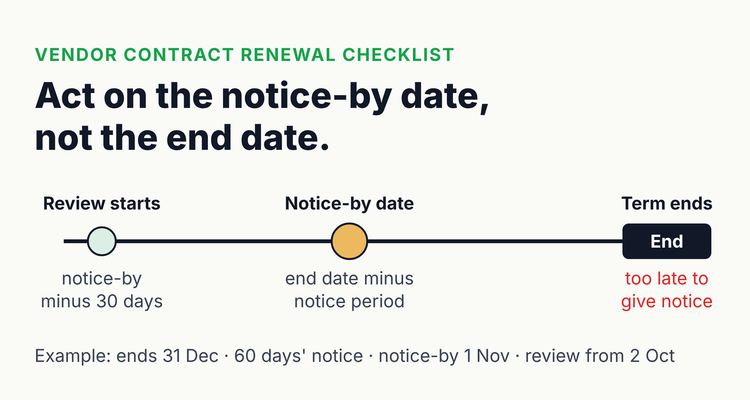 Work back from the end date: the notice-by date is the last day you can act, so the review starts 30 days before it.
What goes on a vendor contract renewal checklist?
A vendor contract renewal checklist covers five things for each contract: the dates, the clause, the evidence, the decision and the notice. Run it for every contract that renews automatically, costs real money or puts a vendor on your premises. If you need the full 180-day process for strategic contracts, our contract renewal process guide sets out a ten-step timeline; this checklist is the working version for everyday vendors.
Vendor contract renewal checklist
- ✓
Find the signed contract, every order form and amendment, and any online terms it incorporates by reference
- ✓
Record the end date, renewal term length and notice period in days
- ✓
Calculate the notice-by date (end date minus notice days) and put it in two people's calendars
- ✓
Note how notice must be given: method, address or portal, named recipient, and calendar or business days
- ✓
Check for traps: evergreen renewal, price escalators, minimum commitments, order forms that restart the term
- ✓
Pull 12 months of invoices and usage; compare with what you are paying for
- ✓
Review service performance: missed service levels, open issues, credits owed
- ✓
Confirm the vendor's insurance certificates, licenses and other required documents are current
- ✓
Ask the vendor in writing for renewal pricing and terms
- ✓
Decide: renew as is, renegotiate, switch vendor, or exit; record who decided and when
- ✓
Send notice or the signed renewal, as the clause requires, before the notice-by date
- ✓
File proof of notice and the new terms; set next year's dates
How do you calculate the notice-by date?
Subtract the notice period from the end date. That date is the last day the vendor must receive your notice, so plan to send it earlier. Use this worked example and copy the formulas into any spreadsheet.
Worked example: notice-by date and review start (row 2)
| Column | Header | Example | Formula |
|---|---|---|---|
| A | Vendor and contract | Example – Office cleaning | Text |
| B | End date | 31 Dec 2026 | From the contract |
| C | Notice period (days) | 60 | From the contract |
| D | Notice-by date | 1 Nov 2026 | =B2-C2 |
| E | Review starts | 2 Oct 2026 | =D2-30 |
| F | Send notice by (buffer) | 26 Oct 2026 | =WORKDAY(D2,-5) |
| G | Days left to act | varies | =D2-TODAY() |
| H | Status | varies | =IF(G2<0,"MISSED",IF(G2<=30,"Act now",IF(G2<=90,"Review","OK"))) |
If the notice period is in months, use =EDATE(B2,-C2) instead. If the clause says "business days", use =WORKDAY(B2,-C2). The 30-day review and the five-working-day buffer are our suggestions, not legal rules. A contract that says notice must be "received" by a date means you should allow for post or portal delays. Our free contract renewal tracker has the notice-by formula and status colors built in.
Which auto-renewal clauses catch businesses out?
Most surprise renewals come from the wording around the date, not the date itself. Look for these when you read the clause:
- Evergreen renewal. The contract renews for another full term, sometimes the same length as the original, unless you cancel. A three-year contract that renews for three years is a big commitment to miss.
- A notice window, not just a deadline. Some clauses say "not more than 90 and not less than 60 days" before the end. Notice sent too early may not count.
- A strict notice method. Certified mail to a named address, a specific portal or a named role. An email to your account manager may not be valid notice.
- Price escalators on renewal. A fixed percentage increase, or "then-current list price", can apply automatically.
- Order forms that reset the term. Adding seats or a product can restart the whole term or align everything to a new end date.
- Online terms incorporated by reference. The vendor can change a web page; save a dated copy of the version that applied when you signed.
- Minimum commitments and early termination fees. Check what you owe if you exit mid-term instead of at renewal.
If the date has already passed, read our answer on what to do when a contract auto-renewed before you contact the vendor.
Do any state laws limit auto-renewal in business contracts?
Yes, some do. New York and Wisconsin have statutes that protect business customers, and the table compiles what each requires of the vendor from the official text. Other states' auto-renewal laws may cover only consumer contracts, so check the scope before relying on one.
State auto-renewal laws that cover business customers (last verified 12 Oct 2026)
| State and law | Contracts covered | What the vendor must do | If the vendor does not | Official source |
|---|---|---|---|---|
| New York, General Obligations Law §5-903 | Contracts for service, maintenance or repair to or for real or personal property; not where the renewal period is one month or less | Give written notice, served personally or by certified mail, 15 to 30 days before your deadline to give notice, calling attention to the renewal clause | The renewal clause is not enforceable against you | nysenate.gov (revision 22 Sep 2014) |
| Wisconsin, Stat. §134.49(2) | Business equipment leases and business services used by the customer; many exclusions, including government parties, real property, titled vehicles, medical equipment, elevator contracts and contracts cancellable on one month's notice | For contracts entered, modified or renewed after 1 May 2011 with renewal periods over one month: disclose the renewal terms at signing and get your signature or initials | The renewal provision is not enforceable and the contract ends at the end of the current term | docs.legis.wisconsin.gov (2025 biennium) |
| Wisconsin, Stat. §134.49(3) | Same, where the initial term is over one year and the renewal term is over one year | Send written notice 15 to 60 days before your deadline to decline, stating the deadline, any price increase and how to decline | The renewal provision is not enforceable against you | docs.legis.wisconsin.gov (2025 biennium) |
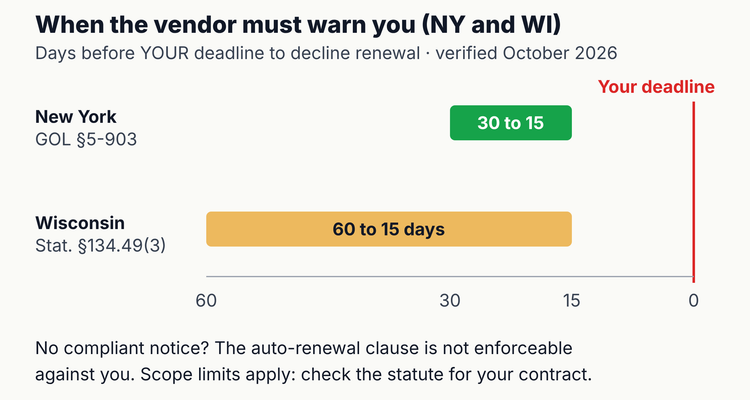 The windows in which New York and Wisconsin vendors must warn business customers of an auto-renewal, verified October 2026.
These are summaries; each statute has more detail and exceptions, and Wisconsin's also bars clauses that let the seller match a competing offer. Check the text for your contract, and take legal advice before refusing to pay.
Do this now: five emails to send your vendors
Copy, fill in the brackets and send. Save each sent email, with any delivery receipt, on the contract record.
Email 1: request renewal terms (at review start)
Subject: [Contract name], renewal terms before [notice-by date]
Hi [Name], our agreement for [service] ends on [end date] and our notice deadline is [notice-by date]. Before we decide, please send in writing: the renewal price, any change to terms or service levels, and the length of the renewal term. We would appreciate this by [date, two weeks before notice-by]. Thank you.
Email 2: notice of non-renewal
Subject: Notice of non-renewal, [contract name and number]
Under clause [number] of our agreement dated [date], [your organization] gives notice that we will not renew the agreement at the end of the current term on [end date]. Please confirm receipt in writing and let us know the steps for transition and the return of our data or equipment. [Send by the method the clause requires; if it says certified mail, send the letter as well as this email.]
Email 3: renew only on revised terms
Subject: [Contract name] renewal, revised terms requested
We would like to continue working with you, on revised terms. Based on our usage over the last 12 months, we propose: [quantity or tier], [price], [service level change], [term length]. If we cannot agree by [date], please treat this as our notice of non-renewal under clause [number], effective [end date].
Email 4: request current compliance documents
Subject: Updated certificates needed for [contract name]
As part of our renewal review, please send current copies of: [certificate of insurance naming us as required], [license or accreditation], [other documents the contract requires]. Our records show [document] expires on [date]. Please send these by [date].
Email 5: confirm the renewal you agreed
Subject: Confirmation of renewal, [contract name]
To confirm what we agreed on [date]: the agreement renews from [start] to [end] at [price], with [changes]. Please send the signed amendment or order form, and confirm the next notice deadline is [date].
What happens if you miss the notice-by date?
⚠️What happens if you miss it: if the clause is enforceable, the contract renews for the full renewal term on its terms, which may include a price increase and a new notice date a year or more away. Exiting early can trigger termination fees. The New York and Wisconsin statutes above make a renewal clause unenforceable only where the vendor failed its own notice or disclosure duties, and only for contracts within their scope.
How can you get more out of each vendor renewal?
- Co-term related contracts. Aligning end dates means one review and more leverage with the vendor.
- Ask for the clause you wish you had. A shorter renewal term, a notice period you can meet, or a reminder from the vendor before renewal.
- Use performance data. Missed service levels and unused licenses are the strongest arguments in a renegotiation.
- Check the vendor's documents at every renewal. Our free contractor document tracker keeps a request-by date for every certificate.
- Name the owner and a backup. One public-sector museum group we work with names an officer in charge for each vendor contract, so there is never a question of who sends the notice.
For maintenance and service agreements specifically, our service contract renewal process adds performance reviews and site visits.
Spreadsheet or software for vendor contract renewals?
A spreadsheet is enough when one person owns a few dozen contracts and opens the file every week. It fails when owners change, notices sit in personal inboxes, or nobody opens the file in the month that matters. Raymond Panko's review of spreadsheet audits found "errors in 94% of the spreadsheets studied" (Panko), so check the date formulas each quarter.
Software earns its place when many people own contracts or a missed notice is expensive. ExpiryEdge holds each contract as a record with an officer in charge, a backup and the notice-by date, sends reminders at 90, 60, 30 and 7 days, and can send vendors a document request link with no login. See vendor contract management for how that fits together.
Frequently asked questions
How far in advance should I review a vendor contract renewal?
Start at least 30 days before the notice-by date, which is the end date minus the notice period. For large or strategic contracts, start earlier so you have time to test the market. These lead times are our suggestions, not legal rules.
How do I calculate a contract's notice-by date?
Subtract the notice period from the end date. In a spreadsheet, use =B2-C2 for days, =EDATE(B2,-C2) for months or =WORKDAY(B2,-C2) for business days. Then send notice a few days early to allow for delivery.
How do I stop a vendor contract from auto-renewing?
Send written notice of non-renewal before the notice-by date, using the exact method and address the contract specifies, and keep proof of delivery. If the clause has a window, such as not more than 90 days before the end, send it within that window.
Are auto-renewal clauses enforceable in business contracts?
Generally yes, if the contract is clear. Some states add conditions: New York requires service, maintenance and repair vendors to send a 15 to 30 day reminder, and Wisconsin requires disclosure and, for multi-year renewals, a 15 to 60 day notice. Without it, the renewal clause is not enforceable against the customer.
What should a non-renewal letter to a vendor include?
The contract name and date, the clause you rely on, a clear statement that you will not renew, the end date, and a request to confirm receipt and arrange transition. Send it the way the contract requires.
What if the contract already auto-renewed?
Read the clause and any statute that applies, then contact the vendor promptly and in writing. If the vendor did not meet a statutory notice duty, the renewal may not be enforceable; otherwise, negotiate and set the next notice-by date so it does not happen again.
Sources
- New York State Senate, General Obligations Law §5-903 (revision 22 Sep 2014; accessed 12 Oct 2026).
- Wisconsin Legislature, Wis. Stat. §134.49, Renewals and extensions of business contracts (2025 biennium; accessed 12 Oct 2026).
- World Commerce & Contracting, Overcoming the Ten Pitfalls of Contracting.
- Raymond R. Panko, What We Don't Know About Spreadsheet Errors Today.
- Last reviewed: 12 October 2026
Frequently asked questions
Subtract the notice period from the end date. In a spreadsheet, use =B2-C2 for days, =EDATE(B2,-C2) for months or =WORKDAY(B2,-C2) for business days. Then send notice a few days early to allow for delivery.
Send written notice of non-renewal before the notice-by date, using the exact method and address the contract specifies, and keep proof of delivery. If the clause has a window, such as not more than 90 days before the end, send it within that window.
Generally yes, if the contract is clear. Some states add conditions: New York requires service, maintenance and repair vendors to send a 15 to 30 day reminder, and Wisconsin requires disclosure and, for multi-year renewals, a 15 to 60 day notice. Without it, the renewal clause is not enforceable against the customer.
The contract name and date, the clause you rely on, a clear statement that you will not renew, the end date, and a request to confirm receipt and arrange transition. Send it the way the contract requires.
Read the clause and any statute that applies, then contact the vendor promptly and in writing. If the vendor did not meet a statutory notice duty, the renewal may not be enforceable; otherwise, negotiate and set the next notice-by date so it does not happen again.
Not legal advice
This article is for general informational purposes and does not constitute legal advice. Laws, regulations and contract requirements vary by jurisdiction and change over time. Consult a qualified attorney in your jurisdiction before making decisions that depend on the specific legal interpretation discussed here.


