
Managing Subcontractor Documentation and Everything Else You Track About Your Subs

Manage subcontractor documentation as one record per subcontractor, with two layers: company documents that follow the sub from job to job (insurance, licence, W-9, prequalification) and project documents that belong to one job (subcontract, NDA, RAMS, schedule of values, lien waivers). Give every item an owner and a date, and keep a log of changes. That structure answers almost every "where's the…" question your team asks.
What goes wrong in most offices isn't a lack of storage. It's that the same insurance certificate lives in three project folders, none of them current, and nobody knows whose job it was to ask for the new one.
Split company documents from project documents
Company-level documents describe the subcontractor as a business. Store them once, on the sub's record, and link to them from each project:
- certificates of insurance and endorsements, with each policy's expiry
- state or trade licences, with number, class and expiry
- the W-9 (US) or CIS details (UK)
- prequalification answers, such as an AIA A305 Contractor's Qualification Statement, and safety programme documents
- banking details for payment
Project-level documents belong to one job, so they sit under that job and point back to the sub:
- the bid, the signed subcontract and any NDA
- method statements, site-specific safety plans and training records for the people on that site
- the schedule of values, pay applications and lien waivers
- change orders and back-charges
The split stops duplication. When the sub's general liability renews, you update one record, and every project that relies on it sees the new date.
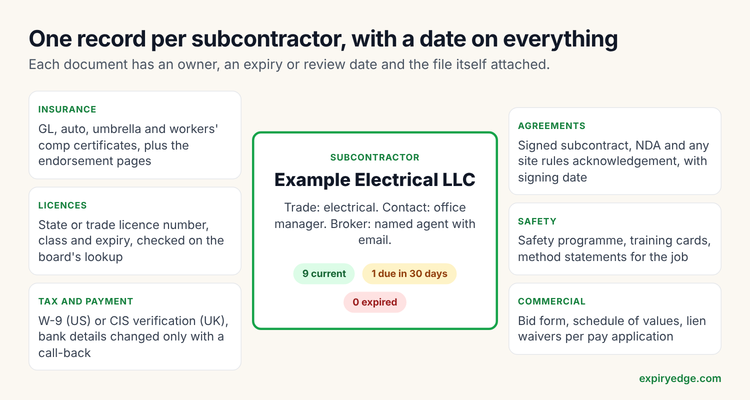 One subcontractor record, with company and project documents attached
Put the same fields on every sub record
A record works when every sub has the same fields filled in. These are the ones GCs reach for most:
Fields to keep on each subcontractor record
| Field | Why you need it |
|---|---|
| Legal name and entity type | Must match the subcontract, the certificate and the W-9 |
| Trades and regions | So estimators can find the sub for the next bid |
| Office contact and authorised signatory | The person who can bind the company isn't always the one who calls you |
| Broker name and email | Renewal certificates come from the broker, not the sub |
| Licence number, class and expiry | Checked on the state board's own lookup |
| Insurance policies and expiry dates | One line per policy, not one per certificate |
| Tax form and date received | W-9 for US subs, CIS verification for UK subs |
| Safety rating or prequal status | EMR, SSIP or your own score, with the date it was assessed |
| Bank details and how they were verified | Changes confirmed by phone on a known number |
| Performance notes | Short, dated notes from project managers after each job |
The broker field and the authorised signatory field get skipped most often. Both save days later.
Give every document an owner and a date
Every item on the record needs a person responsible for keeping it current and a date that triggers action. For most documents the date is an expiry. For some it's a review: a prequalification you reassess every year, or performance notes you update at closeout.
Assign owners by role rather than by name, so the work survives staff changes. Your compliance coordinator owns insurance and licences. Accounts payable owns the W-9 and banking details. The project manager owns project documents.
Treat bank detail changes as a security event
A request to change a sub's bank details is the moment payment fraud happens. Never accept new details from an email alone, even one that looks like it comes from the sub's office manager. Call the sub on a number already on their record, confirm the change, and log who confirmed it and when.
Keep this rule in writing and make accounts payable own it. It's the cheapest fraud control a contractor has.
Collect lien waivers with each pay application
Lien waivers are project documents that pile up fast: one per sub per pay application, conditional before payment and unconditional after. Several states require their own statutory wording. California, for example, voids a conditional progress waiver unless it is in substantially the form set out in Civil Code 8132. Store each waiver against the pay application it covers, so you can prove the chain at closeout.
Log what changed and who checked it
When a certificate is replaced or a licence renewed, keep the old version and note who approved the new one. If something goes wrong on site, the first question will be what you had on file that day. A dated history answers it in minutes.
For tax forms, keep the W-9 even after the sub stops working for you. You'll need the taxpayer ID for information returns, and the IRS instructions for Form 1099-NEC now use a $2,000 reporting threshold for tax years beginning after 2025.
Where to keep it all
A shared drive with a strict folder structure works for a small team if one person polices it. It won't remind anyone that a policy lapses next week, and it can't stop a project manager saving a fourth copy of the same certificate.
ExpiryEdge keeps one record per sub with every dated document on it. Subs send their files, form answers and signatures through a link with no login, your team approves each item with a comment, and every expiry or review date reminds its owner by email, SMS, WhatsApp, Slack or Teams. Plans start at $29 a month with a 14-day free trial. If you also need bids and pay applications in one platform, our comparison of subcontractor management software covers Procore, BuildingConnected and five others.
Frequently asked questions
At minimum the legal name, trades, office contact, authorised signatory and broker email. Add licence and insurance details with expiry dates, the tax form, safety or prequal status, verified bank details and short performance notes from each job.
Give it to roles, not people, so it survives staff turnover. Insurance and licences usually sit with a compliance coordinator. Accounts payable keeps the W-9 and bank details, and the PM owns anything that belongs to one job.
Never change bank details on the strength of an email. Call the sub on a phone number already on their record, confirm the change with someone you know, and log who confirmed it and when.
Keep them at least as long as your contract, insurance and tax obligations require, which often runs years past completion. Agree a retention period with your accountant and insurer, then keep the old versions of replaced documents too.