
UK Contractors: How to Collect and Track Subcontractor Compliance Documents Before Site Start

Before a subcontractor starts on a UK site, you need six things on file: a current prequalification certificate, employers' and public liability insurance, HMRC verification under the Construction Industry Scheme, risk assessments and method statements for this job, card and right to work checks for each operative, and a signed site induction. Collect them through one request per sub, check each against a named rule, and put every expiry date on a reminder.
Below is each document, the rule behind it, and what to check. The rules are current as of October 2026.
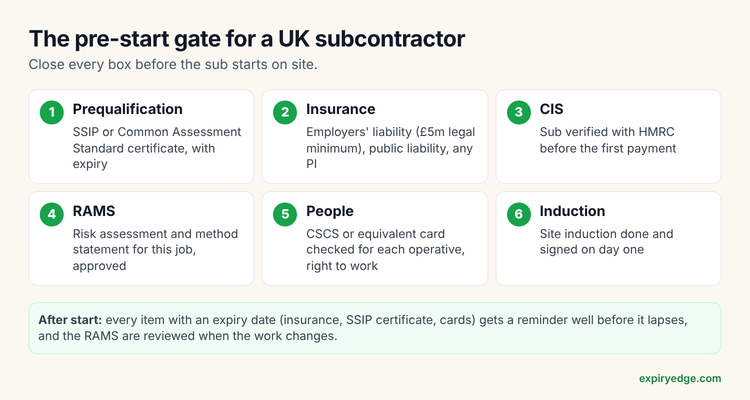 The pre-start gate, in the order most site managers work through it
Why the duty sits with you
Under the Construction (Design and Management) Regulations 2015, anyone appointing a contractor must take reasonable steps to satisfy themselves the contractor has the skills, knowledge, experience and organisational capability for the job. That's regulation 8. As principal contractor, regulation 13 also makes you coordinate contractors and give each worker a suitable site induction.
On building work, Part 2A of the Building Regulations adds a parallel competence check. Regulation 11E requires appointers to take reasonable steps to confirm competence before permitting someone to carry out the work, with extra checks and written records on higher-risk buildings.
The documents below are how you show you took those steps.
1. A prequalification certificate, with its expiry
Ask for one recognised certificate rather than your own 40-page questionnaire. For most packages that's an SSIP certificate. For higher-risk work, ask for the Build UK Common Assessment Standard, which is valid for a year provided the sub keeps its time-critical documents current.
Check the certificate on the issuing body's portal, not just the PDF. That matters this autumn: UKAS listed SMAS Worksafe under imposed suspension from 2 October 2026, and SSIP has withdrawn SMAS certificates issued during that period. Our comparison of UK subcontractor compliance software covers Constructionline, CHAS and the other schemes.
2. Employers' and public liability insurance
Employers' liability is compulsory for a sub with employees. The legal minimum is £5 million for any one occurrence under regulation 3 of the 1998 regulations, and GOV.UK lists fines of up to £2,500 for every day without it. In practice many main contractors ask for £10 million, and the ABI notes that most policies offer at least that.
Public liability isn't compulsory by law, so the limit comes from your subcontract. Add professional indemnity for any sub doing design, and contractors' all risks if your contract passes that to them. Record each policy's expiry separately.
3. CIS verification before the first payment
Before you pay a new subcontractor under the Construction Industry Scheme, you must verify them with HMRC. GOV.UK's verification guidance also requires it for a sub you've used before who hasn't appeared on a CIS return in the current or previous two tax years.
HMRC tells you the deduction rate: 20% for registered subs, 30% for unregistered, or gross payment. Since 6 April 2026, HMRC can cancel gross payment status immediately and charge penalties where a business knew or should have known a payment was connected to fraud. Collect the sub's UTR and legal name in your pre-start request so your payroll lead can verify on day one.
4. RAMS for this job, approved before work starts
Every employer must make a suitable and sufficient risk assessment, and record the significant findings once it has five or more employees, under regulation 3 of the Management Regulations 1999. Method statements aren't generally required by law, though HSE says they're prepared for many construction activities and written ones are needed for demolition and structural alteration.
Ask for RAMS specific to the package and the site, not the sub's generic set. Review them against your construction phase plan, send back comments, and record the approval date and revision. If the work changes, the RAMS need revising too.
5. People: cards and right to work
For each operative, record their card type, number and expiry. Build UK's Training Standard requires a card carrying the CSCS logo for construction occupations and says to check cards with CSCS Smart Check. Industry Accreditation cards issued from 2020 expired on 31 December 2024 and can't be renewed, per CSCS, so treat any you still see as invalid.
Right to work checks now go further. From 1 October 2026, the Home Office code of practice brings individual sub-contractors into the scheme for engagements starting on or after that date, and GOV.UK sets the maximum civil penalty at £60,000 per illegal worker. Agree in the subcontract who checks whom, and ask for confirmation in writing.
For specialist trades, check registration as well. Anyone doing gas work must be on the Gas Safe Register, and HSE explains how to check an engineer using the licence number on their ID card.
6. Site induction, signed on day one
The induction is the last box. Record the date, who gave it, and each operative's signature confirming they understood the site rules, emergency arrangements and the RAMS that apply to them.
Keep the dates alive after start
The pre-start pack gets checked once. The trouble starts in month four, when the sub's employers' liability policy renews, two CSCS cards expire and the SSIP certificate lapses. None of that shows up unless someone diaries it.
Dates to diary for every subcontractor
- ✓
Each insurance policy's expiry (EL, PL, PI, CAR)
- ✓
Prequalification certificate expiry
- ✓
Card expiry for each operative on site
- ✓
RAMS review date, or the next change in the work
- ✓
Next CIS verification needed if the sub leaves your returns for two tax years
ExpiryEdge handles the collecting and the dates. Each sub gets one link, with no account needed, for their certificates, RAMS, operative list and site rules acknowledgement. Your site manager approves or rejects each item with a comment, and every expiry becomes a reminder by email, SMS, WhatsApp, Slack or Teams, escalated if it's overdue. Plans start at $29 a month with a 14-day free trial.
Frequently asked questions
The legal minimum is £5 million for any one occurrence. Many main contractors ask subs for £10 million, which is also what most policies offer, so check your subcontract terms.
No. You verify before the first payment to a new sub, and again for a sub who hasn't been on any of your CIS returns in the current or previous two tax years.
Risk assessments are. The Management of Health and Safety at Work Regulations 1999 require one, written down once a business has five or more employees. Method statements generally aren't, except for jobs like demolition, but HSE expects them for most construction work and you'll struggle to coordinate without one.
From 1 October 2026 the Right to Work Scheme covers people engaged as individual sub-contractors, for engagements starting on or after that date. Agree in the subcontract who carries out the checks.