
Best Veterinary License and DEA Tracking Software for Vets, Vet Techs and Mobile Practices (2027)

For most practice managers, ExpiryEdge is the best way to track veterinary licences and DEA registrations. It puts each DVM's state licence, DEA number and state controlled-substance registration next to every tech's credential, and it texts the right person before their date. If your state vet board takes CE through CE Broker, keep CE Broker for the hours.
The others fit narrower jobs. Certemy suits hospital groups that want each licence verified with the board that issued it. Expiration Reminder is the closest general-purpose rival to ExpiryEdge. Compli Vet bundles a licence vault with OSHA courses, and UK vets and RVNs log CPD on the RCVS's own 1CPD platform.
We make ExpiryEdge. The facts about the other five tools come from their own websites and help pages, which we read on 7 November 2026, and each one is linked where we use it.
| Tool | Reminds the vet or tech directly (email, SMS, WhatsApp) | Clinicians upload renewals from a link, no login | Every licence, DEA and state registration in one team view | Escalates overdue items to the medical director | Published pricing / free trial | Reports CE or checks status with the board |
|---|---|---|---|---|---|---|
| ExpiryEdge Top pick | Yes, email, SMS, WhatsApp, Slack, Teams | Yes, no-login link, AI reads the date | Yes, filter by hospital or state | Yes, at the step you choose | $29-$199/month, 14-day free trial | Keep CE Broker or the register for that |
| CE Broker | Not stated | Each clinician logs in their own account | Individual accounts; employer product for 150+ staff | Not stated | Basic account free in Georgia; paid plans by state | Yes, partner boards read the record |
| Certemy | Alerts admins and staff | Not stated | Yes, staff and facility licences | Not stated | From $3 per user a month | Yes, primary source verification |
| Expiration Reminder | Yes, steps you choose, SMS included | Employee self-service portal | Yes, across sites and states | Not stated | $49-$399/month, 14-day free trial | Not stated |
| Compli Vet | Renewal reminders, recipient not stated | Not stated | Licence vault plus training records | Not stated | Not published | Not stated |
| RCVS 1CPD | Not stated | Each vet or nurse logs their own CPD | No, individual records | Not stated | Not stated on pages read | It is the regulator's tool |
How we compared these tools
A practice manager needs to know who can legally work, and prescribe, this week. So our columns ask whether the reminder reaches the clinician, whether they can send the new certificate without a login, whether you see the whole team at once and whether a late renewal reaches the medical director. We also note whether you can see a price before a call, and whether the tool reports to the board itself. On 7 November 2026 we read each vendor's product, pricing and help pages, and checked the dates against the DEA's rules in the eCFR, the Georgia vet board's CE page and the RCVS. We didn't pay to trial every tool. We also make ExpiryEdge, so weigh our ranking of it with that in mind.
Three registrations per vet, and one more if you drive
A small-animal hospital with four DVMs and six credentialed techs can easily carry 30 renewal dates. Each vet holds a state veterinary licence and a DEA registration, and in states that issue one, a separate state controlled-substance registration with its own date. Techs hold their own credential, with CE rules from the same board or a different one.
The DEA cycle is set in federal rules. Under 21 CFR 1301.13, a registration expires 36 months after the first period ends, and you can't apply to renew more than 60 days before it expires.
Mobile and ambulatory vets get a specific carve-out. Federal law, at 21 U.S.C. 822(e), says a vet doesn't need a second DEA registration to carry and dispense controlled drugs away from the registered practice, as long as the site is in a state where the vet is licensed and isn't another principal place of practice. So a house-call vet who crosses a state line needs that state's licence kept current. An ambulatory practice that opens a fixed base needs a registration there too.
State boards set CE rules as well, and they don't agree. CE Broker lists the Georgia, Michigan, New Hampshire, South Carolina and Tennessee vet boards among the boards it works with. Georgia's Board of Veterinary Medicine won't take a renewal until your CE is recorded in CE Broker with documents uploaded.
In the UK the RCVS sets two dates. Vets renew by 1 April and veterinary nurses by 1 November, and both confirm CPD at renewal, per the RCVS renewal page. The RCVS CPD rules ask for 35 hours a year from vets and 15 from RVNs, each with reflection, and hours don't carry over.
- State veterinary licence or RCVS registration, with its renewal date
- DEA registration, plus any state controlled-substance registration
- Licences in every state an ambulatory vet works in
- Credentialed vet tech or RVN registration
- CE or CPD hours against the current cycle
- USDA accreditation, if your vets sign health certificates
- Professional liability policy
1. ExpiryEdge: best for a practice manager tracking the whole team
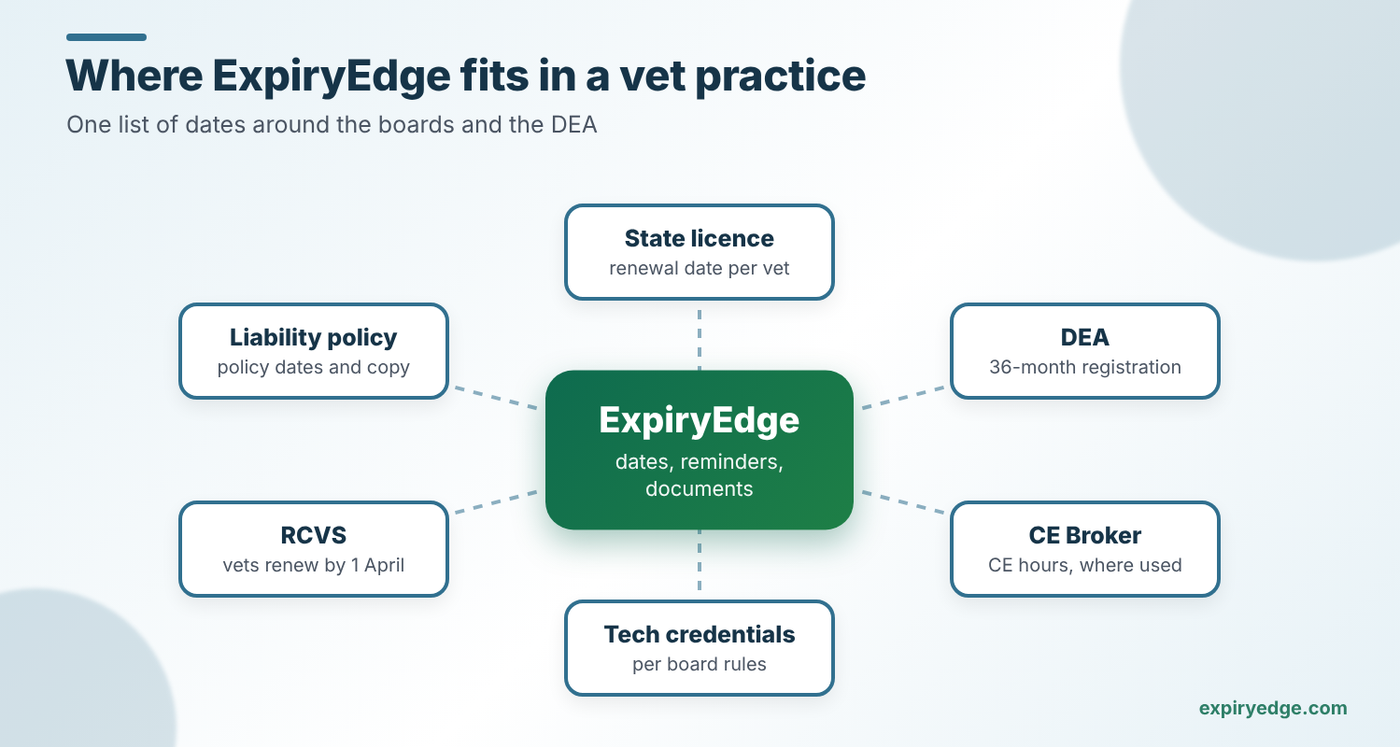
ExpiryEdge means no vet finds out at the controlled-drugs cabinet that their DEA registration lapsed, and no tech works a shift on an expired credential. You see the whole team on one screen, and the clinician who has to renew gets the nudge, not just you.
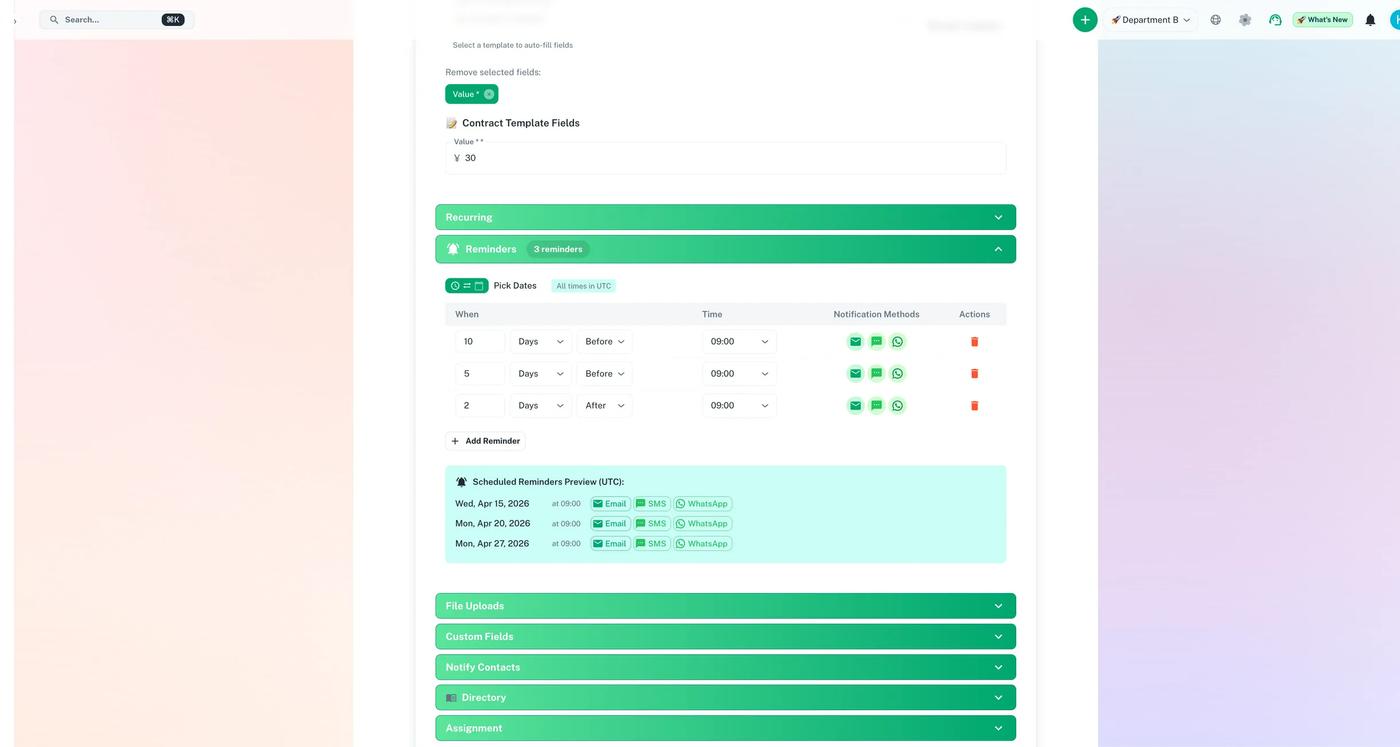
Each vet, tech and RVN gets one record per credential, with custom fields for licence number, state, DEA number and CE hours so far. You pick the reminder steps, and each one goes by email, SMS or WhatsApp to the clinician, with a copy to you in Slack or Teams. For a DEA renewal that means a nudge at 90 days to confirm the state registration is current, then another at 60 days when the DEA window opens. The vet opens a no-login link and uploads the new certificate, ExpiryEdge's AI reads the expiry date, and you approve or reject each field; if nothing arrives, the medical director gets the escalation. Ambulatory vets get one record per state licence, and a group with several hospitals filters one dashboard by location and exports the audit trail when a board or a buyer's due-diligence team asks.
Try it with your own vets' credentials in 15 minutes
- Save your staff list as a CSV with one row per credential (name, type, state, number, expiry) and import it, mapping the extra columns to custom fields.
- Set a 90/60/30/7-day schedule that texts the clinician and copies the practice manager in Slack or Teams.
- Send one vet a no-login request link for their latest DEA certificate and check the date ExpiryEdge reads from it.
Pricing: four plans at $29, $49, $99 and $199 a month, set by users and records. Start with a 14-day free trial, no credit card needed, and compare the plans on the ExpiryEdge pricing page.
Good to know: ExpiryEdge runs beside CE Broker and the RCVS register rather than replacing them. Clinicians keep reporting CE where their board reads it, and ExpiryEdge keeps every renewal date and certificate around it current.
2. CE Broker: best for CE hours where your vet board uses it
In the five states above, CE Broker is where a vet's or tech's CE has to land before the board will renew. Each clinician keeps their own account and logs courses there, and the partner board reads that record directly, according to CE Broker's explainer. Georgia's board points vets to the no-cost Basic account.
There's an employer side too. CE Broker's business page describes CE Broker Learning for healthcare organisations and sends teams of 150 or more to tailored options. EverCheck, its sister product, verifies and monitors licences.
Pricing: the Basic account is free in Georgia, per the board. Paid plans show on the plans page once you pick a state and profession.
Watch out for: it's built around the individual vet. It won't warn a practice manager that a tech's credential or the practice's DEA registration is close to lapsing.
3. Certemy: best for groups that want licences verified at the source
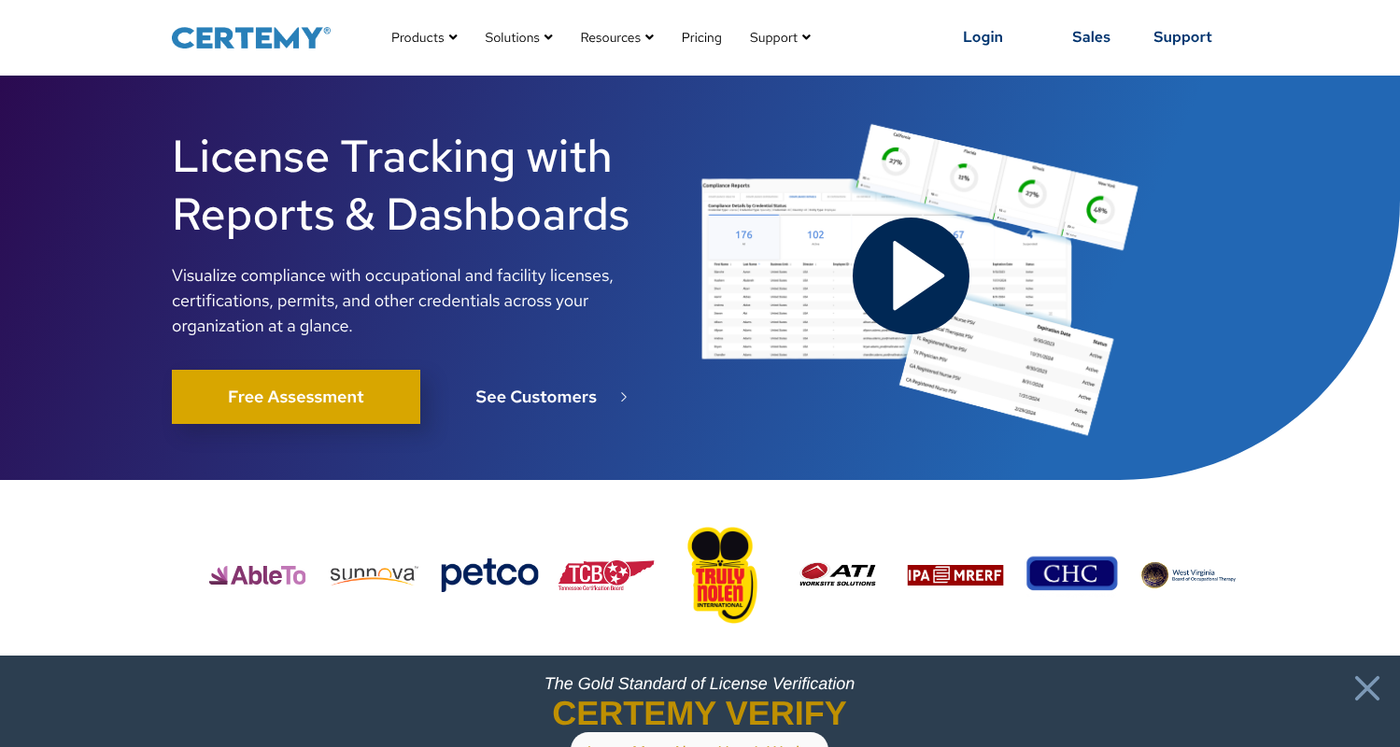
Certemy suits groups that want a board check, not just a date. Its tracking product shows staff and facility licences on one dashboard, runs automated primary source verification, and alerts admins and staff. A page aimed at veterinarians names state vet licences and DEA registration as items it tracks, with alerts before they expire. HRIS and single sign-on links are listed.
Pricing: the pricing page shows Standard Track at $3 per user a month, Enterprise Track and Manage at $6, and $1 per verification. A second, lower set of figures looks like the yearly rate, though the page doesn't say so.
Watch out for: we found nothing on CE hour tracking, or on techs uploading their own renewals. Raise both in the demo.
4. Expiration Reminder: best general-purpose alternative
Expiration Reminder has a page written for DEA licence tracking: every practitioner's registration in one list across sites and states, with reminders at steps you choose, such as 90, 60 and 30 days. Its pricing page includes SMS reminders and an employee self-service portal on every plan.
Pricing: Starter $49 a month for 150 items, Professional $99 for 600, Business $179 for 1,500 and Enterprise $399 for 2,500, cheaper on yearly billing. The 14-day trial doesn't need a card.
Watch out for: e-signatures are a paid add-on, from $29 a month. We couldn't tell from its pages whether a vet can upload a renewed certificate on their own.
5. Compli Vet: best if you also need OSHA training
Compli Vet, from Compliance Training Partners, is a vet compliance platform with a licence vault attached. The product page lists a vault for state and federal licences "with automated renewal reminders", next to online OSHA and infection control courses that carry RACE CE credit. It also stores staff training certificates and logs routine checks.

Pricing: not published; you get a quote through a demo.
Watch out for: the page doesn't say who gets the licence reminders or whether vets upload renewals themselves.
6. RCVS 1CPD: the UK default for CPD
1CPD is the RCVS's own platform where vets and RVNs plan, record and reflect on CPD, on the web or in an iOS or Android app.
Pricing: not stated on the pages we read.
Watch out for: each person logs their own CPD. A practice manager still needs a team view of renewal dates, indemnity and practice premises registration.
ExpiryEdge as an alternative to CE Broker
If your board uses CE Broker, keep it. The board reads it. Practices add something else when the problem is the team, not the hours: ten clinicians, four or five credentials each, and nobody flagging that a DEA registration is 60 days out.
That's the gap ExpiryEdge fills, with one dashboard, SMS or WhatsApp reminders to each vet and tech, and no-login links for the new certificate. CE hours can sit in a custom field with a reminder set well before the board's deadline.
If you need CE reported to the board or licence status pulled from the source, pair ExpiryEdge with CE Broker or Certemy, which do those jobs.
Pick in one afternoon: list every vet, tech and state
Start with one spreadsheet row per credential: each vet's licence, DEA and state controlled-substance registration, each tech's or RVN's registration, and any second-state licence your ambulatory vets hold. Count the rows; that decides which pricing model is cheapest.
Then check your board. If it uses CE Broker, every clinician needs an account anyway. If you're a group buying practices and want board verification, look at Certemy. If you want every date chased and the proof on file, trial ExpiryEdge and Expiration Reminder with that spreadsheet.
Our guide to how long a DEA licence lasts covers the DEA cycle, and licence management shows the setup. For the wider picture, see software for veterinary compliance and our comparison of veterinary compliance software.
Frequently asked questions
Under 21 CFR 1301.13, a DEA registration expires 36 months after its first period ends. You can apply to renew no more than 60 days before it expires, so set a reminder at 90 days to check the state licence and another at 60 days when the window opens.
Not for house calls. Under 21 U.S.C. 822(e), a vet can carry and dispense controlled drugs away from the registered practice without a second registration, if the site is in a state where the vet is licensed and isn't another principal place of practice. Keep each state licence current in a tracker such as ExpiryEdge.
CE Broker's help centre lists the Georgia, Michigan, New Hampshire, South Carolina and Tennessee veterinary boards. Georgia's board says you can't submit a renewal until your CE is recorded in CE Broker with supporting documents, and it points vets to the no-cost Basic account.
On their published pricing pages, ExpiryEdge runs $29 to $199 a month and Expiration Reminder $49 to $399. Certemy lists $3 per user a month plus $1 per verification. CE Broker's paid plans are priced by state, and Compli Vet doesn't publish a price.
The RCVS asks vets for 35 hours a year and veterinary nurses for 15, plus reflection on each activity, and hours can't be carried over. Vets renew by 1 April and nurses by 1 November, and both confirm CPD compliance at renewal.
CE Broker's Basic account costs nothing in Georgia, and UK vets and nurses log CPD on the RCVS's 1CPD platform. ExpiryEdge and Expiration Reminder each offer a 14-day free trial with no credit card, but both are paid after that.
Often yes. CE Broker tracks each clinician's CE against their board's rules. But it doesn't show a practice manager every DEA registration, state controlled-substance registration and tech credential across the team. A tracker such as ExpiryEdge or Expiration Reminder covers those dates.