How Long Does a DEA License Last? Renewal Rules Explained

How Long Does a DEA License Last? Renewal Rules Explained

A standard DEA registration is valid for a multi-year period for most practitioners, running on a regular renewal cycle once the initial period is established. Researchers registered under Form 225 typically fall on a different, often annual, cycle depending on their institution’s activity classification.
The wrinkle most clinicians don’t expect: your very first registration might not run a full three years. Under 21 CFR 1301.13, initial registrations get assigned to expiration groups that can run anywhere from 28 to 39 months, depending on when in the cycle you first registered. Once that initial term expires, every renewal after it follows the standard 36-month schedule.
- Standard practitioner cycle: 36 months
- Initial registration variability: 28 to 39 months
- Researcher/analytical lab cycle: often annual, verify per institution
- Reinstatement window after expiration: one calendar month
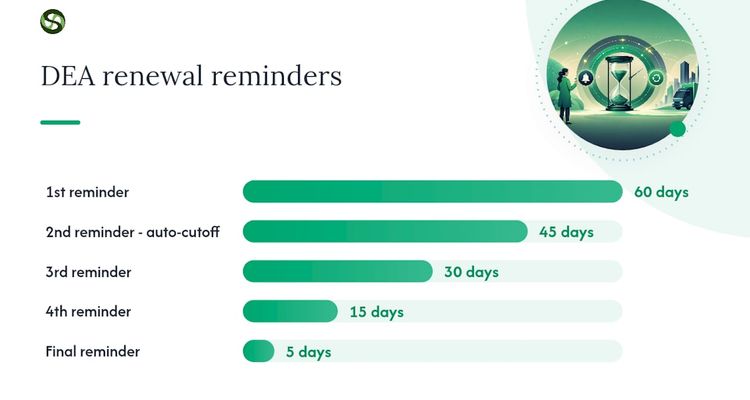
The DEA doesn’t send a single reminder and call it done. It emails registrants at 60, 45, 30, 15, and 5 days before expiration, but the Diversion Control Division makes clear that missing those emails doesn’t excuse a lapsed registration. Tracking your own expiration date is on you, not the agency.
For the authoritative source on registration status, fee schedules, and online filing, go straight to the DEA Diversion Control Division’s registration page and the secure filing portal rather than a third-party summary, including this one.
Key Takeaways
A standard DEA registration lasts 36 months for most practitioners, filing 45 days early preserves an automatic extension, and reinstatement after expiration is limited to one calendar month.
| Point | Details |
|---|---|
| Standard duration | Most practitioners renew every 36 months after an initial 28 to 39 month period. |
| File 45 days early | Filing at least 45 days before expiration triggers an automatic extension while DEA processes renewal. |
| One-month reinstatement window | Expired registrations can be reinstated within a limited one-month window; after that, a new application is required. |
| State license before cross-state moves | DEA requires proof of new-state licensure before approving a registration modification. |
| Automate the tracking | Expiryedge sends multi-channel renewal reminders and stores license documents to reduce missed DEA deadlines. |
How Long Does a DEA License Last by Registrant Type?
Not every registrant runs on the same clock, and confusing a practitioner’s timeline with a researcher’s is a common, avoidable mistake.
Practitioners (physicians, dentists, podiatrists, veterinarians, and mid-level practitioners like nurse practitioners and physician assistants who hold prescribing authority) register on Form 224 and renew every 36 months after their initial period. Mid-level practitioners follow this same cycle. There’s no separate renewal schedule carved out for NPs or PAs. Their registration duration and renewal mechanics mirror a physician’s exactly, though scope of prescribing authority still depends on state law layered on top of the federal registration.
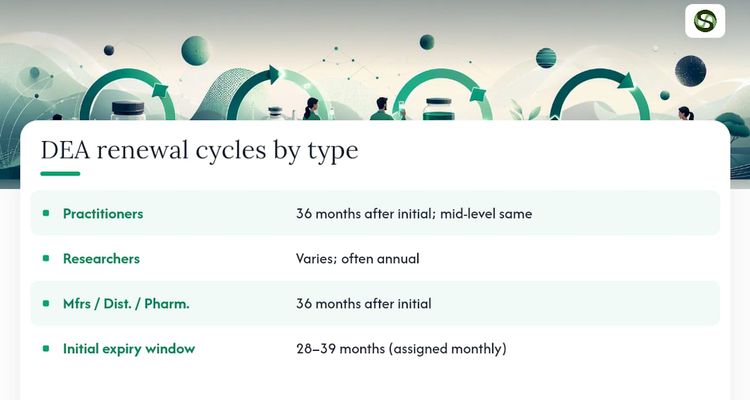
Researchers and analytical laboratories register on Form 225 and frequently operate on a different cycle, often annual, particularly when the registration is tied to a specific research protocol or Schedule I authorization. Because research registrations can be scoped to particular substances and particular studies, the renewal cadence is less uniform than the practitioner track. If you hold a Form 225 registration, confirm the exact expiration tied to your specific certificate rather than assuming a 36-month window.
Manufacturers, distributors, and pharmacies also register separately, each tied to their principal place of business, and each subject to the same 36-month renewal logic as practitioners once past the initial period. A USC Environmental Health & Safety overview of institutional DEA compliance confirms this practitioner/researcher split is the most common point of confusion for new hires and relocating staff.
The variability in that initial 28 to 39 month window isn’t arbitrary. The DEA Practitioner’s Manual explains that new registrants get slotted into monthly expiration groups for administrative load balancing. Two physicians who register two weeks apart could end up with initial certificates that expire months apart from each other, even though both eventually settle into the same 36-month renewal rhythm.
When Does DEA Send Renewal Notices, and How Do You Renew?
The agency’s notification schedule is consistent and worth memorizing:
- 60 days before expiration — first electronic reminder
- 45 days before expiration — second reminder, and the last point at which filing still guarantees an automatic extension
- 30 days before expiration — third reminder
- 15 days before expiration — fourth reminder
- 5 days before expiration — final reminder
Since June 2020, these notices arrive by email only. The Diversion Control Division stopped mailing paper renewal notices, which means an outdated email address in your registration profile is functionally the same as no notice at all.
Renewal itself happens through the DEA’s secure online registration portal, using Form 224a for practitioner and pharmacy renewals or Form 225a for researcher and lab renewals. The base forms (224 and 225) are for new registrations; the “a” suffix denotes the renewal version.
Timing your filing matters more than most clinicians realize. File at least 45 days before expiration, and 21 CFR 1301.36(i) allows your existing registration to extend automatically while DEA processes the paperwork, so you keep prescribing without a gap. Filing later than that still gets processed, but you lose the automatic extension protection and risk a coverage gap if review takes longer than expected.
Pro Tip: Filing at the 45-day mark doesn’t just protect your prescribing authority. Applications submitted with that buffer also tend to draw less scrutiny than last-minute renewals, since a rushed application is more likely to get flagged for missing information and kicked back for correction.
What Happens If Your DEA Registration Expires?
Handling controlled substances without an active DEA registration is prohibited, full stop, regardless of how recently your certificate lapsed. There’s no informal grace period for actually writing scripts or dispensing.
What the DEA does allow is a narrow administrative courtesy: reinstatement within one calendar month after the expiration date. During that window, you can renew as if you’d simply filed late, without starting a brand-new application from scratch. Miss that one-month mark, and the path changes entirely.
Here’s the practical sequence if you let a registration lapse:
- Registration expires. You are legally barred from handling controlled substances starting the day after expiration.
- You have one calendar month to file for reinstatement through the standard renewal process.
- If that month passes without action, you must submit an entirely new application, with new processing timelines and no guarantee of a fast turnaround.
- During any gap, pharmacies and other institutions will typically refuse to fill or process prescriptions tied to your inactive registration number.
That last point catches people off guard. Prescriptions you wrote while your registration was active generally remain valid for the pharmacy to fill after expiration, since the prescription itself was lawfully issued. But anything you attempt to prescribe or dispense after your registration lapses is a different story entirely, and most pharmacy systems will flag an inactive DEA number automatically.
The downtime risk is real. A new application, unlike a reinstatement, can take considerably longer to process, and during that stretch you can’t prescribe controlled substances at all. For a solo practitioner or a small clinic, that’s not a paperwork inconvenience. It’s lost revenue and disrupted patient care.
Do You Need a New DEA Registration When You Move States?
Address changes, name changes, and adding controlled-substance schedules to an existing registration are all handled as modifications, not new applications, as long as you’re staying within the same state and same principal place of business category.
Cross-state moves are a different matter entirely. A registration is tied to a specific state and location, per 21 U.S.C. 823(f), so relocating your practice to a new state means the DEA requires proof of your new state’s professional license and any state-level controlled-substance authority before it will approve the modification. This dependency trips up a lot of relocating clinicians who assume the DEA update is a formality they can handle after the move.
- Modification (same state): address change, name change, added schedules
- New registration required: new principal place of business in a different state without transferring authority
- Prerequisite for cross-state modification: active state license plus state controlled-substance registration, if applicable
State-specific requirements vary widely, and continuing-education or licensure rules like those outlined in Texas’s dental CE requirements illustrate how state boards layer their own obligations on top of federal registration. Under 21 U.S.C. 822(e)(1) and 21 CFR 1301.51, DEA registration and state licensure are legally intertwined, not separate boxes to check independently.
Pro Tip: Start your new state’s licensing application as soon as a relocation is confirmed, ideally well before your moving date. DEA modification approval often depends on receiving the state license first.
Which DEA Forms Do You Need, and Where Do You Check Current Fees?
Getting the right form number matters more than it should, because filing the wrong one is a common source of delay.
| Form | Registrant Type | Purpose |
|---|---|---|
| Form 224 | Practitioner / pharmacy | Initial registration |
| Form 224a | Practitioner / pharmacy | Renewal |
| Form 225 | Researcher / analytical laboratory | Initial registration |
| Form 225a | Researcher / analytical laboratory | Renewal |
Fees are periodically revised, so don’t rely on a number you saw last year or on a third-party guide, including this one. The DEA registration portal is the authoritative source for the current fee schedule and accepted payment methods at the moment you file.
If you need a duplicate certificate, or simply want to confirm your registration status before an audit or credentialing review, that same portal lets you check status and request documentation directly rather than waiting on a phone call.
- Confirm form number before starting an application
- Check the portal for current fees before submitting payment
- Request duplicate certificates through the same online system
- Keep a saved PDF of your current certificate for quick reference
A Checklist to Avoid Missing Your DEA Renewal
Most missed renewals aren’t caused by ignorance of the rules. They’re caused by nobody owning the calendar.
- Confirm your exact expiration date on your current certificate rather than assuming a round 36-month figure from your original issue date.
- File 60 to 45 days before expiration to guarantee eligibility for the automatic extension.
- Verify your email address in the DEA portal is current, since notices arrive electronically only.
- Assign a specific person (office manager, compliance lead, credentialing coordinator) to own renewal tracking, rather than leaving it to the individual clinician’s memory.
- Confirm new-state licensure before any relocation triggers a required registration modification.
If a renewal is genuinely at risk of lapsing, escalate immediately rather than waiting to see what happens. Contact the DEA registration unit directly through the portal, loop in your facility’s compliance or legal team if you’re part of a larger practice, and give your dispensing pharmacy a heads-up so prescriptions already in the pipeline aren’t unexpectedly rejected.
- Maintain a shared calendar or inbox for renewal dates across a multi-provider practice
- Set internal reminders well ahead of DEA’s own 60-day notice
- Loop in compliance or legal counsel the moment a lapse looks likely, not after it happens
Pro Tip: Don’t rely on memory or a single person’s inbox. A shared tracking system with automated reminders catches the renewals that get lost when a busy clinician’s attention is elsewhere for a few critical weeks. Certification expiration tracking checklists built for compliance teams work the same way for DEA registrations.
Why DEA Registration Upkeep Is Bigger Than a Paperwork Task
A lapsed DEA registration doesn’t just create an administrative headache. It stops patient care in a very literal way. A clinician who can’t prescribe controlled substances for even a week can mean delayed pain management, disrupted psychiatric medication schedules, or a pharmacy simply refusing to fill anything tied to an inactive registration number.
Compliance teams treat this deadline with more urgency than most clinicians expect, and for good reason. A single missed renewal in a group practice can cascade into rescheduled appointments, frustrated patients, and a pharmacy relationship that takes weeks to rebuild trust in. It’s rarely one dramatic failure. It’s usually a slow accumulation of “we’ll deal with it next week” that catches up all at once.
The detail that trips up even experienced clinicians is that a DEA registration is not a personal credential that follows you everywhere, the way a medical degree does. It’s tied to a specific location and a specific scope of activity. Change either one without squaring away the paperwork first, and you can find yourself fully licensed to practice medicine in a state, yet unable to prescribe a single controlled substance until the registration catches up. That mismatch between what you’re clinically qualified to do and what you’re federally authorized to do is where real disruption happens, and it’s almost always preventable with earlier tracking, not better intentions.
How Expiryedge Helps You Stay Ahead of DEA Deadlines
Most missed DEA renewals trace back to one root cause: nobody was watching the calendar closely enough, soon enough. Expiryedge exists to close that gap. Instead of relying on a single email notice from DEA or a sticky note on someone’s monitor, you get automated multi-channel reminders tied to your actual expiration date, escalation paths if a renewal task stalls, and a central place to store the state license documentation you’ll need before any cross-state modification.

This isn’t a substitute for filing with the DEA or your state licensing board. It’s the tracking layer that makes sure those filings happen with enough runway to protect your automatic extension window, instead of scrambling in the final days before expiration. For practices managing renewals across multiple providers, license renewal software turns a scattered set of individual deadlines into one visible, assignable workflow, and pairs naturally with broader healthcare license expiration tracking for every other credential your team already juggles. Start a free trial at Expiryedge and set your first DEA expiration reminder today.
Where to Confirm Current DEA Rules and Forms
- DEA Diversion Control Division — Registration: official renewal notices, reinstatement policy, and current registration guidance
- DEA Practitioner’s Manual: detailed explanation of initial registration periods and practitioner obligations
- 21 CFR 1301.13: federal regulation governing application timing and expiration date assignment
- DEA secure registration portal: official site for filing, checking status, and confirming current fees
- DEA Registration FAQ: guidance on modifications and state-license dependency for relocations
Confirm fees, form versions, and contact details directly through these sources before filing. Third-party summaries, this one included, can go stale faster than the DEA’s own portal.
This article is general information, not a substitute for advice from a qualified lawyer. Consult a qualified legal professional about your own circumstances before acting on anything here.
Sources
- DEA Diversion Control Division — Registration
- DEA Diversion Control Division — Practitioner’s Manual (final)
- USC Environmental Health & Safety — DEA registration overview
- DEA secure registration portal (MM application)
FAQ
Who needs a DEA license?
Any practitioner, researcher, pharmacy, or manufacturer that prescribes, dispenses, distributes, or handles controlled substances in Schedules I through V needs an active DEA registration for each applicable location.
What is a DEA license used for?
It authorizes the legal handling of controlled substances, including prescribing, dispensing, manufacturing, or researching them, within the scope and location specified on the certificate.
How long does a DEA license last for researchers?
Researcher registrations under Form 225 often run on an annual cycle rather than the standard 36-month practitioner cycle, though the exact term depends on the specific research authorization.
Can you still prescribe if your DEA registration just expired?
No. Handling controlled substances without an active registration is prohibited immediately upon expiration, though reinstatement remains available for one calendar month afterward.
Do you need a new DEA registration if you move to a different state?
Yes, in most cases. Moving your principal place of practice to a new state requires a registration modification, and DEA requires proof of your new state’s professional license before approving it.
Recommended
Frequently asked questions
It authorizes the legal handling of controlled substances, including prescribing, dispensing, manufacturing, or researching them, within the scope and location specified on the certificate.
Researcher registrations under Form 225 often run on an annual cycle rather than the standard 36-month practitioner cycle, though the exact term depends on the specific research authorization.
No. Handling controlled substances without an active registration is prohibited immediately upon expiration, though reinstatement remains available for one calendar month afterward.
Yes, in most cases. Moving your principal place of practice to a new state requires a registration modification, and DEA requires proof of your new state's professional license before approving it.