
Extended Warranty Renewal Strategy: Offers, Timing and Declines

An extended warranty renewal strategy works when the offer is designed before the reminder fires. Build three tiers from your own repair history, co-term customers with several machines to one renewal date, start talking 90 days before cover ends, and treat every decline as a coded reason with a scheduled win-back, not a lost sale.
Your reminders go out on time, yet customers still say no, or say nothing at all. This guide fixes the offer: tiers, pricing, shared dates, auto-renewal rules and what to do after a decline.
Key takeaways
- An extended warranty sold later is a service contract. The Federal Trade Commission (FTC) says service contracts, unlike warranties, "are purchased separately from a product."
- Federal consumer warranty law usually stays out of it. The Magnuson-Moss Warranty Act "does not apply to warranties on products sold for resale or for commercial purposes," so your contract wording does the work.
- Price each tier from your own repair records: cost per machine-year, plus planned visits and admin, divided by (1 minus your target margin).
- Co-term with one formula: =ROUND(AnnualPrice*(CoTermDate-StartDate+1)/365,2) prorates each machine to a shared renewal date.
- Auto-renewal has rules in some states. New York requires written notice 15 to 30 days before the customer's cancellation deadline; Wisconsin requires 15 to 60 days for terms over one year.
- Code every decline (price, budget timing, low use, replacing, in-house, no response) and book the next touch the same day.
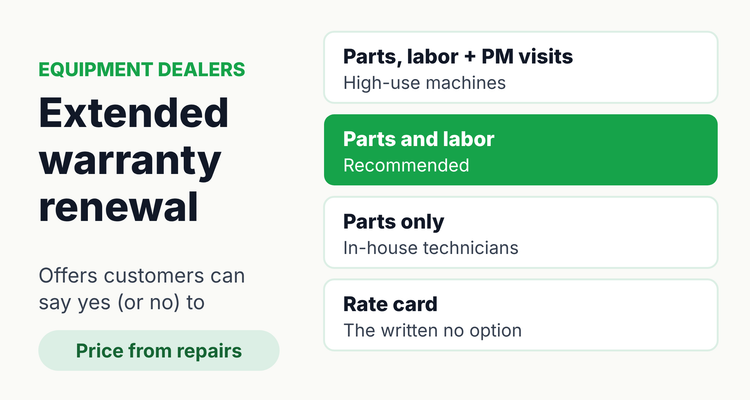 Give customers a ladder of choices, including a clear rate card for the ones who say no.
What makes an extended warranty renewal offer work?
An offer works when it matches how the customer uses the machine, arrives before their budget is set, and makes the cost of saying no visible.
If you still need the per-serial tracker and the 90/60/30/7 email sequence, start with our warranty tracking plan for equipment dealers. This guide picks up where that one stops: offer design, packaging, pricing, auto-renewal rules and declines.
Is an extended warranty a warranty or a service contract?
In federal terms, an extended warranty you sell after the product is a service contract. The FTC's guide to federal warranty law says: "Service contracts, unlike warranties, are purchased separately from a product." The same guide says the Magnuson-Moss Warranty Act "does not apply to warranties on products sold for resale or for commercial purposes."
For a dealer selling to businesses, that means the contract you write sets the cover, the exclusions and the renewal terms. If you design your own plan rather than resell a manufacturer's, ask your attorney whether any state rules on service contracts apply to you. That is advice, not a statement of law.
How should you design extended warranty renewal tiers?
Design three paid tiers plus a written rate card, so every customer has a sensible yes and a clear no. Use this matrix as a starting template; the inclusions are suggestions, not industry standards.
Extended warranty renewal offer design matrix (template for dealers)
| Tier | What it includes | Who it suits | Price basis | Watch out for |
|---|---|---|---|---|
| Rate card (the no option) | Labor rate, travel and common repair prices | Low-use machines, customers with in-house techs | Published rates | Send it with every decline |
| Parts only | Covered parts; labor and travel billed | Customers with in-house technicians | Parts cost per machine-year | Exclusions for wear parts and consumables |
| Parts and labor | Covered parts, labor and travel | Most single-shift users | Full repair cost per machine-year | Response-time promise you can keep |
| Parts, labor and preventive visits | As above, plus scheduled preventive maintenance (PM) visits | High-use or critical machines | Repair cost plus visit cost | Visits booked, not just promised |
| Multi-year with price hold | Any tier above for 2 or 3 years at a fixed price | Customers who budget once | Tier price plus a risk margin for later years | Age-related failure in years 2 and 3 |
Recommend one tier in the quote, based on the machine's usage and service history. A clear recommendation gives the buyer a default instead of three equal choices.
How do you price each tier from your repair history?
Pull 12 months of out-of-warranty service tickets per model, work out the cost per machine-year, then add planned costs and margin.
Tier pricing worksheet: columns and formulas (row 2)
| Column | What goes in it | Formula or example |
|---|---|---|
| A: Model | One row per model and tier | Example: WF-20 series, parts and labor |
| B: Machine-years | Machines out of warranty multiplied by years observed | 40 |
| C: Repair cost | Parts, labor and travel on those machines in the period | $18,000 |
| D: Repair cost per machine-year | Average cost to keep one machine running for a year | =C2/B2 |
| E: PM visits per year | 0 for tiers without visits | 1 |
| F: Cost per PM visit | Your loaded labor and travel cost | $180 |
| G: Admin per contract | Quoting, invoicing, renewal handling | $60 |
| H: Target margin | As a decimal | 0.30 |
| I: Annual price | Cost divided by (1 minus margin), rounded | =ROUND((D2+E2*F2+G2)/(1-H2),0) |
Worked example (illustrative numbers). $18,000 over 40 machine-years is $450 per machine-year. Add one PM visit at $180 and $60 of admin to get $690. At a 30% margin the price is $690 divided by 0.7, or $986. Run the sheet again each year, because repair costs change as machines age.
How do you co-term customers with several machines?
Pick one renewal date per customer and prorate each machine's first contract to it, so the customer raises one purchase order a year.
Use this formula, with the annual price in A2, the contract start in B2 and the shared renewal date in C2: =ROUND(A2*(C2-B2+1)/365,2). Worked example. A customer's shared date is June 30, 2027. A printer's warranty ends February 28, 2027, so its contract runs March 1 to June 30, 2027: 122 days. At $1,200 a year, the prorated price is $401.10. From July 1, 2027 it renews with the other machines at the full annual price.
Choose the shared date with the customer. Ask for their budget month at install and set the renewal date a month or two before it.
When should the renewal conversation start?
Start at three points: when you sell the machine, 90 days before the warranty ends, and 90 days before each contract anniversary. Each one needs a different message.
- At the sale. Show the tiers on the original quote, so the customer knows cover exists before the warranty clock starts. Record their budget month.
- Before the warranty ends. Run the 90/60/30/7 sequence from the dealer tracking guide, starting from whichever cover ends first.
- Before each contract anniversary. Send a year-in-review: visits made, faults fixed, and what those repairs would have cost on the rate card.
- After a lapse. Re-offer at the next service visit and at the next budget month. Decide whether you require an inspection before cover restarts, and write the rule into the offer.
Anniversary email (copy and adapt). Subject: Your [model] service year in review, and next year's cover. "Hi [Name], your service contract on [number] machines renews on [date]. This year we made [number] visits and fixed [faults]; on our rate card those repairs would have cost [amount]. Next year's price is [price] ([no change / up X% because ...]). To change tier or stop cover, reply by [date]."
Should your service contracts renew automatically?
Auto-renewal keeps good customers covered without a new purchase order, but some states put conditions on it. We verified two statutes that reach business service or maintenance contracts. Check your own state's law before you add an auto-renewal clause.
State rules on auto-renewing service contracts (last verified 12 October 2026)
| State and law | Applies to | Notice you must give | How to send it | If you don't |
|---|---|---|---|---|
| New York General Obligations Law 5-903 | Contracts "for service, maintenance or repair to or for any real or personal property"; not renewal periods of one month or less | Written notice calling attention to the auto-renewal clause, "at least fifteen days and not more than thirty days" before the customer's notice deadline | "served personally or by certified mail" | The renewal clause is not enforceable against the customer |
| Wisconsin Statutes 134.49(2) | Business equipment leases and business services contracts made, changed or renewed after May 1, 2011, renewing for more than one month (with listed exclusions) | At signing: a signed disclosure form, or conspicuous disclosure initialled by the customer, stating the renewal, its length, any price increase, how to decline and the deadline | In the contract or on a separate signed form | The renewal is not enforceable and the contract ends at the current term |
| Wisconsin Statutes 134.49(3) and (4) | Same contracts where the initial term and the renewal term are each more than one year | Written notice 15 to 60 days before the customer's decline deadline, with the deadline, any price increase and how to decline | Mail, personal delivery, bold 12-point notice on page 1 of a monthly invoice, or fax, email or courier if the customer may decline that way | Same; customer may also claim damages under 134.49(6) |
Wisconsin also voids clauses that require a customer to let you match a competitor's offer for service after the term ends (134.49(5)). If you sell in either state, put the notice window in your tracker as its own date, so it can't slip. Customers see the same rules from the other side in our service contract renewal process guide.
⚠️What happens if you miss it: in New York, an auto-renewal clause in a service, maintenance or repair contract is not enforceable against the customer unless you gave the written notice 15 to 30 days before their notice deadline (GOL 5-903). In Wisconsin, a missing disclosure or notice makes the renewal unenforceable and the contract ends at the current term; if you then refuse to end the contract after the customer declines, a customer who prevails can recover twice their damages, or twice the periodic payment or $1,000, whichever is less, plus costs and reasonable attorney fees (134.49(6)).
What should a renewal message say?
Lead with what the customer got and what happens next, then the price.
- Show value from their own records. Visits made, faults fixed and the rate-card cost of those repairs.
- Give a deadline and a default. "Reply by [date]; if we don't hear from you, cover ends on [date]." For auto-renewing contracts, follow the notice rules above.
- Offer one alternative. A lower tier or a shorter term keeps a price-sensitive customer covered.
How should you handle extended warranty declines?
Record a reason code the day a customer declines, send the rate card, and book the next touch. A decline with a reason and a date is a future renewal; a decline with no record is a lost customer.
Decline reason codes, responses and next touch
| Code | What the customer says | Your response | Next touch |
|---|---|---|---|
| PRICE | "Too expensive" | Offer a lower tier or parts only; show the rate-card cost of last year's repairs | Next quote cycle, or after the first billable repair |
| BUDGET | "Not this year's budget" | Ask for the budget month; hold the quote open until then | 30 days before their budget month |
| LOW-USE | "We hardly use it" | Agree, send the rate card, offer a visit-only option | Next service visit |
| REPLACING | "We're replacing it" | Ask when; quote the new machine with cover included | Replacement date minus 90 days |
| IN-HOUSE | "Our team fixes it" | Offer parts only or a training visit | Annual check-in |
| NO-RESPONSE | Silence | Phone the decision-maker; check the contact is still right | 7 days, then next service visit |
Decline acknowledgment (copy and adapt). "Thanks for letting us know. Your cover on [machine, serial] ends on [date]. After that we'll bill repairs at the attached rates. If anything changes, reply and we'll quote again."
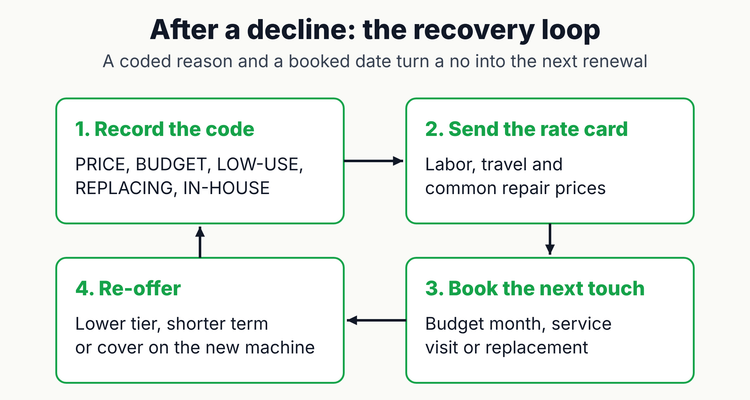 A decline is the start of the next renewal, not the end of the customer.
Do this now: a two-hour offer design session (no software)
Book two hours with your service manager and an account manager (time estimates are our planning guide).
- Pull the tickets (30 minutes). Export 12 months of out-of-warranty service tickets with model, parts, labor and travel.
- Fill the pricing worksheet (30 minutes). One row per model and tier, using the formulas above.
- Write the tiers (20 minutes). One page per tier: inclusions, exclusions, response time and visits.
- Write the rate card (10 minutes). Labor rate, travel and five common repairs per model.
- Agree decline codes (10 minutes). Use the six above and add a column to your tracker.
- Check auto-renewal rules (20 minutes). List auto-renewing contracts with customers in New York or Wisconsin and add a notice-window date to each.
How do you measure renewal and retention?
Measure three numbers each month from your tracker, for contracts and warranties that reached their end date in that month. These are definitions to use, not benchmarks.
- Renewal rate: Taken divided by (Taken + Declined + Lapsed). In a sheet: =COUNTIF(Q:Q,"Taken")/(COUNTIF(Q:Q,"Taken")+COUNTIF(Q:Q,"Declined")+COUNTIF(Q:Q,"Lapsed")).
- Decline mix: the share of each reason code. If PRICE leads, revisit tiers; if NO-RESPONSE leads, fix contacts and timing.
- Win-back rate: declined machines that later took cover, divided by all declines from 12 months earlier.
💡 Pro Tip
Store the customer's budget month as a field next to each renewal date. When a renewal falls just after the budget is set, move the co-term date forward at the next renewal instead of fighting for money that is already allocated.
Spreadsheet or software for extended warranty renewals?
A spreadsheet is enough for one account manager with a few dozen contracts who opens it every week. The pricing worksheet, co-term formula and decline codes all work in Excel or Google Sheets, and our free warranty and service contract tracker already has the per-serial pipeline and status columns.
It breaks when several account managers share renewals, when statutory notice windows must be sent on time and proven, or when the person who built the sheet leaves. A tool such as ExpiryEdge gives each contract an owner and a backup, sends reminders at 90, 60, 30 and 7 days by email, SMS, Slack or Teams, rolls annual contracts forward as recurring records, and keeps an audit trail of who acted. Our warranty tracking page shows the dealer and owner views, and the warranty management software buyer's guide covers what else to compare.
Frequently asked questions
When should a dealer offer an extended warranty renewal?
Offer it at the original sale, again 90 days before the manufacturer warranty ends, and 90 days before each contract anniversary. Follow up at 60, 30 and 7 days. Line the dates up with the customer's budget month where you can.
Is an extended warranty the same as a service contract?
When it is sold separately from the product, it is a service contract in federal terms. The FTC says service contracts, unlike warranties, are purchased separately from a product. For business equipment, the contract wording sets the cover, because the Magnuson-Moss Act does not apply to products sold for commercial purposes.
How do you price an extended warranty for business equipment?
Start from your own repair history: total out-of-warranty parts, labor and travel per machine-year for each model. Add planned visits and admin, then divide by (1 minus your target margin). Review the price yearly, because repair costs change as machines age.
What is co-terming a service contract?
Co-terming means giving all of a customer's machines one shared renewal date. Prorate each first contract with =ROUND(AnnualPrice*(CoTermDate-StartDate+1)/365,2), then renew everything together at full annual prices. The customer handles one purchase order a year.
Can a service contract renew automatically?
It can, but some states set conditions. New York requires written notice, served personally or by certified mail, 15 to 30 days before the customer's notice deadline. Wisconsin requires a disclosure at signing and, for terms over one year, notice 15 to 60 days before the decline deadline.
What should you do when a customer declines?
Record a reason code, send your rate card, and book the next touch the same day. Re-offer at the next service visit, before the customer's budget month, or when they plan to replace the machine.
Sources
- Federal Trade Commission, Businessperson's Guide to Federal Warranty Law (page updated March 11, 2025)
- New York General Obligations Law section 5-903 (NY Senate, revision of September 22, 2014)
- Wisconsin Statutes section 134.49, Renewals and extensions of business contracts (2023-24 statutes, published October 1, 2026)
- Microsoft Support, ROUND function
Last reviewed: 12 October 2026
Frequently asked questions
When it is sold separately from the product, it is a service contract in federal terms. The FTC says service contracts, unlike warranties, are purchased separately from a product. For business equipment, the contract wording sets the cover, because the Magnuson-Moss Act does not apply to products sold for commercial purposes.
Start from your own repair history: total out-of-warranty parts, labor and travel per machine-year for each model. Add planned visits and admin, then divide by (1 minus your target margin). Review the price yearly, because repair costs change as machines age.
Co-terming means giving all of a customer's machines one shared renewal date. Prorate each first contract with =ROUND(AnnualPrice*(CoTermDate-StartDate+1)/365,2), then renew everything together at full annual prices. The customer handles one purchase order a year.
It can, but some states set conditions. New York requires written notice, served personally or by certified mail, 15 to 30 days before the customer's notice deadline. Wisconsin requires a disclosure at signing and, for terms over one year, notice 15 to 60 days before the decline deadline.
Record a reason code, send your rate card, and book the next touch the same day. Re-offer at the next service visit, before the customer's budget month, or when they plan to replace the machine.


