
The Role of Expiry Alerts in HR Compliance

TL;DR:
Automated expiry alerts positively impact HR compliance by increasing renewal rates and preventing violations.
They reduce legal costs, lower operational disruptions, and free HR staff from manual tracking tasks.
Expiry alerts in HR compliance are automated notifications that trigger before employee certifications, licenses, and regulatory documents reach their expiration dates. The role of expiry alerts in HR compliance goes beyond simple reminders. These systems are the difference between a proactive compliance program and a reactive one that discovers violations only during audits. Organizations that deploy automated expiry notifications shift their compliance rate from 76% to 88% and prevent the majority of regulatory violations before they occur. For HR professionals and compliance officers managing dozens or hundreds of certification deadlines, that gap is not a minor improvement. It is the foundation of a defensible compliance posture.
What is the role of expiry alerts in HR compliance?
Expiry alerts are the operational backbone of any certification management program. In HR compliance, the industry term for this practice is “credential lifecycle management,” which covers the full cycle from issuance to renewal of employee certifications, licenses, permits, and policy acknowledgments. Expiry alerts are the enforcement mechanism that keeps that lifecycle on track.

Without automated alerts, HR teams rely on spreadsheets, calendar reminders, or manual audits to catch expiring documents. Manual tracking of expirations takes up to five days to identify a single expiring item. Automated systems flag the same issue in seconds. That speed difference directly affects whether a certification lapses before renewal action begins.
The compliance risk is not theoretical. Ignoring expiry dates exposes organizations to legal fines, failed audits, and reputational damage. Regulatory bodies including OSHA, the Joint Commission, and state licensing boards treat expired certifications as active violations, not administrative oversights. HR teams that treat expiry tracking as a back-office task consistently face higher audit failure rates than those who treat it as a front-line compliance function.
How do expiry alerts improve compliance rates and reduce risk?
Automated expiry alert systems produce measurable results across three areas: compliance rates, legal costs, and operational continuity.
Compliance rates rise because alerts remove the human memory dependency from deadline management. Organizations using automated systems report a compliance rate increase from 76% to 88%, preventing approximately 80% of regulatory violations through real-time identification of expiring certifications. That 12-point improvement translates directly into fewer audit findings and lower regulatory exposure.
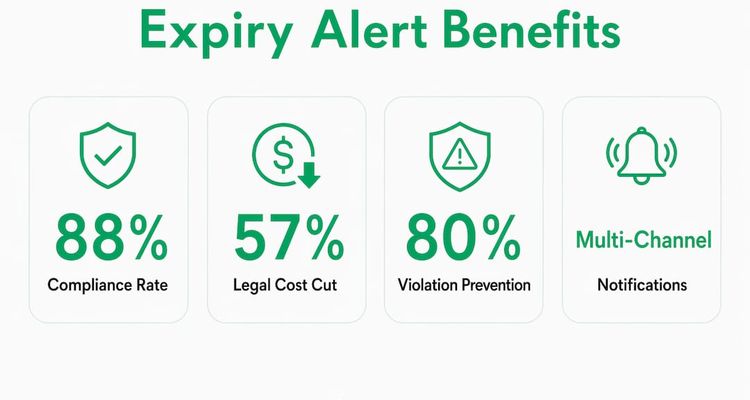
Legal and operational costs fall in parallel. Companies using automated expiry reminders report a 57% reduction in legal expenses and a 42% decrease in operational disruptions tied to compliance failures. Legal costs drop because violations are caught before they become enforcement actions. Operational disruptions decrease because employees are not pulled from active roles to address emergency renewals.
The productivity impact is equally significant. Manual tracking of 200 certification items consumes 10–15 hours per week. Automated systems cut that workload by 50%, freeing HR staff to focus on higher-value compliance work. For a compliance team managing hundreds of employees across multiple credential types, that time savings compounds quickly across a calendar year.
Key benefits of automated expiry notifications in HR:
- Compliance rates increase from the mid-70s to the high-80s percentile range
- Legal expense reductions of more than half compared to manual processes
- Operational disruptions tied to compliance failures drop by nearly half
- HR staff recover 50% of time previously spent on manual tracking
- Audit preparation shifts from weeks of manual work to minutes of report generation
What are the best practices for implementing expiry alerts in HR?
Effective implementation of expiry alerts in HR requires more than turning on a notification system. The structure of the alert schedule, the channels used, and the escalation logic all determine whether alerts produce renewals or get ignored.
1. Build a multi-stage alert schedule. A single reminder sent one week before expiration gives employees too little time to act. Multi-stage alert systems that notify at 90, 60, and 30 days before expiration, with escalation to supervisors, improve on-time renewals by up to 95%. The 90-day alert creates awareness. The 60-day alert prompts scheduling. The 30-day alert triggers urgency. Each stage serves a different behavioral purpose.
2. Use multi-channel notifications. Email alone is insufficient for high-stakes compliance deadlines. Effective expiry alert systems deliver notifications via email, SMS, and dashboard alerts to reach employees, managers, and HR teams through the channels they actually monitor. For workforce-facing alerts, automated workforce notifications that reach employees directly reduce the lag between alert and action.
3. Assign escalation ownership. Every alert must have a named owner who is accountable for the renewal outcome. Alerts without escalation paths become noise. When an employee does not respond to a 30-day alert, the system must automatically notify the direct supervisor and then the compliance officer if the deadline passes without action. This transforms alerts from passive reminders into active compliance enforcement.
4. Integrate alerts with document tracking. Alerts are only as reliable as the underlying document library. HR teams must organize certifications by type, validation rules, and renewal requirements so the system knows what to track and when. Certification expiration tracking checklists help compliance teams build this structure before deploying alerts.
5. Generate audit-ready reports automatically. Compliance teams benefit from built-in reports showing notifications sent, renewals completed, and exception backlogs. These reports provide evidence during audits without requiring manual compilation.
Pro Tip: Set your 90-day alert to include a direct link to the renewal form or training registration page. Removing friction from the renewal process at the moment of awareness increases completion rates significantly.
Manual tracking vs. automated expiry alert systems
The operational gap between manual and automated expiry tracking is wide enough to affect audit outcomes, not just administrative efficiency.
| Category | Manual tracking | Automated alert systems |
|---|---|---|
| Detection speed | Up to 5 days per item | Seconds |
| Compliance rate | Approximately 76% | Up to 88% |
| On-time renewal rate | Inconsistent | Up to 95% with tiered alerts |
| Weekly HR time cost | 10–15 hours per 200 items | 5–7 hours per 200 items |
| Audit preparation | Weeks of manual report building | Minutes with built-in reports |
| Error risk | High due to human oversight | Low with automated validation |
| Escalation | Manual follow-up required | Automatic escalation to supervisors |
Manual tracking fails not because HR professionals are careless, but because the volume of certifications across a growing workforce exceeds what any spreadsheet-based system can reliably manage. A single missed renewal for a safety-critical certification can trigger an OSHA citation. The escalation workflow built into automated systems addresses exactly this failure point by removing human follow-up as a dependency.
Automated systems also produce a compliance audit trail that manual processes cannot replicate. Every notification sent, every acknowledgment received, and every renewal completed is logged with a timestamp. That log is the evidence an auditor needs to confirm that the organization acted in good faith before a certification lapsed.
How do you overcome common challenges in expiry alert adoption?
The most common failure mode in expiry alert programs is the “set and forget” approach. HR teams configure alerts at implementation and then assume the system will manage itself. It will not.
Organizations must audit expiry alert policies regularly and maintain current document libraries organized by type, validation rules, and completeness reporting. Certifications change. Regulatory requirements update. Employees change roles and acquire new credential requirements. An alert system built on a stale document library will miss new obligations and continue alerting on certifications that are no longer required.
Regulatory alignment is the second major challenge. Regulatory guidance changes frequently, and HR compliance must align internal policies with current federal and state requirements. In 2026, several states updated their professional licensing renewal cycles and added new mandatory training requirements for healthcare and construction workers. HR teams that subscribe to regulatory alert services catch these changes before they create compliance gaps.
The third challenge is backlog management. When an organization first deploys an expiry alert system, it often discovers a backlog of certifications that have already lapsed or are within 30 days of expiration. Addressing that backlog requires a prioritization framework. Safety-critical certifications and those tied to active regulatory requirements take precedence over administrative credentials.
Pro Tip: Schedule a quarterly review of your alert configuration and document library. Assign one compliance officer as the owner of that review. Organizations that treat alert maintenance as a recurring task rather than a one-time setup sustain higher compliance rates year over year.
Key Takeaways
Automated expiry alerts are the most direct mechanism HR teams have for maintaining certification compliance and preventing regulatory violations before they occur.
| Point | Details |
|---|---|
| Compliance rate impact | Automated alerts raise organizational compliance rates from 76% to 88%, preventing most violations. |
| Cost reduction | Companies report a 57% drop in legal expenses and a 42% decrease in operational disruptions. |
| Multi-stage scheduling | Alerts at 90, 60, and 30 days with supervisor escalation drive up to 95% on-time renewal rates. |
| Avoid “set and forget” | Quarterly audits of alert configurations and document libraries sustain compliance gains over time. |
| Audit readiness | Automated systems generate compliance reports in minutes, replacing weeks of manual preparation. |
Why I think most HR teams underestimate expiry alerts
Most HR technology conversations center on recruiting, performance management, and payroll. Expiry alerts rarely make the shortlist of priorities. That is a mistake I have seen cost organizations real money.
The compliance failures I have observed most often are not caused by ignorance of the rules. They are caused by the gap between knowing a certification exists and actually tracking when it expires. A safety manager who holds a valid OSHA 30 certification today will have an expired one in three years. If no system flags that expiration 90 days out, the organization discovers the lapse during an inspection, not before it.
What surprises me most is how quickly the ROI becomes visible once automated alerts are in place. The renewal alerts strategy that procurement teams have used for vendor contracts translates directly to HR certification management. The mechanics are identical. The stakes in HR are often higher because the certifications are tied to employee safety and regulatory licensing, not just contract terms.
The 2026 regulatory environment has made this more urgent. States are accelerating enforcement of professional licensing requirements and adding new credential categories. HR teams that rely on manual tracking will not keep pace. The organizations that treat expiry alert systems as core compliance infrastructure, not optional add-ons, are the ones that pass audits without scrambling.
— Kuldeep
How Expiryedge helps HR teams stay ahead of compliance deadlines
HR compliance officers managing certification deadlines across a growing workforce need more than a calendar reminder. Expiryedge is a deadline tracking platform built specifically for time-sensitive compliance work, including employee certifications, license renewals, regulatory obligations, and audit schedules.

Expiryedge delivers automated expiry reminders through email, SMS, and dashboard alerts, with multi-stage scheduling and escalation workflows that notify supervisors when renewals are not completed on time. The platform centralizes all certification tracking in one place, generates audit-ready compliance reports, and reduces the manual workload that consumes HR team capacity. For compliance officers who need a defensible, documented record of every notification sent and every renewal completed, Expiryedge provides the infrastructure to build that record without manual effort.
FAQ
What are expiry alerts in HR compliance?
Expiry alerts in HR compliance are automated notifications sent before employee certifications, licenses, or regulatory documents expire. They give HR teams and employees advance notice to complete renewals before deadlines are missed.
How much do automated expiry alerts improve compliance rates?
Automated expiry alert systems raise organizational compliance rates from approximately 76% to 88% and prevent around 80% of regulatory violations by identifying expiring certifications in real time.
What is the best alert schedule for certification renewals?
A multi-stage schedule sending alerts at 90, 60, and 30 days before expiration, with automatic escalation to supervisors, produces up to 95% on-time renewal rates according to HR technology research.
How do expiry alerts reduce legal costs?
Companies using automated expiry reminders report a 57% reduction in legal expenses. Alerts catch compliance violations before they become enforcement actions, removing the primary trigger for regulatory fines.
What is the biggest risk of relying on manual expiry tracking?
Manual tracking takes up to five days to identify a single expiring certification, compared to seconds for automated systems. That delay creates a window where certifications lapse before renewal action begins, increasing audit failure risk.
Recommended
Frequently asked questions
Automated expiry alert systems raise organizational compliance rates from approximately 76% to 88% and prevent around 80% of regulatory violations by identifying expiring certifications in real time.
A multi-stage schedule sending alerts at 90, 60, and 30 days before expiration, with automatic escalation to supervisors, produces up to 95% on-time renewal rates according to HR technology research.
Companies using automated expiry reminders report a 57% reduction in legal expenses. Alerts catch compliance violations before they become enforcement actions, removing the primary trigger for regulatory fines.
Manual tracking takes up to five days to identify a single expiring certification, compared to seconds for automated systems. That delay creates a window where certifications lapse before renewal action begins, increasing audit failure risk.