
Deadline Escalation Workflow Guide for Ops and Compliance

Deadline Escalation Workflow Guide for Ops and Compliance

A deadline escalation workflow automates alerts and interventions to ensure tasks meet deadlines and compliance is maintained. It uses multiple tiers of urgency, risk weighting, and confirmation to prioritize high-risk tasks and prevent missed deadlines. Regular review and manual override options improve effectiveness, especially in compliance environments.
A deadline escalation workflow is a structured, automated process that triggers alerts and interventions as deadlines approach, ensuring tasks are completed on time and compliance obligations are met. This guide covers the design, configuration, and execution of escalation workflows built specifically for operations and compliance professionals. The core principle is simple: waiting for a deadline to fail is not a strategy. Firms using automated deadline escalation achieve 95% on-time delivery and identify at-risk engagements earlier than teams relying on manual tracking. That gap between 95% and the industry average represents missed filings, regulatory penalties, and lost contracts.
What are the essential components of a deadline escalation workflow?

A deadline escalation workflow operates through a multi-tier architecture. Each tier represents a stage of urgency, and the system moves a task through those stages automatically based on time remaining and task status. The standard industry model includes five tiers: monitoring, advisory, warning, urgent, and critical.
The table below shows how each tier maps to trigger points, recipients, and automatic actions.
| Tier | Trigger point | Primary recipient | Auto action |
|---|---|---|---|
| Monitoring | Task created | Assigned owner | Dashboard flag only |
| Advisory | 33% of time remaining | Assigned owner | Email + in-app alert |
| Warning | 25% of time remaining | Owner + team lead | Multi-channel alert |
| Urgent | 10% of time remaining | Owner + manager | Escalation notification |
| Critical | Deadline breached or imminent | Senior leadership | Emergency intervention |
SLA-based escalation thresholds set warning triggers at 25–33% of remaining time before a deadline. That window gives teams enough runway to intervene before a task reaches critical status. Tasks that reach the critical tier have only a 40% chance of on-time completion without emergency intervention. That statistic alone justifies investing in earlier-stage escalation design.
Escalation path components
Every escalation path must define three things: who receives the escalation, what context transfers with it, and whether the escalation supersedes the original assignment. Escalation paths require this structure to avoid confusion when a task moves up the chain. Without clear context transfer, the receiving manager inherits a deadline but not the history, which creates delays rather than resolving them.
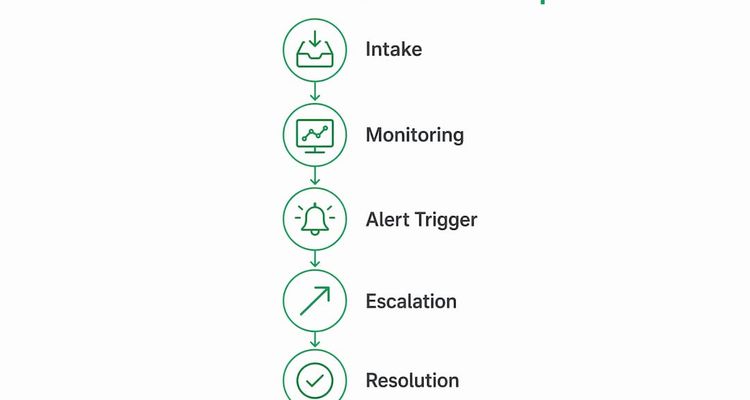
Escalation timers start running from the moment a task enters the system, not from when it is assigned. This distinction matters because assignment delays are one of the most common sources of late escalation. A task sitting unassigned for three days has already consumed time that the escalation timer should have been tracking.
How do you configure escalation triggers and integrate risk weighting?
Uniform reminders sent to every task at the same intervals create alert fatigue. Risk-weighted triggers prevent this by prioritizing complex, high-risk tasks for earlier escalation. A routine license renewal and a multi-agency regulatory filing should not follow the same escalation schedule.
Risk weighting works by assigning a complexity score to each task type at intake. Higher scores compress the escalation timeline, moving the advisory and warning tiers earlier relative to the deadline. Lower scores allow more time before alerts begin. This keeps high-stakes deadlines visible without flooding teams with notifications about low-risk tasks.
Types of escalation triggers to configure
Three trigger types form the foundation of any escalation configuration:
- Time threshold triggers: The system escalates automatically when a defined percentage of deadline time has elapsed. Set these at 33%, 25%, and 10% of remaining time as a baseline, then adjust based on task complexity.
- Completion percentage triggers: If a task reaches a deadline with less than a defined percentage of its subtasks complete, the system escalates regardless of time remaining. This catches tasks that are progressing too slowly even when time appears sufficient.
- Silence triggers: When a responsible party does not confirm receipt or action within a set window, the system treats silence as a failure signal. Confirmation responses reset escalation timers; silence triggers automatic escalation to the next authority level.
Pro Tip: Start escalation timers from task intake, not task assignment. Tying triggers to intake improves early risk detection and gives your team more time to intervene before a deadline becomes critical.
Confirmation workflows are particularly effective in compliance environments. A responder must actively confirm that an action has been taken. That confirmation resets the timer. If no confirmation arrives, the system escalates automatically. This eliminates the silent failure mode where a task appears assigned but no one is actually working on it.
What are the best practices for implementing escalation workflows?
Implementation follows a defined sequence. Skipping steps, particularly the testing phase, is the most common reason escalation workflows underperform after launch.
- Map your current workflow and identify failure points. List every deadline type your team manages. For each one, document where tasks have historically stalled, missed, or required emergency intervention. These failure points become your primary escalation targets.
- Build capacity profiles for each task type. Capacity profiles define how long each task type realistically takes to complete. They feed directly into risk weighting and help set realistic escalation thresholds. A task that takes three days on average needs different escalation timing than one that takes three weeks.
- Integrate your communication platforms. Escalation alerts are only effective if they reach the right person through the right channel. Connect your escalation system to email, SMS, and any internal messaging tools your team uses. Multi-channel delivery reduces the chance that a critical alert goes unnoticed.
- Test with historical data before going live. Run your escalation configuration against past deadline data to see how it would have performed. This surfaces misconfigured thresholds, missing recipients, and gaps in context transfer before they affect real deadlines. Proactive risk detection before deadline breaches is a well-established practice in professional services project management.
- Build in manual override capability. Manual override is essential for adapting escalation when sudden project complexity changes or unforeseen risks arise. Automation handles the routine; humans handle the exceptions.
- Monitor, calibrate, and adjust. After launch, track escalation frequency by tier. If most tasks are reaching the urgent or critical tier before resolution, your advisory and warning thresholds are too late. Move them earlier. If teams are ignoring advisory alerts, the alerts may be arriving too frequently for low-risk tasks.
Pro Tip: Avoid setting all escalation thresholds identically across task types. A compliance audit deadline and a subscription renewal carry different risk profiles. Treat them differently from day one.
How do you troubleshoot and measure escalation workflow effectiveness?
Three failure patterns appear most often in escalation workflows that underperform.
- Escalation silences: A task escalates to a manager, but no action follows. This usually means the escalation notification lacks enough context for the recipient to act. Fix it by including task history, current status, and the specific action required in every escalation message.
- False positives: Low-risk tasks escalate too early or too often, training teams to ignore alerts. Reduce false positives by tightening risk weighting criteria and raising the threshold for advisory-tier triggers on routine tasks.
- Incomplete context transfer: When a task moves from one escalation tier to the next, the receiving party needs the full history. Missing context forces them to investigate before acting, which wastes the time the escalation was meant to protect.
Measure effectiveness using four metrics. First, track on-time delivery rate by task type. Second, measure how frequently tasks reach each escalation tier. A healthy workflow resolves most tasks at the advisory or warning stage. Third, track confirmation response times to identify which team members or departments are slow to acknowledge escalations. Fourth, measure the time between escalation and resolution at each tier.
Post-escalation review, known as loopback, is the most underused improvement tool in escalation management. After any task that reaches the urgent or critical tier, review what caused the delay. Use those findings to improve initial task instructions, update knowledge articles, and refine escalation thresholds. Loopback converts individual failures into system improvements.
Key Takeaways
A deadline escalation workflow succeeds when it combines risk-weighted triggers, multi-tier architecture, confirmation requirements, and regular loopback review to keep critical tasks on track before they breach.
| Point | Details |
|---|---|
| Start timers at intake | Begin escalation timers when a task enters the system, not when it is assigned. |
| Use five escalation tiers | Structure escalation from monitoring through critical, with defined recipients at each stage. |
| Apply risk weighting | Assign complexity scores at intake to compress escalation timelines for high-risk tasks. |
| Require confirmation | Active confirmation resets timers; silence automatically escalates to the next authority level. |
| Run loopback reviews | Review every critical-tier escalation to improve thresholds, instructions, and future workflows. |
Why automation alone is not enough in escalation workflows
Automation handles the predictable. It fires alerts on schedule, routes tasks to the right recipients, and logs every action. What it cannot do is detect a sudden change in project complexity or recognize that a key team member is unavailable due to an unplanned event. That gap is where manual override earns its place.
I have seen escalation systems that were technically well-configured fail repeatedly because teams had no way to intervene outside the automated sequence. A compliance filing that suddenly required additional legal review needed a human to compress the escalation timeline immediately. The system kept sending advisory alerts while the clock ran out. Manual override is not a workaround. It is a design requirement.
Risk weighting is the other area where teams consistently underinvest. The instinct is to set uniform reminders and let volume do the work. The result is alert fatigue, where teams stop reading escalation notifications because too many of them are irrelevant. Effective escalation workflows blend automation with manual override for exactly this reason. Automation provides consistency; human judgment provides adaptability. Neither works well without the other.
The loopback phase is where most teams leave real value on the table. Reviewing escalations after the fact feels like administrative overhead. In practice, it is the fastest way to reduce future escalations. Every critical-tier event contains information about where the workflow broke down. Capturing that information and acting on it is what separates teams that improve over time from teams that keep hitting the same failures.
— Kuldeep
How Expiryedge handles deadline escalation for compliance teams
Operations and compliance teams managing contracts, certifications, audits, and regulatory filings need more than a reminder tool. They need a system built around fixed dates and escalating urgency.

Expiryedge is a date-driven work management platform that automates multi-tier escalation workflows across every deadline type your team manages. Teams configure escalation tiers, set risk-weighted triggers, require confirmation responses, and receive alerts through email, SMS, and in-app notifications. The platform tracks contracts, licenses, vendor agreements, employee certifications, insurance policies, and compliance obligations from a single dashboard. Manual override is built in, and every escalation event is logged for loopback review. If your team manages deadlines that carry real consequences when missed, Expiryedge gives you the structure to stay ahead of them.
FAQ
What is a deadline escalation policy?
A deadline escalation policy is a defined set of rules that determine when and how a task is escalated to higher authority as its deadline approaches. It specifies trigger thresholds, recipient sequences, and required actions at each escalation stage.
How do escalation workflows work in practice?
Escalation workflows monitor task status and time remaining against a deadline, then automatically notify assigned owners, managers, and senior leaders in sequence when thresholds are crossed. Confirmation responses reset timers; silence triggers the next escalation level.
What does escalation path mean in workflows?
An escalation path defines the sequence of recipients who receive a task as it moves through escalation tiers, along with the context transferred and whether the escalation replaces or supplements the original assignment.
What types of triggers are used in deadline escalation workflows?
The three primary trigger types are time threshold triggers, completion percentage triggers, and silence triggers. Each fires under different conditions and serves a different purpose in catching at-risk tasks before they breach.
What is the role of escalation in compliance workflows?
Escalation in compliance workflows ensures that regulatory deadlines, certification renewals, and audit requirements receive increasing attention as their due dates approach. It reduces the risk of missed filings and the penalties that follow by routing unresolved tasks to progressively higher authority before the deadline passes.
Recommended
Frequently asked questions
Escalation workflows monitor task status and time remaining against a deadline, then automatically notify assigned owners, managers, and senior leaders in sequence when thresholds are crossed. Confirmation responses reset timers; silence triggers the next escalation level.
An escalation path defines the sequence of recipients who receive a task as it moves through escalation tiers, along with the context transferred and whether the escalation replaces or supplements the original assignment.
The three primary trigger types are time threshold triggers, completion percentage triggers, and silence triggers. Each fires under different conditions and serves a different purpose in catching at-risk tasks before they breach.
Escalation in compliance workflows ensures that regulatory deadlines, certification renewals, and audit requirements receive increasing attention as their due dates approach. It reduces the risk of missed filings and the penalties that follow by routing unresolved tasks to progressively higher authority before the deadline passes.