
Procurement Contract Management: A 7-Step Process for Small Teams

Procurement contract management is the work after signature: give each contract a named owner, log its obligations and key dates, set a renewal decision date well before any notice deadline, check vendor performance on a schedule, and keep the records. A small team can run all of it from one shared register and a 30-minute monthly review.
The contract is signed, the purchase order is raised, and the file goes into a shared drive where nobody looks at it again until an invoice is wrong or the vendor sends a renewal. This guide gives you a seven-step process, the registers to copy and a first-30-days plan, sized for a team where procurement is one part of someone's job.
Key takeaways
- World Commerce & Contracting puts average value erosion from ten common contracting pitfalls at 9.2% of anticipated contract value.
- Every contract needs one named owner and a backup. A shared inbox is not an owner.
- The date to manage is the renewal decision date, set before the notice-by date, not the end date.
- If you spend federal grant money, 2 CFR 200.318(b) requires you to maintain oversight so contractors perform to the terms of their contracts or purchase orders.
- The same rule requires records detailing the history of each procurement, and 2 CFR 200.334 generally requires keeping award records for three years from the final financial report.
- Some states limit auto-renewals in business contracts (New York for service and maintenance contracts, Wisconsin for some business contracts), but neither protects you from simply missing your own notice date.
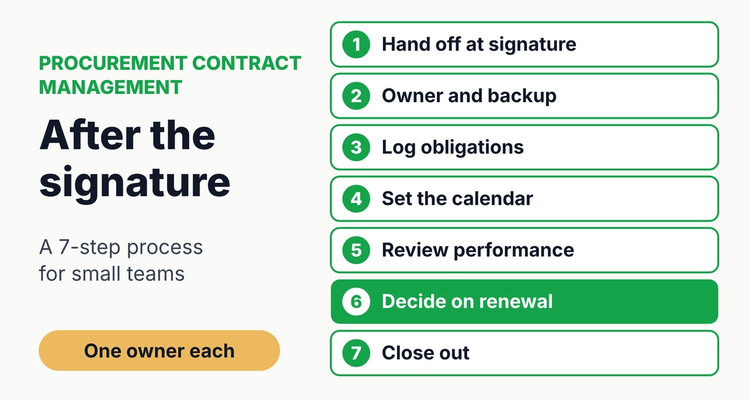 Seven steps from signature to close-out, run from one register.
9.2%
average value erosion, as a share of anticipated contract value, from the ten most common contracting pitfalls (World Commerce & Contracting)
More than 5%
of contract value forfeited to poor contract management (WorldCC with Icertis, 2025)
What is procurement contract management?
Procurement contract management is everything that happens to a purchasing contract between signature and close-out: making sure the vendor delivers, that you meet your own obligations, that money and dates are tracked, and that someone decides in time whether to renew, re-tender or exit. Large organizations call this post-award contract administration.
Small teams usually do the buying well and the managing badly, because nobody is assigned to it. The fix is not a bigger team. It is a light routine: an owner, a register, a calendar and a review.
What are the steps in a procurement contract management process?
The process has seven steps, and the first four take place in the week after signature. Each produces something you can check later.
- Hand off at signature. Procurement passes the signed contract, purchase order, pricing and any tender commitments to the person who will own it. Output: a register row.
- Assign an owner and a backup. The owner is the person who uses the service or budget, not the person who negotiated it. Output: two names on the row.
- Log obligations. Read the contract once and list every dated or recurring duty on both sides (see the register below). Output: an obligations list.
- Set the calendar. End date, notice period, notice-by date, renewal decision date, price review dates and certificate expiry dates. Output: reminders.
- Review performance. A short scorecard on a fixed schedule, with issues raised in writing. Output: dated scores and notes.
- Decide on renewal. Renew, renegotiate, re-tender or exit, with the decision recorded before the notice-by date. Output: a decision note.
- Close out. Final invoice, return of data, keys or equipment, a last performance note, and files kept for your retention period. Output: a closed row.
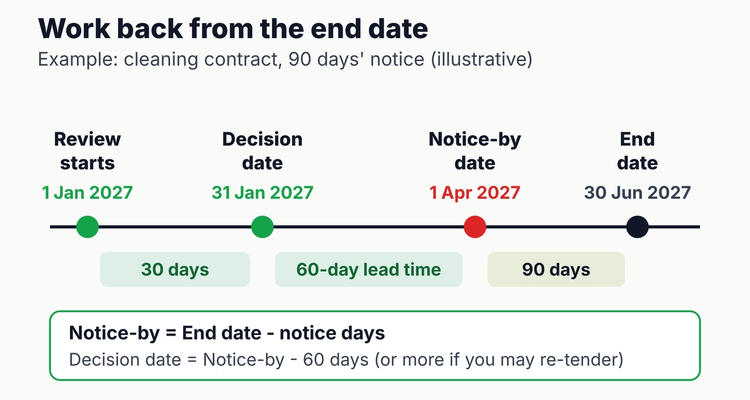 Work back from the end date so the renewal decision lands well before the notice-by date (illustrative dates).
Who should own each contract?
The contract owner should be the person who relies on the service day to day and holds the budget, with procurement or finance keeping the register. Split the roles so nothing depends on one inbox. This is our suggested split for a team of two to ten people:
Contract roles for a small team (suggested split, adapt to your approval rules)
| Role | Responsible for | Typical person in a small organization |
|---|---|---|
| Contract owner | Day-to-day relationship, performance reviews, renewal recommendation | Department lead who uses the service |
| Backup owner | Covers absences, receives every reminder too | A colleague in the same team |
| Register keeper | Adds new contracts, checks dates and documents, runs the monthly review | Office, operations or finance manager |
| Approver | Signs off renewals and new commitments above your limit | Director, executive director or board treasurer |
| Vendor contacts | Account manager, escalation contact and emergency line | Named on the register, not just in email |
If you run term contracts with extension options in a public body, our guide to term contract management in the public sector covers the extra publication and re-tender duties.
How do you track contract obligations?
Track obligations by reading each contract once and logging every duty that has a date, a frequency or a trigger, for both the vendor and you. Most obligations fall into a few types:
Obligations register: what to log from each contract
| Obligation type | Example | Who acts | Evidence to keep |
|---|---|---|---|
| Deliverables and service levels | Monthly report, 4-hour response, quarterly visit | Vendor | Reports, tickets, visit records |
| Your own duties | Provide access, data or approvals by a date | You | Emails, sign-offs |
| Payment terms | Invoice timing, early-payment discount, late fees | Finance | Invoices, payment dates |
| Price changes | Annual increase cap or index review date | Owner and finance | Notice letters, new price schedule |
| Vendor documents | Insurance certificate, licence, accreditation | Vendor, checked by register keeper | Current copies with expiry dates |
| Notice and renewal | Auto-renews for 12 months unless 60 days' notice | Owner and approver | Decision note, notice sent and received |
| Exit duties | Return or deletion of data, handover support, equipment collection | Both | Certificates of deletion, handover notes |
Vendor documents are where small teams slip most often, because the certificate that was current at signature expires mid-term. The free contractor document tracker gives each document a request-by date.
When should you make the renewal decision?
Make the renewal decision before the notice-by date, with enough time left to re-tender if the answer is no. Work backwards from the end date:
- Notice-by date = end date minus the notice period in the contract.
- Decision date = notice-by date minus your own lead time. For a simple renewal we suggest at least 60 days; if you might re-tender, add your procurement lead time.
- Review start = decision date minus 30 days, so the owner has time to gather performance data and quotes.
Worked example (illustrative): a cleaning contract ends 30 June 2027 with 90 days' notice. The notice-by date is 1 April 2027, the decision date 31 January 2027 and the review starts 1 January 2027.
State law gives limited cover. New York General Obligations Law 5-903 makes an auto-renewal clause in a service, maintenance or repair contract unenforceable unless the vendor sends written notice 15 to 30 days before your deadline. Wisconsin statute 134.49 requires notice 15 to 60 days before the deadline for certain business contracts longer than a year, but excludes contracts with government bodies. Our vendor contract renewal checklist walks through the review step by step.
How do you measure vendor performance without a big system?
Use a one-page scorecard with four or five measures, scored on the same scale every time, on a schedule set by how much the contract matters. Our suggested rhythm is quarterly for contracts that are critical or high value and once a year for the rest, plus a final note at close-out.
Vendor performance scorecard (copy into a sheet; score 1 to 5)
| Measure | What to check | Evidence |
|---|---|---|
| Delivery | Did the vendor deliver what the contract specifies, on time? | Reports, visit logs, delivery notes |
| Service levels | Were response and fix times met? | Ticket data, call logs |
| Invoicing | Were invoices correct and at contract prices? | Invoice checks |
| Compliance | Are insurance, licences and required documents current? | Document register |
| Relationship | Were issues raised and fixed without chasing? | Owner notes |
Write down any score of 1 or 2 with the date and what you asked the vendor to fix. If you buy with federal grant funds, those notes are part of how you show the oversight that 2 CFR 200.318(b) requires.
⚠️What happens if you miss it: if nobody acts by the notice-by date, an auto-renewing contract usually rolls into a new term on its existing terms, and the limited state protections above apply only to some contracts. For federal grant recipients, 2 CFR 200.318 requires contractor oversight and records detailing the history of each procurement, and 2 CFR 200.334 requires keeping award records for three years from the final financial report, longer if an audit or claim has started.
Do this now: a first-30-days plan
You can set up the whole process in four weeks alongside your normal job. Time estimates are ours, for an organization with 20 to 50 active contracts.
First 30 days: procurement contract management set-up
| Week | What to do | Time (estimate) |
|---|---|---|
| 1 | Inventory: list every active contract from AP payments, card statements and shared drives, one row each | 3 to 4 hours |
| 2 | Owners: name an owner and backup for each row, and confirm with them | 1 to 2 hours |
| 3 | Obligations and dates: read each contract once, fill in end date, notice period and key obligations | 10 to 15 minutes per contract |
| 4 | Calendar and review: add formulas, book a 30-minute monthly review, run the first one | 1 hour |
Use these columns: Contract | Vendor | Owner | Backup | Annual value | End date | Auto-renews? | Notice days | Notice-by | Decision date | Next review | Last score | Status. Formulas: Notice-by =F2-H2, Decision date =I2-60, Status =IF(J2<TODAY(),"DECIDE NOW",IF(J2-TODAY()<=30,"REVIEW","OK")). Sort by decision date at each monthly review. The free contract renewal tracker already has the notice-by formula and colour coding.
How can you improve the process once it runs?
- Co-term related contracts so one review covers several renewals.
- Record why you renewed. One line per decision saves the next owner from repeating the analysis.
- Check prices at each renewal against the price review clause before the notice-by date, not after the invoice.
💡 Pro Tip
Keep vendor contacts in tiers on the contract record, not in one person's email. One public-sector museum group we work with records the vendor, the department, the officer in charge, the purchase order description and tiered vendor contacts on each contract, so a new officer can pick up any contract on day one.
Spreadsheet or software for procurement contract management?
A spreadsheet is enough while one person keeps the register, reviews it monthly and the contract count stays in the dozens. The formulas above cover the dates.
A tool earns its place when reminders must reach owners in other departments, vendors must send certificates, owners change, or an auditor or funder asks who did what and when. ExpiryEdge keeps each contract as a record with an owner and backup, reminders at 90, 60, 30 and 7 days by email, SMS, Slack or Teams, document requests, and an audit trail. See vendor contract management and contract expiration tracking. For building service contracts, our facilities maintenance contract guide covers scope and inspection frequencies.
Frequently asked questions
What is procurement contract management?
It is the work after a purchasing contract is signed: making sure the vendor delivers, meeting your own obligations, tracking money and dates, reviewing performance and deciding in time whether to renew, re-tender or exit. Larger organizations call it post-award contract administration.
Who should own a contract after it is signed?
The person who relies on the service and holds the budget, with a named backup. Procurement or finance keeps the register and runs the monthly review, but should not be the only name on a contract.
When should we decide whether to renew a contract?
Before the notice-by date, which is the end date minus the notice period. We suggest setting a decision date at least 60 days before the notice-by date, and earlier if you may need to re-tender.
How often should we review vendor performance?
No general law sets this for private organizations. We suggest quarterly for critical or high-value contracts, annually for the rest, and a final note at close-out, using the same short scorecard each time.
What records should we keep for grant-funded procurement?
Under 2 CFR 200.318(i), records detailing the history of each procurement, including the rationale for the method, contract type, contractor selection or rejection, and the basis for the price. 2 CFR 200.334 generally requires keeping award records for three years from the final financial report.
Do auto-renewal laws protect businesses?
Only in some states and for some contracts. New York requires written notice 15 to 30 days before the cancellation deadline for service, maintenance and repair contracts, and Wisconsin has a notice rule for certain business contracts. Track your own notice-by dates rather than relying on them.
Sources
- eCFR, 2 CFR 200.318 General procurement standards
- eCFR, 2 CFR 200.334 Record retention requirements
- New York General Obligations Law 5-903
- Wisconsin Statutes 134.49, Renewals and extensions of business contracts
- World Commerce & Contracting, Overcoming the Ten Pitfalls of Contracting
- World Commerce & Contracting with Icertis, Smarter Contracts, Better Margins (24 September 2025)
Last reviewed: 12 October 2026
Frequently asked questions
The person who relies on the service and holds the budget, with a named backup. Procurement or finance keeps the register and runs the monthly review, but should not be the only name on a contract.
Before the notice-by date, which is the end date minus the notice period. We suggest setting a decision date at least 60 days before the notice-by date, and earlier if you may need to re-tender.
No general law sets this for private organizations. We suggest quarterly for critical or high-value contracts, annually for the rest, and a final note at close-out, using the same short scorecard each time.
Under 2 CFR 200.318(i), records detailing the history of each procurement, including the rationale for the method, contract type, contractor selection or rejection, and the basis for the price. 2 CFR 200.334 generally requires keeping award records for three years from the final financial report.
Only in some states and for some contracts. New York requires written notice 15 to 30 days before the cancellation deadline for service, maintenance and repair contracts, and Wisconsin has a notice rule for certain business contracts. Track your own notice-by dates rather than relying on them.
Not legal advice
This article is for general informational purposes and does not constitute legal advice. Laws, regulations and contract requirements vary by jurisdiction and change over time. Consult a qualified attorney in your jurisdiction before making decisions that depend on the specific legal interpretation discussed here.


