
Term Contract Management: Extensions and Re-Tender Lead Times

A term contract supplies goods, services or works for a fixed period, often with options to extend. To manage one in a UK public body, record the end date, each option-exercise date and a re-procurement start date. Under the Procurement Act 2023, an extension is safest when the contract and tender notice unambiguously provided for it.
The cleaning, maintenance or catering contract ends in four months, nobody has started the re-tender, and someone asks whether you can just extend it. This guide sets out what the Act allows, which notices each stage triggers and how far back to start, with a register you can build in an afternoon.
Key takeaways
- Four dates matter, not one: re-procurement start, option-exercise date, notice-by date and end date.
- Planned extensions are the safe route. Schedule 8, paragraph 1 permits a modification "unambiguously provided for" in both the contract and the tender or transparency notice.
- Unplanned extensions are limited. Changing the term by more than 10% of the maximum term provided for on award is a substantial modification (s.74(3)).
- Most changes need a contract change notice first (s.75), unless the change is within the 10% (15% for works) value or 10% term limits.
- Expiry is a termination for notice purposes. Publish a contract termination notice within 30 days of the contract ending (s.80).
- Contracts awarded under the Public Contracts Regulations 2015 stay under those rules until they end, including when you extend them.
- The legal minimum periods for a competitive flexible re-tender add up to roughly two months. Your own approvals take most of the time.
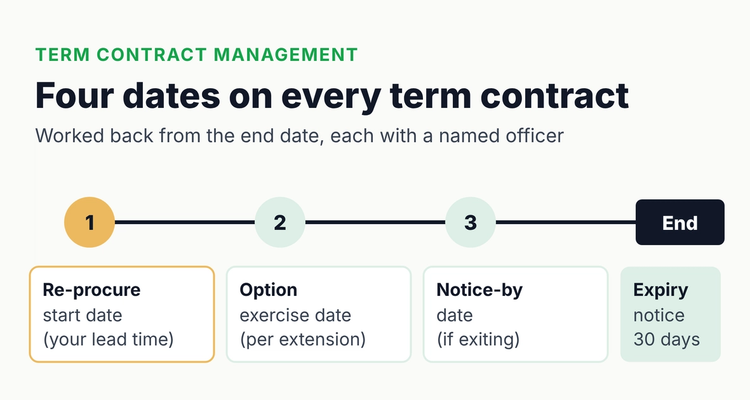 Four dates on every term contract, worked back from the end date. Expiry triggers a contract termination notice within 30 days (s.80).
What is a term contract?
A term contract is an agreement to supply goods, services or works over a set period, usually at agreed rates, rather than a single delivery. Public bodies use them for facilities maintenance, cleaning, catering, IT support and repairs. Many run for a base term with one or more extension options, such as three years plus one plus one.
A framework is different. It sets terms for future call-off contracts. Under the Procurement Act 2023, a framework may not exceed four years, or eight for defence and security or utilities frameworks, unless the authority gives reasons for a longer term (s.47). Cabinet Office guidance adds that "call-off contracts may extend beyond the term of the framework" (Frameworks guidance). Track the framework expiry and each call-off's end date as separate records.
Which rules apply to your term contract?
It depends on when the procurement started and where you are. Check this first, because extension rules and notices differ.
- Started on or after 24 February 2025 (England, Wales, Northern Ireland and reserved bodies): the Procurement Act 2023 applies.
- Awarded under the old regime: Cabinet Office guidance says such contracts "will continue to be managed under that legislation until such a time as the contract... ceases to exist". You modify them under regulation 72 of the Public Contracts Regulations 2015 (PCR) and publish PCR notices, not a contract change notice (transitional guidance).
- Devolved Scottish authorities: the Act does not apply. Cabinet Office guidance notes that section 2(5)(a) puts them in the list of "excluded authorities" (devolved authorities guidance). Follow Scottish rules.
- Devolved Welsh and Northern Ireland authorities: the Act applies with some differences, such as s.53(3) on publishing contracts.
Can you extend a term contract under the Procurement Act 2023?
Yes, if the extension fits one of the grounds in section 74. The cleanest is an option you planned at the start. Under Schedule 8, paragraph 1, a modification is permitted if "the possibility of the modification is unambiguously provided for in (i) the contract as awarded, and (ii) the tender or transparency notice" and it does not change the overall nature of the contract.
Without a planned option, you have two narrower routes:
- Not a substantial modification (s.74(1)(b)). A change is substantial if it would increase or decrease the term by more than 10% of the maximum term provided for on award, materially change the scope, or materially shift the economic balance to the supplier (s.74(3)). For a contract with a maximum of 5 years (60 months), 10% is 6 months.
- Below-threshold modification (s.74(1)(c)). The change must not increase or decrease the contract value by more than 10% for goods or services or 15% for works, must keep the cumulative total of such changes below the procurement threshold, and must not materially change the scope (s.74(4)). Cabinet Office guidance gives the example of adding a year to a 5-year contract: if the value rises by no more than 10%, this ground may be available (modifications guidance).
Before most modifications you must publish a contract change notice (s.75). It is not needed where the value changes by 10% or less (15% for works) or the term changes by 10% or less of the maximum term. Splitting one change into several small ones does not avoid it: s.75(4) and (5) treat them as one.
Which dates does the Procurement Act 2023 set for a term contract?
The Act attaches a notice or a deadline to almost every stage of a term contract's life. The table compiles the ones a contract manager needs, in the order they arise.
Procurement Act 2023: dates and notices in a term contract's life (last verified 12 Oct 2026)
| Stage | What the Act requires | Section | Official source |
|---|---|---|---|
| Annual planning | Authorities expecting to pay over £100m in the coming financial year publish a pipeline notice within 56 days of its start, listing contracts over £2m planned for the next 18 months | s.93 | legislation.gov.uk |
| Market engagement | If you engage suppliers before tendering, publish a preliminary market engagement notice first, or give reasons in the tender notice | s.16, s.17 | legislation.gov.uk |
| Advance notice | A planned procurement notice published 40 days to 12 months before the tender notice can cut the minimum tendering period to 10 days | s.15, s.54(4) | legislation.gov.uk; Time Periods guidance |
| Participation | At least 25 days for requests to participate (10 if urgent; none for light touch) | s.54(3) | legislation.gov.uk; Time Periods guidance |
| Tendering | At least 25 days if tenders are electronic and all documents are issued with the notice; 30 or 35 days otherwise | s.54(4) | legislation.gov.uk; Time Periods guidance |
| Award | Publish a contract award notice, then wait a standstill of eight working days before entering into the contract | s.50, s.51 | legislation.gov.uk |
| Contract signed | Contract details notice within 30 days (120 for light touch); copy of contracts over £5m within 90 days (180 light touch) | s.53 | legislation.gov.uk |
| KPIs | Contracts over £5m: set and publish at least three KPIs before signing | s.52 | legislation.gov.uk; KPI guidance |
| During the term | Assess and publish KPI performance at least once every 12 months and on termination (in force 1 Jan 2026 for contracts under the Act) | s.71 | legislation.gov.uk; S.I. 2025/1316 |
| Extension or change | Fit a ground in s.74 and publish a contract change notice before modifying, unless exempt | s.74, s.75, Sch. 8 | legislation.gov.uk; Modifications guidance |
| End of contract | Contract termination notice within 30 days of the contract ending, including by expiry | s.80 | legislation.gov.uk; Termination guidance |
Light touch contracts, private utilities, defence and security contracts and devolved arrangements have exceptions. Check the section text for your contract before relying on a row.
How long does re-procurement take?
Longer than the legal minimum. For a competitive flexible procedure with electronic tenders, the minimum periods alone are a 25-day participation period, a 25-day tendering period and an eight-working-day standstill: roughly two months. Everything else is your own time: the decision to re-tender, the business case and specification, approvals, evaluation, award and mobilisation of the new supplier.
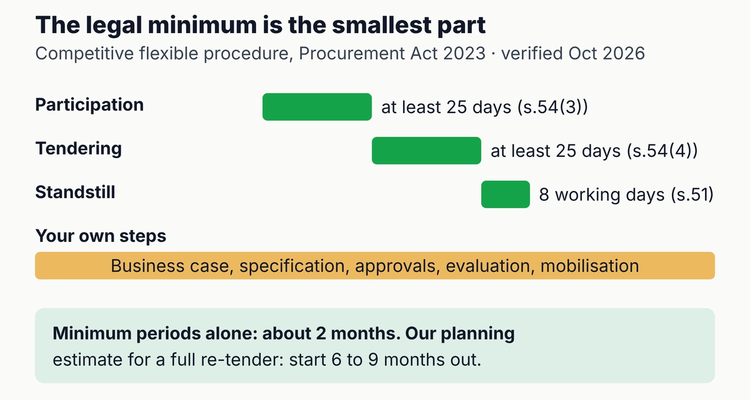 The statutory minimum periods are a small part of a re-tender. The 6 to 9 month start is our planning estimate, not a legal rule.
Our planning estimate: start a full re-tender 6 to 9 months before the end date, and a call-off from an existing framework 2 to 3 months before. These are estimates, not rules. Lengthen them if your contract needs committee or cabinet approval, TUPE (staff transfer) consultation, or a long mobilisation period, and set your own figures from your procurement rules.
What should you do in the 12 months before a term contract ends?
- 12 months out: review. The officer in charge reviews performance, spend and KPIs, and checks whether an extension option is left.
- 10 to 12 months out: decide. Extend under a planned option, re-procure, call off from a framework, bring in house or stop. Record who decided and why.
- 9 months out: plan the route. If re-procuring, agree the timetable backwards from the end date and consider a planned procurement notice.
- Option deadline: exercise in writing. Send the extension notice the way the contract requires, before the option-exercise date. Check whether a contract change notice is needed.
- 6 months out: go to market. Publish the tender notice, or run the call-off.
- 3 months out: award and mobilise. Award notice, standstill, contract signed, contract details notice within 30 days.
- End date: close out. Final KPI assessment if KPIs were set, contract termination notice within 30 days, and archive the file.
The times are our planning suggestions. If you are past the 6-month point with no plan, escalate now: our vendor contract renewal checklist has wording for notices to suppliers.
What happens if a term contract runs out?
⚠️What happens if you miss it: if the end date passes with no extension or replacement in place, the service has no contract behind it. An extension decided at the last minute must still fit a ground in s.74, such as a planned option or a change within the 10% term limit, and most need a contract change notice first (s.75). Expiry also starts the 30-day clock for the contract termination notice (s.80). For contracts awarded under the old regime, modification must fit regulation 72 of the PCR 2015.
Do this now: a term contract register in one afternoon
You can build a working register in a spreadsheet today. Use one row per contract and these columns; the formulas work in Excel, Google Sheets and LibreOffice.
Term contract register: worked example (row 2)
| Column | Header | Example | Formula |
|---|---|---|---|
| A | Contract, supplier | Example – Building maintenance | Text |
| B | Department / officer in charge / backup | Estates / J. Officer / K. Deputy | Names, not teams |
| C | Regime | Procurement Act 2023 | Act, PCR 2015 or other |
| D | Current end date | 30 Sep 2027 | From the contract |
| E | Extension option left (months) | 12 | From the contract |
| F | Option notice (months) | 3 | From the contract |
| G | Option-exercise date | 30 Jun 2027 | =IF(E2>0,EDATE(D2,-F2),"") |
| H | Re-procurement lead time (months) | 9 | Your estimate |
| I | Re-procurement start | 30 Dec 2026 | =EDATE(D2,-H2) |
| J | Next action date | 30 Dec 2026 | =MIN(G2,I2) |
| K | Status | varies | =IF(J2<TODAY(),"OVERDUE",IF(J2-TODAY()<=90,"Act within 90 days","OK")) |
Add columns for contract value, framework or call-off, KPI review date and the termination notice date. Time estimates: 60 minutes to list contracts from the contract register and accounts payable, 90 minutes to read each contract for end date and options, 30 minutes for formulas and owners. These are our estimates for about 50 contracts. Our free contract renewal tracker already has end-date and notice-by formulas and status colours.
💡 Pro Tip
One public-sector museum group we work with names an officer in charge for each vendor contract and records the supplier's contacts in tiers: account manager, escalation contact and emergency number. When a contract nears its option date, the reminder goes to a named person, and when service fails, nobody has to hunt for a phone number.
How can you manage term contracts better than the minimum?
- Write options you can use. At award, set out each extension's length, price mechanism and notice period in both the contract and the tender notice, so Schedule 8, paragraph 1 is available later.
- Track the maximum term, not just the current end date. The 10% limit in s.74(3) is measured against the maximum term provided for on award.
- Keep supplier documents current. Insurance certificates and accreditations expire mid-term; our contractor document tracker gives each a request-by date.
- Hold a quarterly contracts meeting. Review every contract whose next action date falls in the next 12 months.
- Keep KPI evidence as you go. If s.71 applies, you need a dated assessment at least every 12 months.
Spreadsheet or software for term contract management?
A spreadsheet works when one team owns a few dozen contracts and reviews the register every month. It struggles when officers change roles, options sit in different departments, or nobody opens the file in the month that matters. Raymond Panko's review of spreadsheet audits found "errors in 94% of the spreadsheets studied" (Panko), so check your formulas each quarter.
Software earns its place when many officers own contracts and a missed option date is costly. ExpiryEdge records each contract with an officer in charge, a backup and every action date, sends reminders at 90, 60, 30 and 7 days by email, SMS, Slack or Teams, and keeps an audit trail. See vendor contract management for how it fits, or contract expiration tracking for notice-date maths.
Frequently asked questions
What is a term contract in the public sector?
A contract to supply goods, services or works over a set period, often at agreed rates and with options to extend, such as three years plus one plus one. Common examples are maintenance, cleaning, catering and IT support.
Can a public body extend a contract that has no extension option?
Sometimes. Under the Procurement Act 2023, an unplanned change may be allowed if it is not a substantial modification, such as changing the term by no more than 10% of the maximum term, or if it is a below-threshold modification. Most modifications need a contract change notice first. Take advice for anything significant.
How far ahead should we start re-procuring a term contract?
Our planning estimate is 6 to 9 months before the end date for a full re-tender and 2 to 3 months for a framework call-off. The statutory minimum periods for a competitive flexible procedure add up to about two months; approvals and evaluation take the rest.
Does a contract expiring need a notice under the Procurement Act 2023?
Yes. Section 80 requires a contract termination notice within 30 days of a public contract being terminated, and the definition of termination includes expiry. Private utilities and some direct awards are excluded.
Do these rules apply to contracts awarded before February 2025?
No. Contracts awarded under the Public Contracts Regulations 2015 continue to be managed under those regulations until they end, including modifications under regulation 72. Use the PCR notices for them, not a contract change notice.
How long can a framework last?
Four years, or eight for defence and security or utilities frameworks, unless the authority considers a longer term is required and gives reasons in the notice (s.47). Call-off contracts may extend beyond the framework's term.
Sources
- Procurement Act 2023, sections 15, 16, 17, 47, 50, 51, 52, 53, 54, 71, 74, 75, 80, 93 and Schedule 8, legislation.gov.uk (accessed 12 Oct 2026).
- The Procurement Act 2023 (Commencement No. 4) Regulations 2025, S.I. 2025/1316.
- Cabinet Office, Guidance: Contract Modifications (updated 20 July 2026) and Guidance: Contract Termination (updated 20 July 2026).
- Cabinet Office, Guidance: Frameworks (updated 13 July 2026), Guidance: Key Performance Indicators (updated 20 July 2026) and Guidance: Time Periods (updated 17 August 2026).
- Cabinet Office, Guidance on transitional and saving arrangements and Guidance: Devolved Contracting Authorities (updated 15 April 2026).
- Raymond R. Panko, What We Don't Know About Spreadsheet Errors Today.
- Last reviewed: 12 October 2026
Frequently asked questions
Sometimes. Under the Procurement Act 2023, an unplanned change may be allowed if it is not a substantial modification, such as changing the term by no more than 10% of the maximum term, or if it is a below-threshold modification. Most modifications need a contract change notice first. Take advice for anything significant.
Our planning estimate is 6 to 9 months before the end date for a full re-tender and 2 to 3 months for a framework call-off. The statutory minimum periods for a competitive flexible procedure add up to about two months; approvals and evaluation take the rest.
Yes. Section 80 requires a contract termination notice within 30 days of a public contract being terminated, and the definition of termination includes expiry. Private utilities and some direct awards are excluded.
No. Contracts awarded under the Public Contracts Regulations 2015 continue to be managed under those regulations until they end, including modifications under regulation 72. Use the PCR notices for them, not a contract change notice.
Four years, or eight for defence and security or utilities frameworks, unless the authority considers a longer term is required and gives reasons in the notice (s.47). Call-off contracts may extend beyond the framework's term.
Not legal advice
This article is for general informational purposes and does not constitute legal advice. Laws, regulations and contract requirements vary by jurisdiction and change over time. Consult a qualified attorney in your jurisdiction before making decisions that depend on the specific legal interpretation discussed here.


