
Every vendor contract with an officer in charge, a vendor contact and a date to act on.
Vendor contract management is mostly the work after signature: who inside owns the contract, who to call at the vendor, which certificates the vendor must keep current, and when to extend, re-tender or exit. ExpiryEdge keeps each contract as a record with those answers attached and reminds the officer in charge at 90, 60, 30 and 7 days.
Last updated · ExpiryEdge editorial team
The internal owner, the vendor contact and the next decision on one record
Department, officer in charge and backup on every contract
Tiered vendor contacts, from account manager to emergency line
Extension options and re-tender start dates worked back from the end date
Vendor certificates requested and filed before they lapse
Quick answer
Vendor contract management is the work after signature: knowing who owns each vendor agreement, who to call at the vendor, what the vendor must keep current, and when to extend, re-tender or exit. Keep one record per contract with its end date, notice or option date, owner, vendor contacts and documents, and remind the owner early enough to act.
What goes on each vendor contract record
End date and the notice-by date worked out from it
Extension options and the last date to exercise each one
Department, officer in charge and a named backup
Vendor contacts: account manager, escalation and emergency
Purchase order number and what the PO covers
Contract value, budget line and price review dates
Vendor insurance certificates and their expiry dates
Vendor licences, accreditations and safety documents
Service levels and KPI review dates
Planned maintenance visits and inspections the vendor carries out
Signed contract, variations and change notices
The date re-procurement has to start
Who runs vendor contracts on ExpiryEdge
Procurement and contracts teams
Hold the register for the whole organisation, set the re-tender calendar and need to know which department owns each contract without chasing.
Officers in charge and budget holders
Own the day-to-day relationship with a vendor and get reminded about the decisions that are theirs: extend, renegotiate, re-tender or exit.
Facilities managers
Run maintenance, cleaning, security and lift contracts where the vendor's own certificates and inspection reports matter as much as the contract date.
Finance
See what renews or needs re-procuring in the next 30, 60 or 90 days before the budget is set, not after the invoice arrives.
Public bodies with term contracts
Museums, councils, schools, universities and trusts running framework call-offs and term contracts with extension options and publication duties.
Owners, vendors and dates, each with a place on the record
An officer in charge for every contract, not a shared inbox
Each contract sits under a department with a named officer in charge and a backup. Reminders go to that person, escalate to the department head if a date passes, and move to a new owner in one step when someone leaves. One public-sector museum group we work with tracks about 60 vendor master and term contracts this way, each with the vendor, the department, the officer in charge, the PO description and tiered vendor contacts.
Department, owner and backup on every record
Escalation to the department head when a date passes
Ownership handed over in one step when staff change
Extension options and re-tender dates, worked back from the end date
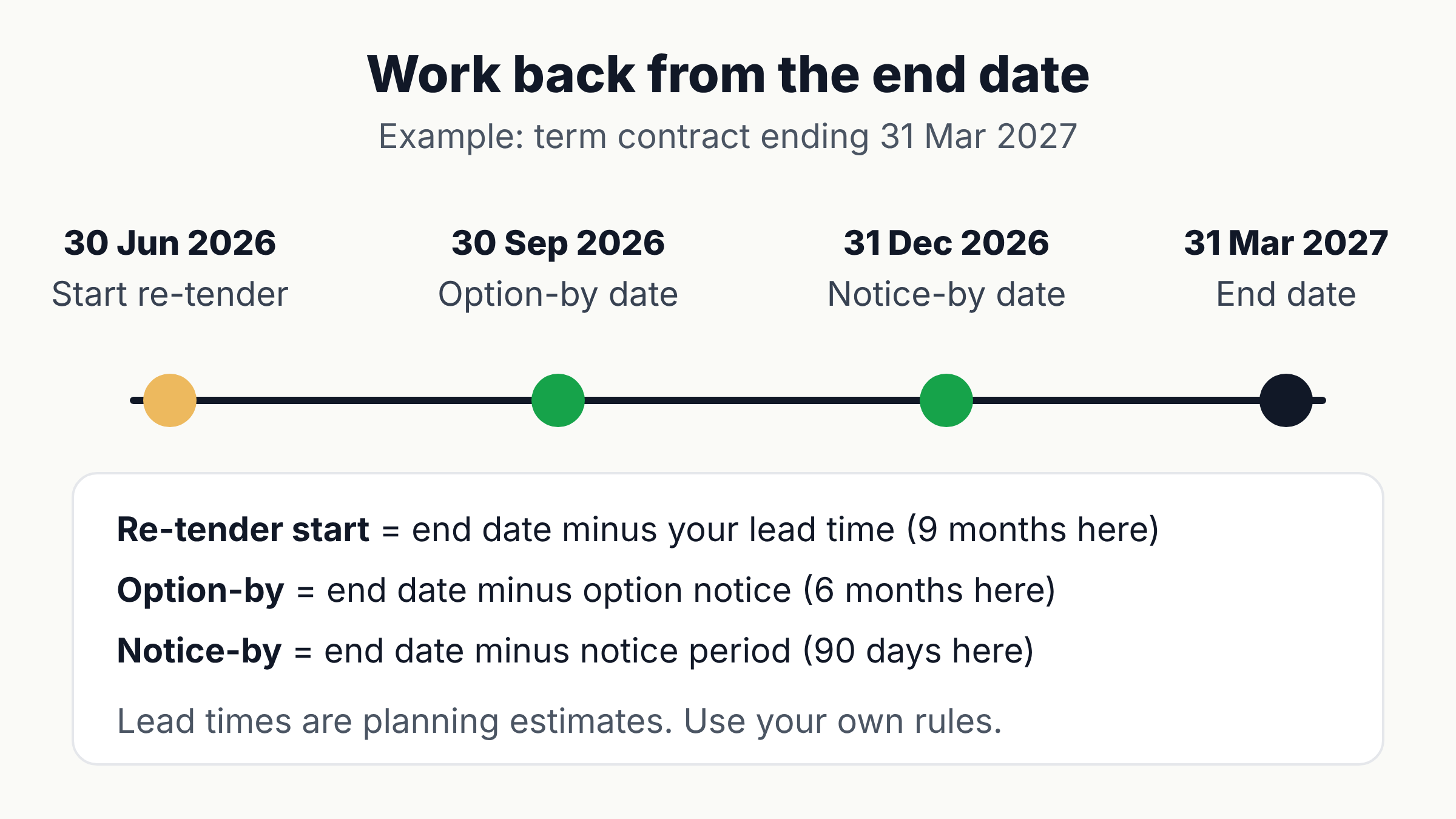
A term contract has more than one date that matters. There is the end date, the last day to exercise each extension option, and the day a re-tender has to start if you are not extending. Put the option notice period and your own procurement lead time on the record, and each date becomes a reminder to the officer in charge. Lead times depend on value, route and your own approval steps, so set them from your procurement rules.
Option-exercise date per extension period
Re-procurement start date from your own lead time
Notice-by date for contracts you plan to exit
The vendor's certificates requested before the old ones lapse
Vendors on site usually have to keep insurance certificates, licences, accreditations and safety documents current for the life of the contract. ExpiryEdge sends the vendor contact a document request link with no login, files the renewed certificate on the contract record and timestamps it, so the evidence is ready when an auditor or insurer asks.
Document requests to the vendor contact, no login needed
Renewed certificates filed on the contract record
Export by vendor, department or contract as CSV, PDF or XLSX
Do this now: a vendor contract register in one afternoon
| Time (estimate) | What you end up with | |
|---|---|---|
| 1. Pull every recurring vendor payment from the last 12 months out of accounts payable | 45 minutes | A list of vendors you are actually paying, each with a contract behind it |
| 2. Find each contract and copy the end date, notice period and any extension options | 90 minutes | End date, notice days, option periods and option notice days per row |
| 3. Add the formulas: Notice-by = End date - Notice days; Option-by = End date - Option notice days; Re-tender start = EDATE(End date, -Lead time in months) | 15 minutes | Three action dates per contract, calculated, not remembered |
| 4. Name the department, officer in charge and backup for every row | 30 minutes | Nobody can say "I thought procurement had that" |
| 5. Add the vendor's account manager, escalation contact and emergency number | 30 minutes | Who to call when service fails or a certificate is late |
| 6. List the certificates each vendor must keep current, with expiry dates | 30 minutes | A request-by date for every vendor document |
| 7. Sort by the earliest of the three action dates and book a 15-minute weekly review | 15 minutes, then 15 a week | A short list of decisions due this quarter |
UK public bodies: post-award dates the Procurement Act 2023 creates
| What the Act requires | Official source | Last verified | |
|---|---|---|---|
| Framework term (s.47) | A framework may not exceed four years, or eight years for defence and security or utilities frameworks, unless the authority considers a longer term is required and sets out its reasons in the notice | https://www.legislation.gov.uk/ukpga/2023/54/section/47 | 12 Oct 2026 |
| Key performance indicators (s.52) | Before entering into a public contract with an estimated value of more than £5 million, set at least three KPIs, and publish them | https://www.legislation.gov.uk/ukpga/2023/54/section/52 | 12 Oct 2026 |
| Contract details notice (s.53(1)) | Publish within 30 days of entering into the contract (120 days for a light touch contract) | https://www.legislation.gov.uk/ukpga/2023/54/section/53 | 12 Oct 2026 |
| Copy of the contract (s.53(3)) | For contracts over £5 million, publish a copy within 90 days (180 days for a light touch contract) | https://www.legislation.gov.uk/ukpga/2023/54/section/53 | 12 Oct 2026 |
| KPI assessment (s.71(2)) | Where KPIs were set, assess performance and publish the information at least once in every 12 months and on termination | https://www.legislation.gov.uk/ukpga/2023/54/section/71 | 12 Oct 2026 |
| Poor performance or breach (s.71(5)) | Publish the required information within 30 days of the breach or failure to perform first meeting the conditions in s.71(3) or (4) | https://www.legislation.gov.uk/ukpga/2023/54/section/71 | 12 Oct 2026 |
What changes for the contracts lead
Sixty contracts in a shared spreadsheet, the officer in charge recorded for some of them, vendor contacts in personal inboxes and insurance certificates in a folder nobody checks. Extension options are noticed when the vendor raises them, and re-tenders start when the contract has already run out.
Every contract has a department, an officer in charge, a backup and its vendor contacts. Option, notice-by and re-tender dates are reminders on the owner's calendar, vendor certificates arrive through a request link, and anything overdue escalates to the department head.
Spreadsheet or software for vendor contract management?
| ExpiryEdge | Spreadsheet | Calendar | |
|---|---|---|---|
| Notice-by, option and re-tender dates calculated | With formulas | ||
| Reminders to the officer in charge and a backup | Manual | ||
| Escalation to the department head when a date passes | |||
| Certificates requested from the vendor and filed on the record | |||
| Ownership handed over when staff leave | Manual | ||
| Timestamped history of decisions and notices | |||
| Free | 14-day trial |
Vendor contract management is how an organisation runs its supplier agreements after they are signed. It covers who owns each contract, who the vendor contacts are, what the vendor has to deliver and keep current, and when to extend, renegotiate, re-tender or exit. The practical core is a register with one record per contract, an owner for every record and reminders before each decision date.
CLM software usually focuses on drafting, negotiating, approving and signing contracts. Vendor contract management starts at signature and runs until the contract ends: owners, vendor contacts, obligations, vendor documents, performance reviews and renewal or re-tender decisions. Many smaller teams do not need drafting tools at all, only a reliable register and reminders. ExpiryEdge covers the post-signature part and does not draft contracts.
The person who manages the service day to day and can make the renew, extend or exit call, usually an officer in the department that uses the service. Procurement holds the register and the process, but a contract owned by "procurement" alone is often owned by nobody. Name a backup for every contract so leave and staff changes do not leave a date unwatched.
Work back from the end date by your own procurement lead time, plus any notice the contract requires. Lead times depend on the contract value, the procurement route and your approval steps, so ask your procurement team for realistic figures and record them on each contract. As a planning estimate, many teams start a competitive re-tender six to nine months before the end date and a framework call-off two to three months before.
List the documents each vendor must hold under the contract, record each expiry date, and ask for the renewed document about 30 days before the old one expires. Store it against the contract, not in an inbox. ExpiryEdge sends the vendor a request link with no login, files the upload on the record and reminds the officer in charge if nothing arrives.
For a small number of contracts with one owner who reviews the sheet weekly, yes. Use columns for end date, notice days, option dates, owner, backup, vendor contacts and document expiry dates, with formulas for the action dates. A spreadsheet falls short when several departments own contracts, when owners change, or when you need to chase vendors for documents and prove who decided what.
Under the Procurement Act 2023, a contracting authority must publish a contract details notice within 30 days of entering into a public contract (120 days for light touch contracts). For contracts over £5 million it must also publish a copy of the contract within 90 days and, where KPIs were set, assess and publish performance at least once every 12 months. Check sections 52, 53 and 71 for the exceptions that apply.
Give every vendor contract an owner and a date to act on
Import your contract register, name the officer in charge, send the first document requests. Free 14-day trial, no credit card.