
OCIP Insurance Explained: Enrollment, Close-Out and Excess Layers

OCIP insurance is an owner-controlled insurance program, or wrap-up: the project owner buys general liability, workers’ compensation, or both, for every enrolled contractor working at one construction site, often with excess layers on top. Contractors bid without those insurance costs, enroll before mobilizing, report payroll monthly and close out when their work ends.
Wrap-ups confuse everyone the first time: whose policy pays, what still needs your own cover, and which date ends what. This guide explains the life cycle, quotes the two state rules we could verify, and shows how to track each layer and contractor so nothing lapses or stays open.
Key takeaways
- OCIP means the owner buys; CCIP means the general contractor buys. Texas law calls both “consolidated insurance programs.”
- Enrollment is not automatic. Public owners’ OCIP manuals say a contractor that is not enrolled has no cover under the program.
- Wrap-ups cover the project site. Off-site work, auto and your own equipment stay on your own policies.
- Texas sets minimum terms. A program with general liability must provide completed operations cover for at least three years (Tex. Ins. Code §151.051).
- Wisconsin sets entry rules for workers’ compensation wrap-ups. At least $25 million estimated project cost and $250,000 estimated manual premium (Wis. Admin. Code DWD 80.61).
- Close-out starts with a notice of work completion. That triggers the final payroll audit; owners can hold final payment until the forms are in.
- Track every layer and every enrolled contractor as its own record. Each has its own carrier, limit, term and dates.
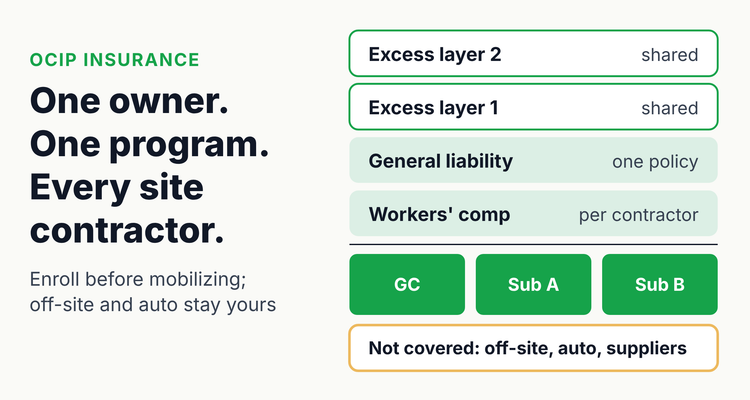 One program, many contractors: the wrap-up covers work at the site, and each contractor keeps its own cover for everything else.
What is OCIP insurance?
OCIP insurance is a single insurance program bought by a project owner to cover the contractors working on its construction project. Texas defines a consolidated insurance program as one “under which a principal provides general liability insurance coverage, workers’ compensation insurance coverage, or both that are incorporated into an insurance program for a single construction project or multiple construction projects” (Tex. Ins. Code §151.001). The principal is the person who buys it.
In practice, an OCIP usually has three parts:
- Workers’ compensation and employer’s liability. Often a separate policy issued to each enrolled contractor, paid for by the owner.
- Commercial general liability (CGL). One policy for the project, with every enrolled contractor named as an insured and limits shared by all.
- Excess liability. One or more layers above the CGL and employer’s liability, also shared.
Some programs add builder’s risk for the structure under construction. If yours does, its term runs to completion, not to a calendar date; our guide to builder’s risk insurance expiration covers what happens when a project runs late.
What is the difference between OCIP and CCIP insurance?
The difference is who buys and controls the program. In an OCIP, the owner is the sponsor; in a CCIP (contractor-controlled insurance program), the general contractor is. Texas law names both: “an owner-controlled or owner-sponsored consolidated insurance program or a contractor-controlled or contractor-sponsored consolidated insurance program” (Tex. Ins. Code §151.105). For a subcontractor the mechanics are similar: enroll, exclude wrap-up costs from your bid, report payroll and close out. Who you report to changes.
What does an OCIP cover, and what does it leave out?
An OCIP covers enrolled contractors for work at the project site. It does not cover everything a contractor does. Two public owners’ manuals we read are explicit:
- Off-site work is out. The New Jersey Schools Development Authority (NJSDA) OCIP IV manual says its CGL “does not cover offsite operations of any Enrolled Party.”
- Excluded parties get nothing. The same manual says “Excluded Parties are not granted any insurance coverage under the OCIP.”
- Suppliers and truckers are usually excluded. The Wisconsin Department of Transportation (WisDOT) Zoo Interchange manual excludes “vendors, suppliers, fabricators, material dealers, truckers, haulers, drivers and others who merely transport” materials to or from the site.
- Your own cover still matters. NJSDA requires enrolled parties to show workers’ compensation and general liability for off-site activities, and auto liability for both on-site and off-site work.
Your own policies will also change. Wisconsin’s rule requires the owner to tell each contractor’s insurer of “the need for attaching a proper endorsement to the regular carrier’s policy to exclude coverage for the wrap-up job site” (DWD 80.61(3)(c)2.c.). Keep that endorsement with your own policy record.
What do state rules and owners’ manuals say about OCIPs?
There is no single national OCIP rulebook. Texas has a statute on consolidated insurance programs, and Wisconsin regulates workers’ compensation wrap-ups. Everything else comes from the owner’s own manual, which is usually a contract document. We compiled the rules we could verify from official text.
OCIP insurance rules in law and in public owners’ manuals (last verified 12 Oct 2026)
| Source | Rule | Citation | Official link |
|---|---|---|---|
| Texas statute | Principal must give OCIP details (contacts, eligibility, site, coverage summary with limits and term of each limit, audit and claims costs) no later than the 10th day before entering the contract | Tex. Ins. Code §151.003 | statutes.capitol.texas.gov, Insurance Code ch. 151 |
| Texas statute | If the information is late, the contractor may elect not to enroll; it must then buy substantially similar cover and be paid its actual cost | Tex. Ins. Code §151.006 | same |
| Texas statute | Contractor may request a complete policy copy in writing; due by the later of 30 days after the request or 60 days after its covered work begins | Tex. Ins. Code §151.007 | same |
| Texas statute | Not providing the copy by the later of 75 days after the request or 90 days after work begins is a material breach | Tex. Ins. Code §151.008 | same |
| Texas statute | A program with general liability must provide completed operations cover for a policy period of not less than three years | Tex. Ins. Code §151.051 | same |
| Wisconsin rule | Workers’ compensation wrap-up needs estimated project cost of at least $25 million and estimated manual premium of $250,000 or more; single location (roads, bridges and pipelines count as one) | Wis. Admin. Code DWD 80.61(3)(b) | docs.legis.wisconsin.gov |
| Wisconsin rule | Bids and contracts on an ex-insurance basis; material suppliers excluded except from the site safety program | DWD 80.61(3)(b)6.–7. | same |
| Wisconsin rule | Owner submits each contractor’s application to the department before that contractor begins work | DWD 80.61(3)(c)2.d. | same |
| NJSDA manual (2019) | Monthly on-site payroll report by the 10th, including zero-payroll months; notice of work completion starts the final audit | OCIP IV Insurance Manual, pp. 14–15 | njsda.gov |
| WisDOT manual (2012) | Enrollment “required, but not automatic”; a contract extension form if work runs past the enrollment time frame; final payment held until close-out forms are in | Zoo Interchange OCIP Insurance Manual, pp. 20–23 | trust.dot.state.wi.us |
The manuals are examples from two public owners, not law that binds other projects. Your program’s manual and contract decide your duties, so read them before you bid.
How does OCIP enrollment work?
Enrollment is a paperwork step you complete before you set foot on site. Based on the Texas statute and the manuals above, the sequence usually runs like this:
- Receive the program information. In Texas, at least 10 days before you sign. Check limits, terms, deductible charge-backs and payroll reporting duties.
- Bid without wrap-up costs. Remove the cost of the covered lines from your price, as the contract instructs.
- Submit the enrollment form. Payroll estimates by classification, subcontractor details and your own insurance information.
- Get confirmation in writing. NJSDA issues a welcome letter and an OCIP certificate; keep both with the project record.
- Endorse your own policies. Ask your broker for the wrap-up exclusion endorsement on your own workers’ compensation and GL.
- Enroll your subcontractors. Each tier enrolls separately. A sub on site without enrollment is not covered.
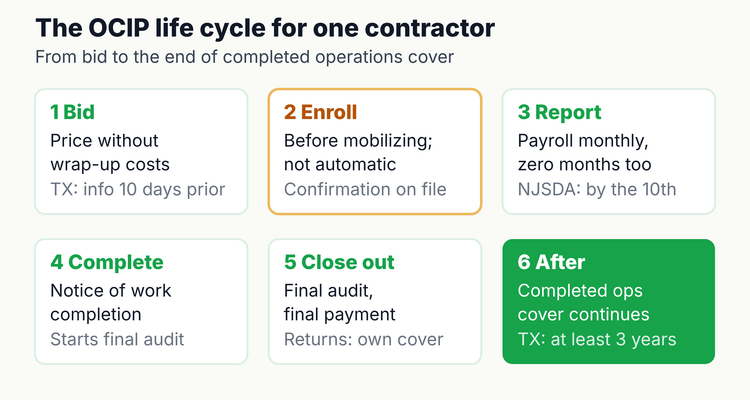 The OCIP life cycle for one contractor, from bid to the end of completed operations cover.
How does OCIP close-out work?
Close-out starts when your work at the site ends and you have no workers left there. The NJSDA manual says an enrolled subcontractor “must submit the Notice of Work Completion” and that it “will initiate the final payroll report and audit of payroll and man-hours by the OCIP Insurer.”
- File the notice of work completion for each subcontract, including your subs’.
- Submit the final payroll report and keep records for the insurer’s audit.
- Settle charge-backs. Some programs bill contractors a share of deductibles; the Texas statute requires this method to be disclosed up front.
- Collect final payment. WisDOT states it “will not release final payment until all necessary forms / information have been submitted.”
- Switch back to your own cover for return visits. NJSDA says a contractor returning to site does “so under their own insurance program” and must show its own certificate.
- Diary the completed operations end date. Claims from finished work can arrive years later; know which policy answers them.
How do you track OCIP excess layers and policy terms per project?
Give every layer and every enrolled contractor its own record, grouped by project. A wrap-up tower can have several excess layers, each with a different carrier, limit, attachment point and term, plus a completed operations period that outlives them all. Copy this layout:
OCIP tracker: one row per layer (row 2)
| Column | Header | What goes in it |
|---|---|---|
| A | Project | Project name or number |
| B | Layer | CGL primary, Excess 1, Excess 2, workers’ comp, builder’s risk |
| C | Carrier and policy number | From the program summary |
| D | Limit and attachment | e.g. “$25M xs $25M” |
| E | Policy term end | Expiration of the project policy period |
| F | Final acceptance date | Enter when the owner accepts the work |
| G | Completed ops years | From the program; at least 3 in Texas |
| H | Completed ops end | =IF(F2="","",EDATE(F2,12*G2)) |
| I | Days to term end | =IF(E2="","",E2-TODAY()) |
| J | Status | =IF(F2<>"","Completed ops",IF(I2<=90,"Extend or close?","Active")) |
Add a second sheet with one row per enrolled contractor: project, contractor, enrollment confirmed date, mobilization date, monthly payroll last filed, notice of completion date and final audit status. One formula catches the most dangerous gap, a contractor on site without confirmed enrollment: `=IF(AND(D2<>"",C2=""),"NOT ENROLLED","OK")`, where D is mobilization and C is enrollment confirmed.
Worked example (illustrative dates). The owner accepts the project on Jun 30, 2027. A program with a 10-year completed operations extension, as in the NJSDA manual, gives `=EDATE(F2,120)` = Jun 30, 2037. A Texas program at the three-year minimum would end Jun 30, 2030. If the project policy term ends Mar 31, 2027 and work is still running on Jan 15, 2027, the row shows 75 days and “Extend or close?”, which is the cue to ask the administrator about an extension.
Brokers placing these programs can file each tower under its client; our page on insurance renewal tracking for brokers shows the portfolio view. For the general method, see insurance policy tracking for businesses.
Do this now: an OCIP check before your next wrap-up job
Run this before you sign, whichever side you are on. Allow about an hour per project; that is our estimate.
OCIP insurance checklist for contractors
- ✓
Program information received (in Texas, at least 10 days before signing)
- ✓
Covered lines, limits, deductible charge-backs and term of each limit noted
- ✓
Bid priced without wrap-up costs, as the contract instructs
- ✓
Enrollment confirmed in writing for you and every subcontractor before mobilizing
- ✓
Wrap-up exclusion endorsement on your own policies, filed with the policy
- ✓
Own cover in place for off-site work, auto and equipment
- ✓
Monthly payroll report diarized, including zero months
- ✓
Notice of work completion filed when your last worker leaves
- ✓
Completed operations end date recorded per layer
If you are in Texas and need the policy, send this request and keep the date:
Subject: Request for complete OCIP policy copy, [project]
Under Texas Insurance Code §151.007, we request a complete copy of the insurance policy that provides our coverage under the consolidated insurance program for [project]. Our covered work began on [date]. Please send it to [email].
⚠️What happens if you miss it: an unenrolled contractor is not covered by the wrap-up. The NJSDA manual says “OCIP coverage will not be provided if sub is not enrolled” and “Access to the Project Site will not be permitted until enrollment is complete.” At the other end, WisDOT holds final payment until close-out forms are submitted, and a contractor who returns after close-out works under its own insurance.
How can owners and contractors run a wrap-up better?
- Make one person own enrollment. On the contractor side, the project manager should not mobilize a sub until the enrollment confirmation is on file.
- Reconcile payroll monthly, not at the end. A missing month is easier to fix in month two than in year three.
- Ask about extensions early. Ninety days before the project term ends is a sensible point to raise delays; that is our suggestion.
- Keep the program summary with every layer. Texas requires the term of coverage for each limit to be disclosed; store it with the record.
- Plan for claims after completion. Note who handles completed operations claims and how to reach them years later.
Spreadsheet or software for OCIP tracking?
A spreadsheet is enough for one project with a handful of layers and one person who opens it every week. It strains with several projects, dozens of enrolled subs and completed operations dates that run for a decade, because the person who built the file may be gone before the last date arrives. Audits compiled by Raymond Panko found errors in 94% of business spreadsheets studied, so check the date formulas whenever someone edits the file.
💡 Pro Tip
Brokers we work with track each OCIP excess layer as its own record, with carrier, limit and attachment point as fields and a folder per client project, instead of one record for the whole tower. When a single layer is extended or replaced, only that record changes, and the other layers keep their own dates.
ExpiryEdge is one option when the dates outlive the team: each layer or enrolled contractor becomes a record with an owner, a backup, files and reminders at 90, 60, 30 and 7 days, and contractors’ own certificates can be collected through certificate of insurance tracking. For the policies your own firm buys, see insurance renewal tracking software.
Frequently asked questions
What is OCIP insurance?
OCIP insurance is an owner-controlled insurance program, also called a wrap-up. The project owner buys general liability, workers’ compensation, or both, usually with excess layers, for the enrolled contractors working at one construction project. Contractors bid without those insurance costs and keep their own cover for off-site work and auto.
What is the difference between an OCIP and a CCIP?
In an OCIP the project owner buys and controls the program; in a CCIP the general contractor does. Texas Insurance Code §151.105 names both as consolidated insurance programs. For subcontractors, enrollment, payroll reporting and close-out work in much the same way.
Is enrollment in an OCIP automatic?
No. Public owners’ manuals such as those of the New Jersey Schools Development Authority and the Wisconsin Department of Transportation state that enrollment is required but not automatic. A contractor that is not enrolled has no cover under the program and may not be allowed on site.
How long does OCIP completed operations coverage last?
It depends on the program. In Texas, a consolidated insurance program that provides general liability must provide completed operations cover for at least three years (Tex. Ins. Code §151.051). The NJSDA and WisDOT manuals we read describe 10-year extensions.
What does OCIP close-out involve?
You file a notice of work completion when your work at the site ends, submit final payroll, and the insurer audits it. Some owners hold final payment until the close-out forms are in, and a contractor returning to site afterward works under its own insurance.
Do I still need my own insurance on an OCIP project?
Yes. Wrap-ups typically cover only work at the project site. Owners’ manuals require contractors to keep their own cover for off-site operations and auto liability, and your own policies usually carry an endorsement excluding the wrap-up site.
Is there a minimum project size for a wrap-up?
Not nationally. Wisconsin’s workers’ compensation rule requires an estimated project cost of at least $25 million and an estimated manual premium of $250,000 or more for a designated-carrier wrap-up (DWD 80.61). Other states and owners set their own thresholds.
Sources
- Texas Legislature, Insurance Code Chapter 151, Consolidated Insurance Programs (accessed 12 Oct 2026); confirmed against enrolled bills H.B. 2093 (2011) and S.B. 1081 (2015).
- Wisconsin Legislature, Wis. Admin. Code DWD 80.61 (accessed 12 Oct 2026).
- New Jersey Schools Development Authority, OCIP IV Insurance Manual (dated 1 Apr 2019; accessed 12 Oct 2026).
- Wisconsin Department of Transportation, Zoo Interchange OCIP Insurance Manual (Dec 2012; accessed 12 Oct 2026).
- Raymond R. Panko, What We Don’t Know About Spreadsheet Errors Today, arXiv:1602.02601.
- Last reviewed: 12 October 2026
Frequently asked questions
In an OCIP the project owner buys and controls the program; in a CCIP the general contractor does. Texas Insurance Code §151.105 names both as consolidated insurance programs. For subcontractors, enrollment, payroll reporting and close-out work in much the same way.
No. Public owners’ manuals such as those of the New Jersey Schools Development Authority and the Wisconsin Department of Transportation state that enrollment is required but not automatic. A contractor that is not enrolled has no cover under the program and may not be allowed on site.
It depends on the program. In Texas, a consolidated insurance program that provides general liability must provide completed operations cover for at least three years (Tex. Ins. Code §151.051). The NJSDA and WisDOT manuals we read describe 10-year extensions.
You file a notice of work completion when your work at the site ends, submit final payroll, and the insurer audits it. Some owners hold final payment until the close-out forms are in, and a contractor returning to site afterward works under its own insurance.
Yes. Wrap-ups typically cover only work at the project site. Owners’ manuals require contractors to keep their own cover for off-site operations and auto liability, and your own policies usually carry an endorsement excluding the wrap-up site.
Not nationally. Wisconsin’s workers’ compensation rule requires an estimated project cost of at least $25 million and an estimated manual premium of $250,000 or more for a designated-carrier wrap-up (DWD 80.61). Other states and owners set their own thresholds.


