
Insurance renewal tracking software for the policies your business buys.
A policy rarely lapses because someone decided to let it go. It lapses because the renewal notice landed in an inbox nobody checks in August. ExpiryEdge holds every policy your business buys - employers' liability, fleet, property, cyber, D&O - with its insurer, renewal date, premium and cover limit, and reminds a named owner at 90, 60, 30 and 14 days on the channel they actually read.
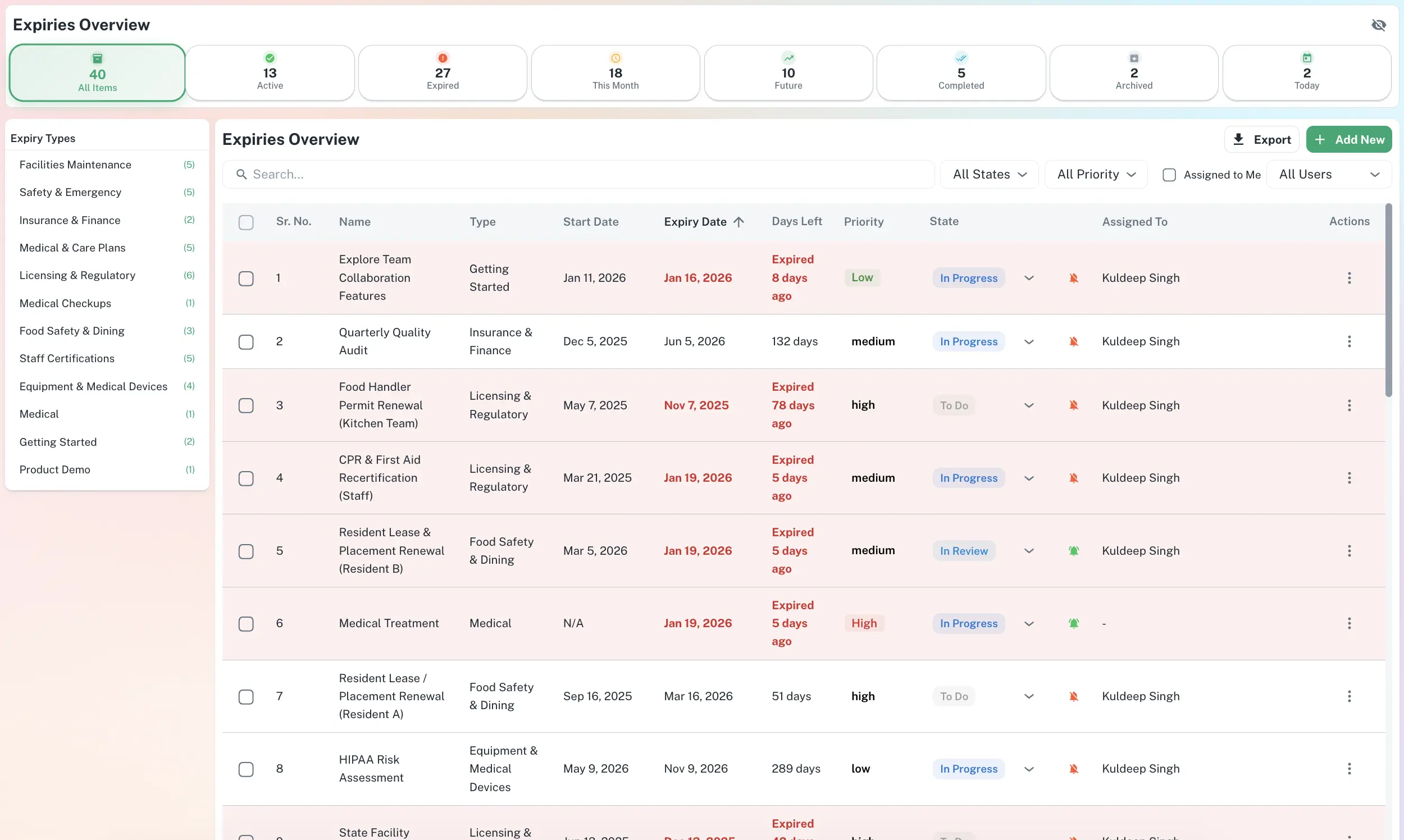
Your own cover - not the certificates your vendors send you
Every policy logged with insurer, renewal date, premium and cover limit
Reminders at 90 / 60 / 30 / 14 days to a named owner, not a shared inbox
Schedules, certificates and endorsements held on the record
Multiple entities and sites in one renewal calendar
Quick answer
Insurance renewal tracking software records every policy a business holds - insurer, policy number, renewal date, premium, cover limit and a named owner - then fires reminders before each renewal date so cover never lapses between terms. ExpiryEdge covers the policies you buy for your own operations. Chasing and verifying certificates from vendors and subcontractors is a separate job, handled on the certificate of insurance tracking side of the product.
Renewing on time is not the same as renewing correctly
90%
of small-business owners are not completely confident they have adequate insurance coverage
Source: NEXT Insurance / Wakefield Research (2023)29%
of small-business owners carry no insurance at all
Source: NEXT Insurance / Wakefield Research (2023)70%
of audited insurance policies in a multiyear certificate audit study contained material coverage gaps
Source: IRMI, D. Dybdahl (2015)Four ways cover quietly stops existing
It sat between two teams
Finance assumed operations had it. Operations assumed the broker had it. The policy expired on a Friday and nobody noticed until the following week.
Renewal day is not a negotiating position
Deal with a renewal on the day it falls due and your only real option is the quote in front of you. Ninety days out, you can go to market or ask for a higher limit.
Proof asked for, proof missing
A client, landlord or lender wants a current certificate. The most recent copy anyone can find is attached to an email from fourteen months ago.
One spreadsheet per trading company
Three entities, three files, three people who each maintain their own. Nobody can answer which company is covered for what, or when.
A control on every renewal date
Every line of cover in one stack
Employers' liability, general and public liability, professional indemnity, product liability, commercial property, fleet, cyber, D&O and business interruption - one dashboard, ordered by what renews next.
Lead time you set per policy
Use 90 / 60 / 30 / 14 days on a policy you want to market-test and 30 / 7 on one you will simply roll over. ExpiryEdge counts back from the renewal date on its own.
A named owner on every policy
Fleet goes to the fleet manager, property to facilities, liability to finance. Add a second recipient and an escalation step so annual leave cannot cause a lapse.
Schedule, certificate and endorsements on the record
Upload the policy schedule, the certificate and every mid-term endorsement against the policy itself. When a lender asks, you send the current version rather than the one you can find.
Premium and limits tracked term by term
Log annual premium and cover limit per policy. See what the programme costs, what renews next quarter, and where a limit has not moved in three years while the business doubled.
Multiple entities, multiple sites
Group policies by legal entity, subsidiary or site. Look at one company on its own, or roll the whole group into a single renewal calendar.
Get the new certificate back without an email chain
Send your broker a document collection link. They upload the renewed certificate and sign if needed, with no account. ExpiryEdge chases until it arrives, and a rejected document reopens the link for that one fix.
The policies that sit on this dashboard
Employers' liability / workers' comp
General and public liability
Professional indemnity (E&O)
Commercial property and contents
Commercial fleet and motor
Cyber and data breach
Management liability (D&O)
Business interruption
Product and completed-operations liability
Surety and performance bonds
Certificates you issue to clients
From a renewal date to cover that does not gap
Every policy ordered by days to renewal
Open the dashboard and the nearest renewal is at the top with its insurer and cover limit beside it. No sorting, no cross-referencing a spreadsheet against a broker email from last spring.
Ordered by days to renewal
Insurer and cover limit on every row
Expiring and lapsed policies flagged before anyone asks
The reminder reaches the person who can act on it
A shared inbox is where renewal notices go to die. Each policy carries a named owner plus any additional recipients, and reminders go out on email, SMS, WhatsApp, Slack or Microsoft Teams. When an owner leaves, you reassign the policy and the schedule carries on without a gap.
Named owner plus copied recipients per policy
Email, SMS, WhatsApp, Slack, Microsoft Teams
Escalation to a director when a reminder goes unactioned
Track, alert, renew, verify - then the next cycle schedules itself
ExpiryEdge does not close a policy record when you renew it. You log the new term, upload the new certificate, and the reminder schedule is already counting down against the new date before you close the tab.
New term and certificate captured at renewal
Next reminder cycle scheduled automatically
Renewal history kept per policy, term by term
Cover across entities, subsidiaries and sites
A group with four trading companies has four employers' liability policies falling on four different dates. Filter to one entity for its own renewal calendar, or roll everything up for the board pack.
Group by legal entity, subsidiary or site
Per-entity and group-wide renewal calendars
Filter by insurer, owner or renewal quarter
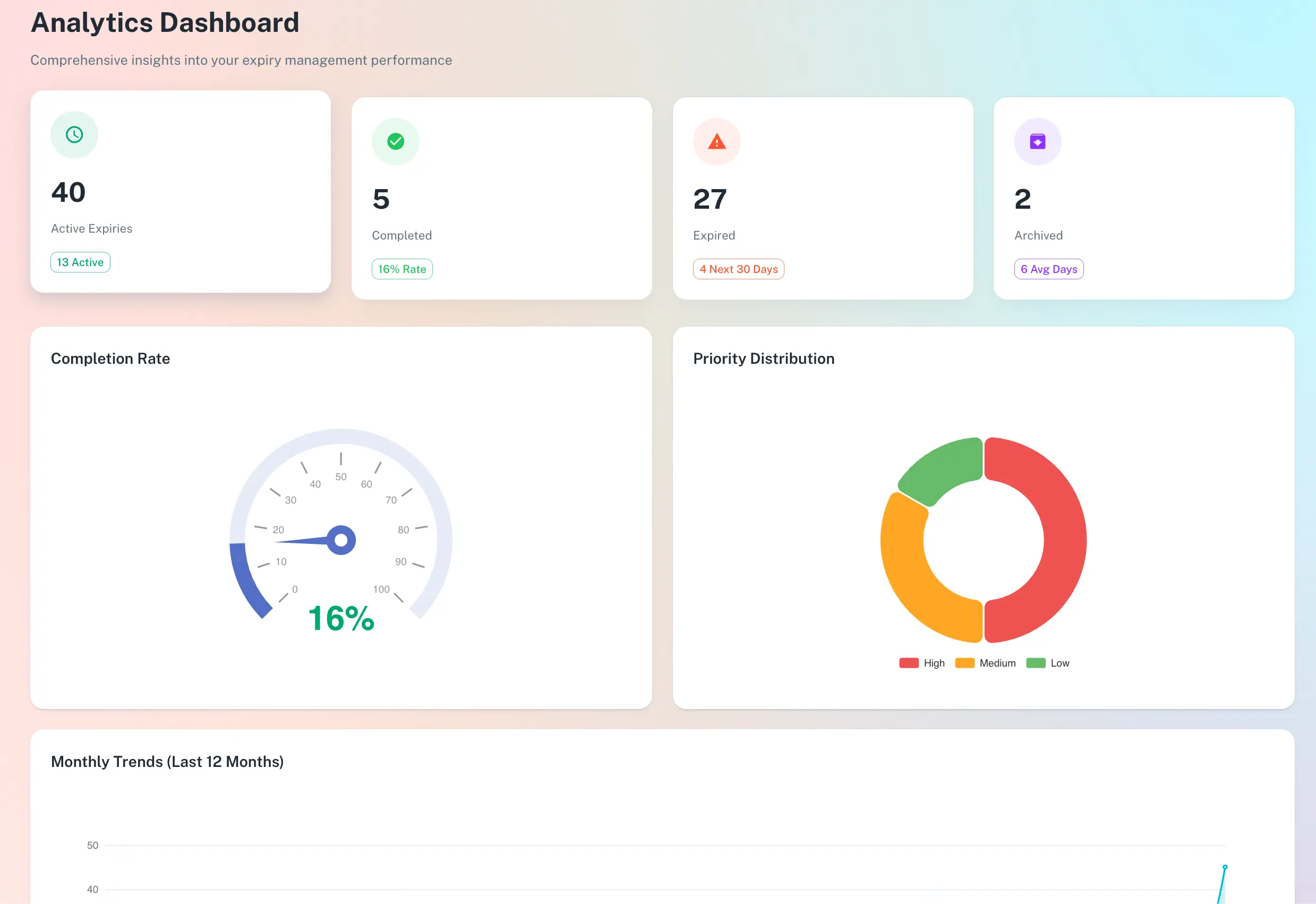
The whole insurance programme on one dashboard
Insurer, owner, premium, cover limit and renewal date on every row. Filter by what renews this quarter, by entity, or by the person responsible - then export the lot to CSV, PDF or XLSX for the board or the broker.
Filter by quarter, entity or owner
Total annual premium at a glance
Export to CSV, PDF or XLSX
Who ends up owning this
Finance director
Signs off the insurance spend. Wants the renewal calendar and the premium history ninety days out, not a renewal invoice in week one of the new term.
Operations or office manager
Holds the broker relationship and fields every request for a certificate. Needs the current document findable in seconds, from a phone, on a Friday afternoon.
Risk or compliance manager
Runs a multi-policy programme - D&O, cyber, property, motor - across several entities, and has to show the board what is covered and what is not.
Owner-director of an SME
No risk function, no insurance manager, no cover for a mistake. Wants one place where renewal dates live so an employers' liability lapse cannot happen by accident.
Where a spreadsheet, a calendar and a broker email each stop
| ExpiryEdge | Spreadsheet | Broker renewal email | Calendar reminder | |
|---|---|---|---|---|
| Staged reminders before the renewal date | Sometimes | One ping | ||
| Goes to the policy owner, not one inbox | ||||
| Escalates when nobody acts | ||||
| Premium and cover-limit history | Manual | |||
| Certificate stored on the record | In the thread | |||
| Every entity in one renewal calendar | Manual | Partial | ||
| Survives the owner leaving | Partial | |||
| Export for the board or an auditor | Manual |
That depends on how the policy is written, and it is the reason lead time matters. An occurrence policy responds to incidents that happened during the policy period even if the claim arrives later. A claims-made policy - professional indemnity, D&O, cyber - generally only responds if cover is live on the day the claim is made against you, so a gap between terms can leave you exposed for work you did while you were insured. ExpiryEdge cannot tell you which basis your policy is written on. It will tell you, 90 days out, which policies are coming up for renewal, so the question never has to be answered after the fact.
Any policy with a renewal date. In practice that means employers' liability and workers' compensation, general and public liability, professional indemnity, product and completed-operations liability, commercial property and contents, fleet and motor, cyber and data breach, management liability (D&O), business interruption, trade credit, and surety or performance bonds. If it has a term and a renewal date, it belongs on the dashboard.
You assign an owner per policy and set the cadence per policy. The default is 90, 60, 30 and 14 days, which gives room to go to market on the big lines; a straightforward roll-over usually only needs 30 and 7. Reminders go out on email, SMS, WhatsApp, Slack or Microsoft Teams, you can copy additional recipients at any stage, and an unactioned reminder escalates to a director.
Our own policies. This page is about the cover your business buys and has to keep in force. Collecting, chasing and verifying certificates of insurance from vendors, subcontractors and tenants is a different job with different failure modes - expired subcontractor cover, wrong additional-insured wording, a certificate that does not match the policy behind it - and it has its own product area, certificate of insurance tracking. Plenty of customers run both sides.
Every policy record holds the schedule, the certificate and any endorsements, so you send the current document rather than the one you can find. Alongside that, ExpiryEdge logs every reminder sent, every renewal logged and every document uploaded, with a name and a timestamp. Export the record set as CSV, PDF or XLSX and you have both the cover and the evidence that it was managed.
Yes. Policies are grouped by legal entity, subsidiary or site. Each entity has its own renewal calendar for whoever runs it, and a group-level view rolls all of them up - useful when a holding company has to answer for cover it does not directly buy. Filters work across both views by insurer, owner, renewal quarter or entity.
No. ExpiryEdge is not a broker and does not sell insurance. It tracks the policies you already hold and tells the right person, with time to spare, when one is coming up. What you do with that lead time - go to market, brief your broker, raise a limit, drop a line of cover - stays your decision and your broker’s advice.
Yes. Send a document collection link. The broker opens it, uploads the certificate and schedule, fills in the policy details you asked for, and signs if that is part of your process - no account, no login. ExpiryEdge follows up automatically until the document comes back, and if what arrives is wrong or incomplete you reject it with a comment and only that item is resubmitted.
Most teams are live in under 10 minutes with their first few policies: insurer, renewal date, premium, cover limit, owner, reminder cadence, certificate uploaded. A full programme of thirty or forty policies across several entities is usually a single afternoon, and a CSV import handles the bulk of it. The 14-day trial is full-access and does not need a card.
Put every renewal date somewhere other than your head
Free 14-day trial. No credit card. Most teams have their first policies loaded in under 10 minutes.