
Why Lease Renewal Notices Have Legal Deadlines

Why Lease Renewal Notices Have Legal Deadlines

Lease renewal notice deadlines exist because they convert an open-ended landlord-tenant relationship into a predictable, enforceable window that protects both sides. Without a fixed deadline, a tenant could claim renewal rights indefinitely, and a landlord could never safely re-let a space. Courts enforce these windows because they reflect a core contract principle: a renewal option is only as good as the mechanics that trigger it.
- “Time is of the essence” clauses appear in most commercial leases and make a missed deadline a material breach, not a technicality. Courts routinely uphold them without equitable relief.
- Statutory floors in many U.S. states set minimum notice periods regardless of what the lease says, protecting tenants from waiving rights they cannot legally surrender.
- Operational reality: platforms like Expiryedge exist precisely because missed renewal windows are among the most preventable, and most costly, errors in property management.
The practical verdict: calendar the deadline the day you sign the lease, serve notice by the method the lease specifies, and keep proof.
Key Takeaways
Lease renewal notice deadlines are legally enforceable because they convert informal expectations into binding contract mechanics, and missing one typically forfeits the option with limited judicial remedy.
| Point | Details |
|---|---|
| Deadlines are legally binding | “Time is of the essence” clauses make a missed day a material breach in most commercial leases. |
| Commercial windows are long | Commercial leases typically require 60–180 days’ notice; some long-term leases require up to one year. |
| Wrong method voids the notice | Delivering by email when the lease requires certified mail can invalidate an otherwise timely notice. |
| Amendments shift deadlines | Any lease amendment that changes the commencement date recalculates every downstream renewal window. |
| Expiryedge automates prevention | Expiryedge maps lease dates to multi-channel alerts and audit trails, reducing missed deadlines across portfolios. |
What a lease renewal notice is and how it works
A lease renewal notice is a formal written communication stating that one party intends to extend the lease term under specified conditions. It is not a casual email or a verbal agreement. The notice references the existing lease, identifies the clause being exercised, and states the proposed new term.
Two distinct documents often get confused here:
- An option-to-renew exercise is the tenant’s unilateral right, already written into the lease, to extend the term by giving timely notice. The landlord has no discretion once the option is properly exercised.
- A renewal offer is a negotiated proposal, typically from the landlord, inviting the tenant to continue on new or modified terms. The tenant can accept, counter, or walk away.
Most residential leases use the renewal-offer model. Most commercial leases with long-term tenants include a formal option clause. The lease itself usually specifies the exercise window, the required delivery method, and any enclosures (such as a signed amendment or a statement of no defaults).
Example phrasing a tenant can adapt:
“Pursuant to Section [X] of the Lease Agreement dated [date] between [Landlord] and [Tenant] for the premises at [address], Tenant hereby exercises its option to renew the lease for an additional [term] commencing [date], on the terms set forth in said Section [X].”
This is illustrative only, not legal advice. Your lease’s specific language controls.
Who decides the deadline: lease, statute, or local rules?
The short answer: the lease usually controls, but state and local law set the floor. Here is how the hierarchy works in practice:
- Lease terms are the first source. If your lease says notice must be given 90 days before expiration by certified mail, that is your deadline.
- State landlord-tenant statutes override lease terms when they impose mandatory minimums. A lease cannot strip a tenant of statutory protections, even if both parties signed it.
- Municipal rent-board rules add another layer in cities with rent stabilization or rent control. New York City’s NYC Rent Guidelines Board rules, for example, impose specific notice windows for rent-stabilized tenants that supersede standard lease language.
When conflicts arise, mandatory statutes win over contract terms. A landlord cannot contract away a tenant’s statutory right to 90 days’ notice by writing a 30-day clause into the lease. The reverse is also true: a lease can give a tenant more protection than the statute requires, but not less.
One practical complication: amendments. A lease amendment that changes the commencement date or adds an extension period can shift every downstream deadline. Always re-read notice windows after any amendment is signed.
Common U.S. timelines and what they look like in practice
Residential and commercial leases operate in different worlds when it comes to notice periods.
| Attribute | Residential | Commercial |
|---|---|---|
| Typical notice window | 30–60 days (month-to-month); 60–90 days (fixed-term) | 60–180 days; up to 1 year for long-term leases |
| Common required method | Written notice; certified mail or personal delivery | Certified mail with return receipt; often personal delivery required |
| Stakes of missing deadline | Holdover tenancy, higher rent, loss of renewal rights | Forfeited option, landlord free to re-let, loss of negotiating leverage |
| “Time is of the essence” | Less common in residential | Standard in most commercial leases |
A few important caveats:
- Long-term commercial leases (10+ years) frequently push notice windows to 12 months or more. A tenant in a 15-year retail lease may need to act a full year before expiration to preserve renewal rights.
- Month-to-month residential tenancies often require only 30 days’ notice under state law, but some states require 60 days for tenancies longer than one year.
- Local exceptions matter. California, New York, and New Jersey all have specific statutory requirements that can extend notice periods beyond what a standard lease would require. Always check your state’s landlord-tenant statute.
Missed critical lease dates, including renewal windows, escalation anniversaries, and termination rights, are a leading preventable source of financial loss in commercial leasing. A single overlooked deadline can compound across a portfolio.
The legal reasons behind renewal-notice deadlines
Deadlines allocate risk. They convert a vague expectation into an enforceable contract term, and that conversion serves several distinct policy goals.
- Security of tenure: Tenants who have invested in a location, built a customer base, or signed long-term employment leases need to know they can stay. A fixed notice window gives them a defined window to act before that right expires.
- Landlord planning certainty: A landlord cannot market a space to new tenants, negotiate financing, or plan renovations without knowing whether the current tenant will stay. A deadline forces the tenant to commit.
- Preventing leverage gaming: Without a deadline, a sophisticated tenant could delay exercising an option until market conditions favor them, or a landlord could create ambiguity to extract concessions. Deadlines eliminate that gray zone.
- Administrability: Courts need a clear rule to apply. “Reasonable time” is litigated endlessly; a specific date is not.
The “time is of the essence” doctrine is the legal mechanism courts use to enforce these goals. In commercial contexts, courts apply it strictly. Missing the window by one day can be treated as a material breach, and equitable relief is discretionary, rare, and fact-specific. The doctrine reflects a deliberate policy choice: certainty over flexibility.
What happens when you miss the deadline
Missing a renewal deadline commonly forfeits the option entirely. The consequences stack quickly:
- Forfeited renewal option: The tenant loses the contractual right to extend. The landlord is free to re-let the space at market rate.
- Holdover exposure: If the tenant stays past expiration without a new agreement, most leases convert the tenancy to a holdover, often at 125–150% of the prior rent.
- Loss of negotiating leverage: A tenant without a valid option is negotiating from scratch, usually at a disadvantage in a tight market.
- Possible litigation with limited relief: Courts generally require strict compliance with renewal-option timing. Equitable relief from forfeiture may be available when the delay was inadvertent and the landlord suffered no prejudice, but that relief is discretionary and far from guaranteed.
- Compounded portfolio risk: For property managers with multiple leases, one missed window can trigger a cascade of renegotiations at unfavorable terms.
When a lease includes a “time is of the essence” clause, missing the deadline by even one day can be treated as a material breach. Courts rarely rescue tenants in that situation unless exceptional circumstances apply.
Pro Tip: If you suspect you have missed a deadline, do not wait. Contact the landlord in writing immediately, propose interim arrangements, and consult a real estate attorney before the lease expires. Silence makes the situation worse.
What a compliant renewal notice must include
Tenants bear responsibility for delivering notice exactly as the lease requires. A notice sent to the wrong address, by the wrong method, or missing a required enclosure can be invalidated even if it arrives on time.
Required elements checklist:
- Full legal names of all parties (landlord and tenant as named in the lease)
- Property address and lease reference (date of original lease, section number of the renewal clause)
- Clear statement that the option is being exercised or the renewal is being accepted
- Proposed new term (start date and end date)
- Any required enclosures (signed amendment, certificate of no defaults, updated insurance certificate)
- Signature of the authorized party and date
Acceptable service methods (check your lease):
- Certified mail with return receipt requested
- Personal delivery with written acknowledgment
- Registered mail
- Email or electronic delivery, only where the lease expressly permits it
Keep copies of everything: the notice itself, the tracking number, the signed return receipt, and any email delivery confirmation. If the lease allows multiple delivery methods, use two of them.
Short sample snippet:
“Tenant hereby exercises the renewal option under Section 12 of the Lease dated March 1, 2022, for a two-year term commencing March 1, 2025.”
That is the minimum. Your lease may require more.
Exceptions and special situations that change how deadlines work
Some narrow exceptions exist, but they are fact-sensitive and rarely guaranteed. Do not plan around them.
- Equitable relief from forfeiture: A court may excuse a missed deadline when the delay was inadvertent, the landlord was not prejudiced, and the tenant acted promptly upon discovery. This is discretionary and uncommon.
- Landlord waiver or estoppel: If a landlord accepted a late notice in prior renewal cycles without objection, a court might find the landlord waived strict compliance. This requires a consistent pattern, not a single instance.
- Lease amendments that reset windows: An amendment extending the lease term or changing the commencement date often shifts the renewal notice window. Many tenants miss this. Re-read the amendment carefully.
- Automatic renewal clauses: Some leases renew automatically unless one party gives notice of non-renewal. These flip the default and require the departing party to act, not the staying party.
- Force majeure: Expressly applicable only when the lease includes a force majeure clause covering notice obligations, which is uncommon. A pandemic or natural disaster does not automatically excuse a missed deadline unless the clause says so.
- Rights of first refusal and expansion options: These often carry separate, shorter notice windows that run independently of the main renewal clause. Missing one does not affect the other, but both need to be tracked.
Practical steps for tenants and landlords after receiving or missing a notice
Act immediately. Preserving proof and calendaring deadlines is the first move for both sides.
Tenant actions:
- Read the notice carefully and confirm it references the correct lease clause and term.
- Calendar the response deadline and set two reminders (30 days out and 7 days out).
- Verify the required response method in the lease and prepare a compliant written response.
- Deliver by certified mail and keep the tracking number and return receipt.
- If the deadline has passed, contact the landlord in writing the same day and consult a real estate attorney before the lease expires.
Landlord actions:
- Confirm the notice was delivered by the method and to the address specified in the lease.
- Calendar the tenant’s response window and note the date after which the option lapses.
- If no response arrives, send a written reminder before the window closes (this is a courtesy, not a legal obligation, but it reduces disputes).
- If the window lapses without a valid notice, document the lapse in writing and consult counsel before re-letting the space.
- Review any amendments to confirm downstream dates have not shifted.
The practical checklist guidance from lease practitioners consistently points to two reminders and backup proof of service as the minimum standard for avoiding disputes.
How to avoid missing renewal deadlines operationally
The single most effective prevention is a centralized source of truth for all lease dates, enforced by multi-step alerts that fire well before the window opens.
Operational best practices:
- Centralized lease calendar: Every lease date, including renewal windows, escalation anniversaries, and termination rights, lives in one system, not a spreadsheet per property.
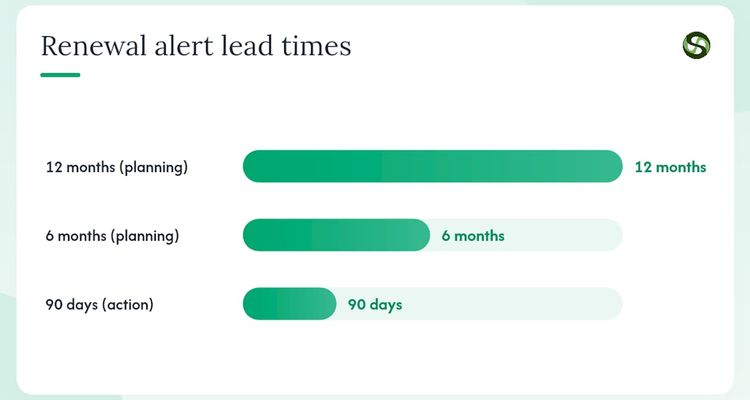
- Dual reminders: Set alerts at 12 months, 6 months, and 90 days before each critical date. The 90-day alert is the action trigger; the earlier ones are planning signals.
- Proof-of-service SOP: Document the delivery method, tracking number, and receipt for every notice sent. Store it with the lease file.
- Amendment audit policy: Every time a lease is amended, re-run the date calculation. Commencement-date changes shift renewal windows. Missing this step is one of the most common sources of downstream errors.
- Cross-team ownership: Assign a named owner for each lease’s critical dates. Shared responsibility is no responsibility.
For property managers handling multiple leases, centralized expiry tracking removes the single-point-of-failure risk that comes with manual calendaring. Platforms like Expiryedge map each lease’s renewal window to automated multi-channel alerts, create audit trails for every notice sent, and flag when amendments shift downstream dates. That is the operational equivalent of the legal checklist above, running automatically.
Pro Tip: If a renewal deadline is within 30 days and you have not yet served notice, stop what you are doing and treat it as an emergency. Draft the notice today, confirm the delivery method with the lease in hand, and send it by certified mail before close of business. Document everything.
For teams managing contracts and renewals at scale, automated renewal alerts reduce the risk of human error that manual tracking cannot eliminate. Aligning lease renewal timing with your insurance renewal cycles is also worth reviewing, particularly for portfolio landlords managing multiple properties and insurance renewal obligations simultaneously.
Deadlines are a legal necessity, not an administrative formality
Most people treat a missed lease deadline as a paperwork problem. It is not. It is a legal event with consequences that can include losing a location, paying holdover rent, or litigating for equitable relief with uncertain odds.

The legal framework behind renewal-notice deadlines is deliberate. Legislatures and courts designed these rules to force both parties to commit, to plan, and to act before the relationship drifts into ambiguity. The “time is of the essence” doctrine is not a technicality courts invented to punish careless tenants. It is the mechanism that makes a renewal option worth having in the first place.
What I find underappreciated is how often the problem is not ignorance of the deadline but a failure of operational infrastructure. A landlord with 40 leases managed in a spreadsheet is not going to catch every 90-day window. A tenant whose lease is filed in a drawer is not going to remember the certified-mail requirement. The legal risk is real, but the root cause is almost always a process gap, not bad faith.
Prevention is not complicated. It requires a single source of truth, a multi-step alert system, and a proof-of-service habit. The legal consequences of skipping those steps are disproportionate to the effort of building them.
Never miss a lease deadline again with Expiryedge
Missed renewal windows cost landlords and tenants real money, and the margin for error is measured in days, not weeks. Expiryedge gives property managers and legal teams a centralized deadline-tracking platform that maps every lease’s renewal window to automated multi-channel alerts, fires reminders at 12 months, 6 months, and 90 days out, and creates a full audit trail for every notice sent and received.

Where a spreadsheet fails silently, Expiryedge escalates. When an amendment shifts a commencement date, the platform recalculates downstream windows automatically. Every notice delivery is logged, timestamped, and stored, so proof of service is never a question. For operations, legal, and property management teams tracking multiple leases, that is the difference between a controlled process and a preventable loss.
This article is general information, not legal advice. Confirm current rules with a qualified real estate attorney or your state’s landlord-tenant authority.
Start tracking your lease deadlines with Expiryedge today.
Sources
- Lease Renewal Options: Types, Requirements, and Deadlines - LegalClarity
- What Happens If You Miss Your Lease Renewal? - Weilers LLP
- Lease Notices and Renewals: A Practical Deadline Checklist for Tenants - Liberty Law APC
- Critical Lease Dates: The Deadlines That Cost Landlords Millions When Missed | LeasePilot Blog | LeasePilot
- Reoptimizer
- What Is a Renewal Notice? A Renter’s Guide to Lease Renewals
This article is general information, not a substitute for advice from a qualified lawyer. Consult a qualified legal professional about your own circumstances before acting on anything here.
FAQ
What is a lease renewal notice?
A lease renewal notice is a formal written letter that references the existing lease and states one party’s intent to extend the term under specified conditions. Effective notices cite the specific lease clause being exercised and comply with the delivery method the lease requires.
How much notice does a landlord have to give if not renewing a lease in New York?
In New York, notice requirements depend on tenancy type and length. For rent-stabilized tenants, the NYC Rent Guidelines Board rules impose specific windows; for unregulated tenancies, state law generally requires 30–90 days depending on how long the tenant has lived there.
What happens if you don’t respond to a lease renewal notice?
Failing to respond within the required window typically means the renewal option lapses. The tenant may be treated as a holdover, often at a higher rent rate, and the landlord becomes free to re-let the space or negotiate new terms without the prior option constraining them.
How soon can a landlord require a tenant to renew a lease?
The lease controls. Commercial leases commonly require tenants to exercise renewal options 60–180 days before expiration; some long-term leases set that window at a full year. Residential leases typically require 30–60 days, though state law sets the minimum floor.
Can you get relief if you miss a lease renewal deadline?
Courts may grant equitable relief in narrow, fact-specific cases, typically when the delay was inadvertent and the landlord suffered no prejudice. Relief is discretionary and not guaranteed, particularly in leases with “time is of the essence” clauses, where courts apply strict compliance standards.
Recommended
Frequently asked questions
In New York, notice requirements depend on tenancy type and length. For rent-stabilized tenants, the NYC Rent Guidelines Board rules impose specific windows; for unregulated tenancies, state law generally requires 30–90 days depending on how long the tenant has lived there.
Failing to respond within the required window typically means the renewal option lapses. The tenant may be treated as a holdover, often at a higher rent rate, and the landlord becomes free to re-let the space or negotiate new terms without the prior option constraining them.
The lease controls. Commercial leases commonly require tenants to exercise renewal options 60–180 days before expiration; some long-term leases set that window at a full year. Residential leases typically require 30–60 days, though state law sets the minimum floor.
Courts may grant equitable relief in narrow, fact-specific cases, typically when the delay was inadvertent and the landlord suffered no prejudice. Relief is discretionary and not guaranteed, particularly in leases with "time is of the essence" clauses, where courts apply strict compliance standards.
Not legal advice
This article is for general informational purposes and does not constitute legal advice. Laws, regulations and contract requirements vary by jurisdiction and change over time. Consult a qualified attorney in your jurisdiction before making decisions that depend on the specific legal interpretation discussed here.