
The 7 Best Pharmacist License and CPE Tracking Tools in 2027, Ranked for Pharmacies With Techs and Immunizers

A pharmacy has two layers of credentials: the people's and the store's. Each pharmacist's licence, each technician's registration and PTCB certificate, the immunizers' CPR cards, then the pharmacy permit and DEA registration on the wall. ExpiryEdge is the best way for an owner or pharmacist-in-charge to hold both layers in one place and text each person before theirs runs out. NABP CPE Monitor stays the home for each pharmacist's CPE credits, and its Standard level costs nothing.
The others fit narrower jobs. CE Broker matters if you're in a state such as Florida whose board takes CE reports through it. Certemy suits multi-state groups that want primary source verification. PAAS Vault is a cheap add-on for PAAS compliance members, Expiration Reminder is a close general-purpose rival, and D2's ComplySuite is built for larger pharmacy organisations licensed in many states.
So you know where we stand: We make ExpiryEdge, and it's ranked first below. For the six other tools we used only their own product pages, help articles and price lists, checked on 7 November 2026, and we've linked each one.
| Tool | Whole-team view | Counts CPE hours | Verifies with the board | Published pricing |
|---|---|---|---|---|
| ExpiryEdge Our product | Yes, any dated item | Hours as custom fields | No | $29 to $199 a month |
| NABP CPE Monitor | No, one pharmacist each | Yes, ACPE credits load automatically | No | Standard free; Plus $15 a year |
| CE Broker | Employer product for teams of 150+ | Yes, by state | Reports CE to partner boards such as Florida | Employer pricing on request |
| Certemy | Yes | Not stated | Yes, primary source verification | From $3 per user a month |
| PAAS Vault | Yes, pharmacy records | No | No | $99 a year after first year (PAAS members) |
| Expiration Reminder | Yes | Not stated | No | $49 to $399 a month |
| D2 ComplySuite | Yes, every location and role | Not stated | Not stated | Not published |
How we compared these tools
A PIC needs to know two things before the shift: is everyone on the bench licensed, and are the store's own registrations current? So we compared on a whole-team view, CPE hour counting, verification with the board, and a public price. On 7 November 2026 we read each vendor's own product, pricing and help pages, and checked the rules against eCFR for the DEA, PTCB's recertification policy, Florida's board and the GPhC. We didn't run paid trials of these tools. ExpiryEdge is our product, so challenge our ranking with your own staff list.
Who's allowed on the bench today, and is the store still registered?
Every role in a pharmacy carries its own clock. Your pharmacists hold state licences, your technicians hold registrations and PTCB certificates, and anyone who gives vaccines needs immunization training plus a current CPR card. Above them sit the store's DEA registration and state pharmacy permit. When a person's credential lapses, they come off the bench. When the store's lapses, the whole dispensary stops handling controlled substances.
The store's DEA date is fixed in federal rules. Under 21 CFR 1301.13, a retail pharmacy's registration runs 36 months after its first period, and you can apply to renew no more than 60 days before it expires. Put a reminder at 90 days so the paperwork is ready when the window opens.
Technicians run on PTCB's cycle. Its recertification policy says a CPhT stays active for about two years and needs at least 20 hours of CE, including one hour of pharmacy law and one of patient safety. Applications are due by the first day of the expiry month.
Pharmacists answer to their state board, and some boards use outside systems. Florida's pharmacist renewal page asks for 30 hours each cycle (including 2 on controlled substances and 2 on medication errors), says current licences expire on 30 September 2027, and tells pharmacists to report CE through CE Broker.
In Great Britain, revalidation is a yearly job. The GPhC asks pharmacists and pharmacy technicians to renew every year, and its revalidation page sets out what each registrant records: four CPD entries, one peer discussion and one reflective account. We didn't find a tracker that connects to the GPhC register, so the superintendent usually owns the date and the evidence.
- State pharmacist licence or technician registration, with its renewal date
- PTCB or other technician certificate and its CE cycle
- CPE hours against the current renewal cycle, including required topics
- Immunisation training and the CPR or BLS card that goes with it
- GPhC registration renewal and revalidation records (UK)
- The pharmacy's own DEA registration and state pharmacy permit
1. ExpiryEdge: best for an owner or PIC tracking people and premises together
ExpiryEdge gives each pharmacist and technician a record with every credential they hold: state licence, PTCB certificate, CPR card, immuniser training and anything else with a date. Custom fields hold licence numbers, states and CPE hours logged. The pharmacy's own DEA registration and state permit go in the same dashboard, filtered by category or store.
Reminders run on steps you pick (90, 60, 30 and 7 days works for most). The technician or pharmacist who must renew gets them by SMS, WhatsApp or email, and the PIC sees a copy in Slack or Teams. Miss the date with nothing uploaded and the item moves up to the owner or district manager.
The renewal itself comes back through a link that needs no account. A tech opens it on her phone, uploads the licence printout or new CPR card, and ExpiryEdge pulls the expiry date out of the file. You accept or reject each field; a rejection sends her back to the same link to fix just that one. For a five-store group, the whole audit trail exports in one go when the board inspector asks.
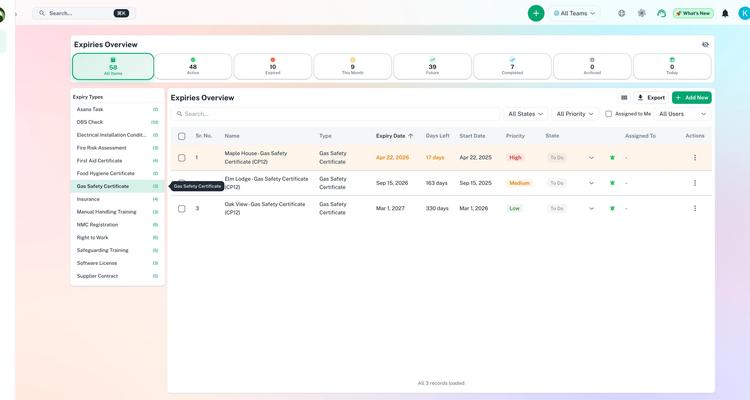
Pricing: pick from four tiers at $29, $49, $99 or $199 a month, sized by users and records. The trial runs 14 days and skips the credit card.
Watch out for: ExpiryEdge doesn't check licences against state boards, NABP or the GPhC register, and it doesn't report CPE to anyone. Someone still looks up the board site, and each pharmacist still reports their own CE.
Try it with your own pharmacy team in 15 minutes:
- Import a CSV of pharmacists, technicians and immunizers with custom fields for licence number, PTCB expiry, CPR expiry and CPE hours, plus one record each for the store's DEA registration and pharmacy permit.
- Give the DEA record a 90/60/30-day schedule that escalates to the owner, and give CPR cards a 60/30/7-day SMS to each immunizer.
- Send your technicians one no-login request link to upload their current PTCB certificates.
Item and user limits for each plan are on the pricing page.
2. NABP CPE Monitor: best home for each pharmacist's CPE credits
CPE Monitor is NABP's CPE tracker. Credits from more than 325 ACPE-accredited providers load to the pharmacist's dashboard on their own. The Plus tier adds uploads of non-ACPE credits and state-specific transcripts across licences. It's also in the NABP app for iOS and Android.
Pricing: the Standard plan is free, and NABP's page prices Plus at $15 a year whatever number of licences you hold.
Watch out for: CPE Monitor is built around one pharmacist's own account. The page doesn't mention an employer view, so a PIC still needs somewhere to see who's behind across the team.
3. CE Broker: best where your board takes CE through it
For a Florida pharmacy, CE Broker isn't optional. The board tells pharmacists and consultant pharmacists to report CE through it instead of mailing certificates. Course providers feed it too: TRC Healthcare's CE Broker reporting page says it passes Florida pharmacist and technician completions to CE Broker on its own, usually in 24 to 48 hours, and lists Michigan and New Hampshire as coming soon.
There's an employer product as well. CE Broker's business page describes CE Broker Learning, which helps staff track CE for renewal, and EverCheck, which verifies and monitors licences daily. Teams of 150 or more are sent to tailored options.
Pricing: you'll need a sales call for employer pricing.
Watch out for: the employer page is written for big healthcare employers. A six-person independent will mostly touch CE Broker through each pharmacist's personal account, which leaves the PIC without a team view.
4. Certemy: best for multi-state groups that need verification
If you run stores in several states, the question isn't just "when does it expire?" but "is it actually active?" Certemy Track puts employee and facility credentials and their status on one dashboard, and checks occupational licences at the primary source automatically. Its pharmacy article mentions alerts ahead of renewals and expirations and a view across the whole workforce. It lists HRIS and single sign-on connections.
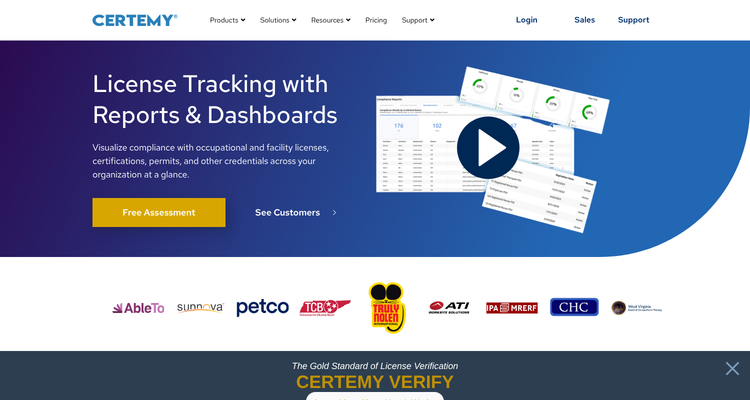
Pricing: per user, per month, on Certemy's pricing page: $3 for Standard Track and $6 for Enterprise Track and Manage, with each verification at $1. A second, unlabelled set of figures 20% lower looks like the yearly rate.
Watch out for: we didn't see CPE hour tracking, or a way for a technician to upload her own renewed certificate, on the pages we read. Ask about both.
5. PAAS Vault: best add-on for PAAS compliance members
PAAS National sells compliance programmes to community pharmacies, and the PAAS Vault is its electronic lockbox. It stores licences, certifications, business associate agreements, insurance policies and compliance forms, and emails you and your team before and at expiry.
Pricing: the Buy Now page says Vault licence tracking is free for the first year with the FWA/HIPAA programme ($648 a year), then $99 a year.
Watch out for: the pages don't say whether staff can upload their own renewals or whether reminders go by text. It's an add-on to PAAS membership, not a standalone product.
6. Expiration Reminder: best general-purpose alternative
A technician's PTCB date is just another expiring item to Expiration Reminder, which isn't pharmacy-specific. You get unlimited text reminders and as many admin users as you like on any plan, and staff have a self-service portal. Stores on BambooHR can use the BambooHR integration to sync staff records and remind employees to renew training, credentials and licences.
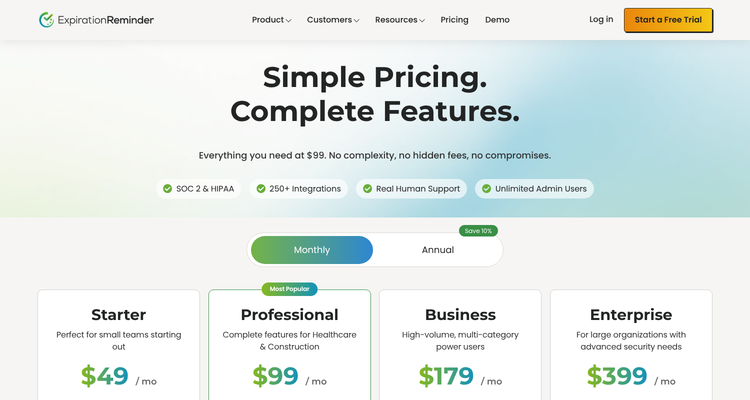
Pricing: $49 a month buys Starter with 150 items; Professional ($99) holds 600, Business ($179) 1,500 and Enterprise ($399) 2,500. Yearly billing is cheaper, and the 14-day free trial needs no credit card.
Watch out for: e-signatures are a paid add-on from $29 a month.
7. D2 ComplySuite: best for larger multi-state pharmacy organisations
D2 Solutions built ComplySuite for pharmacy organisations. Its LicenseComply module gives live status monitoring of licences, renewal dates and key documents "across every location and role", and sits beside modules for accreditation (AccredComply) and regulatory alerts (RegComply).

Pricing: not published; D2 describes modular contracts and asks you to book a demo.
Watch out for: it's sized for organisations with many licensed sites, such as mail-order, specialty or non-resident pharmacies. A single store will find it more than it needs.
ExpiryEdge as an alternative to CE Broker and CPE Monitor
CPE Monitor and CE Broker both look after one pharmacist's credits. Keep them for that. What neither shows is the store: whether Saturday's technician is still registered, whether the immunizer's CPR card covers next week's flu clinic, and whether the DEA renewal window has opened.
That's the view owners move to ExpiryEdge for. People and premises sit on one dashboard. Reminders reach each person by text or WhatsApp, and a no-login link brings back the new card or certificate. CPE hours go in a custom field, with a reminder set well before each reporting deadline.
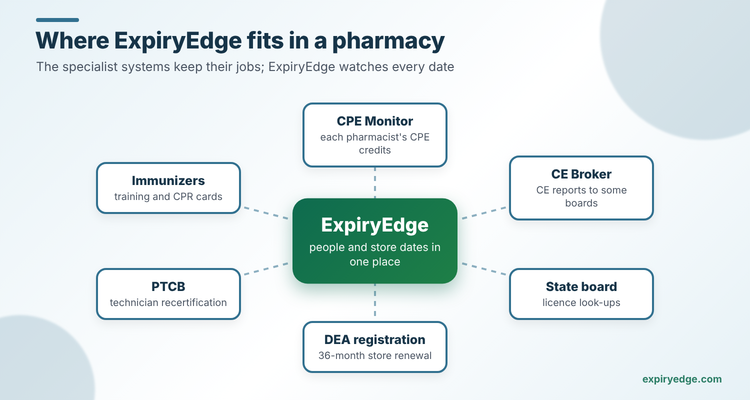
Don't switch if you need licence status verified by the board or CE reported for you. Certemy and CE Broker do those jobs, and ExpiryEdge doesn't.
Count people, then add the store
Put each pharmacist and technician on a list with every credential and its expiry date, then add the store's DEA registration and pharmacy permit. Four pharmacists and six technicians with three credentials each is 30 dates, before you add the store's own. A UK pharmacy adds each registrant's GPhC renewal and revalidation entries.
Then decide what you need beyond dates. With stores in several states and a need for verified status, trial Certemy. If you're already a PAAS member, the Vault is the cheapest step. If you just need every date chased with proof on file, trial ExpiryEdge and Expiration Reminder with your own list.
Our guide to how long a DEA licence lasts covers the DEA cycle, and the staff certification tracking page shows the set-up. For the full picture, see our software for pharmacy compliance guide and the comparison of pharmacy compliance software. Pharmacy-specific set-ups are on the pharmacies page.
Frequently asked questions
Most US pharmacists use NABP CPE Monitor, which loads credits from ACPE-accredited providers on its own. The Standard plan is free and Plus is $15 a year. In Florida, pharmacists also report CE through CE Broker, as the board's renewal page says.
Yes. NABP's Standard CPE Monitor plan costs nothing. The Plus plan is $15 a year and adds uploads of non-ACPE credits, state-specific transcripts and topic changes. Neither tier gives an employer a view of the whole team's CPE, so owners usually track renewal dates separately.
Under 21 CFR 1301.13, a retail pharmacy's DEA registration runs 36 months after its first period. You can apply to renew no more than 60 days before it expires, so set a reminder at 90 days and another at 60 to have everything ready.
PTCB says a CPhT certificate stays active for about two years. Technicians need at least 20 hours of CE in the cycle, including one hour of pharmacy law and one hour of patient safety, and should apply by the first day of their expiry month.
The GPhC asks pharmacists and pharmacy technicians to record four CPD entries, one peer discussion and one reflective account every year, then make declarations and pay a fee to renew. A tracker such as ExpiryEdge can remind each registrant before their renewal date.
On their published pages, ExpiryEdge runs $29 to $199 a month, Expiration Reminder $49 to $399 a month and Certemy from $3 per user a month plus $1 per verification. PAAS Vault is $99 a year after its first year. CE Broker employer pricing and D2 ComplySuite are quoted on request.