
Make Data Retention Deadlines Enforceable for Compliance Teams

Make Data Retention Deadlines Enforceable for Compliance Teams

A data retention deadline is the date by which a specific category of records must be destroyed, anonymized, or migrated to archive, based on when a legal, tax, or operational clock starts ticking. Baseline windows cluster around 1, 3, 6, and 7 years, with some records held permanently. Legal holds override every one of these deadlines, and any retention policy worth defending needs a written justification for each period.
TL;DR:
Retention deadlines typically range from one to seven years, but legal holds suspend these periods until the hold is lifted or the litigation is resolved.
Specific minimum retention periods include seven years for financial records and six years for protected health information, with variation depending on jurisdiction and record type.
Building a documented retention schedule involves detailed data categories, trigger events, legal justifications, disposal methods, and review dates to ensure compliance.
Automated enforcement, including alerting and hold management, is essential for meeting deadlines and avoiding violations during scale operations.
Shorter, justified retention periods reduce breach and discovery risks, especially when policies are actively enforced and integrated into daily workflows.
ExpiryEdge helps compliance teams monitor time-sensitive obligations with alerts, reminders, escalations, and centralized deadline tracking.
What Are the Common Data Retention Deadlines by Record Type?
Retention periods vary by record category, and the number you should plan around depends on which regulator or business need is driving it. The table below covers the categories that trip up most compliance teams, along with the legal basis behind each figure.
| Record Type | Typical Minimum Retention | Legal/Operational Basis |
|---|---|---|
| Financial and tax records | 7 years | IRS recordkeeping guidance |
| Protected health information (PHI) policies | 6 years minimum | HIPAA baseline, per Harvard Medical School guidance |
| Employee exposure/OSHA records | Duration of employment plus an extended period typical for workplace safety compliance | Federal workplace safety recordkeeping rules |
| Signed contracts | Contract term plus 7 years typical | Statute of limitations on written contracts, varies by state |
| Security and audit logs | 12 months minimum | SOC 2 baseline practice |
A few of these numbers move depending on where you operate. State general records retention schedules frequently set their own minimums for public-sector and licensed-industry records, and clinical records specifically often follow state medical-records law rather than the HIPAA policy baseline. Research institutions see even more variance. Sponsor-funded projects often carry retention windows of three to seven years depending on the grant terms.
None of these deadlines apply once a legal hold is in place. If a record is relevant to pending litigation, a subpoena, or an active audit, the clock stops regardless of what your schedule says.
How Do You Build and Document a Records Retention Schedule?
A records retention schedule is the document that turns “how long to retain data” from a guess into a defensible policy. Auditors and regulators expect the same core fields no matter the industry, and skipping any one of them is what turns a routine review into a finding.
Every entry on a working schedule should include:
- Data category: what the record actually is (invoice, employee file, server log, signed agreement)
- Trigger event: the date that starts the clock (contract termination, employee separation, transaction date, ticket closure)
- Retention period: the length of time counted from the trigger
- Legal or operational justification: the statute, regulation, or business reason behind that specific number
- Disposal method: secure deletion, physical shredding, or transfer to permanent archive
- Owner: the team or role accountable for enforcing the entry
- Review date: when the entry itself gets re-evaluated
When no statute dictates a period, the safer move is picking the shortest window that still covers your actual business need, then writing down why you chose it. A vendor contract might trigger disposal seven years after termination, while a job applicant’s rejected résumé might trigger disposal after just one year with no further use. Some categories never hit a disposal date at all: cap tables, incorporation documents, and certain intellectual property filings typically move to permanent archive rather than a countdown clock.
What Happens to Deadlines During a Legal Hold?
A legal hold suspends your normal retention schedule the moment litigation, a regulatory investigation, or a credible threat of either becomes reasonably foreseeable. Records that would otherwise be destroyed on schedule get frozen in place until the hold is formally lifted, and destroying them anyway is one of the fastest ways to turn a routine dispute into a spoliation claim.
Operationalizing a hold takes more than a memo to legal. It needs a repeatable process:
- Tag affected records in whatever system stores them, flagging them as exempt from automated deletion.
- Assign a hold owner responsible for tracking scope and lift date.
- Maintain a hold audit trail showing when the hold started, who issued it, and what it covers.
- Notify custodians directly, in writing, rather than relying on a general policy announcement.
Legal holds are the most common operational reason retention schedules get exceptions, and the gap between a documented hold and an informal one is exactly what regulators probe first. A schedule that says “7 years” but has no record of holds ever being applied looks incomplete, even if every deletion was technically correct.
Why Automation Matters for Enforcing Retention Deadlines
Manual retention tracking breaks down at scale. A spreadsheet of “when to delete what” works fine for fifty records and falls apart at five thousand, which is roughly when most organizations start missing deadlines in both directions: keeping data too long and creating breach exposure, or deleting it too early and losing audit evidence.
The technical baseline for enforcement includes retention metadata attached at the point a record is created (category, trigger date, owner), automated lifecycle policies that execute deletion or archival on schedule, immutable deletion logs that can’t be edited after the fact, and role-based access so only authorized staff can alter a retention entry. SOC 2 audits routinely flag organizations that can’t produce at least 12 months of security log retention or can’t prove a deletion actually happened. A destruction log with date, method, and responsible party is the minimum evidence an auditor will accept.
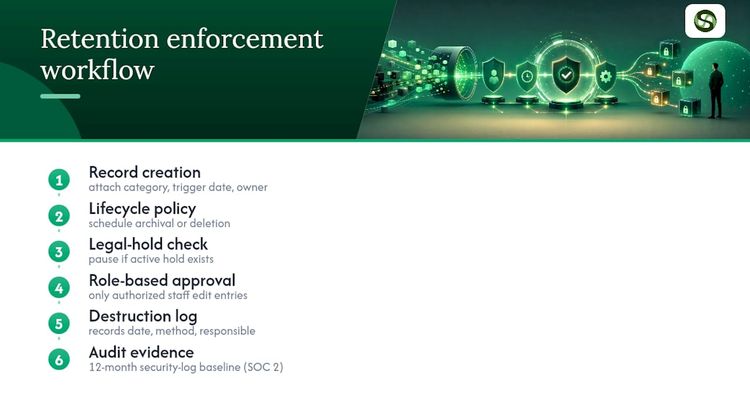
Common implementation patterns include lifecycle rules on cloud storage that auto-transition or delete backups on a schedule, log retention policies tuned to the 12 month SOC 2 baseline, and destruction certificates for decommissioned hardware and physical media. A platform like ExpiryEdge handles the alerting and escalation layer on top of these controls, flagging approaching deadlines and routing sign-off tasks before a deletion date arrives rather than after it’s missed.
Pro Tip: Set your automated alert at least 30 days before a retention deadline, not on the day itself. That gap gives compliance and legal time to check for an active hold before anything gets deleted.
What Should Your Retention Checklist and Review Cadence Look Like?
Retention schedules go stale fast if nobody revisits them. A workable cadence looks like this:
- Immediately: map your top ten data categories, assign an owner to each, and set the trigger event that starts each retention clock.
- Quarterly: spot-check high-risk categories, specifically security logs, PHI, and biometric data, where state laws move faster than most policies get updated.
- Annually: run a full policy review with sign-off from compliance, legal, and IT, confirming every entry still matches current law.
- Out-of-cycle: trigger an immediate review after a data breach, a new state privacy law taking effect, or a regulatory audit finding.
Skipping the quarterly check is the most common failure point. Annual reviews catch big structural problems, but a biometric retention rule that changed six months ago won’t wait for your annual cycle to bite you.
What Are the Penalties for Missing Data Retention Deadlines?
Non-compliance with retention requirements carries two distinct kinds of risk, and most organizations only prepare for one of them. The first is regulatory penalty: failing to produce records an auditor or regulator requires, or holding data past the point state privacy law permits, can trigger fines, consent decrees, or loss of licensure depending on the sector. The second, often bigger risk is litigation exposure from records you should have deleted but didn’t. Data held past its justified purpose becomes discoverable evidence in a lawsuit that otherwise might never have touched it, and it becomes a bigger target in a breach.
Under-retention carries its own penalty. If a regulator or opposing counsel requests records you destroyed before the required window closed, you’re now explaining a gap in your evidence, and “we didn’t have a documented schedule” is rarely a defense that lands well. Courts and regulators generally expect to see a written retention policy, not just a claim that deletion happened for good reasons.
The practical risk sits in the middle: organizations that keep everything indefinitely because deleting feels risky, and organizations that delete aggressively without documentation because storage feels expensive. Both postures fail an audit. The shortest defensible retention period that still satisfies your legal and operational obligations minimizes exposure on both fronts, but only if it’s written down with the reasoning attached.
How Should You Communicate Retention Policies to Employees?
A retention schedule that lives only in a compliance binder doesn’t protect you, because employees are the ones actually creating, storing, and (sometimes) deleting the records it governs. The people closest to the data need to know what applies to them specifically, not the full policy document cover to cover.
Effective communication breaks the policy down by role rather than handing everyone the same document. HR needs to know personnel file rules. Finance needs the tax and invoice windows. IT needs the technical lifecycle settings. A generic all-hands memo about “our data retention policy” tends to get skimmed and forgotten, while a one-page summary tied to someone’s actual job function gets used.
New hire onboarding is the natural entry point, paired with a refresher whenever the schedule changes materially. Make the disposal method and trigger events visible in whatever system employees already use daily rather than a separate policy portal nobody opens voluntarily. When a legal hold goes into effect, direct written notice to named custodians works far better than a broadcast announcement, since it creates the individual accountability an auditor or opposing counsel will look for later. Documenting that notification, not just sending it, closes the loop that most policies leave open.
How Do Cross-Border Data Retention Rules Interact?
Operating in more than one jurisdiction means more than one retention clock running on the same record, and the rules rarely line up neatly. A customer record touching California, the European Union, and a federal tax obligation could theoretically be subject to three different minimum and maximum retention windows simultaneously.
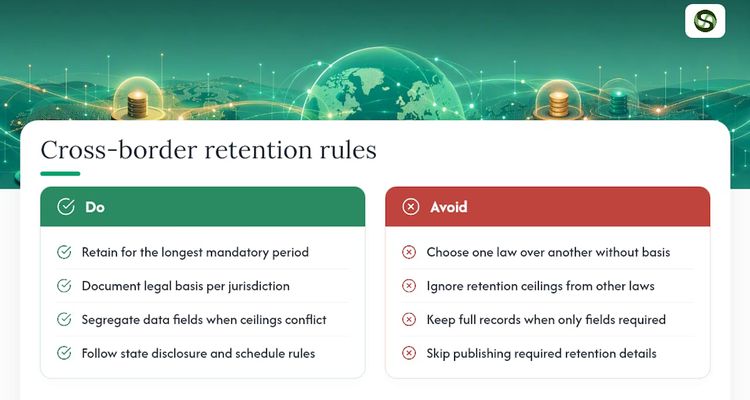
The safest working rule when jurisdictions conflict: retain for the longest mandatory period that legitimately applies, and document the justification for holding that specific jurisdiction’s record that long. This protects you from the accusation of over-retention in the shorter-window jurisdiction, because the documentation shows the longer period was legally required elsewhere, not arbitrary.
Watch specifically for jurisdictions with retention ceilings rather than just floors. Some privacy frameworks cap how long you can hold personal data once its original purpose is served, which can directly conflict with a US tax rule requiring the same data for seven years. When that conflict shows up, segregating the data (keeping only the fields the tax obligation actually requires, rather than the full original record) is often the practical fix, rather than picking one law over the other.
State privacy laws add their own layer even within a single country. California’s framework requires disclosing retention periods by category in your privacy notice, Minnesota requires a retention description with a last-updated date, and Illinois’s biometric law requires a published, publicly available retention schedule specifically for biometric identifiers. Treat these as a floor for documentation quality even for organizations operating only domestically.
Is Data Retention the Same as Data Backup?
No, and conflating the two is one of the more expensive mistakes a compliance team can make. A retention policy governs how long a record is legally or operationally allowed to exist in an accessible form. A backup policy governs how you protect against data loss through redundancy and recovery, and it operates on a completely different logic.
The mismatch shows up when a company deletes a record from its primary system on schedule, satisfying the retention policy, but that same record sits untouched in a six-month-old backup snapshot that nobody accounted for. If a regulator or plaintiff’s attorney later discovers the record still exists in backup, the fact that it was “deleted” from production doesn’t help.
Retention schedules need to explicitly extend to backup and archive copies, not just live systems, or they leave a gap that undermines the whole policy. Practically, this means backup rotation schedules should be shorter than or aligned with your longest applicable retention period, and any backup retained beyond that window needs its own documented justification, the same as a primary record would.
How Do Retention Deadlines Affect Privacy and Security?
Every record you hold past its justified purpose is an asset sitting in your breach exposure with no corresponding business benefit. This is the core logic behind the storage limitation principle: data that no longer serves the purpose it was collected for should be deleted or anonymized, not kept “just in case.”
The security math is straightforward even without a specific incident to point to. A smaller, well-defined dataset is faster to secure, easier to encrypt comprehensively, and less costly to notify about if a breach does occur, since notification obligations typically scale with the volume and sensitivity of exposed records. Retention deadlines, when actually enforced rather than just written down, function as a continuous reduction in attack surface.
The privacy side runs on the same principle from a different angle. State privacy laws increasingly require you to state, in plain terms, how long you keep personal data and why. An organization that can’t answer that question with a specific policy, rather than “as long as we need it,” is exposed both to regulatory scrutiny and to the reputational cost of a consumer finding out their data sat unused for a decade.
What Are the Biggest Challenges in Managing Retention Deadlines?
The most common failure isn’t a missing policy document. Most organizations have one. The failure is that the policy exists on paper while the systems holding the actual data have no mechanism to enforce it, so deletion becomes a manual task someone forgets to do.
A second recurring challenge is inconsistent trigger tracking. A retention period is only as accurate as the trigger date it counts from, and when systems record “date created” instead of “date contract terminated” or “date employment ended,” every downstream deletion date is wrong without anyone noticing until an audit surfaces it.
A third challenge is reconciling legal holds with automated deletion. Automation without a hold-check step will delete records right on schedule, hold or no hold, which is arguably worse than a slow manual process that at least gives someone a chance to catch the conflict.
The fix for all three runs through the same infrastructure: metadata tagging at the point of creation, automated lifecycle enforcement that checks hold status before executing deletion, and a logging system that produces evidence rather than just a policy claim. Organizations that treat retention as a one-time documentation exercise rather than an ongoing operational system are the ones that fail audits, not the ones with unusual or complex retention requirements.
Why Shorter, Justified Retention Reduces Risk
The instinct to keep everything indefinitely feels safer, but it’s backwards. Every record held past its justified purpose is pure downside: more breach exposure, more discovery risk, zero added protection. The trade-off that actually matters isn’t “keep more to be safe.” It’s “keep exactly what a specific obligation requires, and write down why,” because that documentation is what protects you when a regulator or opposing counsel asks the question directly. A retention policy that isn’t wired into daily workflows is a document, not a control. It only works when it’s living, enforced, and produces its own evidence.
— Kuldeep
How Can a Deadline-Tracking Platform Support Your Retention Schedule?
A written retention schedule tells you what should happen and when. Making it actually happen, on time, every time, across hundreds of records and multiple departments, is a different problem entirely, and it’s the one most policies fail on quietly.

Expiryedge automates the part a spreadsheet can’t: it tracks every retention trigger and deadline in one place, sends multi-channel alerts and escalations before a disposal date arrives, and keeps an audit log of what happened and when, which is exactly the evidence a SOC 2 audit or a state regulator will ask to see. It also flags records under legal hold so an automated deletion job doesn’t override an active exception, closing the gap that trips up most manual processes. Expiryedge is not a substitute for legal judgment on how long a given record must be kept. It’s the enforcement layer that makes sure the judgment your team already documented actually gets carried out. If your retention schedule currently lives in a document nobody checks weekly, start a free trial and connect it to a system that checks it for you.
Where to Verify Retention Requirements for Your Organization
Check IRS recordkeeping guidance for federal tax records, your state archives for a general records retention schedule, and state privacy law summaries for California, Minnesota, and Illinois. Confirm binding interpretations with counsel before finalizing any schedule.
Sources
- State Government general records retention schedule v.6.3 (Oct 2024) | Washington Secretary of State Archives
- Data Retention | Harvard Medical School Biomedical Data Management
FAQ
What Is the 7 Year Retention Policy?
The seven year rule generally refers to IRS guidance recommending that businesses keep financial and tax records for seven years to cover the statute of limitations on amended returns and audits.
What Records Need to Be Kept for 7 Years?
Tax returns, supporting financial documentation, expense records, and most signed contracts are commonly retained for seven years, though many contracts use the term of the agreement plus seven years as the actual countdown.
What Is the Standard Retention Period for Data?
There is no single standard period. Baselines cluster around 1 year for security logs, 6 years for HIPAA policy documentation, and 7 years for financial records, with the correct figure depending on the record category and applicable law.
What Records Should Be Kept for 3 Years?
Certain research data and grant-funded project records are commonly retained for three years at minimum, though sponsor terms and institutional policy often extend that window depending on the funding source.
Recommended
Frequently asked questions
Tax returns, supporting financial documentation, expense records, and most signed contracts are commonly retained for seven years, though many contracts use the term of the agreement plus seven years as the actual countdown.
There is no single standard period. Baselines cluster around 1 year for security logs, 6 years for HIPAA policy documentation, and 7 years for financial records, with the correct figure depending on the record category and applicable law.
Certain research data and grant-funded project records are commonly retained for three years at minimum, though sponsor terms and institutional policy often extend that window depending on the funding source.
Not legal advice
This article is for general informational purposes and does not constitute legal advice. Laws, regulations and contract requirements vary by jurisdiction and change over time. Consult a qualified attorney in your jurisdiction before making decisions that depend on the specific legal interpretation discussed here.