
Before Mobilization: 6 COI Checks for General Contractors

Before Mobilization: 6 COI Checks for General Contractors

Every certificate of insurance needs six things confirmed before a subcontractor sets foot on site: the correct policy lines and limits, the exact legal name of the named insured, the required additional insured and primary noncontributory endorsements, active effective and expiration dates, and a carrier you can actually verify exists. Collect and check all of it before mobilization, then keep watching renewal dates for as long as that sub is on your project. Skip any one of these and you’re the one holding the risk you thought you handed off.
TL;DR:
Ensuring active insurance is verified through endorsements like additional insured and waiver of subrogation before subcontractor mobilization is critical, especially for high-value or ongoing work.
Relying solely on COI certificates is risky because they are temporary snapshots; verification must include direct carrier confirmation and review of the declaration pages.
Automated tracking systems and structured alert schedules are essential to prevent coverage lapses, as manual methods often lead to missed renewals and claims exposure.
Most construction projects require at least five insurance lines with specific endorsements, and policies should meet the contractual minimums, not just industry defaults.
Continuous oversight, including monthly rechecks of high-risk subcontractors, prevents coverage gaps that could turn into costly claims or legal liabilities.
COI Tracking 101: Reading the Certificate Correctly
A certificate of insurance, usually issued on an ACORD 25 or ACORD 28 form, packs a lot of information into one page: the named insured, the issuing carrier and its NAIC number, the producing agent, policy numbers, effective and expiration dates for each line, and the limits attached to each one. The problem is that most people scan it for a checkmark instead of reading it for a mismatch. A COI is a snapshot taken on the day it’s issued. It doesn’t guarantee coverage still exists six months into a project, which is exactly why COI certificate verification has to happen more than once.
For most construction work, you’re looking for five lines minimum:
- Commercial General Liability (CGL), ideally with products and completed operations coverage intact, not excluded.
- Workers’ Compensation and Employers’ Liability, confirming actual payroll is covered, not just a policy number on paper.
- Commercial Auto, including hired and non owned auto if the sub’s crew drives personal vehicles to or between job sites.
- Umbrella or Excess Liability, sitting on top of CGL and auto for anything over the primary limits.
- Professional Liability, when the sub is doing design work, engineering, or anything with an errors-and-omissions exposure.
A common baseline often used is a million-dollar per occurrence and two million aggregate minimum on CGL, but your contract language sets the actual number, not habit. Check that the aggregate hasn’t been eroded by other claims and that products/completed operations wasn’t quietly excluded to save the sub money on premium.
Endorsements to Request Before You Trust a Certificate
The certificate holder line at the bottom of a COI tells you almost nothing. Being listed as certificate holder just means you get notified (sometimes) if the policy is canceled. It does not make you an additional insured, and it does not extend any coverage to you if a claim hits. If your subcontract requires additional insured status, request the actual endorsement form, such as CG 20 10 or CG 20 37 or the carrier’s equivalent, not just a COI that mentions it in a text box.
Three endorsements matter most in general contractor insurance contracts:
- Additional insured, ongoing operations (CG 20 10) covers you while the sub is actively working.
- Additional insured, completed operations (CG 20 37) extends that protection after the work is done, which matters for defects that surface later.
- Primary and noncontributory language forces the sub’s policy to pay first, ahead of your own coverage, instead of splitting the claim.
A waiver of subrogation on both general liability and workers’ compensation stops the sub’s insurer from turning around and suing you after paying out a claim. Many prime contracts require it explicitly, so check your subcontract clause against what’s actually endorsed, not assumed.
Pro Tip: For subs on high-dollar scopes or repeat multi-year work, ask for the policy declarations page alongside the COI. Declarations show the real limits, exclusions, and endorsement schedule; the certificate is just a summary someone typed up.
The Verification Workflow and Red Flags That Stop Work
Verification isn’t a glance, it’s a sequence. Run it the same way every time and you catch the same mistakes before they become claims.
- Match the certificate’s limits and lines against your subcontract’s insurance clause, line by line.
- Confirm the named insured is the exact legal entity you’re contracting with, not a parent company, DBA, or sister entity.
- Check that every line’s effective and expiration dates cover the full project duration.
- Verify the additional insured and waiver of subrogation endorsements are actually attached, not just referenced.
- Run the carrier through a NAIC lookup to confirm it’s a licensed, active insurer.
- Call the issuing agency directly to confirm the policy is currently in force.
Watch for these red flags, since certificate holder listings and expired dates are the most common failure points: an expired COI means you hold mobilization, full stop. A sub listed only as certificate holder needs the actual endorsement before they touch the site. Workers’ comp with zero reported payroll (a “ghost policy”) needs proof of active payroll reporting. Mismatched entity names get corrected and reissued, not waved through. Aggregate erosion, where prior claims have eaten into the policy limit, needs a broker confirmation or fresh declarations page before you proceed. For anything high value or high risk, involve your own broker, since fast broker verification can confirm carrier standing in a day when a bid deadline is tight.
Tracking Expirations Without Losing Sleep Over Renewals
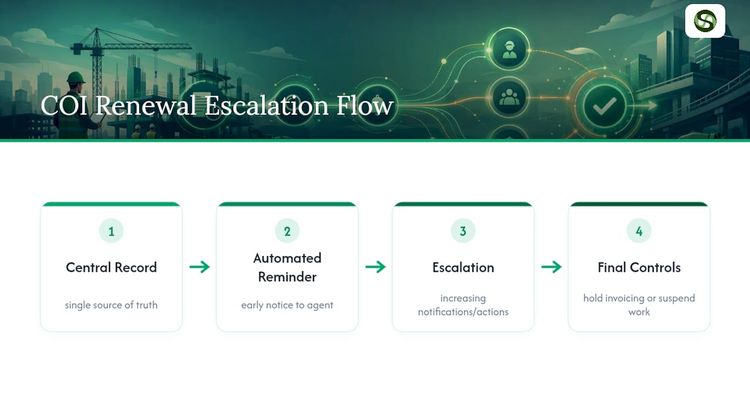
A COI collected on day one is worthless on day two hundred if nobody’s watching the expiration date. The fix is a single source of truth, whether that’s a spreadsheet or a platform, tracking subcontractor legal name and EIN, carrier and NAIC number, policy types, policy numbers, effective and expiration dates, endorsement flags, project assignment, and approval status. Best practice among prime contractors is enforcing “no COI, no mobilization” as a hard rule, not a suggestion PMs can override under schedule pressure.
Alert cadence matters more than most GCs think. A workable structure includes automated reminders to the sub’s agent well before expiration, escalating notifications and actions as the expiration date approaches, culminating in holding invoicing or suspending work authorization if renewal isn’t confirmed.
Structured alert timelines tied to project records cut audit risk substantially compared to relying on someone remembering to check a calendar. Once you’re managing more than roughly 10 to 15 active subcontractors, or running several projects simultaneously, spreadsheets start dropping renewal dates and nobody notices until a claim exposes the gap. That’s the point where automated reminders and workflow-based approvals start paying for themselves in avoided lapses alone.
An Operations Lead’s Take on What Actually Holds Up
No COI, no mobilization, no exceptions. Require the endorsement forms before the sub’s crew starts, not after. Standardize the intake form so every project manager collects the same fields the same way. Recheck high-risk subs monthly, not annually. I’ve seen a renewal lapse catch a roofing sub mid job. A 30-day alert flagged it in time to hold the next payment until the policy was reinstated, and it never became a claim. That’s the entire point of a cadence: it turns a disaster into a Tuesday.
— Kuldeep
Put Your COI Tracking on Autopilot
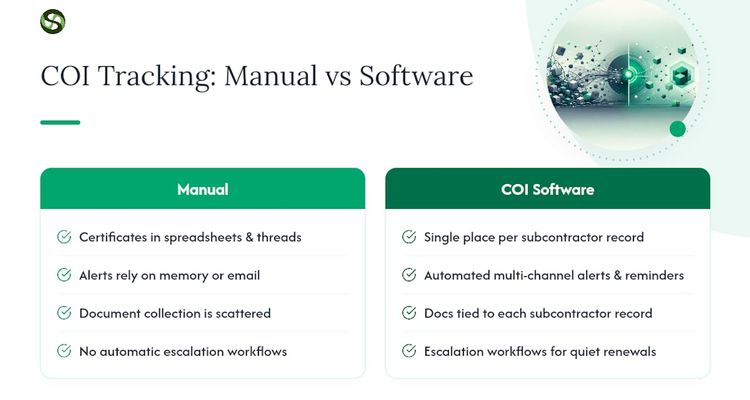
Chasing renewal dates across spreadsheets and email threads is how gaps happen. Dedicated COI tracking software gives your compliance team one place to store every subcontractor’s certificates, flag missing endorsements, and trigger reminders automatically well before expiration instead of relying on someone’s memory. Such platforms handle common challenges general contractors face: automated multi-channel alerts, document collection tied to each subcontractor record, escalation workflows when a renewal goes quiet, and dashboards showing exactly which subs are compliant right now. If you’re running enough active subcontractors that a missed renewal keeps you up at night, it’s worth reviewing your own certification tracking process against established best practices for alert structure and ownership. Start a free trial and load your current subcontractor list to see how the cadence runs before your next renewal deadline hits.
Sources
Run carrier checks through your state’s NAIC lookup before trusting any policy number. For endorsement language, Procore’s insurance library breaks down waiver of subrogation mechanics, and the certificate of insurance verification guide walks through common certificate mistakes. Contract-side insurance clauses are also worth comparing against real examples, like this breakdown of commercial maintenance contract requirements.
- Procore library (COI and insurance best practices)
- Subcontractor COI Tracking & Insurance Verification: Stop Coverage Gaps Before They Cost You (FileFlo)
- Certificate of Insurance Verification Guide
FAQ
How do you verify a COI?
Match the certificate against your subcontract’s insurance requirements, confirm the named insured’s legal name, check effective and expiration dates, verify the additional insured endorsement is actually attached, run the carrier through a NAIC lookup, and call the issuing agency to confirm the policy is active.
Which COI tracking software is best for general contractors?
The right choice depends on how many subs and projects you’re managing, but a platform like Expiryedge that centralizes documents, automates renewal alerts, and builds in approval workflows outperforms spreadsheets once you’re past roughly 10 to 15 active subcontractors.
What are the requirements for a certificate of insurance?
A construction COI generally needs to show CGL with products and completed operations, workers’ compensation and employers’ liability, commercial auto, and often umbrella coverage, each meeting the limits your subcontract specifies and listing the correct named insured.
What does “COI tracking” actually mean day to day?
It means maintaining a live record of every subcontractor’s policy dates, limits, and endorsements, then acting on expiration alerts before coverage lapses rather than discovering a gap after a claim.
Is a COI enough proof of coverage on its own?
No. A COI is a point-in-time summary, not a binding document, so policies can change or lapse after it’s issued, which is why ongoing verification matters more than the initial collection.
Recommended
Frequently asked questions
The right choice depends on how many subs and projects you're managing, but a platform like Expiryedge that centralizes documents, automates renewal alerts, and builds in approval workflows outperforms spreadsheets once you're past roughly 10 to 15 active subcontractors.
A construction COI generally needs to show CGL with products and completed operations, workers' compensation and employers' liability, commercial auto, and often umbrella coverage, each meeting the limits your subcontract specifies and listing the correct named insured.
It means maintaining a live record of every subcontractor's policy dates, limits, and endorsements, then acting on expiration alerts before coverage lapses rather than discovering a gap after a claim.
No. A COI is a point-in-time summary, not a binding document, so policies can change or lapse after it's issued, which is why ongoing verification matters more than the initial collection.