9 Essential COI Tracker Fields for Multi-State Subcontractor Compliance

9 Essential COI Tracker Fields for Multi-State Subcontractor Compliance

Run one source-of-truth certificate-of-insurance tracker with a conditional 60/30/14/7/0 renewal escalation, and treat certificate collection as step one, not proof of compliance. Verify every endorsement, log who checked it and when, and archive expired certificates instead of deleting them. That is the whole operational model. Everything below is how to build it and adjust it when a subcontractor works across state lines.
TL;DR:
State-specific endorsement forms and notice requirements must be flagged in the tracker to ensure proper verification before project mobilization.
The tracker should include detailed fields such as coverage limits, effective dates, carrier info, endorsements, and last review for audit compliance.
Renewal automation must be conditional, with reminders starting 60 days before expiration and escalations up to the principal if renewals are not verified, without redundant notices.
Collecting a certificate and verifying its endorsement and active status are separate steps; automation helps confirm renewals and document validity efficiently.
Expired certificates must remain archived through the full project record to support claims or disputes years later, not deleted once lapsed.
ExpiryEdge centralizes compliance obligations, renewal dates, alerts, assignments, and escalations so teams can act before deadlines are reached.
Three things shift by jurisdiction and deserve their own tracker flag:
- Workers’ compensation jurisdiction rules. Some states let sole proprietors or small crews waive workers’ comp with a filed exemption certificate. Your tracker needs a field for that exemption document, separate from the standard workers’ comp COI, or you will chase a certificate that legally does not exist.
- State-specific endorsement forms. A handful of states use nonstandard additional-insured endorsement language or require specific waiver-of-subrogation wording tied to state statute. Flag these subs so your verification step pulls the actual endorsement form instead of accepting the certificate at face value.
- Notice requirements. Some jurisdictions and some carriers still require 30 or 60 days’ notice of cancellation on the certificate language itself. Map that notice period into your renewal cadence so the alert fires before the notice window closes, not after.
When a contract clause references a state-specific bonding or licensing rule, add a checklist item to the tracker row rather than a footnote. A row is only useful if the state exceptions live where the reviewer is already looking.
How Do You Build a Single Source-of-Truth COI Tracker?
A tracker built for renewals needs specific fields, not a generic spreadsheet with “insurance status” in one column. Here is the field list that holds up under audit:
- Subcontractor name and EIN — ties every certificate to a single verified entity, not a project alias.
- Policy types — general liability, workers’ comp, auto, umbrella, professional liability, listed separately.
- Effective and expiration dates — the two dates that drive every downstream calculation.
- Coverage limits — per occurrence and aggregate, matched against the contract’s required minimums.
- Carrier name and NAIC number — lets you confirm the insurer is real and licensed before you trust the paper.
- Endorsements on file — a yes/no flag plus a link to the actual endorsement PDF, not just the COI.
- Days to expiration — a formula field, recalculated daily.
- Status — Current, Expiring Soon, Pending Renewal, or Expired.
- Last reviewed date and reviewer name — your audit trail.
Status logic should be mechanical: 60 days out, the row flips to Expiring Soon and triggers the first notice. Inside 14 days with no renewal received, it flips to Pending Renewal and escalation intensifies. Zero days with nothing received, it flips to Expired and the row should automatically populate a stop-work or payment-hold task for the project team.
Pro Tip: Build the days-to-expiration column as a live formula, not a manual entry. A purpose-built template with automatic thresholds catches lapses that a static spreadsheet quietly misses.
What Should You Verify Before Accepting a Certificate?
Collecting a PDF and verifying it are two different jobs, and treating them as one is the single most common failure in subcontractor compliance. A certificate on its own is a snapshot, not proof that the endorsement is active.
Run this checklist on every certificate before you file it as approved:
- Confirm the limits on the certificate match the contract’s required minimums, line by line.
- Pull the actual additional-insured endorsement (commonly CG 20 10 or CG 20 37) rather than trusting the box checked on the ACORD form.
- Confirm waiver of subrogation language is present when the contract requires it.
- Confirm primary and noncontributory wording, which determines whose policy pays first in a claim.
- For high-risk subcontractors or large-dollar scopes, run the carrier through an NAIC lookup and call the agent directly to confirm the policy is still in force.
Automating the document parsing step matters here. Manual review of a certificate typically runs 8 to 12 minutes per document; automated extraction of key fields cuts that human review time down to roughly 2 minutes. Record the verification date, the reviewer’s name, and attach the endorsement PDF directly to the tracker row. Without that trail, “verified” is just a claim, not a fact you can defend six months later when a claim gets filed.
How Should Renewal Automation and Escalation Actually Work?
The renewal cadence that works is conditional, not calendar-based. Every step should check first whether a verified renewal has already landed, and skip itself if it has. That single design choice is what separates automation that saves time from automation that just adds noise.
- 60 days out: automated notice to the subcontractor requesting the renewal certificate.
- 30 days out: follow-up notice, this time copying the subcontractor’s insurance broker.
- 14 days out: broker escalation, with a direct outreach task assigned to your compliance contact.
- 7 days out: escalation to the subcontractor’s principal or owner, with a payment-hold flag raised on the project ledger.
- Day zero: automatic stop-work task creation if nothing verified has arrived, gating any new work orders.
Each stage fires only if the certificate has not been received and verified. That conditional check is what keeps a compliant subcontractor from getting five redundant notices while a lapsed one gets escalated properly.
Pro Tip: Never delete an expired certificate from the tracker. Retention guidance recommends keeping expired COIs on file through the project’s full record life, since claims and disputes can surface years after a policy has lapsed.
Rolling Out the Tracker: Checklist and Contract Language
Mobilization should be gated, full stop: no subcontractor starts work until a verified COI with confirmed endorsements is on file, logged through a single intake point.
Sample clause language procurement teams can adapt directly:
- “Subcontractor shall furnish a renewal certificate of insurance no later than 30 days prior to expiration of any required policy.”
- “Contractor may withhold payment on any pay application where a current, verified certificate of insurance is not on file.”
- “Contractor reserves stop-work authority for any active work performed without a verified, current certificate of insurance.”
- “Subcontractor’s insurance broker shall be available for direct confirmation of coverage upon Contractor’s request.”
Rollout itself is three steps: migrate every existing paper or email-based COI into the centralized tracker, set a weekly reconciliation meeting where the compliance lead reviews every row inside 30 days of expiration, and run a monthly or quarterly audit sample checking a handful of “Current” rows against the actual endorsement PDFs on file. Payment holds tied directly to COI status remain one of the most effective enforcement levers a general contractor has.
Summary of Statutory Minimum Insurance Coverage by State
Statutory minimums for general liability, workers’ compensation, and bonding vary by state, by trade classification, and often by project size or public versus private work. A tracker built for renewal management should not try to hardcode these figures. Legal minimums change through legislative sessions, and a tracker that bakes in a fixed number becomes wrong the moment a state updates its threshold.
The operational move is to store the contract’s required minimum as a field on each subcontractor row, sourced from the executed agreement rather than from a general statutory table. Your legal or risk-management team sets that number for each contract; your tracker simply confirms the certificate meets it. This keeps your compliance workflow accurate even as underlying state law shifts, because the comparison point is always the current contract, not a static reference chart that can go stale within a year.
Where a state does require documentation beyond a standard certificate, such as a workers’ compensation waiver filing or a state-specific bonding rider, that requirement should live as a checklist item attached to the subcontractor’s row, verified the same way you verify an endorsement. Treat statutory questions as a legal-team input feeding the tracker, not a feature the tracker itself needs to calculate.
How Insurance Type Requirements Differ by State
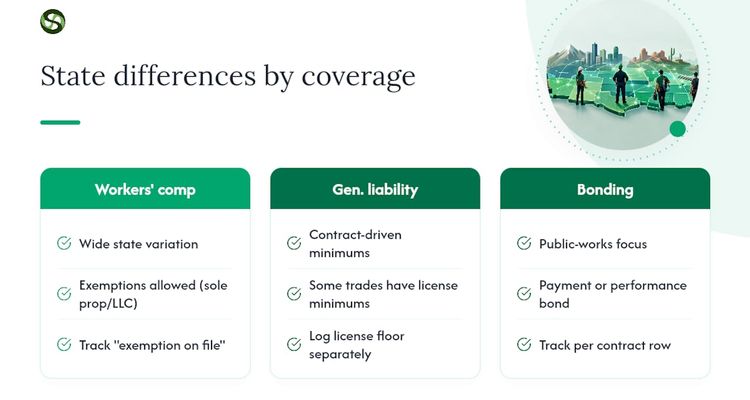
General liability, workers’ compensation, and bonding behave differently across state lines, and each has its own operational wrinkle for a tracking team.
Workers’ compensation carries the widest variation. Several states allow sole proprietors, partners, or small LLCs to file for an exemption instead of carrying a policy, which means your tracker needs an “exemption on file” field distinct from an actual COI. Skipping this distinction is how compliance teams end up chasing a certificate a subcontractor is legally entitled not to have.
General liability minimums are almost always contract-driven rather than statute-driven, but some states impose licensing-linked minimums for specific trades (electrical, plumbing, roofing) tied to the contractor’s state license, not the project contract. When a subcontractor’s trade license carries its own insurance floor, log that separately from the project’s contractual requirement, since the two numbers can differ.
Bonding requirements show up most often on public works projects and vary by state procurement code, sometimes requiring a payment bond, a performance bond, or both above a certain contract value. Because bonding is typically a project-level requirement rather than a subcontractor-level policy, track it against the specific contract row rather than the subcontractor’s general profile, since the same sub might need a bond on one job and not another.
Managing Multi-State Subcontractors and Interstate Projects
A subcontractor working across state lines complicates the tracker in a specific way: the same entity can carry different exemption statuses, different endorsement requirements, and different notice periods depending on which state the work is physically happening in.
The cleanest fix is to track compliance at the project level, not just the subcontractor level. A subcontractor with one master general liability policy might still need a different workers’ comp exemption filing in each state where they send crews. Build your tracker so a single subcontractor can have multiple active rows, one per state or per active project, each with its own status and escalation clock.
Watch for two failure points specifically. First, a policy’s workers’ compensation coverage sometimes lists specific states of operation; if a sub crosses into a state not listed on the policy, coverage may not extend to that work, so confirm the state list on the policy itself, not just the certificate. Second, notice-of-cancellation timing and endorsement form requirements can differ enough between states that a certificate valid for a project in one state does not automatically satisfy the requirements of a project in another. Flag interstate subcontractors for a manual review pass before mobilization on each new state’s project, rather than assuming last project’s approval carries over.
Are There Exceptions or Exemptions to Track by State?
Exemptions are common enough that failing to account for them creates its own compliance headache. The most frequent is the workers’ compensation exemption available in many states to sole proprietors, certain partners, or small closely held corporations who file the appropriate exemption paperwork with the state.
Treat an exemption filing as its own document type in the tracker, with its own expiration date and renewal cadence, since exemption certificates lapse and need renewal just like insurance policies do. Do not let “exempt” become a permanent status with no follow-up date attached.
Some states also carve out exceptions for very short-duration work, for certain owner-operator arrangements in trucking and hauling, or for specific licensed trades that self-insure through a state fund rather than a private carrier. Each of these needs its own verification path: a self-insured trade might provide a certificate from the state fund rather than a standard ACORD form, and your reviewer needs to know that substitution is legitimate rather than flagging it as missing paperwork.
The operational rule holds regardless of exemption type: log the underlying document, log its expiration, and route it through the same renewal cadence as a standard COI. An exemption that lapses unnoticed exposes the general contractor to the same liability gap as an expired policy would.
Common Compliance Pitfalls With State Insurance Requirements
The pitfalls that show up most often are process failures, not knowledge gaps. Teams usually know the rules; they lose track of the paperwork.
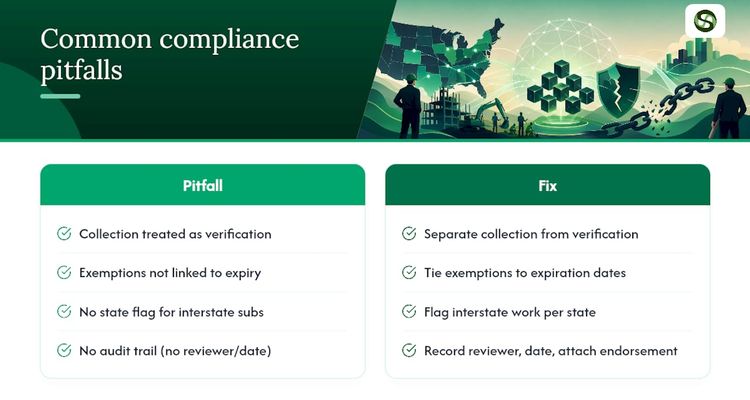
Treating collection as verification. A subcontractor emails a PDF, someone files it, and the row gets marked “compliant” without anyone confirming the endorsement, the limits, or whether the policy is still active. This is the single largest gap between a tracker that looks complete and one that actually protects the company.
Missing the exemption-to-expiration link. Workers’ comp exemptions and self-insurance certificates get filed once and never revisited, even though they carry their own renewal dates.
No state-level flag on interstate subs. A subcontractor approved for a project in one state gets waved through on a project in another state without a fresh review of that state’s specific endorsement or notice requirements.
No audit trail. A verified status with no reviewer name, no date, and no attached endorsement PDF is unenforceable in a dispute. If a claim surfaces, “we checked it” means nothing without a documented who and when.
Deleting expired records. Expired certificates get purged to keep the tracker clean, which destroys the exact evidence needed if a claim arises years after the fact.
Every one of these is fixable with a tracker that separates collection from verification, ties exemptions to expiration dates, flags interstate work for state-specific review, and keeps expired records archived rather than deleted.
A Practical Take on Where Compliance Programs Actually Fail
Most subcontractor insurance programs do not fail because someone misunderstood a state rule. They fail because the tracking system was a shared inbox and a spreadsheet, and neither scales past a few dozen active subcontractors. The paperwork gets ahead of whoever is supposed to be chasing it.
The real trade-off is schedule pressure versus risk exposure. Every compliance lead has felt the urge to let a sub keep working while a renewal is “in progress,” because holding payment slows the job. Clear contract language, spelled out before mobilization, removes that judgment call from the middle of a live project and puts it in writing where it belongs.
My honest read: prioritize conditional automation with a real audit trail over any manually maintained system, no matter how disciplined the team running it is today. People change roles. Spreadsheets do not enforce themselves.
— Kuldeep
Put the Tracker on Autopilot With ExpiryEdge
You could keep this running in a shared spreadsheet with someone manually checking expiration dates every Monday. Software platforms exist so nobody has to. It’s built to run the exact tracker described above: pre-expiration alerts at your chosen intervals, conditional escalation logic that skips a step the moment a renewal is verified, and document attachments so every endorsement PDF sits right next to the policy row it belongs to.

Every reviewer action, every status change, and every escalation gets a timestamp and a name attached, so the audit trail exists automatically instead of depending on someone remembering to log it. That maps directly onto the field list and the 60/30/14/7/0 sequence covered above, without anyone rebuilding formulas by hand. If your team is still chasing certificates through email, start a trial on the ExpiryEdge platform and load your current subcontractor list in to see the escalation clock start running on its own.
Templates and Playbooks Worth Bookmarking
For hands-on setup, pair this reference with a COI collection playbook for workflow examples, a tracking best-practices guide for field lists, and a free expiration tracker template to adopt quickly. For pre-contract verification steps, a contractor verification guide covers what to check before signing.
Sources
- Subcontractor COI Collection Playbook (Prime Contractors)
- COI Tracking Best Practices | SubcontractorCOI
- How Do You Chase COI Renewals from Subs Automatically in 2026?
- Free Subcontractor COI Expiration Tracker
FAQ
What Is the Difference Between Collecting and Verifying a COI?
Collecting means receiving the certificate PDF; verifying means confirming the limits, endorsements, and active status of the policy behind it. A verification checklist treats these as two separate, sequential steps.
How Often Should You Send Renewal Reminders?
Best practice is a conditional cadence starting at 60 days before expiration, with follow-ups at 30, 14, and 7 days, escalating to broker and principal contacts if nothing verified arrives.
What Should Happen if a Certificate Expires With No Renewal on File?
The subcontractor’s project row should trigger a payment hold and a stop-work flag automatically, gating any new work orders until a verified renewal certificate is received.
How Long Should Expired Certificates Be Kept on File?
Expired certificates should stay archived through the project’s full record life, since claims can surface years after a policy lapses and the certificate may be needed as evidence.
Does State Law Change What Fields Belong in a COI Tracker?
State law changes which supporting documents you need, such as workers’ comp exemption filings or state-specific endorsement forms, but the core tracker fields, like expiration date, limits, and endorsement status, stay the same across every state.
Recommended
Frequently asked questions
Best practice is a conditional cadence starting at 60 days before expiration, with follow-ups at 30, 14, and 7 days, escalating to broker and principal contacts if nothing verified arrives.
The subcontractor's project row should trigger a payment hold and a stop-work flag automatically, gating any new work orders until a verified renewal certificate is received.
Expired certificates should stay archived through the project's full record life, since claims can surface years after a policy lapses and the certificate may be needed as evidence.
State law changes which supporting documents you need, such as workers' comp exemption filings or state-specific endorsement forms, but the core tracker fields, like expiration date, limits, and endorsement status, stay the same across every state.