
90–180 Day Contract Renewals: Stop Missed Deadlines for Legal & Ops

90–180 Day Contract Renewals: Stop Missed Deadlines for Legal & Ops

A contract renewal is the decision point where you renew, renegotiate, extend, or terminate an existing agreement before it lapses. The single most important action in the entire cycle is starting 90 to 180 days ahead of expiry with one named, accountable owner. Everything else, the checklist, the negotiation prep, the automation, exists to support that one deadline.
TL;DR:
Starting renewal preparations 90 to 180 days in advance with an accountable owner is critical to avoiding missed deadlines and auto-renewal traps.
Maintaining centralized contract data, clear ownership, and performance metrics helps prevent renewal failures caused by scattered information and lack of insight.
Automation should focus on deadline alerts, obligation tracking, and clause detection, while strategic negotiation decisions remain human-driven.
Key KPIs such as on-time renewal rate, time-to-renew, and percent renegotiated enable ongoing process improvement and risk mitigation.
Building early ownership accountability before leveraging automation ensures a trusted, reliable renewal management program that reduces surprises.
What Is the Contract Renewal Process, and Why Does It Matter?
People often use “renewal,” “extension,” and “amendment” as if they mean the same thing. They don’t. A renewal creates a new term under existing or updated conditions. An extension pushes the current term’s end date without renegotiating terms. An amendment changes specific clauses mid-term, independent of the renewal date. Confusing the three is how companies end up locked into pricing they never agreed to.
The financial risk is real and specific. Auto-renew clauses convert silence into a binding commitment, often for another full year, sometimes at an increased rate. Poor renewal handling erodes contract value over time as LegalSifter notes, whether through missed savings opportunities, service gaps, or terms nobody remembers agreeing to.
Renewals aren’t just administrative housekeeping. They’re the best negotiating leverage you’ll get all year, because the vendor knows switching costs you something and you know exactly how the relationship has performed. Treating renewal as a strategic checkpoint rather than a rubber stamp gets you:
- Better pricing based on actual usage data, not last year’s assumptions
- A chance to fix compliance gaps before they become audit findings
- Leverage to renegotiate SLAs that underperformed
- An opportunity to consolidate redundant vendor relationships
Why Do Contract Renewals Fail?
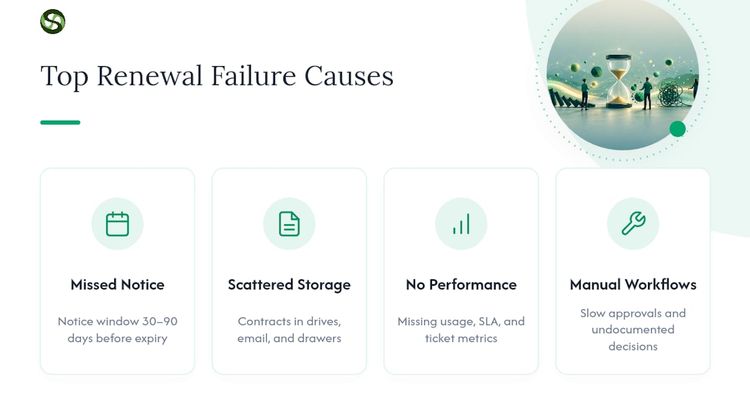
Most renewal failures trace back to four repeatable patterns, not bad luck.
Missed notice periods. Auto-renew and evergreen clauses are designed to activate by default. If nobody flags the notice window, typically 30 to 90 days before expiry, the contract renews on autopilot at whatever terms were originally signed.
Scattered storage and unclear ownership. When contracts live in shared drives, email threads, and someone’s desk drawer, nobody can say with confidence who owns a given renewal or when it’s due. Organizations relying on spreadsheets and manual calendars struggle to scale this process as Zoho’s contract management research points out, once contract volume grows past a handful of active agreements.
No performance data. You can’t negotiate from strength if you don’t know how the vendor actually performed. Missing usage stats, SLA breach history, or support ticket volume means you’re negotiating blind.
Manual workflows and audit gaps. Slow approval chains and undocumented decisions create both missed deadlines and compliance exposure.
Pro Tip: Pull your last three renewal cycles and check how many closed within five business days of the deadline. If more than half did, you’re running a reactive process, not a managed one.
The 10-Step Renewal Framework: A 180-to-30-Day Timeline
A modern renewal process starts 120 to 180 days before expiry, and building alerts and workflows around specific milestones is what separates a controlled renewal from a scramble, according to the step-by-step 2026 renewal guide from Ziasign. Here’s a framework that works across contract types, adjusted up or down based on contract complexity and value.
- Day 180: Trigger review. The system or the calendar flags the contract. Accountable owner assigned (usually the business owner of the relationship, not legal).
- Day 170: Pull the contract and metadata. Confirm renewal terms, notice period, auto-renew status, and pricing escalators. Responsible: contract admin or procurement analyst.
- Day 160: Performance audit. Gather usage data, SLA compliance history, incident logs, and support responsiveness. Consulted: the internal team that actually uses the service.
- Day 150: Spend and market benchmark. Compare current pricing against market rates and internal budget targets. Responsible: finance or procurement.
- Day 130: Stakeholder input round. Legal, compliance, finance, and the business owner weigh in on priorities. Informed: executive sponsor if contract value crosses a threshold.
- Day 120: Draft negotiation plan. Define non-negotiables, flex points, and walk-away conditions.
- Day 100: Initial vendor conversation. Signal renewal intent and share priority changes early, before the vendor assumes automatic renewal.
- Day 90: Formal negotiation and redlines. Legal reviews proposed changes; procurement handles commercial terms.
- Day 60: Internal approval routing. Finance and legal sign off; escalate any unresolved terms to the accountable owner.
- Day 30: Execution and documentation. Final signatures captured, obligations scheduled in the tracking system, and the audit trail archived.
Contracts under a certain value threshold can compress this to a 90-day version, starting at step 5. High-value or high-risk agreements deserve the full 180-day runway, and piloting automation on those contracts first, before rolling it out organization-wide, tends to surface process gaps while the stakes are still manageable.
What Role Should Automation Play in Contract Renewals?
Automation should handle the repetitive, deadline-sensitive parts of renewal and leave judgment calls to people. That division of labor is what makes a renewal program both fast and defensible.
Here’s what belongs on the automated side:
- Multi-channel alerts at configurable milestones (90, 120, 180 days) so different contract types get appropriate runway
- Obligation tracking, so SLA commitments and deliverables don’t fall through after signature
- Approval routing, moving a contract through legal and finance review without someone chasing signatures by email
- Renewal letter and notice generation, formatted and sent on schedule
- Clause detection, flagging auto-renew and evergreen language using contract metadata so nothing renews by default without a human decision
CLM platforms that centralize contracts and automate alerts and obligation tracking measurably cut missed renewals and value leakage, as Sirion’s renewal best-practices guide details, because the system replaces memory and inbox searches with a structured trigger.
What automation should never own: negotiation strategy, legal risk judgment, or the final call on whether to walk away from a vendor. Those decisions need context that no workflow engine has, an understanding of the relationship’s history, internal politics, and where the business is headed next quarter.
A tool like ExpiryEdge’s renewal alert configuration can flag auto-renew clauses automatically by scanning metadata fields at intake, which matters because those clauses are exactly where the most expensive surprises hide.
How Do You Measure Whether Your Renewal Process Is Working?
Five metrics tell you almost everything about program health, and none of them require a data science team to calculate.
- On-time renewal rate: percentage of contracts renewed before their notice deadline, without lapsing into default auto-renewal terms.
- Time-to-renew: days elapsed from initial review trigger to final signature. Shrinking this number over successive cycles is the clearest sign the process is maturing.
- Savings realized: dollar value of price reductions negotiated, or spend eliminated by terminating unused licenses and services.
- Percent renegotiated: share of renewals where terms actually changed, versus contracts that rolled over unchanged.
- Compliance exceptions: count of renewals that closed without required legal review, missing signatures, or incomplete audit documentation.
These five KPIs, on-time renewal rate, time-to-renew, savings realized, percent renegotiated, and compliance exceptions, cover the core of what Zoho recommends tracking for renewal programs of any size.
Calculating “value saved” is simpler than most teams assume: take the prior contract’s annual cost, subtract the newly negotiated cost, and add any spend eliminated from unused seats or services you cut during the renewal. Report this quarterly to whoever owns the vendor budget, and review the full KPI set monthly with the cross-functional group, legal, procurement, finance, and the business owner, so small process breakdowns get caught before they become a pattern.
How Do You Prepare a Negotiation Strategy for Renewal?
Negotiating from data beats negotiating from habit every time. Renewals decided on performance and spend evidence consistently outperform renewals treated as paperwork, a point Sirion’s negotiation research makes clear, and the prep work is straightforward if you start early enough.
- Pull usage data. How many licenses are active versus purchased? Unused seats are your strongest leverage point, full stop.
- Compile SLA history. Document every breach, response time miss, or downtime incident with dates and impact.
- Gather compliance and incident records. Security issues, audit findings, or regulatory concerns from the current term belong in this file.
- Benchmark against market rates. Third-party pricing data or competitive quotes give you a defensible target number.
- Set your three tiers before the call: non-negotiables (things you won’t concede), flex areas (where you have room), and acceptable concessions (what you’ll give up to get something else).
Once you’ve built the file, the tactics practically write themselves. Underused license counts justify a smaller renewal footprint. If you’re running three overlapping tools that do similar jobs, consolidation gives you a bigger combined contract to negotiate against, which usually means better per-unit pricing. And a conditional extension, a 60 or 90-day bridge tied to specific performance benchmarks, gives you leverage without committing to a full new term before problems get fixed.
Pro Tip: Never open a renewal negotiation by asking for a discount. Open by stating what changed, usage dropped, an SLA was missed, a competitor quoted lower, and let the number follow from the fact.
What Belongs on a Renewal Readiness Checklist?
A short pre-close checklist catches the mistakes that turn up in audits six months later.
- Contract metadata updated (new term dates, pricing, key contacts)
- Notice windows set and confirmed in the tracking system
- Redlines archived alongside the final executed version, not just the clean copy
- Obligations and deliverables scheduled with owners assigned
- E-signature audit trail preserved with timestamps and signer verification
When you tag the final document, include metadata fields for contract type, renewal date, owner, value, and auto-renew status, since these are what future automation runs against. Electronic signatures captured this way hold up as legally defensible records under the ESIGN Act and UETA framework that governs electronic contracting in the U.S., provided the audit trail is intact.
What Happens When Organizations Actually Run This Process
Teams that shift from manual tracking to a structured, deadline-driven renewal cycle report a consistent pattern: fewer missed renewals, shorter time-to-renew, and cleaner audit outcomes when compliance reviews come around. The common thread across adoption stories isn’t a bigger team. It’s fewer surprises.
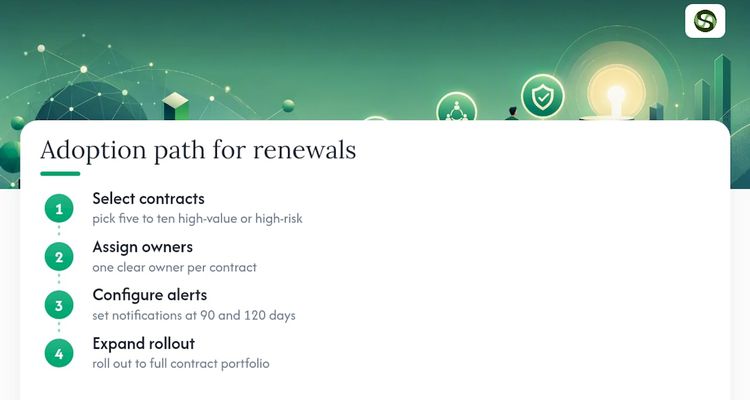
The adoption path that tends to work best starts small: pick five to ten high-value or high-risk contracts, assign one clear owner to each, and configure alerts at 90 and 120 days out before expanding to the full portfolio. Trying to automate everything on day one usually backfires, because nobody trusts a system they haven’t seen catch a real deadline yet.
ExpiryEdge was built around this exact problem: tracking dates that matter across contracts, licenses, and compliance obligations, then making sure the right person gets notified with enough runway to act instead of react.
An Editorial Take on Where Renewal Programs Actually Go Wrong
Most advice on contract renewal treats the timeline as the hard part. It isn’t. The 180-day countdown is easy to write down and easy to ignore, because the actual failure point is almost always ownership, not scheduling. A contract with no clearly accountable person will miss its deadline even with a calendar reminder sitting right there in someone’s inbox, because reminders addressed to nobody get archived by everybody.
The conventional wisdom oversells automation as the fix and undersells governance as the requirement. Alerts don’t renegotiate pricing, and a workflow engine doesn’t decide whether a vendor relationship is worth keeping. Automation earns its value by protecting the deadline so a human has time to make that decision well, not by making the decision for them.
If you’re building or fixing a renewal program in 2026, start with ownership before you touch a tool. Name one accountable person per high-value contract, then layer automation on top to protect their deadline. Do it backward, tool first, owner second, and you’ll get a system nobody trusts and everybody routes around.
— Kuldeep
Get Renewal Deadlines Off Spreadsheets and Into a System That Alerts You
Manual trackers and shared calendars work fine until your contract count outgrows them, and by then you’ve usually already missed one. ExpiryEdge centralizes every contract, license, and compliance deadline in one dashboard with configurable multi-channel alerts, automated approval routing, e-signature audit trails, and reporting that turns your KPI tracking into a five-minute monthly task instead of a spreadsheet hunt.

Procurement, legal ops, compliance, HR, and facilities teams use it the same way: set the alert windows once at 90, 120, or 180 days depending on contract risk, assign an owner, and let the system chase the deadline instead of a person. For teams managing certifications and licenses on top of contracts, the same license renewal tracking logic applies without a second tool to learn.
Start a free trial and connect your highest-value contracts first at ExpiryEdge to see your next 90 days of deadlines mapped out before they become a problem.
Sources
For deeper reading on renewal timelines, KPIs, and clause risk, see the MSA reference guide from SDR.ai on common renewal clause language, and the contract manager staffing guide for governance and resourcing benchmarks.
- Contract Renewal Management Process Step-by-Step Guide for 2026
- Contract renewal process — LegalSifter blog
- Contract Renewal Process: Best Practices and Step-by-step guide
- Contract renewal management: the complete guide — Zoho
FAQ
How many times can you renew a contract?
There’s no universal legal limit; most contracts can renew indefinitely unless the agreement specifies a maximum number of renewal terms or a total cap on the relationship’s duration. Check the renewal clause itself, since some contracts cap automatic renewals at two or three cycles before requiring a full renegotiation.
What happens if a contract is not renewed?
The agreement expires at the end of its current term, and both parties’ obligations under it generally end, unless the contract specifies post-termination duties like data return, confidentiality, or transition assistance. Services or deliverables tied to that contract stop unless a new agreement replaces it before the expiry date.
What is it called when you renew a contract?
The action is called a contract renewal, and if it happens automatically under a clause in the original agreement, it’s specifically an auto-renewal or evergreen renewal. A renewal that changes terms rather than simply continuing the old ones is more accurately called a renegotiation.
Is not renewing a contract the same as getting fired?
No. Not renewing a contract, whether it’s an employment, vendor, or service agreement, simply means the term ends as scheduled; it carries no disciplinary implication by itself. Termination “for cause” during an active term is a different, separate action with different legal and reputational consequences.
Recommended
Frequently asked questions
The agreement expires at the end of its current term, and both parties' obligations under it generally end, unless the contract specifies post-termination duties like data return, confidentiality, or transition assistance. Services or deliverables tied to that contract stop unless a new agreement replaces it before the expiry date.
The action is called a contract renewal, and if it happens automatically under a clause in the original agreement, it's specifically an auto-renewal or evergreen renewal. A renewal that changes terms rather than simply continuing the old ones is more accurately called a renegotiation.
No. Not renewing a contract, whether it's an employment, vendor, or service agreement, simply means the term ends as scheduled; it carries no disciplinary implication by itself. Termination "for cause" during an active term is a different, separate action with different legal and reputational consequences.
Not legal advice
This article is for general informational purposes and does not constitute legal advice. Laws, regulations and contract requirements vary by jurisdiction and change over time. Consult a qualified attorney in your jurisdiction before making decisions that depend on the specific legal interpretation discussed here.