
Best Supplier Approval Software for Small and Mid-Sized Food Manufacturers (2027)

ExpiryEdge is our first pick for small and mid-sized food plants that need every supplier document kept current. Each supplier's GFSI certificate, spec sheet, allergen statement and insurance is a dated record. The supplier's QA contact gets a reminder by email, SMS or WhatsApp and a no-login link to upload the renewal and e-sign the spec, and the price is published, from $29 a month.
If you manage a long ingredient list, need specs and formulas at scale, or want supplier data feeding product compliance, pick TraceGains: it tracks certificates, specs and approvals with expiry alerts, and many of your suppliers may already be on its network. The rest fit narrower cases. Trustwell's FoodLogiQ and SafetyChain suit larger quality teams that want scorecards and approval workflows. ReposiTrak will chase suppliers for you. Ideagen Safefood 360 and FoodReady make sense if you also want HACCP and audits in the same system.
We make ExpiryEdge, ranked first below. The six other vendors are described from their own sites and help pages as they read on 7 November 2026, and each claim carries a link.
| Tool | Reminds the supplier's QA contact (email, SMS, WhatsApp) | Suppliers upload and e-sign specs from a link, no login | QA approves or rejects what arrives | Escalates to your QA manager | Audit trail you can export | Published pricing / free trial |
|---|---|---|---|---|---|---|
| ExpiryEdge Top pick | Yes, email, SMS, WhatsApp, Slack, Teams | Yes, no-login link, up to 200 suppliers a send | Yes, field by field, rejected items reopen | Yes, at the step you choose | Yes, timestamped and exportable | $29-$199/month, 14-day free trial |
| TraceGains | Automatic alerts, 30-day warnings | Through its free Gather network | Yes | Not stated | Not stated | Quote on request |
| Trustwell FoodLogiQ | Automated to-dos and reminders | Branded supplier portal | Yes, with scorecards | Not stated | Not stated | Quote on request |
| SafetyChain | Notifies suppliers before documents lapse | Portal with supplier login | Yes, with SCARs | Not stated | Not stated | Facility-based quote |
| ReposiTrak | Automated expiry notices | Its team collects for you | Automated document review | Not stated | Not stated | Quote on request |
| Ideagen Safefood 360 | Not stated | Supplier portal | Pre-assessment and scored audits | Not stated | Not stated | Quote on request |
| FoodReady | Scheduled requests and expiry tracking | Not stated | QA and procurement sign-off | Not stated | Not stated | Quote on request |
How we compared these tools
Supplier approval breaks down when a supplier won't log in to a portal, or when a certificate lapses quietly. So we compared whether reminders reach the supplier, how each supplier gets documents to you, how your QA team approves or rejects what arrives, and whether a late certificate reaches a manager and leaves a trail an auditor can read. We also noted whether the price is public. On 7 November 2026 we read each vendor's product, pricing and help pages, and checked the rules against FDA's preventive controls rule, 21 CFR 117.430 and SQFI's certification pages. We didn't run paid trials of all seven tools. ExpiryEdge is ours, so read its section knowing that.
Approved before it arrives: what the supply chain rules ask of your QA team
The job starts with a legal duty. Under FSMA's preventive controls rule, if your hazard analysis relies on a supplier to control a hazard, you need a supply-chain program, and those ingredients must come only from approved suppliers, per FDA's summary of the rule. Where the hazard could cause serious harm or death, 21 CFR 117.430 calls for an onsite audit of the supplier before you use the ingredient and at least annually after that, unless you document why other checks are enough.
Then come the papers your customers and certification body expect. For each supplier you hold a GFSI certificate (SQF, BRCGS or FSSC 22000), a spec sheet, an allergen statement, often a certificate of insurance, a letter of guarantee and COAs per lot. Each one has its own date. SQF certification, for example, is valid for one year, according to SQFI.
So the software earns its keep in three places. It has to collect documents from suppliers without a long email chain. It has to warn you, and the supplier, before a certificate lapses. And it has to show an auditor who approved each supplier, when, and on what evidence.
- GFSI or equivalent certificate and the latest audit report
- Product specification, signed
- Allergen statement and any cross-contact controls
- Letter of guarantee or continuing guarantee
- Certificate of insurance
- Annual onsite audit record, where the hazard calls for one
1. ExpiryEdge: best simple, low-cost option for keeping supplier documents current
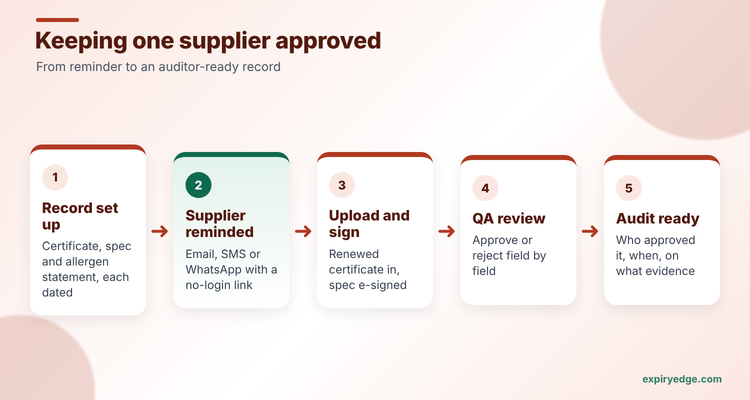
With ExpiryEdge, an auditor never finds a lapsed BRCGS certificate in your approved supplier file, and your QA team stops chasing suppliers by email thread. Renewals arrive before the old certificate runs out, checked and signed, and the file is ready whenever the auditor asks.
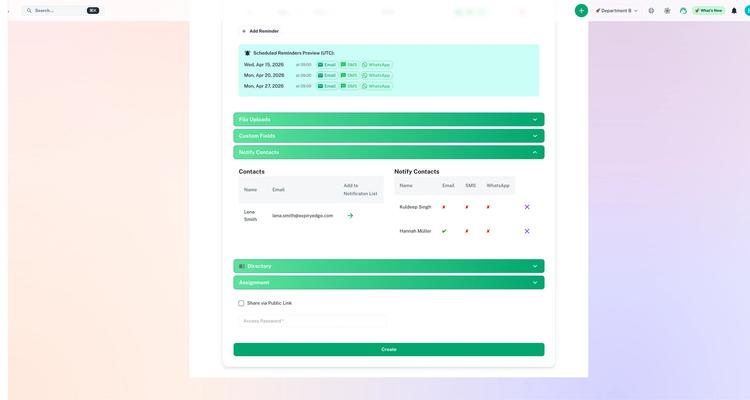
Each supplier gets a record with its GFSI certificate, spec sheet, allergen statement, insurance and letter of guarantee as dated items, built from a custom template with the fields you need. Reminders run on your schedule, say 90, 60, 30 and 7 days, by email, SMS or WhatsApp to the supplier's QA contact and by Slack or Teams to your team. The supplier opens a request link without creating an account, uploads the renewed certificate, answers the allergen questions and signs the spec sheet with a legally binding e-signature, and ExpiryEdge reads the expiry date from the upload. Your reviewer approves or rejects each field with a comment, a rejected field reopens the same link, and requests follow up automatically until complete, up to 200 suppliers per send. If a certificate is a week out and nobody has acted, it escalates to your QA manager, and the exportable audit log shows every request, upload and approval.
Try it with your own suppliers in 15 minutes
- Import your approved supplier list as a CSV with GFSI scheme, certificate expiry and allergen status as custom fields.
- Build a reusable request with an upload slot for the BRCGS or SQF certificate, the allergen questions and an e-signature for the spec sheet, and send it to three suppliers.
- Set a 90/60/30/7-day schedule that emails each supplier's QA contact and escalates to your QA manager a week before a certificate lapses.
Pricing: $29, $49, $99 or $199 a month, by users and dated items. Start with a 14-day free trial, no credit card needed. A plant with 60 suppliers and four dated documents each fits the $49 Pro plan's 250 items, and each plan's limit is on the ExpiryEdge pricing page.
Good to know: ExpiryEdge keeps supplier documents current and works beside a supplier network if you have one. For risk scoring or a COA-per-lot workflow, pair it with TraceGains, FoodLogiQ or SafetyChain. See our document collection feature for how the request links work.
2. TraceGains: best for large ingredient lists
TraceGains' supplier management page says it stores supplier documents and certifications in one system, tracks document expiration dates and lets you set automatic alerts, with 30-day warnings shown in its product shots. It can automate document requests and flag supplier response issues.
The draw is the network. Suppliers join TraceGains Gather for free, and the company says 70 to 80% of a customer's suppliers are typically already on its network. That's a vendor claim, but if it holds for your list, onboarding gets much shorter.
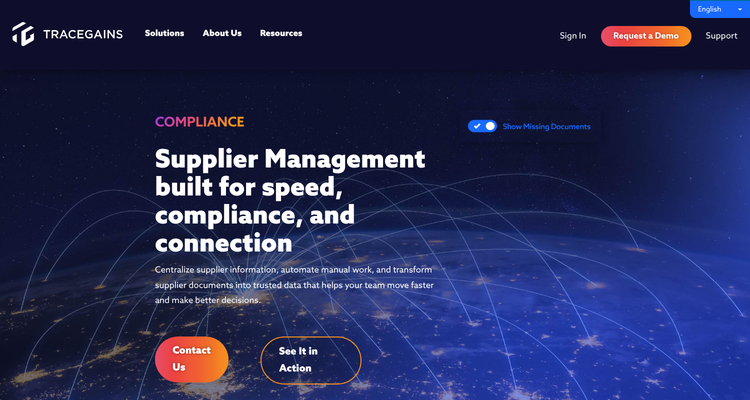
Pricing: not published. The site routes you to a demo request.
Watch out for: the pages we read don't mention GFSI certificates by name or describe integrations beyond "support for data migration, integrations". Ask to see how it handles a certificate that a supplier uploads with the wrong expiry date.
3. Trustwell FoodLogiQ: best for scorecards and approval history
FoodLogiQ is Trustwell's supply chain product. Its Compliance page describes a branded supplier portal where suppliers receive requests, upload documents and complete assessments, with automated to-dos and reminders. It tracks expired documents and GFSI certification records, flags failed audits and feeds audit data into supplier scorecards.
Trustwell says AI converts supplier specs, COAs and audit documents into structured data, and there's a dedicated COA document type. The page says it's trusted by over 2,500 brands.
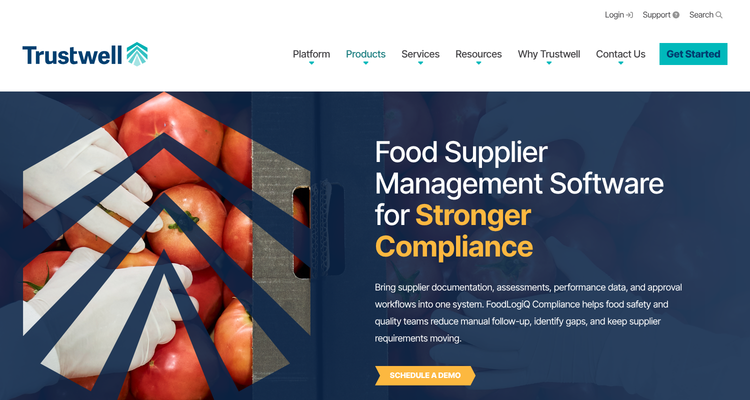
Pricing: not published. You schedule a demo or take a hands-on tour.
Watch out for: suppliers work in a portal, so expect some to need help with their first login.
4. SafetyChain: best if supplier approval sits with plant QA
SafetyChain's supplier management page lists a secure portal where suppliers log in and upload documents, a central store for COAs, organic and GFSI certificates, and document expiration tracking. Workflows notify suppliers before critical documents lapse, and reports cover expired, overdue and upcoming requirements. It also has onboarding and approval workflows, scorecards and supplier corrective action requests.
Pricing: not published. The pricing page says pricing is facility-based with unlimited users, and the Supplier package can be added to any plan or used on its own.
Watch out for: you'll need a sales call. Its strength is plant-floor quality data, so you get most value if you also run its HACCP and GMP checks.
5. ReposiTrak: best if you want someone else to chase suppliers
ReposiTrak's compliance management page says its customer success team engages suppliers on your behalf to collect documents. It sends automated notices for expiration dates, uses OCR and automated document review to check content, and stores COAs. It calls itself the largest compliance network, with 30,000+ suppliers.
Pricing: not published. The site offers a cost calculator and a phone number.
Watch out for: the page doesn't say who pays, you or your suppliers. Ask before you invite 200 of them.
6. Ideagen Safefood 360: best for supplier approval inside a full food safety system
Safefood 360 is now part of Ideagen. Its supplier quality page covers a supplier portal, a pre-assessment step that decides whether a supplier needs a full assessment, configurable audit checklists with scoring, and corrective actions from audits. It sits alongside more than 35 other modules, including HACCP and document control.
Pricing: not published. You request a demo.
Watch out for: the pages we read don't mention certificate expiry alerts. Ask how it warns you when a supplier's GFSI certificate is about to lapse.
7. FoodReady: best for small plants that want consultants too
FoodReady's site says it requests COAs and certificates from suppliers on a schedule, tracks expirations ahead of time, requires QA and procurement sign-off on approvals and gives each supplier a risk score. Higher tiers add a food safety consultant.
Pricing: not published. Its pricing page lists three packages with "Get a Quote" on each.
Watch out for: supplier management isn't listed as a line in the pricing table, so confirm which package includes it.
ExpiryEdge as an alternative to TraceGains
We put ExpiryEdge first because, for a plant with dozens of suppliers rather than hundreds, the work is chasing paper on time. Switch to ExpiryEdge if your problem is chasing paper, not analysing supplier data. A bakery with 40 ingredient suppliers doesn't need a networked marketplace. It needs the flour mill's renewed certificate before the old one lapses, and a text to the mill's QA lead when it doesn't arrive.
ExpiryEdge also covers what sits outside a supplier tool: your own SQF certificate, pest control contract, calibration dates and staff training. One dashboard, one price you can see.
If most of your suppliers are already on TraceGains' network, if you manage specs and formulas at scale, or if you need supplier data to feed product compliance, pair ExpiryEdge with TraceGains. Some plants run both: TraceGains for ingredients, ExpiryEdge for everything with a date around it.
Count supplier documents, then send one real request
Count your active suppliers and the dated documents each one owes you. Sixty suppliers with five documents each is 300 renewals a year, and that number tells you whether a per-facility, per-supplier or per-item price is cheaper.
Then test the chase. Pick a supplier whose certificate expires next month and ask each vendor to show exactly what that supplier receives, whether they need a login, and what happens if they ignore it.
Finally, decide where your own dates live. Our food manufacturing compliance guide covers the full picture, the HACCP software comparison handles monitoring logs, and how supplier compliance tracking works walks through the process. For the setup, see ExpiryEdge for manufacturing.
Frequently asked questions
Yes, when your hazard analysis relies on a supplier to control a hazard. FDA's preventive controls rule then requires a supply-chain program, and those ingredients must come only from approved suppliers. For hazards that could cause serious harm, 21 CFR 117.430 expects an onsite supplier audit at least annually unless you document an alternative.
Most use a supplier portal or tracking tool that stores each certificate with its expiry date and sends reminders. TraceGains, SafetyChain and FoodReady alert before documents lapse. ExpiryEdge sends reminders to your team and the supplier by email, SMS or WhatsApp, with a no-login link to upload the renewal.
Most food-focused vendors, including TraceGains, Trustwell FoodLogiQ, SafetyChain, ReposiTrak, Safefood 360 and FoodReady, quote on request. SafetyChain prices by facility with unlimited users. ExpiryEdge publishes its prices at $29 to $199 a month, with a 14-day free trial and no credit card.
It depends on the tool. FoodLogiQ and SafetyChain use supplier portals, TraceGains uses its free Gather network, and ReposiTrak's team collects documents for you. ExpiryEdge sends a link the supplier opens without an account, which tends to suit small suppliers who upload once a year.
Yes. ExpiryEdge is a simpler option for small plants that mainly need certificates, specs and allergen statements collected and renewed on time, at a published price. FoodReady pairs supplier tracking with consultants. Neither offers TraceGains' supplier network.
It depends on the scheme. SQF certification is valid for one year, so you should expect a new certificate every year. Specs and allergen statements usually renew when a recipe changes or on a review date you set. Ask for renewals 60 to 90 days before expiry.