
Background Check Renewal: How Often to Re-Screen Employees

Federal law sets no background check renewal date for most US employers. Reports do not expire, so your sector sets the clock: DOT carriers review each driver's record every 12 months, Head Start and many child care providers repeat full checks every 5 years, and some states add their own. Everyone else needs a written re-screening policy.
The usual problem: you screened everyone at hire, years have passed, and now an auditor or client asks when you last checked. Nobody knows which roles need re-screening, how often, or whether the old consent form still covers it. This guide gives you the rules by sector, the Fair Credit Reporting Act (FCRA) steps for current staff, and a policy you can adopt this week.
Key takeaways
- Background checks have no legal expiry date. A report shows what was on record on the day it was run.
- Interstate motor carriers must pull and review each driver's motor vehicle record at least once every 12 months (49 CFR 391.25), and query the FMCSA Drug and Alcohol Clearinghouse at least once a year for drivers subject to testing (49 CFR 382.701).
- Head Start programs must repeat the complete background check for each employee, consultant and contractor at least once every five years (45 CFR 1302.90). Child care providers covered by federal CCDF rules must request one at least once every 5 years (45 CFR 98.43).
- The OIG exclusion list is not a legal requirement for most providers, but OIG says monthly screening "best minimizes" liability because the list is updated monthly.
- States add their own clocks, such as every 4 years for Wisconsin community-based residential facility caregivers and every 5 years for Florida level 2 screening.
- Re-screening a current employee is an FCRA "employment purpose". You need a stand-alone disclosure and written authorization, and the adverse action steps apply.
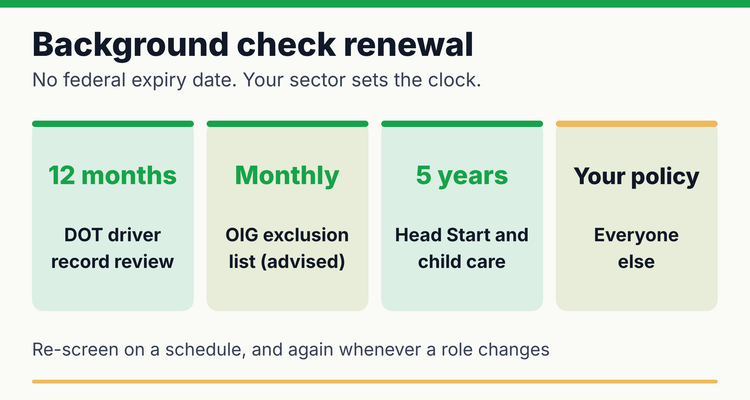 Most US employers have no federal background check renewal date. Where a rule exists, it comes from your sector or state.
Do background checks expire?
No. A background check is a snapshot, and no federal law gives it an expiry date. But a clean report from 2021 says nothing about a conviction in 2025, which is why some regulators set re-check intervals and many employers set their own.
One limit is worth knowing before you re-run old checks. Under the FCRA (15 U.S.C. 1681c), a consumer reporting agency generally cannot report arrest records, civil suits and most other adverse items older than 7 years. Records of convictions are not time-limited by that section. The 7-year limits do not apply to jobs paying $75,000 a year or more, though some states set tighter rules.
How often do regulations require background check renewal?
Only certain sectors have a federal or state renewal interval. The table below compiles the ones we verified against the regulation itself. If your role is not listed, no general federal schedule applies and your policy decides.
Background check renewal intervals by sector (US, last verified 12 October 2026)
| Who | What must be repeated | How often | Official source |
|---|---|---|---|
| Motor carriers (FMCSA-regulated drivers) | Get and review each driver's motor vehicle record | At least once every 12 months | 49 CFR 391.25 |
| Employers of drivers subject to DOT drug and alcohol testing | Query the FMCSA Clearinghouse | At least once per year (full query before hire) | 49 CFR 382.701 |
| Head Start and Early Head Start programs | Complete background check: state or tribal and FBI fingerprint criminal history checks, sex offender registry and child abuse and neglect registry | At least once every five years | 45 CFR 1302.90(b)(5) |
| Child care providers covered by CCDF rules | Request a full criminal background check for each existing staff member | At least once during each 5-year period | 45 CFR 98.43(d)(2); 42 U.S.C. 9858f |
| Health care providers paid by federal programs | Check staff and contractors against the OIG exclusion list (LEIE) | Not set by law; OIG says monthly best minimizes liability | OIG Special Advisory Bulletin (May 2013); OIG exclusions FAQ |
| State Medicaid agencies | Check enrolled providers against the LEIE and federal exclusion lists | No less than monthly | 42 CFR 455.436 |
| Wisconsin community-based residential facilities | Caregiver background check | At hire and every 4 years | Wis. Admin. Code DHS 83.17(1) |
| Florida providers licensed under s. 408.809 (level 2 screening) | Level 2 rescreening (fingerprint-based) | Every 5 years | Fla. Stat. 408.809(2) |
| Texas facilities and agencies under ch. 253 (for example assisted living, home and community support services) | Search the employee misconduct registry and nurse aide registry | Before hire, then annually | Tex. Health & Safety Code 253.008 |
| Most other private employers | Nothing set by federal law | Your written policy | None (policy decision) |
State rules change and many states have similar provisions for other licensed settings, so check your licensing agency's current rule before relying on this list. For the onboarding side of care roles, see our caregiver onboarding checklist.
What does the FCRA require when you re-screen current employees?
If you use a consumer reporting agency (a background screening company), the FCRA applies to re-screening just as it does at hire. The Federal Trade Commission (FTC) says the rules cover consumer reports used for "hiring, retention, promotion or reassignment". Follow these steps in order.
- Give a stand-alone disclosure. Before the report is ordered, tell the employee in writing, in a document that consists only of that disclosure, that a report may be obtained (15 U.S.C. 1681b(b)(2)).
- Get written authorization. If you want one signature to cover checks throughout employment, the FTC says to "say so clearly and conspicuously" on the form. If your old form only covered hiring, get a new one.
- Certify to the screening company that you complied. Vendors usually build this into ordering.
- Before any adverse action, send a pre-adverse action notice with a copy of the report and the official "Summary of Your Rights Under the Fair Credit Reporting Act" (15 U.S.C. 1681b(b)(3)). Then give the employee time to dispute errors before you decide. The statute sets no waiting period; many employers allow 5 business days, which is common practice rather than a rule.
- If you go ahead, send the adverse action notice. It must give the screening company's name, address and phone number, say the company did not make the decision, and explain the right to dispute and to a free report if requested within 60 days (15 U.S.C. 1681m(a)).
- Dispose of reports securely when you no longer need them. The FTC says you must securely dispose of the report and any information you gathered from it.
For criminal records, 15 U.S.C. 1681k requires the screening company either to notify the person when it reports damaging public records, or to keep strict procedures so those records are complete and up to date. Ask your vendor which it uses. Many states and cities also have fair chance laws that limit how you use records, so have your policy reviewed locally.
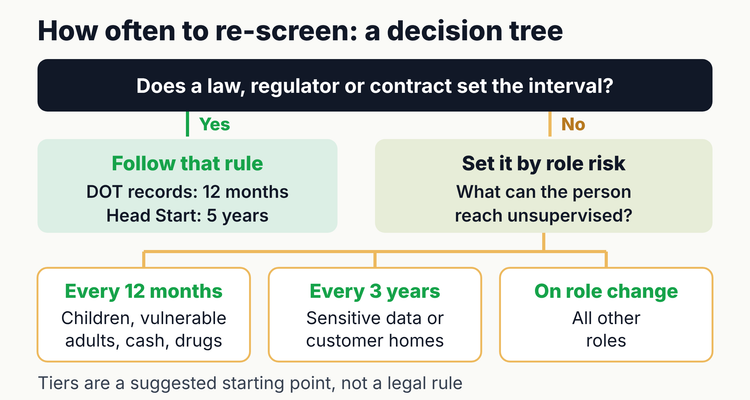 Start with the rule that binds you. Where none exists, a risk tier sets the interval. The tiers are our suggestion, not law.
How do you write a background check renewal policy?
A good re-screening policy answers four questions for every role: what is checked, how often, what triggers an early check, and who acts on the result. Build it in this order.
- List every role and its checks: county criminal, federal, motor vehicle record, registry or fingerprint.
- Mark any legal interval from the table above, plus any interval in client contracts or payer agreements. These override your own tiers.
- Set a risk tier for the rest. As a starting point (our suggestion), re-screen every 12 months for unsupervised access to children, vulnerable adults, cash, drugs or vehicles; every 3 years for access to sensitive data or customer homes; and on role change for everyone else.
- Fix your consent forms. Make the authorization cover checks throughout employment, in a stand-alone form.
- Define early triggers: promotion or transfer into a higher tier, a self-disclosed arrest or conviction, or a client request.
- Name an owner and a backup for each step, and write the adverse action process into the policy.
- Record every check: date run, scope, vendor reference, result and decision. Keep the result itself in a restricted file.
Background check re-screening policy template
Copy this into your handbook and fill in the brackets. Have it reviewed against your state's law before you adopt it.
1. Purpose. [Company] re-screens staff and contractors in designated roles so our checks stay current, at all locations.
2. Legal intervals. Where a law, regulator or contract sets an interval, we follow it: [for example, DOT drivers: driving record review every 12 months].
3. Risk tiers. Tier 1 roles [list] are re-screened every 12 months. Tier 2 roles [list] every [36] months. Tier 3 roles are re-screened when they move into a Tier 1 or Tier 2 role.
4. Exclusion checks. [If you bill federal health programs:] we check all staff and contractors against the OIG exclusion list before hire and monthly.
5. Consent. We obtain a stand-alone disclosure and written authorization covering checks during employment.
6. Self-disclosure. Employees in Tier 1 and Tier 2 roles must tell [HR contact] about any arrest, charge or conviction within [5] working days.
7. Results. [HR lead] reviews results using our written criteria. Before any adverse action we send a copy of the report and the FCRA Summary of Rights, and wait [5] business days.
8. Records. We log the date, scope and outcome of each check, restrict access to reports, and dispose of them securely.
9. Review. [Owner] reviews this policy every 12 months and when a law or contract changes.
Do this now: a 60-minute re-screening audit
For up to 50 employees this takes about an hour (our estimate).
- Export your staff list with role, location and hire date (10 minutes).
- Add the last check date and type for each person from your screening vendor's portal (20 minutes).
- Tag each role with its legal interval or policy tier (10 minutes).
- Paste in the formulas below and sort by Status (10 minutes).
- Order checks for everyone marked OVERDUE, after confirming each has a valid authorization on file (10 minutes).
Re-screening tracker: columns and row 2 formulas (Excel or Google Sheets)
| Column | Heading | Row 2 |
|---|---|---|
| A | Employee | Name |
| B | Role | Job title |
| C | Interval (months) | 12, 36 or 60 from the table or your tiers; 0 if re-screen on role change only |
| D | Last full check | Date the last report was completed |
| E | Next re-screen due | =IF(OR(D2="",C2=0),"",EDATE(D2,C2)) |
| F | Days left | =IF(E2="","",E2-TODAY()) |
| G | Ongoing authorization on file? | Yes or No |
| H | Last exclusion check (health care only) | Date |
| I | Status | =IF(A2="","",IF(G2<>"Yes","GET CONSENT",IF(AND(H2<>"",TODAY()-H2>31),"EXCLUSION CHECK DUE",IF(F2="","OK",IF(F2<0,"OVERDUE",IF(F2<=60,"ORDER SOON","OK")))))) |
Worked example: a home health aide last checked on 15 January 2026 sits in a 12-month tier. Column E returns 15 January 2027, and from 16 November 2026 the status reads ORDER SOON, leaving time for fingerprint appointments. The 60-day lead time is our advice, not a rule.
Prefer a ready-made sheet? Our free staff training matrix template already handles expiry dates per person, so you can add a "Background re-screen" column alongside training and certificates.
How can you do better than the minimum?
- Re-screen on change, not just the calendar. A move into a cash-handling or patient-facing role is a better trigger than an anniversary.
- Keep the scope the same. Re-run the original package so results are comparable year on year.
- Separate the clocks. Monthly exclusion checks, annual driving records and 5-year fingerprints need separate dates, not one "background" date.
- Store the decision, not just the report. Auditors ask who reviewed the result and why the person was cleared.
💡 Pro Tip
Multi-site care and staffing employers we work with tend to keep one screening record per person, with the next re-screen as a recurring record and the monthly exclusion check as a checklist step. When a check is done, they renew the record as a copy, which keeps the history and resets the date in one step.
What happens if you miss a re-screen or skip the FCRA steps?
⚠️What happens if you miss it: an employer who willfully breaks the FCRA can owe each affected person actual damages or statutory damages of $100 to $1,000, plus punitive damages and legal fees (15 U.S.C. 1681n). In health care, federal programs will not pay for items or services furnished by an excluded person, and that payment bar applies to anyone who employs or contracts with them, with overpayment and civil monetary penalty exposure (OIG). In Florida, level 2 rescreening is a condition of continuing in the job (Fla. Stat. 408.809(2)).
Spreadsheet or software for background check renewal?
A spreadsheet like the one above is enough if one person owns it, you have a few dozen employees, and there is only one interval to track per person.
It gets harder when the clocks multiply: monthly exclusion checks, annual driving records, 5-year fingerprints, plus the training and licenses in our employee certification tracking guide. That is where reminders that reach the right owner, and a record of who did what, earn their place. ExpiryEdge tracks each check as a record with an owner and a backup owner, sends reminders at 90, 60, 30 and 7 days by email, SMS, Slack or Teams, and keeps an audit trail. If you place workers with clients, our staffing agency compliance checklist covers the extra contract layer, and UK readers should see DBS check renewal and the Update Service.
Background check renewal checklist
- ✓
Every role tagged with a legal interval or a policy tier
- ✓
Consent forms are stand-alone and cover checks during employment
- ✓
Next re-screen date calculated for every employee
- ✓
Monthly exclusion checks scheduled (health care employers)
- ✓
Driving record reviews and Clearinghouse queries on a 12-month cycle (DOT carriers)
- ✓
Early triggers written down, and a policy owner named
Frequently asked questions
Do background checks expire?
No. US law gives background check reports no expiry date. A report reflects records on the day it was run, so regulators in some sectors, and many employers, set a date to repeat it.
Is there a federal law on how often to re-screen employees?
Not for most employers. Specific rules exist for some sectors, such as annual driving record reviews for motor carriers (49 CFR 391.25) and complete checks at least every five years for Head Start programs (45 CFR 1302.90). Otherwise your written policy sets the interval.
Do I need new consent to re-run a background check on a current employee?
You need a valid FCRA disclosure and written authorization before each report. One signed authorization can cover checks during employment if it says so clearly and conspicuously, according to the FTC. If your form only mentions hiring, get a new one.
How often should health care employers check the OIG exclusion list?
OIG says providers are not required by statute or regulation to check the list, but because it is updated monthly, monthly screening best minimizes overpayment and penalty liability. CMS has also recommended that states require providers to screen employees and contractors monthly, so check your state Medicaid rules.
Do DOT drivers need an annual background check?
Motor carriers must get and review each driver's motor vehicle record at least once every 12 months. Employers of drivers subject to drug and alcohol testing must also query the FMCSA Clearinghouse at least once a year.
Sources
- 15 U.S.C. 1681b, permissible purposes; employment disclosure, authorization and adverse action (govinfo, 2024 edition)
- 15 U.S.C. 1681c, information excluded from consumer reports
- 15 U.S.C. 1681k, public record information for employment purposes
- 15 U.S.C. 1681m, duties of users taking adverse actions
- 15 U.S.C. 1681n, civil liability for willful noncompliance
- FTC, Using Consumer Reports: What Employers Need to Know
- CFPB, Regulation V Appendix K: Summary of Consumer Rights
- 49 CFR 391.25, annual inquiry and review of driving record
- 49 CFR 382.701, Drug and Alcohol Clearinghouse queries
- 45 CFR 1302.90, Head Start personnel policies (background checks)
- 45 CFR 98.43, CCDF criminal background checks
- 42 U.S.C. 9858f, criminal background checks (CCDBG Act)
- 42 CFR 455.436, federal database checks by State Medicaid agencies
- HHS-OIG, Updated Special Advisory Bulletin on the Effect of Exclusion (May 2013)
- HHS-OIG, Exclusions FAQ
- Wisconsin Admin. Code DHS 83.17, caregiver background checks
- Florida Statutes 408.809, background screening
- Texas Health and Safety Code chapter 253 (section 253.008)
Last reviewed: 12 October 2026
Frequently asked questions
Not for most employers. Specific rules exist for some sectors, such as annual driving record reviews for motor carriers (49 CFR 391.25) and complete checks at least every five years for Head Start programs (45 CFR 1302.90). Otherwise your written policy sets the interval.
You need a valid FCRA disclosure and written authorization before each report. One signed authorization can cover checks during employment if it says so clearly and conspicuously, according to the FTC. If your form only mentions hiring, get a new one.
OIG says providers are not required by statute or regulation to check the list, but because it is updated monthly, monthly screening best minimizes overpayment and penalty liability. CMS has also recommended that states require providers to screen employees and contractors monthly, so check your state Medicaid rules.
Motor carriers must get and review each driver's motor vehicle record at least once every 12 months. Employers of drivers subject to drug and alcohol testing must also query the FMCSA Clearinghouse at least once a year.


