
DBS Check Renewal: Update Service Rules and a Recheck Policy

DBS check renewal is an employer decision, because DBS certificates have no official expiry date. Unless sector rules apply, you choose when to recheck. The simplest way to keep checks current is the DBS Update Service: £15 a year (free for volunteers), joined within 30 days of the certificate's issue, with free status checks for employers.
Here is the usual situation: half your staff were checked years ago, a few are on the Update Service, and an inspector or commissioner asks how you know their checks are still current. This guide explains how the Update Service works, what each sector expects, and gives you a recheck policy you can adopt.
Key takeaways
- DBS certificates do not expire. GOV.UK says it is up to the employer to decide when a new check is needed.
- From 5 October 2026, fees fell: basic and standard checks £20, enhanced £41, and the Update Service £15 a year (from £16).
- Join the Update Service within 30 days of the certificate's issue date, or at application stage using the application reference. A reprint does not restart the 30 days.
- Status checks are free and instant for employers, but need the person's consent, the same level and workforce of check, and sight of the original certificate.
- DBS will not tell you about a change. It searches weekly for new convictions and barring decisions, but you must run the status check.
- Sector rules differ: schools recheck existing staff only in set cases, NHS Employers leaves periodic checks to local policy, and CQC expects providers to regularly review staff fitness.
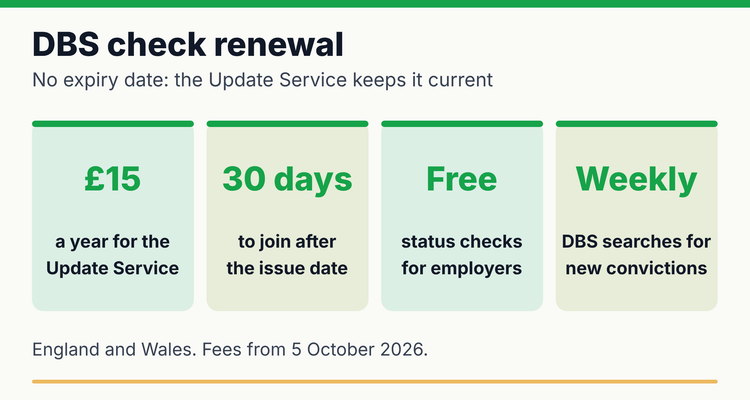 DBS certificates never expire. The Update Service and a written recheck policy keep them current.
Do DBS checks expire?
No. GOV.UK says "A DBS check has no official expiry date. Any information included will be accurate at the time the check was carried out. It's up to you to decide when a new check is needed." The employer guidance adds that you should look at the certificate's date of issue when deciding, and that some sectors require a new check periodically.
This applies to DBS checks in England and Wales. Scotland and Northern Ireland run separate systems: in Scotland, mygov.scot says PVG scheme membership lasts for five years.
How much does a DBS check cost in 2026?
DBS cut its fees on 5 October 2026. Registered bodies and umbrella bodies may add their own admin fee on top.
DBS fees from 5 October 2026 (England and Wales, last verified 12 October 2026)
| Product | Fee | Previous fee | Official source |
|---|---|---|---|
| Basic DBS check | £20 | £21.50 | GOV.UK news, 9 Sep 2026; Check someone's criminal record |
| Standard DBS check | £20 | £21.50 | Same |
| Enhanced DBS check | £41 | £49.50 | Same |
| Enhanced with barred list check(s) | £41 | £49.50 | Check someone's criminal record |
| DBS Update Service | £15 a year | £16 | GOV.UK news; DBS Update Service employer guide (5 Oct 2026) |
| Volunteer checks and Update Service for volunteers | Free | Free | GOV.UK news; DBS Update Service page |
| DBS Adult First (care roles, on top of the enhanced check) | £6 | Not stated | Check someone's criminal record |
Watch out for older pages that still show the previous fees of £21.50, £49.50 and £16. The September 2026 announcement is the current statement.
How does the DBS Update Service work?
The Update Service lets a person keep a standard or enhanced certificate up to date and lets employers check it online. It does not work with basic checks. Here is the process from both sides.
- The applicant joins, either while applying (using the application form reference, with the form reaching DBS within 28 days) or within 30 days of the certificate's issue date.
- DBS keeps searching. It checks for new convictions and barred list decisions weekly, and for new non-conviction police information every 9 months.
- The employer sees the original certificate once, checks ID, and gets the person's consent. Copies and video calls do not count.
- The employer runs free status checks on GOV.UK, entering the certificate number, the holder's surname and date of birth. No account or fee is needed.
- The subscription renews yearly. The holder can auto-renew or renew up to 30 days before it ends. If it lapses, they need a new check and a new subscription.
You can only run a status check if you could legally ask for the same level of check, for the same workforce (child, adult or other), for the role. DBS's own example: a care home recruiting for adult work cannot status-check a certificate that includes the children's barred list, so it must ask for a new check.
DBS status check results and what to do
| Result on screen | What it means | Your next step |
|---|---|---|
| "did not reveal any information and remains current" | Certificate was blank and nothing new has been found | Record the date and result |
| "remains current as no further information has been identified" | Certificate showed information, and nothing new has been found | Record the date and result |
| "is no longer current. Please apply for a new DBS check" | DBS has confirmed new information that a new check would show | Talk to the person and apply for a new check |
| "The details entered do not match" | Not subscribed, certificate removed, or a typing error | Check the details, then ask whether they are still subscribed |
If someone leaves, moves to a role without the same entitlement, or withdraws consent, you must stop status checks. DBS says continuing would break the law.
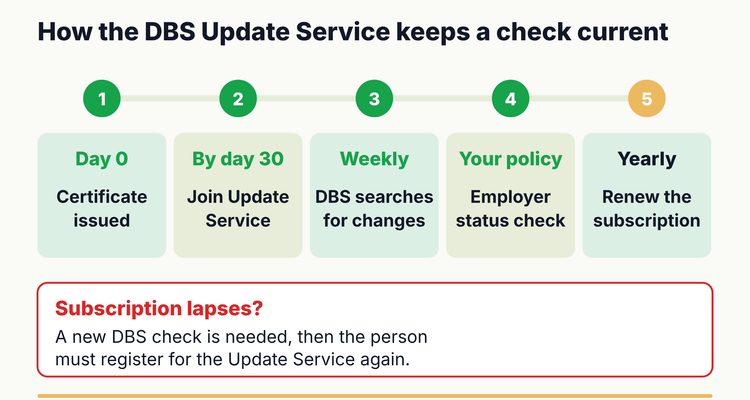 The Update Service keeps one certificate current for as long as the subscription is renewed.
How often should you renew DBS checks in each sector?
DBS sets no frequency. Its employer guide says there is no prescribed frequency for status checks and that organisations should set a risk-based schedule. Some sector bodies add more detail.
DBS recheck rules by sector (England, last verified 12 October 2026)
| Sector | What the guidance says | Source |
|---|---|---|
| All employers | No official expiry. Decide when a new check is needed. Status check frequency should be risk-based | GOV.UK; DBS Update Service employer guide |
| Schools and colleges | New checks on existing staff only when moving into regulated activity, after a break in service of 12 weeks or more, or if there are suitability concerns. Many require the Update Service as good practice | Keeping children safe in education 2026, paras 329 and 425 |
| NHS employers | Periodic checks are not a legal requirement and frequency is a local decision. Agency workers not on the Update Service should have an annual DBS check as a contract condition. Trainee doctors not subscribed need a check at least every three years | NHS Employers criminal record check standard (July 2026), 5.1, 5.2.2, 5.3.2 |
| CQC-registered care providers | Providers must regularly review the fitness of employees | CQC Regulation 19 guidance (updated 16 May 2025) |
| Childminders registering with Ofsted | Ofsted only accepts a certificate within 3 months of issue unless you are on the Update Service, which it strongly recommends | GOV.UK: DBS checks for childminders and childcare workers |
For a US workforce, the equivalent rules are in our background check renewal policy guide.
What should a DBS recheck policy say?
Your policy should set a status check interval for subscribers, a new check interval for everyone else, and the triggers for an early check. Here is a template. The intervals in brackets are examples for you to set by risk.
1. Scope. This policy covers all staff and volunteers in roles eligible for a standard or enhanced DBS check at [Organisation].
2. Update Service. We ask new starters in eligible roles to join the Update Service within 30 days of their certificate's issue. [We pay the £15 fee with their permission.]
3. Status checks. With consent, we run a status check every [6 / 12] months for subscribers, and record the date and result.
4. New checks. For staff not on the Update Service, we request a new check every [3] years.
5. Early checks. We check again when someone moves into regulated activity or a role needing a higher level or different workforce, returns after a break of [12 weeks] or more, changes name, or when concerns arise.
6. Changes. If a status check shows a change, [Manager] meets the person and we apply for a new check. We risk-assess any interim arrangements.
7. Records. We keep the certificate number, issue date, level, workforce, position applied for and our decision. We do not keep copies of certificates, unless a regulator entitles us to, and we keep certificate information no longer than necessary.
8. Leavers. We stop status checks when someone leaves or withdraws consent.
9. Review. [Owner] reviews this policy every 12 months.
Clause 7 follows DBS's sample policy on handling certificate information, which allows you to keep the issue date, name, certificate type, position, certificate number and the recruitment decision. Many organisations' policies still use a fixed six-month limit for certificate information; the current DBS sample says "no longer than is necessary" instead.
Do this now: a 45-minute DBS audit
For up to 50 staff this takes about 45 minutes (our estimate).
- List everyone in an eligible role with their certificate number, issue date, level and workforce (15 minutes).
- Ask who is on the Update Service and when their subscription renews (10 minutes, by email).
- Run status checks for subscribers who consent; GOV.UK has a multiple status checking service for larger batches (10 minutes).
- Flag anyone without a check at the right level or workforce for a new application (10 minutes).
DBS recheck tracker: columns and row 2 formulas (Excel or Google Sheets)
| Column | Heading | Row 2 |
|---|---|---|
| A | Name | Staff member |
| B | Certificate issue date | Date |
| C | Join Update Service by | =IF(B2="","",B2+30) |
| D | On Update Service? | Yes or No |
| E | Subscription renews | Date the person gives you |
| F | Last status check | Date |
| G | Next status check | =IF(D2<>"Yes","",IF(F2="",TODAY(),EDATE(F2,12))) |
| H | Next new check (non-subscribers) | =IF(D2="Yes","",EDATE(B2,36)) |
| I | Status | =IF(A2="","",IF(AND(D2<>"Yes",C2>=TODAY()),"ASK TO JOIN",IF(AND(D2="Yes",E2<>"",E2-TODAY()<=30),"REMIND TO RENEW",IF(MIN(G2,H2)-TODAY()<=30,"CHECK DUE","OK")))) |
Change the 12 and 36 in columns G and H to your policy intervals. Worked example: a certificate issued on Monday 2 November 2026 must be added to the Update Service by Wednesday 2 December 2026, which column C shows. The 30-day reminder before renewal is our advice.
You can also add these columns to our free staff training matrix template, so DBS dates sit next to training and certificates.
How can you do better than the minimum?
- Pay the subscription for staff. DBS allows an employer to pay with the person's permission, though it gives you no access to their account.
- Remind staff before renewal. NHS Employers notes that any lapse ends automatic updates and means a new check is needed.
- Recheck identity every couple of years. DBS's own worked example describes a school that checks status every 6 months and re-checks staff identity every 2 years to catch name changes.
- Use Adult First for care roles. For £6 extra, it usually confirms within 2 days whether a new care worker can start under supervision.
💡 Pro Tip
Care providers we work with typically hold one record per staff member with the certificate number, issue date and Update Service renewal date, and run the status check as a recurring checklist task. When the subscription renews, the record is renewed as a copy, so the history stays in one place.
What happens if you miss a DBS recheck?
⚠️What happens if you miss it: allowing a person you know, or have reason to believe, is barred to work in regulated activity is a criminal offence under section 9 of the Safeguarding Vulnerable Groups Act 2006, with up to five years' imprisonment, a fine or both on indictment. The same section makes it an offence for an agency to supply a barred worker for regulated activity. If an Update Service subscription lapses, the person needs a new DBS check and must register again (GOV.UK).
Spreadsheet or software for DBS check renewal?
A spreadsheet is fine for a small team with one manager who runs status checks on a fixed day each quarter.
It gets harder across several sites, with agency and bank staff, or when subscriptions renew on dozens of different dates. Then you need reminders to the right manager and the staff member, and a log of each status check. ExpiryEdge tracks each check as a record with an owner and a backup owner, sends reminders at 90, 60, 30 and 7 days by email, SMS, Slack or Teams, and keeps an audit trail. See the wider employee certification tracking guide, and if you supply workers to clients, our staffing agency compliance checklist.
DBS check renewal checklist
- ✓
Everyone in an eligible role has a certificate at the right level and workforce
- ✓
Issue dates and certificate numbers recorded
- ✓
Update Service joiners within 30 days of issue
- ✓
Status check interval written into policy
- ✓
New check interval set for non-subscribers
- ✓
Early triggers listed: role change, break in service, name change, concerns
- ✓
Status checks stopped for leavers
Frequently asked questions
Do DBS checks expire?
No. DBS certificates have no official expiry date. The information is accurate on the date of issue, and the employer decides when a new check is needed, unless sector rules set an interval.
How much does the DBS Update Service cost?
£15 a year from 5 October 2026, reduced from £16. It is free for volunteers. Employers pay nothing to run status checks.
Can you join the DBS Update Service after 30 days?
No. You must join within 30 days of the certificate's issue date, and a reprint does not restart the clock. After that, you would need a new DBS check to subscribe.
Can an employer run a DBS status check without consent?
No. You need the person's consent, a legal entitlement to the same level of check for the same workforce, and you must have seen the original certificate. Every check shows in the person's Update Service account.
How often should care homes renew DBS checks?
No national interval is set. CQC expects providers to regularly review the fitness of staff, so set a risk-based schedule, for example yearly status checks for subscribers and a new check every few years for others.
Can a basic DBS check go on the Update Service?
No. The Update Service is only for standard and enhanced checks. Basic check holders use a DBS online account instead.
Does the DBS Update Service work in Scotland?
DBS covers England and Wales. Scotland uses Disclosure Scotland and the PVG scheme, and mygov.scot says PVG scheme membership lasts for five years.
Sources
- GOV.UK, DBS reduces fees for checks and Update Service from 5 October 2026 (9 Sep 2026)
- GOV.UK, Check someone's criminal record as an employer
- GOV.UK, DBS Update Service
- DBS, Update Service: employer guide (updated 5 Oct 2026)
- DBS, DBS checks guidance for employers (updated 5 Oct 2026)
- DBS, A guide for parents and carers employing workers (updated 17 Sep 2026)
- DBS, Handling of DBS certificate information
- Department for Education, Keeping children safe in education 2026
- NHS Employers, Criminal record checks standard (July 2026)
- CQC, Regulation 19: Fit and proper persons employed (updated 16 May 2025)
- GOV.UK, DBS checks for childminders and childcare workers
- Safeguarding Vulnerable Groups Act 2006, section 9
- mygov.scot, PVG scheme
Last reviewed: 12 October 2026
Frequently asked questions
£15 a year from 5 October 2026, reduced from £16. It is free for volunteers. Employers pay nothing to run status checks.
No. You must join within 30 days of the certificate's issue date, and a reprint does not restart the clock. After that, you would need a new DBS check to subscribe.
No. You need the person's consent, a legal entitlement to the same level of check for the same workforce, and you must have seen the original certificate. Every check shows in the person's Update Service account.
No national interval is set. CQC expects providers to regularly review the fitness of staff, so set a risk-based schedule, for example yearly status checks for subscribers and a new check every few years for others.
No. The Update Service is only for standard and enhanced checks. Basic check holders use a DBS online account instead.
DBS covers England and Wales. Scotland uses Disclosure Scotland and the PVG scheme, and mygov.scot says PVG scheme membership lasts for five years.


