
Staffing Agency Compliance Checklist: Every Candidate, Every Date

Staffing agency compliance means verifying each candidate before a placement starts and keeping those checks current while they work. If your agency employs the worker, Form I-9 Section 1 is due on day one and Section 2 within three business days. Then run E-Verify where required, screen to the client's standard, and track every expiry per candidate.
Sound familiar? A client asks for proof that every worker on site has a current license, a clear background check and an I-9 on file, and your answers live in three systems and a recruiter's inbox. This checklist sorts what the law requires, what clients add, and how to track it all per candidate.
Key takeaways
- The I-9 belongs to the employer. When your agency hires and pays the worker, you complete it: Section 1 at the time of hire, Section 2 within three business days (8 CFR 274a.2).
- Reverify work authorization no later than the date it expires. Otherwise the person may no longer be employed.
- Keep each I-9 for three years after hire or one year after employment ends, whichever is later.
- E-Verify is voluntary federally, but federal contractors with the FAR clause and employers in states such as Arizona (all employers) and Florida (private employers with 25 or more staff) must use it.
- OSHA treats the agency and the host employer as joint employers of temporary workers for safety, so training and equipment duties are shared.
- Client requirements are contractual. Drug screens, look-back periods and card types vary by client, so record them per client and track expiries per candidate.
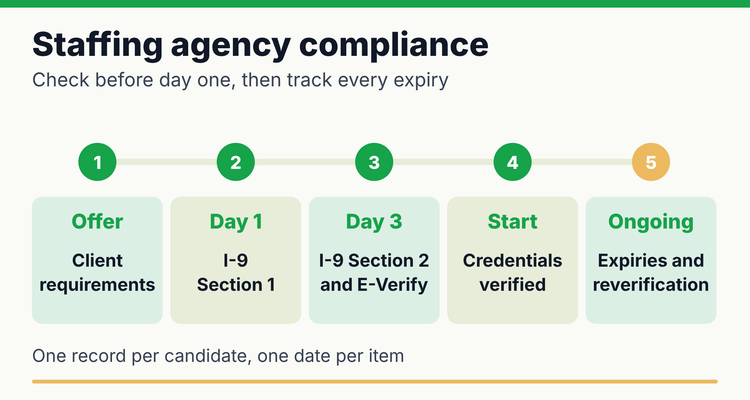 Most staffing compliance happens in the first three business days. The rest is keeping dates current for every candidate.
What does staffing agency compliance cover?
Staffing agency compliance has two layers: duties your agency carries as an employer and business, and checks you run on each candidate for each placement. Both need owners and dates.
- Agency level: state registration or licensing where required, E-Verify enrollment where required, FCRA (Fair Credit Reporting Act) processes for background checks, and shared OSHA (Occupational Safety and Health Administration) duties with host employers.
- Candidate level: identity and work authorization, background screening, licenses and certifications, health items such as drug screens, and client-specific training.
Registration varies by state. For example, the Illinois Department of Labor says its Day and Temporary Labor Services Act "requires certain staffing or temporary labor agencies to register" before operating in Illinois, with proof of a surety bond for new and renewal applications. Check your own state labor department before you open a new market.
Who completes the I-9 when a staffing agency places a worker?
The I-9 duty sits with whoever hires the worker. In temp staffing, where your agency employs and pays the worker, that is your agency. For other industries, the rules for recruiters and referrers for a fee apply only to agricultural associations, agricultural employers and farm labor contractors (8 CFR 274a.2(a)(1)), so in a direct-hire placement the client completes its own I-9.
Form I-9 rules for staffing agencies (last verified 12 October 2026)
| Requirement | Deadline or rule | Source |
|---|---|---|
| Section 1, completed by the worker | At the time of hire | 8 CFR 274a.2(b)(1)(i)(A) |
| Section 2, completed by the employer after examining documents | Within three business days of the hire | 8 CFR 274a.2(b)(1)(ii)(B) |
| Reverification when work authorization expires | No later than the date it expires | 8 CFR 274a.2(b)(1)(vii) |
| Retention | 3 years after hire or 1 year after employment ends, whichever is later | 8 CFR 274a.2(b)(2); USCIS Form I-9 page |
| Form edition | 01/20/25 edition; the 08/01/23 edition with a 05/31/2027 expiry may also be used | USCIS Form I-9 page (reviewed 3 June 2026) |
| Paperwork penalty | $288 to $2,861 per form, for penalties assessed after 3 July 2025 | 28 CFR 85.5 |
To reverify, the worker presents a document that shows continuing work authorization or a new grant of it, and you record its number and expiry date (8 CFR 274a.2(b)(1)(vii)). Track the work permit date, not every document on the form.
Does a staffing agency have to use E-Verify?
Not under federal law in general. E-Verify becomes mandatory through federal contracts, state law or a client contract. Where you use it, create each case no later than the third business day after the employee starts work for pay, using the completed I-9 (E-Verify).
When E-Verify is required (examples, last verified 12 October 2026)
| Trigger | Who must use it | Timing | Source |
|---|---|---|---|
| Federal contract with the FAR E-Verify clause | The contractor, for new hires and for employees assigned to the contract | Enroll within 30 days of award. New hires within 3 business days of hire; assigned staff within 90 days of enrollment or 30 days of assignment, whichever is later | FAR 52.222-54 |
| Arizona | Every employer, after hiring an employee | Keep the record for the length of employment or 3 years, whichever is longer | A.R.S. 23-214 |
| Florida | Public agencies, and private employers with 25 or more employees (from 1 July 2023) | Within 3 business days after the new employee starts work for pay | Fla. Stat. 448.095(2) |
| Client contract | As written in the contract | As written | Your contract |
Other states have their own E-Verify laws, and thresholds differ, so check each state where you employ workers.
What should a staffing agency check before and during each placement?
Use this as your master checklist. It combines federal rules, sector rules and the items clients most often add by contract. Rows marked "contract" are not legal requirements.
Staffing agency compliance checklist: what, when and how often
| Item | When | Repeat or expiry | Basis |
|---|---|---|---|
| Form I-9 | Day one (Section 1); day three (Section 2) | Reverify by the work permit expiry date | 8 CFR 274a.2 |
| E-Verify case | By the third business day after work for pay starts | Once per hire | Where required (see above) |
| Background check: FCRA disclosure and authorization | Before ordering the report | New form if yours does not cover checks during employment | 15 U.S.C. 1681b(b)(2); FTC |
| Background check: pre-adverse and adverse action notices | Before and after any adverse decision | Each time | 15 U.S.C. 1681b(b)(3), 1681m |
| OIG exclusion list (health care placements) | Before placement | Monthly recommended; not required by statute or regulation | OIG Special Advisory Bulletin (2013) |
| Nurse license | Before placement | Board expiry date; free alerts via Nursys e-Notify | State board; NCSBN |
| BLS card (American Heart Association) | Before placement | Valid for two years | AHA BLS course page |
| Driving record (placing CMV drivers with a motor carrier) | Before hire | Reviewed at least every 12 months | 49 CFR 391.25 |
| Child care or Head Start placements | Before unsupervised access | Full check at least every 5 years | 45 CFR 98.43; 45 CFR 1302.90 |
| Site safety training | Before work starts | Per hazard and standard | OSHA, shared with the host employer |
| Drug screen, look-back period, extra checks | As the client specifies | As the client specifies | Contract |
For re-screening intervals by sector and a policy you can adopt, see our background check renewal policy guide.
Are staffing agencies and clients joint employers?
For workplace safety, yes. OSHA says the staffing agency and the host employer "are joint employers of temporary workers and, therefore, both are responsible for providing and maintaining a safe work environment." In practice the host usually trains on site-specific hazards, and the agency checks that the client has done so. Agree who does what in writing.
Joint employment under wage and labor laws is a separate legal question with its own tests, so take advice on it rather than assuming OSHA's position carries across.
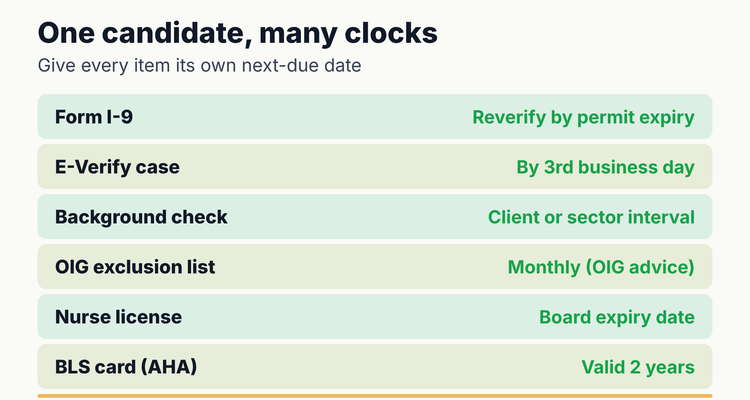 One candidate, many clocks. Each item needs its own next-due date.
How do you track compliance expiries per candidate?
Use one row per candidate per item, not one row per candidate. A wide sheet with a column for every credential breaks as soon as clients ask for different things. A long list lets you filter by candidate, client or item, and sort by the next date.
Per-candidate expiry tracker: columns and row 2 formulas (Excel or Google Sheets)
| Column | Heading | Row 2 |
|---|---|---|
| A | Candidate | Name |
| B | Client | Client name, or "All" for agency-wide items |
| C | Item | For example: I-9 reverification, RN license, BLS, background check, OIG check |
| D | Completed or issued | Date |
| E | Expires (if printed) | Date from the document, or blank |
| F | Recheck every (months) | From law, policy or contract, or blank |
| G | Next due | =IF(AND(E2="",F2=""),"",IF(E2="",EDATE(D2,F2),IF(F2="",E2,MIN(E2,EDATE(D2,F2))))) |
| H | Days left | =IF(G2="","",G2-TODAY()) |
| I | Status | =IF(G2="","NO DATE",IF(H2<0,"EXPIRED: REMOVE FROM SHIFT",IF(H2<=30,"RENEW NOW",IF(H2<=90,"REQUEST DOCS","OK")))) |
| J | Owner | Recruiter or compliance lead |
Worked example: a nurse's BLS card was issued on 10 March 2025 and says it is valid to March 2027. Enter the printed date in column E and leave F blank, and column G uses it. For the monthly OIG check, put the last check date in D and 1 in F; G returns the same day next month. The 90 and 30 day thresholds are our advice.
Then build a summary tab with COUNTIFS on column I, by client, so you can answer "is everyone on site compliant today?" in one line.
Do this now: a placement-ready audit in 90 minutes
For up to 40 active placements, this takes about 90 minutes (our estimate).
- Pull your active placements with candidate, client and start date (10 minutes).
- Check every I-9 for a completed Section 2 within three business days, and list any work permit expiring in the next 90 days (30 minutes).
- Open each client contract and note its required checks, look-back periods and card types in one row per client (20 minutes).
- Fill the tracker with one row per candidate per required item (20 minutes).
- Act on the reds: request documents for anything under 90 days and take anyone expired off the schedule until fixed (10 minutes).
How can a staffing agency go beyond the minimum?
- Collect documents before the offer is final. A credential that expires in week two of a 13-week contract should be renewed before day one.
- Use free primary-source alerts. NCSBN says Nursys e-Notify sends license status changes and expiration updates from boards of nursing free of charge.
- Keep a client requirements matrix. One row per client, listing checks, intervals and card types, stops recruiters from guessing.
- Send clients a monthly compliance summary. It answers audit requests before they arrive and shows which dates are coming up.
💡 Pro Tip
Staffing firms we work with keep one screening record per placed contractor, with each license, card and check as its own dated item. They send a document request to the candidate 90 days out, so renewals arrive before the client asks.
What happens if a staffing agency misses a check or an expiry?
⚠️What happens if you miss it: I-9 paperwork violations carry civil penalties of $288 to $2,861 per form (28 CFR 85.5), and a worker whose work authorization expires without reverification may no longer be employed (8 CFR 274a.2(b)(1)(vii)). Willful FCRA violations can cost $100 to $1,000 per person in statutory damages, plus punitive damages and legal fees (15 U.S.C. 1681n). In health care, federal programs will not pay for services furnished by an excluded person, and the bar applies to anyone who employs or contracts with them (OIG).
Spreadsheet or software for staffing agency compliance?
A spreadsheet works for a small desk with a few dozen placements and one compliance owner who opens it daily.
It breaks down with many clients, each asking for different checks, and recruiters who need reminders on their own channel. Then you need per-candidate records with owners, automatic reminders and a log that proves when each document arrived. ExpiryEdge does this with reminders at 90, 60, 30 and 7 days by email, SMS, Slack or Teams, document collection requests sent to candidates, and an audit trail. See how it works for staffing and recruitment teams and for staffing agency credential tracking, or read the wider employee certification tracking guide.
Staffing agency compliance checklist
- ✓
State registration or licensing confirmed for each state you operate in
- ✓
I-9 Section 1 on day one and Section 2 within three business days
- ✓
Work permit expiry dates tracked for reverification
- ✓
E-Verify used wherever law or contract requires it
- ✓
FCRA disclosure and authorization on file before each background check
- ✓
Client requirements matrix up to date
- ✓
Every license, card and check tracked per candidate with a next-due date
- ✓
Safety training responsibilities agreed with each host employer
Frequently asked questions
Who completes Form I-9 for a temporary worker?
The employer that hires the worker. When a staffing agency employs and pays the temp, the agency completes the I-9. In a direct-hire placement, the client is the employer and completes its own.
Is E-Verify mandatory for staffing agencies?
Not under federal law in general. It is required for federal contractors with the FAR E-Verify clause, under state laws such as Arizona's and Florida's, and wherever a client contract requires it.
How long must a staffing agency keep I-9 forms?
Three years after the date of hire, or one year after employment ends, whichever is later. Keep them available for inspection by DHS, the Department of Labor or the Department of Justice.
Do staffing agencies need a license?
It depends on the state. Some states require registration, such as Illinois for day and temporary labor service agencies, while others do not. Check your state labor department before operating there.
How often should staffing agencies re-screen placed workers?
Federal law sets no general interval. Sector rules apply in some placements, such as annual driving record reviews for motor carriers, and many clients set their own look-back periods by contract.
Who is responsible for safety training for temp workers?
Both. OSHA treats the staffing agency and the host employer as joint employers for safety. The host usually trains on site hazards, and the agency should confirm that it happens.
Sources
- 8 CFR 274a.2, verification of identity and employment authorization
- USCIS, Form I-9, Employment Eligibility Verification (reviewed 3 June 2026)
- 28 CFR 85.5, civil monetary penalty inflation adjustments
- E-Verify, Verification process
- FAR 52.222-54, Employment Eligibility Verification
- Arizona Revised Statutes 23-214
- Florida Statutes 448.095
- Illinois Department of Labor, Day and Temporary Labor Services Act
- OSHA, Protecting Temporary Workers
- 15 U.S.C. 1681b, employment disclosure, authorization and adverse action
- 15 U.S.C. 1681n, civil liability for willful noncompliance
- FTC, Using Consumer Reports: What Employers Need to Know
- HHS-OIG, Updated Special Advisory Bulletin on the Effect of Exclusion (May 2013)
- NCSBN, Nursys e-Notify for employers (flyer)
- American Heart Association, BLS course options
- 49 CFR 391.25, annual review of driving record
- 45 CFR 98.43, CCDF criminal background checks
- 45 CFR 1302.90, Head Start personnel policies
Last reviewed: 12 October 2026
Frequently asked questions
Not under federal law in general. It is required for federal contractors with the FAR E-Verify clause, under state laws such as Arizona's and Florida's, and wherever a client contract requires it.
Three years after the date of hire, or one year after employment ends, whichever is later. Keep them available for inspection by DHS, the Department of Labor or the Department of Justice.
It depends on the state. Some states require registration, such as Illinois for day and temporary labor service agencies, while others do not. Check your state labor department before operating there.
Federal law sets no general interval. Sector rules apply in some placements, such as annual driving record reviews for motor carriers, and many clients set their own look-back periods by contract.
Both. OSHA treats the staffing agency and the host employer as joint employers for safety. The host usually trains on site hazards, and the agency should confirm that it happens.


