Save 300–600 Hours on SOC 2 Evidence Collection for Auditors

Save 300–600 Hours on SOC 2 Evidence Collection for Auditors

SOC 2 evidence collection is the process of producing audit-ready exports mapped to the Trust Services Criteria, staged by source system, owned by named individuals, and automated wherever the underlying system allows it. The immediate task is not writing policies. It’s building a full-population evidence library organized by source, with every artifact assigned an owner and a timestamp before the auditor ever asks for it. Templates and continuous collection cut the scramble down to a fraction of the hours manual prep usually eats.
TL;DR:
Collect evidence directly from source systems once per control, focusing on exports that answer multiple control line items rather than opening each system repeatedly.
Use full population exports in CSV, Excel, or logs, and avoid screenshots for ongoing controls to enable auditors to sample reliable, comprehensive data.
Assign a designated owner and exact capture date to every artifact, and build a pre-audit PBC list in a shared template to streamline evidence preparation.
Organize evidence in a hierarchy by Trust Services Criteria and control family, using consistent naming conventions and a central tracker to maintain version control.
Automate recurring evidence pulls with tools like Expiryedge to ensure timely collection, escalations, and real-time visibility into audit readiness status.
What Counts as SOC 2 Evidence, and How Does It Map to Trust Services Criteria?
Auditors sort evidence into three buckets: procedural, configuration, and observational. Each one proves a different claim about your control environment, and mixing them up is a common reason artifacts bounce back with follow-up questions.
Procedural evidence proves a control exists on paper. Think signed policy documents, onboarding checklists, incident response runbooks, and approval workflows with sign-off dates. It answers the question “does a rule exist,” not “did anyone follow it.”
Configuration evidence proves the rule is technically enforced. A screenshot of multifactor authentication enforced org-wide in your identity provider, a firewall rule set, an S3 bucket policy denying public access. These are point-in-time captures of how a system is set up right now.
Observational (system output) evidence proves the control actually operated over time. Access logs, ticket histories, deployment logs, alert records, vulnerability scan results across multiple dates. This is the category auditors lean on hardest for Type 2 reports, because it shows behavior, not intent.
That distinction drives a major fork in effort. A Type 1 report only needs a snapshot: evidence that controls were designed and in place on a specific date. A Type 2 report examines a rolling period, typically 12 months, and demands evidence that controls operated consistently across that entire window. Microsoft’s SOC 2 documentation notes that its own Type 2 examinations run on a rolling 12-month basis, with bridge letters issued quarterly to cover gaps between audit periods. That’s the standard most enterprise auditors expect from vendors of any size.
Mapping an artifact to a Trust Services Criterion means asking one question: which of the five categories (Security, Availability, Processing Integrity, Confidentiality, Privacy) does this artifact support, and which specific control statement does it satisfy? A vulnerability scan report, for example, typically maps to a Security criterion around risk mitigation, not to Availability, even though slow patching can eventually affect uptime.
- Procedural: policies, SOPs, signed acknowledgments, approval chains
- Configuration: screenshots, exported settings, IAM policy JSON, network diagrams
- Observational: access logs, deployment history, scan results, ticket exports, training completion records
Where Should You Pull Evidence From, System by System?
Organizing evidence by control category first is a mistake most teams make once and then abandon. It forces you to open the same six systems repeatedly, once per control, instead of pulling a full export from each system once and mapping it to every control it happens to satisfy. A system-by-source approach treats each platform as the authoritative record for a specific set of control areas, which means one export often answers three or four PBC line items at once.
Here’s the pull list that covers most of a standard SOC 2 audit, source by source.
- Identity provider (Okta, Azure AD, Google Workspace). Export the full user population with role assignments, MFA enforcement status, and deprovisioning timestamps for terminated employees. This single export typically satisfies access control, least-privilege, and offboarding requests simultaneously.
- Cloud console (AWS, Azure, GCP). Pull IAM policy exports, security group configurations, encryption-at-rest settings, and CloudTrail or equivalent audit logs. Configuration screenshots matter less here than the logs proving those configurations held steady across the audit window.
- Git and CI/CD platforms (GitHub, GitLab, Jenkins). Export pull request approval history, branch protection rules, and deployment logs showing code review gates were enforced before production pushes. This satisfies change management controls almost entirely on its own.
- HRIS (Workday, BambooHR, Rippling). Pull the full employee roster with hire and termination dates, background check completion records, and security awareness training completion logs tied to specific dates.
- Endpoint management / MDM (Jamf, Intune, Kandji). Export device inventory with disk encryption status, patch compliance, and screen lock enforcement across the fleet, not a handful of sample devices.
- Ticketing / ITSM (Jira, ServiceNow, Zendesk). Pull access request tickets, change approval tickets, and incident tickets with resolution timestamps. This is often the weakest link because tickets get closed without documentation, so check that every closed ticket has a resolution note.
- SIEM / monitoring (Splunk, Datadog, Sumo Logic). Export alert history, on-call response times, and log retention configuration proving logs aren’t silently expiring before the audit period closes.
- Vulnerability scanner (Qualys, Tenable, Rapid7). Pull scan results across the full period, not one recent scan, along with remediation ticket links showing critical findings were closed within your stated SLA.
- Vendor / GRC inventory. Export your vendor risk register with the most recent SOC 2 reports or security questionnaires for each critical vendor, plus review dates.
Tag every export with the exact capture date and the person who pulled it. An artifact with no owner is an artifact the auditor will flag for follow-up, because there’s no one to ask when a question comes up mid-fieldwork.
How Do Auditors Sample Evidence, and What Formats Do They Expect?
Auditors don’t review every log line. They request a full population export, count it, and then pull a statistically reasonable sample from that population to test. If you hand over 12 cherry-picked screenshots instead of the underlying population, the auditor has no denominator to sample against, and that’s an automatic follow-up request that adds days to fieldwork.
This is the single biggest gap between what companies think auditors want and what auditors actually need. A screenshot proves a setting exists on the day you took it. A population export, timestamped and exportable to CSV, proves the setting applied to every relevant record across the full audit window, and it lets the auditor pick their own sample rather than trusting yours.
Manual evidence gathering, done the screenshot-and-email way, consumes an estimated 300 to 600 staff hours per audit cycle according to practitioner reporting, most of it burned re-pulling the same data because the first export didn’t meet sampling requirements.
Formats auditors generally accept without pushback:
- CSV or Excel exports for population lists (user rosters, ticket queues, vendor registers)
- PDF exports for policy documents and signed approvals, with visible signature and date
- Immutable or append-only logs for system output (CloudTrail, SIEM alert history)
- Screenshots only for one-time configuration states, always dated and cropped to show the full setting, not just a highlighted field
A quick example: if an auditor asks for evidence that access reviews happened quarterly, a single screenshot of one review meeting proves nothing about the other three quarters. A population export of every access review ticket across the year, with completion dates and reviewer names, lets the auditor sample two quarters at random and confirm the pattern held.
How Do You Build a PBC List and Reusable Evidence Templates?
The Prepared-By-Client (PBC) list is the master request document your auditor sends before fieldwork starts, and pre-building it before the engagement kicks off is the single highest-leverage move in the whole process. Instead of scrambling item by item once the list lands, you’re matching existing exports against known request categories, because most PBC line items map predictably to the same source systems every cycle.
Build a template with these fields for every artifact, and reuse the structure across audit years:
- Control ID (matches your internal control matrix and the relevant Trust Services Criterion)
- Artifact link (direct path to the export, not a description of where it “should” be)
- Owner (the named person responsible for pulling and refreshing this artifact)
- Capture date (exact date, not “Q3”)
- Population size (how many records the export contains, so sampling math works)
- Notes (anything the auditor needs to interpret the artifact correctly)
Pro Tip: Build the PBC template in a shared spreadsheet or tracker before your kickoff call, with every control ID pre-filled and owners assigned. Auditors consistently note that clients who show up with a partially populated PBC list finish fieldwork days faster than clients starting from a blank template.
For a pilot, pick the two or three controls that historically eat the most hours, usually access reviews and change management, connect the relevant source systems, and confirm evidence flows automatically for those controls within a few weeks before expanding further.
How Should You Organize Evidence Once You’ve Collected It?
Structure matters as much as content. An auditor who has to hunt through a messy shared drive loses confidence in the whole control environment before they’ve reviewed a single artifact.
Build your folder hierarchy around the five Trust Services Criteria first, then by control family underneath each one. A typical structure looks like Security > Access Control > [artifact folders], Security > Change Management > [artifact folders], and so on through Availability, Confidentiality, and any other criteria in scope.
Naming conventions should be boring and consistent: [ControlID][ArtifactType][OwnerInitials][YYYY-MM-DD]. A file named CC6.1AccessReviewJD2026-03-15.csv tells anyone, auditor included, exactly what it is without opening it. Secureframe’s compliance documentation guidance recommends this kind of hierarchical, criteria-first structure specifically because it mirrors how auditors organize their own testing workpapers.
Your central tracker, usually a spreadsheet or a dedicated tool, needs at minimum: Control ID, artifact name, source system, owner, last refresh date, and a status flag (current, stale, missing). Link every row to the actual file or export location.
- Fold folders by Trust Services Criteria, then by control family
- Standardize file names with control ID, artifact type, owner initials, and date
- Keep one central tracker linking every control to its current artifact and owner
What Should You Automate, and How Do You Pilot It Without Breaking Anything?
Not every artifact benefits equally from automation. Procedural evidence, like signed policies, still needs a human to draft and approve it. But configuration snapshots, log exports, MDM compliance status, scan results, and ticket data are exactly the categories where automated, continuous pulls replace manual quarterly scrambles.
A focused proof of concept beats a full rollout every time. Pick two or three of your highest-effort controls, connect the relevant source systems (usually your identity provider and cloud console first), and confirm within two to four weeks that evidence flows automatically and metadata stays intact before expanding to the rest of your control set.
The pitfalls that sink these pilots are almost always the same three things: relying on manual screenshots instead of native exports, forgetting to attach owner metadata to automated pulls so no one can answer follow-up questions, and ignoring retention settings so logs age out before the audit window closes. Secure.com’s analysis of evidence collection failures points to scattered proof, unclear ownership, and point-in-time snapshots as the three root causes behind most audit friction, and fixing those three eliminates the majority of findings before they happen.
Pro Tip: Run your automation pilot against a control you already know is painful, like quarterly access reviews, rather than an easy one. If automated collection can’t handle your worst control, it won’t survive the rest of your environment either.
Workflow automation built for deadline-driven compliance tasks tends to outperform generic scripting for this exact reason: it treats evidence refresh as a recurring, dated obligation rather than a one-time integration project.
How Expiryedge Enforces Periodic Evidence Collection
Evidence collection fails less often from missing tools than from missing accountability on a calendar. A control that requires quarterly review becomes stale the moment nobody owns the date it’s due.
Expiryedge treats each recurring evidence pull, an access review, a vendor SOC 2 report refresh, a training completion export, as a scheduled task with a fixed deadline, an assigned owner, and an automated reminder chain. Miss the deadline, and the platform escalates to a manager instead of letting it quietly slip until fieldwork starts.
Operational patterns that map directly onto SOC 2 evidence work:
- A recurring task fires 30, 14, and 3 days before a quarterly access review is due, so the export happens on schedule instead of the week before the auditor arrives
- Missed exports trigger automatic escalation to a compliance lead, closing the gap where evidence usually goes stale
- A live dashboard shows every control’s evidence status at a glance, so audit readiness is a daily fact, not a pre-audit fire drill
Why Does Evidence Collection Break Down in Practice?
Most failures trace back to three habits, and all three are fixable without new tooling.
The first is scattered proof. Evidence lives in someone’s inbox, a personal desktop folder, or a Slack thread instead of a shared, versioned location. When the person who pulled it leaves the company, the evidence effectively disappears even though the underlying system still has it.
The second is unclear ownership. Nobody knows who’s responsible for refreshing a given artifact each quarter, so it either doesn’t get refreshed or three people redundantly pull the same export on different days with different numbers.
The third is point-in-time snapshots masquerading as continuous proof. A single screenshot from January gets reused in a July audit conversation because nobody flagged that Type 2 evidence needs to span the whole period, not one date within it.
Remediation is mostly procedural, not technical: assign a named owner to every control before the audit period opens, set a recurring capture cadence tied to actual calendar dates, and store every artifact in one version-controlled location instead of scattered local drives. Teams that fix ownership first, before touching automation tooling, usually see the fastest drop in auditor follow-up requests, because half of those requests are really just “who can confirm this.”
Can You Reuse SOC 2 Evidence for ISO 27001 or HIPAA?
Yes, and doing so is one of the most underused efficiency gains in compliance programs. ISO 27001 shares substantial overlap with SOC 2’s Trust Services Criteria, particularly around access control, risk assessment, and incident response, so an access review export built for SOC 2 usually satisfies the equivalent ISO 27001 Annex A control with little to no modification.
The trick is mapping evidence once against a control matrix that lists which frameworks each artifact satisfies, rather than treating each framework as a separate collection project. A single quarterly access review, captured with the fields described earlier, can check boxes in SOC 2’s CC6 series and ISO 27001’s Annex A.9 controls at the same time.
HIPAA reuse works differently. HIPAA’s privacy and security rules cover protected health information specifically, so general access control evidence transfers well, but you’ll need additional artifacts unique to PHI handling, like data use agreements and breach notification logs, that SOC 2 doesn’t require on its own. Healthcare organizations tracking staff license and credential compliance alongside SOC 2 evidence often find the same deadline-based tracking approach applies to both.
How Do You Track Evidence Versions Without Losing Audit Trail Integrity?
Every artifact needs a version history, not just a final version. When a policy gets updated mid-audit-period, the auditor needs to see both the old and new versions with effective dates, because the control was arguably operating under two different rules across the same window.
The simplest reliable method is a version suffix in the file name combined with a changelog entry in your central tracker: who changed it, when, and why. Avoid overwriting files in place. A policy document named AccessControlPolicyv32026-02-01.pdf tells its own story; one that just says AccessControlPolicy_FINAL.pdf tells the auditor nothing about what changed since the last audit.
For system-generated evidence like logs and scan results, integrity depends on the source system’s own retention and immutability settings rather than manual versioning. Confirm your SIEM and logging platforms retain records for the full audit period plus a buffer, and that logs can’t be edited after the fact, only appended to. Auditors specifically test for gaps in this kind of continuous record, since a missing week of logs raises more questions than a messy but complete one.
What Tools Actually Support SOC 2 Evidence Collection?
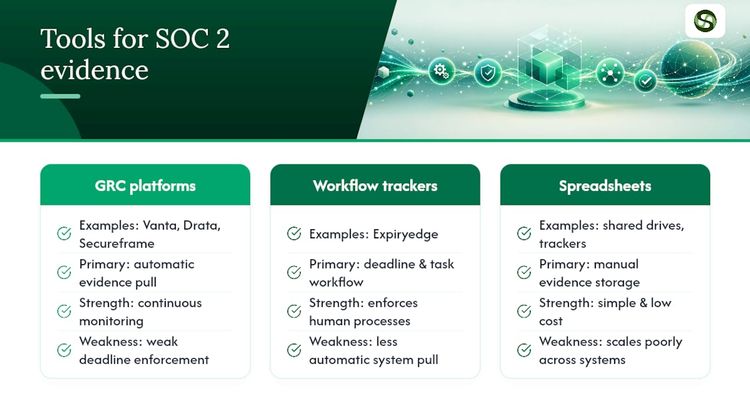
The tooling landscape splits into three rough categories, and most mature programs end up using at least two of them together rather than picking one and calling it done.
Dedicated GRC platforms (Vanta, Drata, Secureframe, Tugboat Logic) connect directly to your identity provider, cloud console, and HRIS to pull configuration and observational evidence automatically, then map it to control frameworks. These are strong for continuous monitoring but generally weak on deadline enforcement for the procedural, human-driven tasks that still need a person to act.
Deadline and workflow tracking platforms, Expiryedge among them, handle the recurring, date-bound side of evidence work: scheduling quarterly reviews, assigning owners, escalating missed exports, and keeping a central status dashboard. These fill the gap GRC platforms often leave open, which is enforcing the human process around evidence, not just the technical pull.
Spreadsheets and shared drives remain the baseline for smaller programs or early-stage companies not yet ready to invest in dedicated tooling. They work fine at a small scale as long as naming conventions and a central tracker are enforced strictly, but they scale poorly once you’re managing evidence across a dozen systems and multiple audit cycles a year.
Choosing among these comes down to how much of your evidence generation is already automatable at the system level versus how much depends on people remembering to act on a deadline.
How Do You Coordinate Evidence Collection Across Teams?
SOC 2 evidence rarely lives in one department. Security owns the SIEM and vulnerability data, engineering owns git and CI/CD logs, HR owns onboarding and training records, and procurement owns the vendor risk register. Coordination failures, not technical gaps, are usually why evidence arrives late.
Assign a single accountable owner per control, not per department, so there’s no ambiguity about who answers when an auditor asks a follow-up question. That owner doesn’t have to pull every artifact personally, but they’re responsible for confirming it landed in the tracker on time.
Run a short kickoff meeting at the start of each audit cycle with one representative from each team that owns a source system. Walk through the PBC list together, confirm who owns each line item, and set refresh dates before fieldwork starts rather than during it. Procurement teams managing vendor evidence can apply the same supplier compliance tracking discipline they already use for contract renewals.
For organizations without enough internal bandwidth to staff this coordination, outsourced backoffice support focused on data entry and compliance documentation can absorb the repetitive export and tracker maintenance work, freeing internal owners to focus on judgment calls instead of data pulls.
How Do You Verify Evidence Is Complete Before Submitting It?
Run a completeness pass against your PBC list at least a week before fieldwork begins, not the day before. Confirm four things for every line item: the artifact exists, it covers the full audit period rather than a single date, it has an assigned owner listed, and the population size is documented so sampling math checks out.
Cross-reference every control ID against your control matrix to catch orphaned artifacts, files sitting in the tracker with no corresponding control, and uncovered controls, controls with no artifact attached at all. Both are red flags an auditor will find immediately.
Spot-check three or four artifacts per Trust Services Criterion by opening the actual file, not just confirming a link exists in the tracker. A broken link or an export that’s actually empty is a common last-minute discovery that a five-minute check would have caught weeks earlier.
How Do You Keep Audit Evidence Confidential During Collection?
Audit evidence often contains sensitive material: employee personal data in HR exports, network architecture in configuration screenshots, vulnerability details in scan results. Treat the evidence repository itself as a system requiring access controls, not just a convenient shared folder.
Restrict access to the evidence tracker and underlying files to the specific owners and compliance leads who need it, and log who accesses or edits each artifact. Store exports in encrypted storage rather than general-purpose file shares, and strip or redact personally identifiable information from evidence where the control being tested doesn’t actually require it.
Set an expiration policy for evidence copies once the audit period closes. Retaining stale, sensitive exports indefinitely increases your exposure surface for no compliance benefit once the report is issued.
Stay Ahead of Every Evidence Deadline With Expiryedge
Templates and system exports solve the “what to collect” problem. They don’t solve the “who remembers to refresh it in October” problem, and that gap is where most evidence libraries quietly go stale between audits.

Expiryedge turns each recurring evidence obligation, a quarterly access review, an annual vendor SOC 2 refresh, a training completion export, into a scheduled task with a named owner, a fixed due date, and automated reminders across multiple channels. When someone misses a deadline, the platform escalates instead of letting the gap sit unnoticed until an auditor finds it. A live dashboard shows exactly which controls have current evidence and which are overdue, so audit readiness stops being a quarterly fire drill and becomes something you can check on any given Tuesday.
If your evidence collection process depends on someone remembering a spreadsheet deadline, that’s the exact failure point Expiryedge was built to close. Start a free trial and connect your first recurring evidence task in the same afternoon.
What Actually Moves the Needle on Audit Readiness
Three actions separate teams that breeze through fieldwork from teams that scramble for weeks. First, pre-build your PBC list by source system before the audit even kicks off, mapping known artifacts to control IDs in advance. Second, assign a named owner and exact timestamp to every single artifact, no exceptions, because unowned evidence is the single most common root cause behind auditor follow-up requests. Third, run a focused two to four week automation pilot on your two worst controls before expanding further.
Do those three things and the audit stops being an annual emergency. The time saved compounds every cycle, and the finding count drops because most findings are really ownership gaps in disguise.
— Kuldeep
Sources
- Microsoft — SOC 2 offering and attestation details
- Secure
- SOC2Auditors — SOC 2 Evidence Request List: What to Pull by Source (2026)
FAQ
What Is SOC 2 Evidence Collection?
SOC 2 evidence collection is the process of gathering, organizing, and mapping procedural, configuration, and observational artifacts to Trust Services Criteria so an auditor can verify your controls operated as designed.
How Much Time Does Manual Evidence Collection Take?
Practitioner estimates put manual SOC 2 evidence collection at roughly 300 to 600 staff hours per audit cycle, most of it spent re-pulling data that didn’t meet sampling requirements the first time.
What’s the Difference Between Type 1 and Type 2 Evidence?
Type 1 evidence proves controls were designed and in place on a single date. Type 2 evidence must prove controls operated continuously across a rolling period, typically 12 months.
Can I Reuse the Same Evidence for ISO 27001?
Yes, in most cases. ISO 27001 overlaps substantially with SOC 2’s Trust Services Criteria, so a single control matrix mapping artifacts to both frameworks avoids duplicate collection work.
What’s the Fastest Way to Improve Audit Readiness?
Pre-build a PBC list organized by source system, assign a named owner and timestamp to every artifact, and use a deadline tracking platform like Expiryedge to enforce recurring collection so evidence never goes stale between audits.
Recommended
Frequently asked questions
Practitioner estimates put manual SOC 2 evidence collection at roughly 300 to 600 staff hours per audit cycle, most of it spent re-pulling data that didn't meet sampling requirements the first time.
Type 1 evidence proves controls were designed and in place on a single date. Type 2 evidence must prove controls operated continuously across a rolling period, typically 12 months.
Yes, in most cases. ISO 27001 overlaps substantially with SOC 2's Trust Services Criteria, so a single control matrix mapping artifacts to both frameworks avoids duplicate collection work.
Pre-build a PBC list organized by source system, assign a named owner and timestamp to every artifact, and use a deadline tracking platform like Expiryedge to enforce recurring collection so evidence never goes stale between audits.